 Exodus 34–35 records the LORD’s renewal of His covenant dealings with Israel after the sin of the golden calf, followed by renewed emphasis on holiness, worship, the sabbath, willing giving, and preparation for the tabernacle. The chapters show that divine mercy never cancels divine holiness: the God who is “merciful and gracious” is also the God who “will by no means clear the guilty” (Exodus 34:6–7).
The immediate sequence is important. Moses had broken the first tables after seeing Israel’s idolatry (Exodus 32:19). After Moses’ intercession and the events of Exodus 33, the LORD commanded him to prepare two new tables of stone. Exodus 34 therefore presents genuine covenant renewal after grievous national sin. Exodus 35 then turns the people toward obedient worship and the work God had commanded.
Chapter Summaries
Exodus 34 — The Covenant Renewed and Moses’ Face Shines
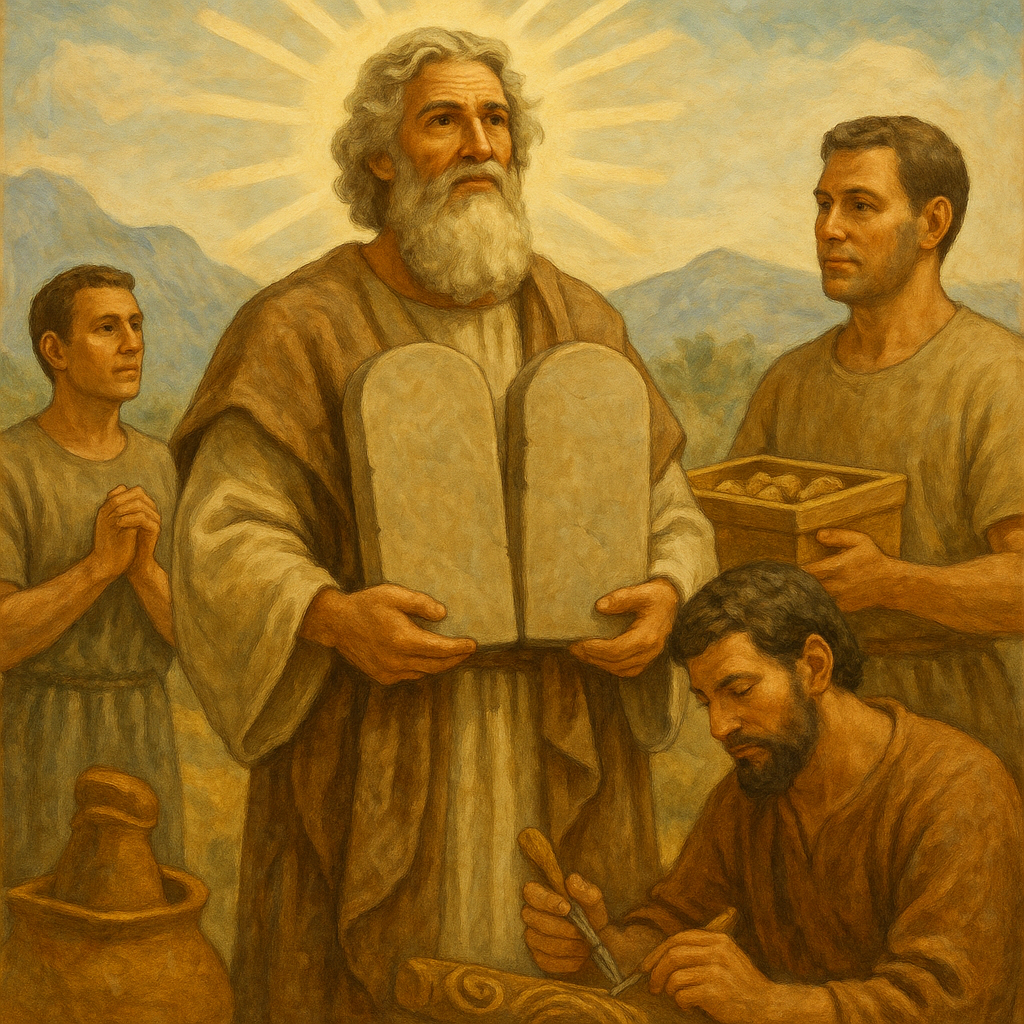
The second tables of stone — Exodus 34:1–4
The LORD commanded Moses:
“Hew thee two tables of stone like unto the first: and I will write upon these tables the words that were in the first tables, which thou brakest.” — Exodus 34:1
Moses was to ascend Mount Sinai alone. The restriction was explicit:
“And no man shall come up with thee, neither let any man be seen throughout all the mount.” — Exodus 34:3
Moses obeyed, hewed the two tables, rose early, and went up Mount Sinai as the LORD commanded.
The text emphasizes both divine authority and human obedience. Moses prepared the stones; God supplied the words. Deuteronomy 10:4 confirms that the LORD wrote upon the replacement tables “according to the first writing, the ten commandments.”
The LORD proclaims His name and character — Exodus 34:5–9
The LORD descended in the cloud and proclaimed His name before Moses:
“The LORD, The LORD God, merciful and gracious, longsuffering, and abundant in goodness and truth,
Keeping mercy for thousands, forgiving iniquity and transgression and sin, and that will by no means clear the guilty…” — Exodus 34:6–7
This is one of Scripture’s great declarations concerning the character of God.
God is merciful, but His mercy is not permissiveness. He is gracious, but grace does not make sin harmless. He is longsuffering, but His patience does not mean that judgment has ceased to exist. He forgives “iniquity and transgression and sin,” yet He “will by no means clear the guilty.”
There is no contradiction between mercy and justice in God. Both belong perfectly to His nature.
Exodus 34:7 also speaks of “visiting the iniquity of the fathers upon the children.” The verse does not say that an innocent child is personally condemned for the guilt of his father. Ezekiel 18:20 plainly states:
“The son shall not bear the iniquity of the father, neither shall the father bear the iniquity of the son.”
Therefore, Exodus 34:7 should not be made to teach inherited personal guilt beyond what the text says. Sin can have consequences extending through generations, while each individual remains accountable before God.
Upon hearing the LORD’s declaration, Moses:
“made haste, and bowed his head toward the earth, and worshipped.” — Exodus 34:8
True knowledge of God’s holiness and mercy should produce reverence rather than casual familiarity.
Moses then pleaded for the LORD to go among Israel, pardon their sin, and take them for His inheritance.
Covenant renewal and separation from idolatry — Exodus 34:10–17
The LORD declared:
“Behold, I make a covenant…” — Exodus 34:10
God promised extraordinary works before Israel and then warned them concerning the peoples of the land into which He would bring them.
The nations specifically named are the Amorites, Canaanites, Hittites, Perizzites, Hivites, and Jebusites (Exodus 34:11).
Israel was commanded:
“Take heed to thyself, lest thou make a covenant with the inhabitants of the land whither thou goest…” — Exodus 34:12
They were commanded to overthrow pagan altars, break their images, and cut down their groves. The reason given was theological:
“For thou shalt worship no other god: for the LORD, whose name is Jealous, is a jealous God.” — Exodus 34:14
God’s jealousy is not sinful human envy. It is His righteous demand for the worship that belongs to Him alone.
The prohibition concerned Israel’s covenant responsibilities and the idolatrous nations of Canaan. Christians should not turn this national command into authorization to destroy another person’s property. The continuing spiritual principle is that God’s people must reject idolatry and spiritual compromise. The New Testament likewise commands believers to separate from fellowship with idolatry and unrighteousness (2 Corinthians 6:14–18; 1 Corinthians 10:14).
The LORD also commanded:
“Thou shalt make thee no molten gods.” — Exodus 34:17
This command directly addresses the kind of sin Israel had committed with the golden calf.
Israel’s appointed worship and covenant responsibilities — Exodus 34:18–26
The LORD restated several requirements given previously, including the feast of unleavened bread, the sanctification of the firstborn, the seventh-day sabbath, the feast of weeks, and the feast of ingathering.
Three times each year the males of Israel were to appear before:
“the Lord GOD, the God of Israel.” — Exodus 34:23
The LORD promised:
“neither shall any man desire thy land, when thou shalt go up to appear before the LORD thy God thrice in the year.” — Exodus 34:24
This was a specific divine promise to covenant Israel.
The chapter also repeats regulations concerning sacrifice, firstfruits, and the command:
“Thou shalt not seethe a kid in his mother’s milk.” — Exodus 34:26
Scripture gives the command plainly here but does not explain its reason in this passage. Therefore, customs or proposed pagan parallels may suggest historical background, but Scripture does not explicitly state the reason, and it should not be asserted as fact.
Forty days with the LORD — Exodus 34:27–28
Moses remained with the LORD:
“forty days and forty nights; he did neither eat bread, nor drink water.” — Exodus 34:28
The verse continues:
“And he wrote upon the tables the words of the covenant, the ten commandments.”
Exodus 34:1 had already promised, “I will write upon these tables,” and Deuteronomy 10:4 explicitly identifies the writer as the LORD. Thus Scripture establishes that God wrote the Ten Commandments upon these replacement tables.
This period was extraordinary and divinely sustained. Scripture does not present Moses’ forty-day fast as a normal physical practice believers are commanded to imitate.
The shining face of Moses — Exodus 34:29–35
When Moses descended Mount Sinai:
“Moses wist not that the skin of his face shone while he talked with him.” — Exodus 34:29
Aaron and the children of Israel were afraid to come near him. Moses called them to him and delivered the LORD’s commandments.
After speaking with them, Moses placed a veil over his face. When he went before the LORD, he removed the veil until he came out again.
The text explicitly connects the shining of Moses’ face with his having spoken with God. Scripture does not say that Moses deliberately produced this appearance or even knew initially that his face shone.
Paul later refers directly to Moses and the veil in 2 Corinthians 3. The law written upon stones possessed real glory, but Paul teaches that the ministry associated with the Spirit possesses greater glory. This does not make God’s law sinful; Romans 7:12 says:
“Wherefore the law is holy, and the commandment holy, and just, and good.”
Rather, the law reveals God’s holy standard and exposes man’s sin, while salvation and spiritual life come through Christ and the work of the Holy Spirit.
Exodus 35 — Sabbath, Willing Offerings, and Spirit-Enabled Service
Moses gathers the congregation — Exodus 35:1–3
Moses assembled:
“all the congregation of the children of Israel” — Exodus 35:1
He again gave them the LORD’s command concerning the sabbath.
“Six days shall work be done, but on the seventh day there shall be to you an holy day, a sabbath of rest to the LORD.” — Exodus 35:2
The command was solemn, with the death penalty attached under Israel’s law.
Verse 3 adds:
“Ye shall kindle no fire throughout your habitations upon the sabbath day.”
This command belongs to Israel under the Mosaic covenant. Exodus 31:16–17 explicitly says that the sabbath was a covenant and a sign “between me and the children of Israel.”
Therefore, conservative Baptist interpretation should not transfer Israel’s sabbath legislation wholesale to the New Testament church. The church is not Israel, and believers are not under the Mosaic covenant as Israel was. Christians nevertheless retain the abiding obligation to worship God faithfully and to order their lives around His service.
A willing offering for the LORD — Exodus 35:4–19
Moses announced the LORD’s command:
“Whosoever is of a willing heart, let him bring it, an offering of the LORD.” — Exodus 35:5
The requested materials included gold, silver, brass, colored fabrics, fine linen, goats’ hair, skins, shittim wood, oil, spices, precious stones, and other items needed for the tabernacle and its ministry.
The offering was designated for a specific work God had commanded. It was not presented merely as an emotional fund-raising effort.
God had already revealed what was to be made. The people were now being given the privilege of contributing toward that work.
The people respond willingly — Exodus 35:20–29
The congregation departed from Moses, and then those moved to give returned.
“And they came, every one whose heart stirred him up, and every one whom his spirit made willing…” — Exodus 35:21
Men and women brought offerings.
Verse 22 says:
“as many as were willing hearted”
came with jewelry and gold.
Women participated through skilled labor:
“And all the women whose heart stirred them up in wisdom spun goats’ hair.” — Exodus 35:26
The rulers brought onyx stones, stones for the ephod and breastplate, spices, and oil.
The section concludes:
“The children of Israel brought a willing offering unto the LORD, every man and woman, whose heart made them willing to bring for all manner of work…” — Exodus 35:29
The repeated emphasis is unmistakable: willingness of heart.
A legitimate New Testament parallel is 2 Corinthians 9:7:
“Every man according as he purposeth in his heart, so let him give; not grudgingly, or of necessity: for God loveth a cheerful giver.”
This does not make the tabernacle offering and New Testament church giving identical covenant institutions. It does show that God values willing, heartfelt giving rather than reluctant religious performance.
Bezaleel and Aholiab equipped for the work — Exodus 35:30–35
Moses identified Bezaleel:
“the son of Uri, the son of Hur, of the tribe of Judah” — Exodus 35:30
and declared:
“And he hath filled him with the spirit of God, in wisdom, in understanding, and in knowledge, and in all manner of workmanship.” — Exodus 35:31
Bezaleel was equipped to devise artistic works involving gold, silver, brass, stones, and wood.
Aholiab, the son of Ahisamach, of the tribe of Dan, was appointed with him.
God also placed in their hearts the ability to teach:
“And he hath put in his heart that he may teach, both he, and Aholiab…” — Exodus 35:34
This is significant. God-given ability was not confined to preaching or public leadership. Craftsmanship, design, construction, and teaching were all used in the work God had commanded.
However, Scripture does not explicitly say that the Old Testament filling of Bezaleel and Aholiab was identical in every respect to the New Testament believer’s relationship to the indwelling Holy Spirit. That distinction should be maintained.
Exodus 35 ends with the workers prepared and equipped. The chapter does not say that the tabernacle was completed here; its actual construction continues in the chapters that follow.
Key People and Places
- The LORD — The covenant God of Israel, who reveals Himself as merciful, gracious, longsuffering, holy, just, and jealous for exclusive worship.
- Moses — Israel’s mediator and leader. He ascends Mount Sinai, receives the covenant words, intercedes for Israel, and communicates God’s commands to the congregation.
- Aaron — Moses’ brother. He and the children of Israel see Moses’ shining face and initially fear to approach him.
- The children of Israel — The covenant nation receiving renewed commands after the golden-calf sin.
- Bezaleel — Son of Uri, son of Hur, of Judah; specifically filled with the spirit of God for wisdom and craftsmanship in the tabernacle work.
- Aholiab — Son of Ahisamach, of Dan; appointed with Bezaleel and enabled for skilled work and teaching.
- The women of Israel — Those whose hearts stirred them in wisdom participated through spinning and preparation of materials.
- The rulers of Israel — Brought precious stones, spices, and oil for the sanctuary work.
- Mount Sinai — The mountain where Moses again met with the LORD and received the replacement tables.
- The promised land — The territory into which God said He would bring Israel, then occupied by the Amorite, Canaanite, Hittite, Perizzite, Hivite, and Jebusite peoples.
- The tabernacle — The sanctuary whose materials, furnishings, priestly garments, and associated items were being prepared for construction. Exodus 35 describes preparations and offerings, not its completed erection.
Main Doctrinal or Spiritual Themes
1. God is both merciful and holy
Exodus 34:6–7 must be kept together. God is:
“merciful and gracious”
and yet He:
“will by no means clear the guilty.”
Biblical grace never requires God to lower His holiness. At Calvary these truths meet perfectly: God remains just while justifying the believer through faith in Christ (Romans 3:26).
2. Forgiveness does not make idolatry acceptable
The covenant is renewed, but God immediately commands Israel to separate from idols.
Grace is never permission to return to sin.
Romans 6:1–2 asks:
“Shall we continue in sin, that grace may abound? God forbid.”
3. God demands exclusive worship
“thou shalt worship no other god” — Exodus 34:14
God will not share His rightful place with idols.
Modern idols need not be carved statues. Anything given the devotion, loyalty, confidence, or supremacy that belongs to God becomes spiritually dangerous. Scripture’s direct command remains:
“Little children, keep yourselves from idols.” — 1 John 5:21
4. God’s Word is authoritative
The replacement tables contained the same commandments as before. Israel’s sin did not alter God’s standard.
Man’s disobedience never gives man authority to revise God’s Word.
The believer’s duty is submission:
“For ever, O LORD, thy word is settled in heaven.” — Psalm 119:89
5. Fellowship with God should produce visible effects in life
Moses’ face literally shone after speaking with the LORD. Scripture does not promise Christians that their skin will physically shine because they pray.
The legitimate practical principle is that fellowship with God should affect the believer’s conduct. Acts 4:13 says that others “took knowledge of them, that they had been with Jesus.”
6. God’s work should be done God’s way
The people were not invited to invent a sanctuary according to personal taste. God had already given the pattern and commands.
Zeal cannot replace obedience.
In spiritual work, sincerity is not sufficient if what is being done contradicts Scripture.
7. Giving should come from a willing heart
Exodus 35 repeatedly emphasizes willing hearts.
Giving to God should not be mere external pressure, showmanship, or grudging obligation. Biblical stewardship flows from gratitude and obedience.
8. God values skilled service
Bezaleel and Aholiab demonstrate that craftsmanship can be sacred service when devoted to what God has commanded.
God’s work requires more than pulpit ministry. Teaching, building, organizing, preparing, creating, maintaining, and countless practical forms of service may all be used for His glory when governed by Scripture.
9. Israel and the Church must remain distinct
Exodus 34–35 concerns Israel under the Mosaic covenant. Its sabbath regulations, pilgrimage feasts, national separation requirements, tabernacle service, and civil penalties were given in that covenantal setting.
The church should learn spiritual truth from these passages because:
“whatsoever things were written aforetime were written for our learning” — Romans 15:4
but learning from Israel is not the same as replacing Israel or placing the church under Israel’s Mosaic covenant.
Practical Applications or Lessons
Approach God with reverence. Moses “bowed his head toward the earth, and worshipped” after hearing the LORD proclaim His character. A clearer understanding of God should make worship deeper and more reverent, not more casual.
Never use mercy as an excuse for sin. The same chapter proclaiming God’s forgiveness also warns against idolatry. Forgiveness should produce gratitude, obedience, and separation from sin.
Do not negotiate with idols. Israel was warned against covenant entanglement with idolatry. Believers likewise must guard against relationships, habits, entertainment, ambitions, or philosophies that draw the heart away from Christ.
Let Scripture set the terms of worship. Israel did not design the tabernacle by popular vote. God gave the instructions. Churches likewise must measure doctrine, worship, ministry, and practice by Scripture rather than fashion or cultural pressure.
Give willingly. The repeated expression “willing heart” should challenge believers to examine not merely what they give, but the spirit in which they give.
Use your abilities for God. Bezaleel and Aholiab remind us that ability itself should be placed under God’s authority. A Christian’s trade, craft, organizational ability, artistic skill, or practical knowledge can serve the Lord when used lawfully and humbly.
Teach others what God has enabled you to learn. God not only gave Bezaleel and Aholiab ability; He put it into their hearts “that he may teach.” Mature ability should often be multiplied through instruction.
Obedience matters in ordinary details. Exodus 34–35 contains great revelations concerning God’s character, but it also contains detailed commands concerning days, materials, offerings, workmanship, and worship. Biblical spirituality is not merely emotional. It obeys God in particulars.
Past failure does not authorize continued rebellion. Israel’s golden-calf sin was serious, yet Exodus 34 records renewed dealings with God. The lesson is not that sin is insignificant, but that God’s mercy is real. For the believer today:
“If we confess our sins, he is faithful and just to forgive us our sins, and to cleanse us from all unrighteousness.” — 1 John 1:9
That promise concerns fellowship and cleansing for those addressed in the Christian context; it is not a requirement to be repeatedly saved.
Overall Emphasis
Exodus 34–35 presents a powerful sequence:
sin had occurred / Moses interceded / God renewed His covenant dealings / God’s holiness was reaffirmed / idolatry was forbidden / worship was ordered according to God’s Word / willing hearts gave ? God-equipped servants prepared to work.
The great lesson is that grace never abolishes holiness. The LORD who forgives is the LORD who commands obedience. The people whom God restores are called to worship Him alone, honor His Word, give willingly, and serve according to His revealed will.
Comments are closed