 Exodus 29–30 continues the LORD’s instructions to Moses concerning the tabernacle, the Aaronic priesthood, and Israel’s worship. The setting belongs to the revelation given to Moses while he was in the mount with God (Exodus 24:12–18). These chapters emphasize that approach to a holy God was not to be invented by man. The priests, sacrifices, altar, washing, anointing oil, and incense were all regulated according to the word of the LORD.
A central truth running through both chapters is expressed in Exodus 29:46:
“And they shall know that I am the LORD their God, that brought them forth out of the land of Egypt, that I may dwell among them: I am the LORD their God.”
God had redeemed Israel from Egypt, and He was establishing the manner in which He would dwell among them. The details therefore emphasize holiness, consecration, blood atonement, obedience, acceptable worship, and separation unto God.
The Mosaic priesthood and tabernacle ordinances belong specifically to Israel. They should not be transferred directly to the New Testament church as church ordinances. At the same time, the New Testament explicitly uses the priesthood, sacrifices, sanctuary, and related institutions to teach truths concerning Christ and His finished work, especially in Hebrews.
Chapter Summaries
Exodus 29 — The Consecration of Aaron and His Sons
Exodus 29 gives the LORD’s instructions for setting apart Aaron and his sons to minister in the priest’s office.
The chapter begins:
“And this is the thing that thou shalt do unto them to hallow them, to minister unto me in the priest’s office” (Exodus 29:1).
The purpose is stated plainly: Aaron and his sons were to be hallowed, or set apart, for priestly service.
1. The required offerings — Exodus 29:1–3
Moses was commanded to take:
- one young bullock,
- two rams without blemish,
- unleavened bread,
- unleavened cakes tempered with oil,
- unleavened wafers anointed with oil.
These were to be brought with Aaron and his sons to the door of the tabernacle.
The repeated insistence upon what God commanded demonstrates that worship under the law was governed by divine revelation rather than personal preference.
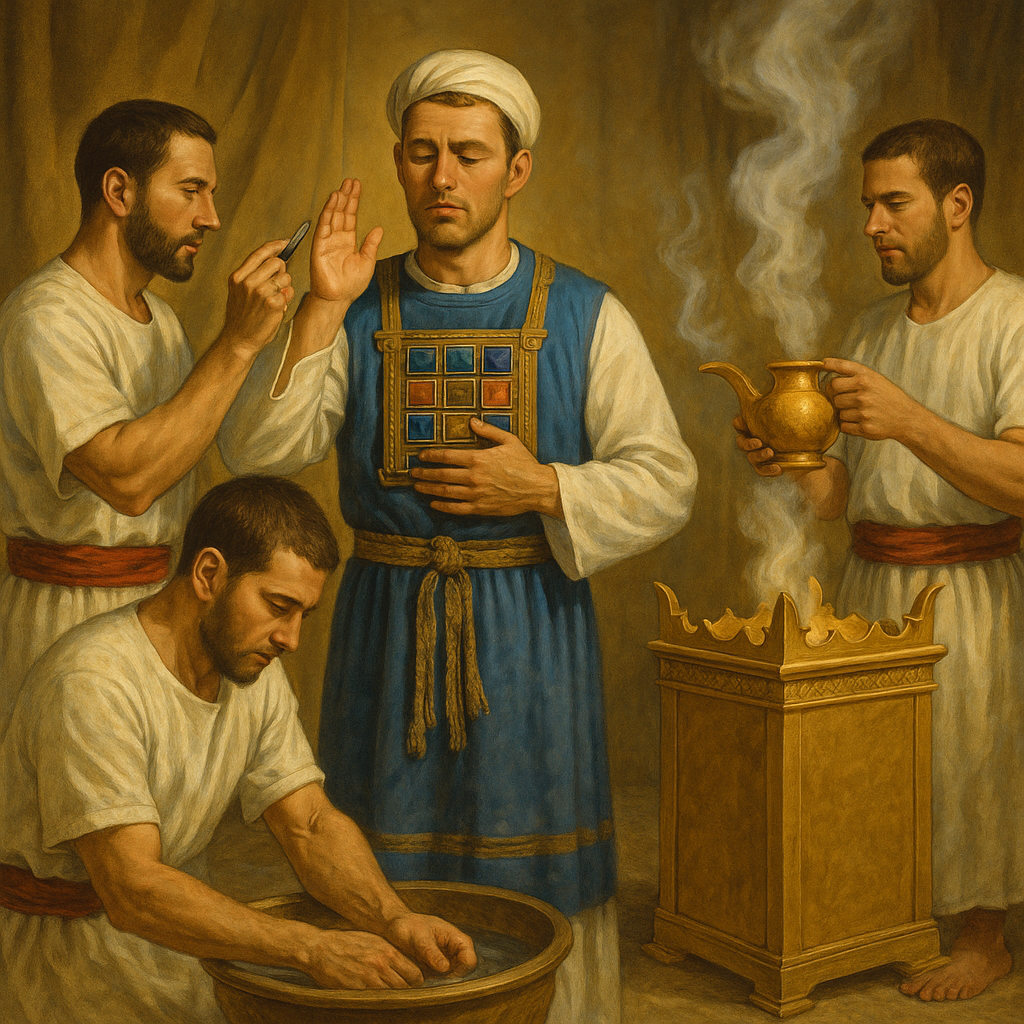
2. Aaron and his sons washed — Exodus 29:4
“And Aaron and his sons thou shalt bring unto the door of the tabernacle of the congregation, and shalt wash them with water.”
The washing was an explicit part of their preparation for priestly ministry.
It would go beyond the text to claim that this particular washing was identical to New Testament baptism or Christian regeneration. Scripture does not say that. It was a ceremonial washing commanded for the Aaronic priesthood.
Nevertheless, the broader biblical principle that God requires holiness and cleansing in those who serve Him is clearly supported elsewhere in Scripture.
3. Aaron clothed in the priestly garments — Exodus 29:5–6
Aaron was clothed with the garments described in Exodus 28:
- the coat,
- robe of the ephod,
- ephod,
- breastplate,
- curious girdle,
- mitre,
- holy crown.
The garments were not left to Aaron’s design. God specified them.
This reinforces an important principle: the servant does not determine the terms of divine service; God does.
4. Aaron anointed — Exodus 29:7
“Then shalt thou take the anointing oil, and pour it upon his head, and anoint him.”
Aaron was formally set apart for his priestly office.
The text explicitly records Aaron’s anointing. One should be cautious about making every detail of the oil represent a separate spiritual truth unless Scripture itself provides that interpretation.
5. Aaron’s sons clothed — Exodus 29:8–9
Aaron’s sons were also clothed for priestly ministry.
God concludes:
“and the priest’s office shall be theirs for a perpetual statute: and thou shalt consecrate Aaron and his sons.”
The priesthood here is specifically the Aaronic priesthood given to Israel.
The New Testament church does not possess an Aaronic priesthood. Christ belongs to a different and superior priesthood:
“Thou art a priest for ever after the order of Melchisedec” (Hebrews 7:17).
6. The bullock for a sin offering — Exodus 29:10–14
Aaron and his sons placed their hands upon the head of the bullock. The animal was then slain, and its blood was applied according to God’s command.
Exodus 29:14 calls it:
“a sin offering.”
The KJV text therefore explicitly identifies the sacrifice.
Blood was central to Israel’s sacrificial system. Hebrews later states:
“And almost all things are by the law purged with blood; and without shedding of blood is no remission” (Hebrews 9:22).
These animal sacrifices did not provide the final and complete removal of sin accomplished by Christ. Hebrews 10:4 states plainly:
“For it is not possible that the blood of bulls and of goats should take away sins.”
Their repeated sacrifices pointed forward within God’s revealed plan to the sufficient sacrifice of Christ.
7. The first ram — Exodus 29:15–18
The first ram was slain and wholly burned upon the altar.
Verse 18 says:
“it is a burnt offering unto the LORD: it is a sweet savour, an offering made by fire unto the LORD.”
God Himself determined what constituted an acceptable offering.
8. The ram of consecration — Exodus 29:19–28
The second ram receives special attention.
Aaron and his sons placed their hands upon its head. After it was slain, its blood was placed upon:
- the tip of Aaron’s right ear,
- the tip of the right ears of his sons,
- the thumb of their right hands,
- the great toe of their right feet.
Blood was also sprinkled upon the altar round about.
The passage itself does not explicitly explain why the right ear, thumb, and great toe were individually chosen. Therefore it would be improper to state as biblical fact that the ear represents hearing, the hand represents service, and the foot represents one’s walk.
Those associations may suggest total consecration of the priest’s person and service, but Scripture does not explicitly state that symbolism in Exodus 29.
What the text does establish beyond question is that their consecration was inseparably connected with sacrificial blood.
9. Blood and oil upon the priests and garments — Exodus 29:21
Moses was commanded to take:
“of the blood that is upon the altar, and of the anointing oil”
and sprinkle it upon Aaron, his garments, his sons, and their garments.
The result is explicitly stated:
“and he shall be hallowed, and his garments, and his sons, and his sons’ garments with him.”
Again, holiness in the priesthood was according to God’s command rather than man’s judgment.
10. The wave offering and priestly portions — Exodus 29:22–28
Certain portions of the ram, together with bread, cake, and wafer, were placed upon the hands of Aaron and his sons and waved before the LORD.
Some portions were afterward burned upon the altar; others were assigned for priestly use.
The repeated expressions “before the LORD” and “unto the LORD” keep the central issue clear: Israel’s worship was directed to Jehovah and regulated by Him.
11. The holy garments passed to Aaron’s sons — Exodus 29:29–30
“And the holy garments of Aaron shall be his sons’ after him, to be anointed therein, and to be consecrated in them.”
The passage provides for continuation of the Aaronic office through Aaron’s descendants.
It should not be confused with the eternal priesthood of Christ. Christ’s priesthood does not pass from one man to another:
“But this man, because he continueth ever, hath an unchangeable priesthood” (Hebrews 7:24).
12. Seven days of consecration — Exodus 29:31–37
The consecration ceremony continued for seven days.
Verse 35 states:
“seven days shalt thou consecrate them.”
A bullock was offered each day as a sin offering for atonement, and the altar itself was cleansed and sanctified.
The altar is described as:
“most holy.”
The repeated emphasis is upon God’s holiness and the necessity of approaching Him according to His appointed order.
13. The continual burnt offering — Exodus 29:38–42
Two lambs of the first year were to be offered day by day continually:
- one in the morning,
- one in the evening.
They were accompanied by flour, oil, and drink offerings.
Verse 42 calls it:
“a continual burnt offering throughout your generations at the door of the tabernacle of the congregation before the LORD.”
Israel’s worship was therefore not designed merely around occasional religious excitement. There was an ordered, continual acknowledgment of God.
14. God promises to meet with Israel — Exodus 29:42–46
The chapter reaches its theological high point here.
God says:
“And there I will meet with the children of Israel, and the tabernacle shall be sanctified by my glory” (Exodus 29:43).
He further promises:
“And I will dwell among the children of Israel, and will be their God” (Exodus 29:45).
And then:
“And they shall know that I am the LORD their God, that brought them forth out of the land of Egypt, that I may dwell among them” (Exodus 29:46).
The Exodus was therefore not merely deliverance from Pharaoh. According to this verse, God brought Israel forth so that He might dwell among them.
Redemption was connected with relationship, worship, holiness, and God’s presence.
Exodus 30 — Incense, Atonement Money, Washing, Anointing Oil, and Holy Incense
Exodus 30 adds several essential elements of tabernacle worship.
1. The altar of incense — Exodus 30:1–10
God commanded:
“And thou shalt make an altar to burn incense upon” (Exodus 30:1).
It was made of shittim wood and overlaid with pure gold.
It was positioned:
“before the vail that is by the ark of the testimony, before the mercy seat that is over the testimony” (Exodus 30:6).
Aaron was commanded to burn sweet incense upon it every morning when he dressed the lamps and again when he lighted the lamps in the evening.
Thus:
“a perpetual incense before the LORD throughout your generations” (Exodus 30:8).
God specifically prohibited:
“strange incense”
upon this altar.
Neither burnt sacrifice, meat offering, nor drink offering was to be offered upon it.
This is another strong example of the principle that sincerity does not replace obedience. God determined both the worship and its boundaries.
2. Annual atonement upon the incense altar — Exodus 30:10
Once a year Aaron was to make an atonement upon its horns:
“with the blood of the sin offering of atonements.”
The verse calls the altar:
“most holy unto the LORD.”
The blood requirement again demonstrates the seriousness of sin and the holiness of the God whom Israel worshiped.
3. The ransom money — Exodus 30:11–16
When Moses numbered the children of Israel, every man was commanded to give:
“a ransom for his soul unto the LORD” (Exodus 30:12).
The amount was half a shekel.
Both rich and poor were placed upon the same basis:
“The rich shall not give more, and the poor shall not give less than half a shekel” (Exodus 30:15).
The money was called:
“atonement money”
and was appointed for the service of the tabernacle.
One should not turn this passage into a doctrine that eternal salvation can be purchased with money. Scripture does not teach that.
Indeed, the New Testament explicitly rejects the notion that spiritual redemption can be bought with corruptible things:
“Forasmuch as ye know that ye were not redeemed with corruptible things, as silver and gold… But with the precious blood of Christ” (1 Peter 1:18–19).
The Exodus passage concerns the specific ransom commanded of numbered Israelites within the Mosaic arrangement.
4. The brazen laver — Exodus 30:17–21
God next commanded a laver of brass containing water.
Aaron and his sons were to:
“wash their hands and their feet thereat” (Exodus 30:19).
Before entering the tabernacle or approaching the altar to minister, they were required to wash.
The warning was severe:
“that they die not.”
The repetition emphasizes that priestly service was not casual.
God’s holiness demanded obedience even in matters men might consider small.
5. The holy anointing oil — Exodus 30:22–33
The LORD specified the ingredients for a sacred anointing oil.
It was used upon:
- the tabernacle,
- ark,
- table and vessels,
- candlestick and vessels,
- altar of incense,
- altar of burnt offering,
- laver,
- Aaron,
- Aaron’s sons.
God said:
“And thou shalt sanctify them, that they may be most holy” (Exodus 30:29).
The oil was not to be copied for common use.
“Upon man’s flesh shall it not be poured, neither shall ye make any other like it” (Exodus 30:32).
Anyone who compounded something like it for unauthorized use was to be:
“cut off from his people.”
Something designated as holy by God was not to be treated as ordinary.
6. The holy incense — Exodus 30:34–38
The LORD also prescribed the composition of the incense.
It was to be:
“pure and holy.”
A portion was placed:
“before the testimony in the tabernacle of the congregation, where I will meet with thee.”
As with the anointing oil, the formula was not for private pleasure.
God warned:
“whosoever shall make like unto that, to smell thereto, shall even be cut off from his people” (Exodus 30:38).
Israel was being taught to distinguish between that which God designated as holy and that which was common.
Key People and Places
Moses
Moses is receiving and transmitting the LORD’s instructions. Exodus 29 repeatedly commands Moses concerning Aaron, his sons, the sacrifices, and the altar.
His role here is administrative and mediatorial within the covenant arrangement God gave Israel.
Aaron
Aaron is explicitly appointed and consecrated to the priest’s office.
He is washed, clothed, anointed, and associated with the prescribed sacrifices.
Aaron later functions as Israel’s high priest, but Exodus 29–30 focuses especially upon his consecration and duties.
Aaron’s sons
Aaron’s sons are consecrated with him to minister in the priesthood.
Exodus 29:9 states:
“the priest’s office shall be theirs for a perpetual statute.”
This pertains specifically to the Aaronic priesthood.
The children of Israel
Israel is the covenant nation among whom God promises to dwell.
The LORD identifies Himself as the One:
“that brought them forth out of the land of Egypt” (Exodus 29:46).
The tabernacle of the congregation
The tabernacle is the appointed location where God says:
“there I will meet with the children of Israel” (Exodus 29:43).
It was not a church building and should not simply be identified with a New Testament Baptist church. It belongs to God’s dealings with Israel under the Mosaic covenant.
The door of the tabernacle
Several of the consecration activities and continual sacrifices are associated with the door of the tabernacle.
God says concerning it:
“where I will meet you, to speak there unto thee” (Exodus 29:42).
The altar of burnt offering
The sacrifices associated with Aaron’s consecration and the continual lamb offerings were presented there.
It was sanctified according to God’s command.
The altar of incense
This golden altar stood before the veil and was reserved for the incense God prescribed.
The veil
The altar of incense stood:
“before the vail that is by the ark of the testimony” (Exodus 30:6).
The veil marked a divinely established boundary within the sanctuary.
The ark of the testimony and mercy seat
These are mentioned as the reference point for the placement of the incense altar.
God describes the mercy seat as the place:
“where I will meet with thee” (Exodus 30:6).
The laver
The brass laver stood between the tabernacle and altar and supplied the water required for priestly washing.
Mount Sinai
Exodus 29–30 does not repeatedly name Sinai within the chapters themselves. However, the surrounding narrative explicitly places Moses in the mount receiving God’s instructions following Exodus 24:12–18. Exodus 31:18 later states that God gave Moses the tables of testimony when He had made an end of communing with him “upon mount Sinai.”
Thus identifying Sinai as the broader setting is supported by the surrounding KJV narrative.
Main Doctrinal or Spiritual Themes
1. The holiness of God
“Holy,” “hallowed,” “sanctified,” and “most holy” recur throughout these chapters.
God establishes distinctions between what is common and what is consecrated to Him.
This holiness is not ceremonial fussiness. It reflects God’s own character.
“Exalt ye the LORD our God, and worship at his footstool; for he is holy” (Psalm 99:5).
The believer should never approach God with irreverence or presume that man’s preferences determine acceptable worship.
2. God determines how He is to be worshiped
The sacrifices, garments, washing, oil, incense, altar, and priestly duties are prescribed in detail.
This teaches that good intentions do not authorize disobedient worship.
The prohibition against “strange incense” in Exodus 30:9 is especially clear.
Biblical worship is governed by God’s revelation.
3. Sin requires atonement
Blood appears repeatedly throughout Exodus 29–30.
The bullock is explicitly called a “sin offering,” the altar receives blood, and annual atonement is made upon the incense altar.
The New Testament reveals the final sufficiency of Christ:
“Neither by the blood of goats and calves, but by his own blood he entered in once into the holy place, having obtained eternal redemption for us” (Hebrews 9:12).
The repeated Mosaic sacrifices were never the final answer to sin.
Christ is.
4. Christ possesses the superior and final priesthood
Aaron’s priesthood required:
- consecration,
- repeated sacrifices,
- successors,
- continued ceremonial ministry.
Christ’s priesthood is fundamentally superior.
“But this man, because he continueth ever, hath an unchangeable priesthood” (Hebrews 7:24).
And:
“Wherefore he is able also to save them to the uttermost that come unto God by him” (Hebrews 7:25).
The believer therefore does not require an earthly sacrificing priesthood.
Christ is the sufficient High Priest.
5. Sacrifice points to the necessity of Christ’s death
Hebrews explicitly connects the Mosaic sacrificial system with the greater work of Christ.
“For the law having a shadow of good things to come, and not the very image of the things” (Hebrews 10:1).
Because Scripture itself calls the law a “shadow,” it is legitimate to recognize a divinely intended forward-looking character in the sacrificial system.
However, individual details should not be assigned elaborate symbolic meanings unless Scripture provides warrant for doing so.
Conservative interpretation should be restrained as well as believing.
6. Consecration to God’s service
Aaron and his sons did not appoint themselves.
They were:
- called to the priestly office,
- washed,
- clothed,
- anointed,
- associated with sacrifice,
- consecrated according to God’s command.
For New Testament believers, service likewise ought to be marked by holiness and yieldedness:
“I beseech you therefore, brethren, by the mercies of God, that ye present your bodies a living sacrifice, holy, acceptable unto God” (Romans 12:1).
Romans 12 is not a continuation of Aaronic consecration rites, but it clearly teaches the continuing moral principle of presenting oneself to God.
7. Continual worship and devotion
The morning and evening lambs were:
“a continual burnt offering” (Exodus 29:42).
Likewise, incense was offered morning and evening.
This establishes an ordered rhythm in Israel’s worship.
For believers today, Scripture commands continuing prayer and praise:
“Pray without ceasing” (1 Thessalonians 5:17).
“By him therefore let us offer the sacrifice of praise to God continually” (Hebrews 13:15).
8. Prayer and incense
Scripture itself elsewhere associates incense with prayer.
David says:
“Let my prayer be set forth before thee as incense” (Psalm 141:2).
Revelation 5:8 speaks of:
“golden vials full of odours, which are the prayers of saints.”
Therefore an association between incense and prayer has direct biblical support.
However, Exodus 30 itself primarily records the command concerning literal incense in Israel’s tabernacle worship.
9. Cleansing before service
The priests were required to wash their hands and feet:
“that they die not” (Exodus 30:20).
The immediate meaning is literal ceremonial washing required of Aaron and his sons.
A broader spiritual application may properly be made from New Testament passages such as:
“Let us cleanse ourselves from all filthiness of the flesh and spirit, perfecting holiness in the fear of God” (2 Corinthians 7:1).
The believer should never use grace as an excuse for careless living.
10. God redeemed Israel in order to dwell among them
One of the strongest statements in the section is Exodus 29:46:
“that brought them forth out of the land of Egypt, that I may dwell among them.”
God’s deliverance of Israel was purposeful.
They were not redeemed simply to become autonomous people living according to their own wishes. They belonged to the LORD who had delivered them.
That historical statement applies directly to Israel.
For believers, the New Testament likewise teaches that redemption establishes God’s ownership:
“For ye are bought with a price: therefore glorify God in your body, and in your spirit, which are God’s” (1 Corinthians 6:20).
11. Israel and the Church must remain distinct
Exodus 29–30 concerns:
- Aaron,
- Aaron’s sons,
- Israel,
- the tabernacle,
- animal sacrifices,
- ceremonial washings,
- sacred incense,
- sacred anointing oil,
- the Mosaic priesthood.
These are not ordinances imposed upon the New Testament church.
The church is not Israel, and the pastor is not a continuation of Aaron’s priesthood.
The believer’s access to God is through Jesus Christ:
“For there is one God, and one mediator between God and men, the man Christ Jesus” (1 Timothy 2:5).
And through Christ believers have:
“boldness to enter into the holiest by the blood of Jesus” (Hebrews 10:19).
Practical Applications or Lessons
God deserves careful obedience
The precision of Exodus 29–30 teaches that God’s instructions are not suggestions.
The priests were not free to substitute their own incense, redesign the ceremonies, or disregard washing.
Believers should likewise take God’s written Word seriously.
“If ye love me, keep my commandments” (John 14:15).
Holiness should accompany Christian service
Aaron and his sons were set apart before serving.
While Christians do not undergo Aaronic consecration ceremonies, the New Testament plainly requires holy living:
“But as he which hath called you is holy, so be ye holy in all manner of conversation” (1 Peter 1:15).
Service for God should never be separated from personal holiness.
Never treat sacred things as common
The special oil and incense were not to be reproduced for ordinary use.
The direct command concerned Israel’s tabernacle service, but the principle is sobering: what God calls holy should not be trivialized.
Church worship, preaching, prayer, Scripture, and the name of God should be handled reverently.
Man cannot approach God on his own terms
Everything in these chapters stresses appointed access.
There was an appointed priesthood, appointed sacrifices, appointed blood, appointed washing, appointed incense, and appointed places.
Under the New Testament the appointed way is Christ:
“Jesus saith unto him, I am the way, the truth, and the life: no man cometh unto the Father, but by me” (John 14:6).
Salvation is not obtained by ritual, priesthood, payment, morality, or religious works. It is by grace through faith:
“For by grace are ye saved through faith; and that not of yourselves: it is the gift of God:
Not of works, lest any man should boast” (Ephesians 2:8–9).
The blood of Christ must remain central
The prominence of blood in these chapters prepares the Bible reader for the fuller revelation of redemption in Christ.
“In whom we have redemption through his blood, the forgiveness of sins” (Ephesians 1:7).
Christian preaching that minimizes the blood of Christ abandons a major biblical emphasis.
Prayer should be continual
The continual incense provides a legitimate biblical reminder of prayer because Scripture elsewhere explicitly associates incense with prayer.
The believer should cultivate regular, persevering communion with God rather than praying only in emergencies.
“Continue in prayer, and watch in the same with thanksgiving” (Colossians 4:2).
Service requires cleansing
The priests could not simply say that because they had been consecrated once, washing was thereafter unnecessary.
The laver remained part of their service.
The Christian parallel should not be forced ceremonially, but Scripture plainly teaches believers to confess and forsake sin:
“If we confess our sins, he is faithful and just to forgive us our sins, and to cleanse us from all unrighteousness” (1 John 1:9).
God’s presence is the great privilege of redeemed people
The climax of Exodus 29 is not the garments, sacrifices, or ceremonies themselves.
It is God’s promise:
“And I will dwell among the children of Israel, and will be their God” (Exodus 29:45).
The tabernacle system taught Israel that the holy God had graciously chosen to dwell among the people He had redeemed, while also teaching them that sinful man could approach Him only according to His appointed order.
For the New Testament believer, that truth reaches a far greater privilege:
“Know ye not that ye are the temple of God, and that the Spirit of God dwelleth in you?” (1 Corinthians 3:16).
Overall Message of Exodus 29–30
Exodus 29–30 teaches that the holy God determines the means by which sinful man may approach Him. Aaron and his sons had to be consecrated according to God’s command. Sacrificial blood was indispensable. Priests were required to wash. Worship had to follow God’s revealed pattern. Holy things could not be treated as common. Morning and evening sacrifices and incense maintained continual worship before the LORD.
Yet the goal behind the entire arrangement is stated plainly:
“that I may dwell among them” (Exodus 29:46).
The tabernacle system belonged to Israel and should be interpreted first in that literal historical setting. The New Testament then explicitly shows that the sacrifices and priesthood were shadows pointing toward the greater, final work of Jesus Christ. Aaron’s ministry was temporary and repetitive; Christ’s sacrifice is sufficient, and His priesthood is everlasting.
The believer therefore does not return to the Aaronic system. He comes directly to God through Jesus Christ, while retaining the enduring biblical lessons of holiness, obedience, reverence, cleansing, prayer, consecration, and faith in the blood of the appointed sacrifice.
Comments are closed