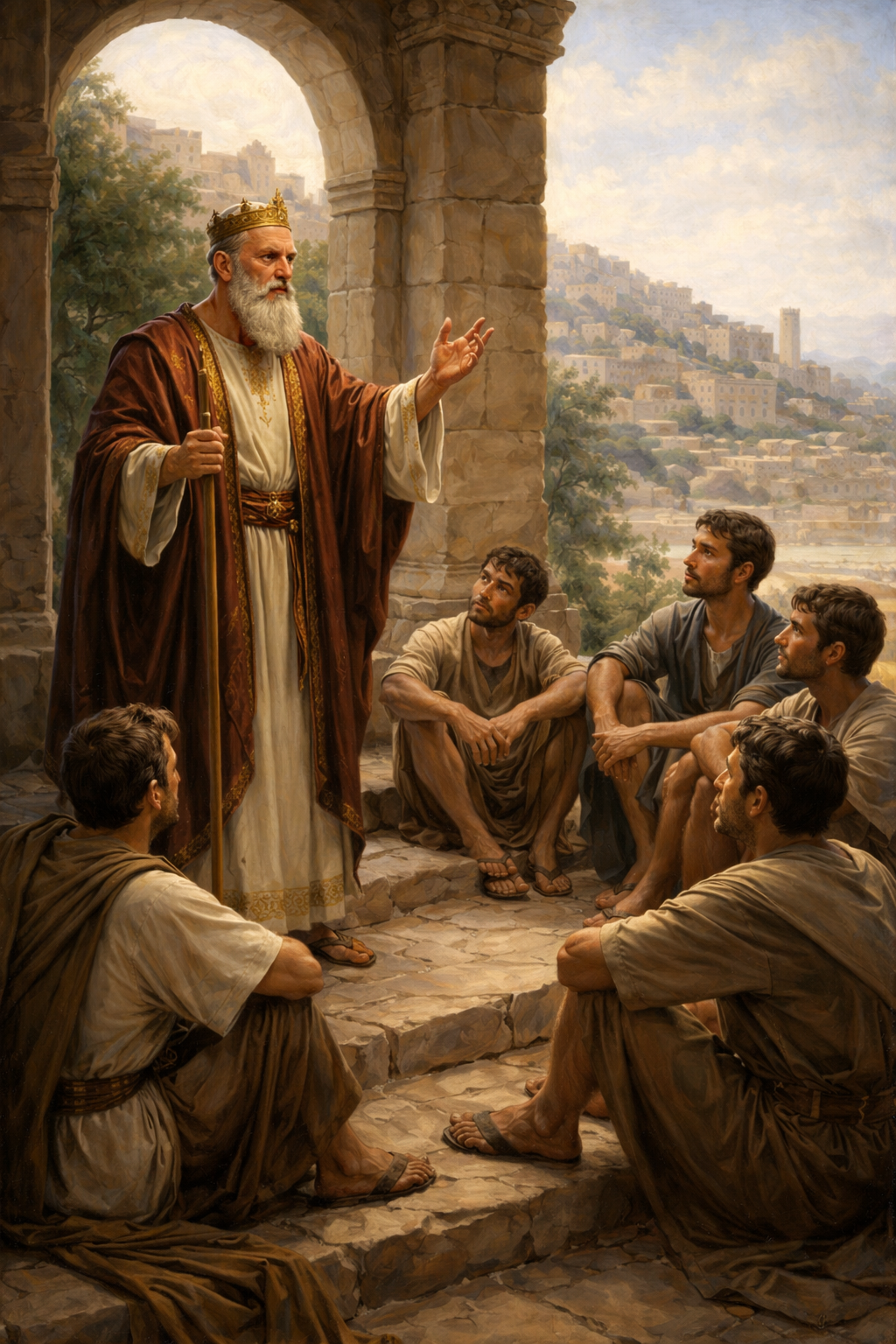
Ecclesiastes 9–12 gives the closing movement of the book. Solomon, “the Preacher,” brings the reader from the sobering certainty of death to the final duty of man: “Fear God, and keep his commandments” (Ecclesiastes 12:13). These chapters are not teaching despair, soul sleep, or moral indifference. They show the emptiness of life viewed merely “under the sun,” while pointing men back to God, judgment, wisdom, and obedient fear.
Chapter Summaries
Ecclesiastes 9 — Death, Diligence, and the Value of Wisdom
 Ecclesiastes 9 begins with the truth that “the righteous, and the wise, and their works, are in the hand of God” (9:1). This is not fatalism. It is the doctrine of divine providence. Man does not control life, death, opportunity, or outcome. God does.
Solomon then observes that “one event” comes to all men: death. “There is one event to the righteous, and to the wicked” (9:2). In this present world, both the godly and ungodly die. Earthly death does not mean there is no moral difference between them; it means death is part of the curse upon fallen man.
Verse 5 says, “the dead know not any thing.” In context, this means the dead no longer participate in earthly affairs “under the sun.” It does not teach soul sleep or annihilation. Other Scripture plainly shows conscious existence after death, as in Luke 16:22-24, where the rich man is conscious in torment. Ecclesiastes 9 is speaking from the earthly perspective of life beneath the sun.
Because life is brief, Solomon commands sober enjoyment of God’s lawful blessings: “Go thy way, eat thy bread with joy, and drink thy wine with a merry heart” (9:7). He says, “Live joyfully with the wife whom thou lovest” (9:9). Marriage, labor, food, and daily responsibilities are not meaningless when received under God’s hand.
The chapter also urges diligence: “Whatsoever thy hand findeth to do, do it with thy might” (9:10). This is a strong practical command. Since earthly opportunity ends at death, a man should serve, work, witness, provide, and obey while he has time.
Solomon also observes that success is not always given to the strongest or smartest: “the race is not to the swift, nor the battle to the strong” (9:11). “Time and chance” does not mean luck rules the universe. It means that, from man’s earthly view, outcomes are often unpredictable. God’s providence remains above man’s understanding.
The chapter closes with the account of “a little city, and few men within it” (9:14). A “poor wise man” delivers the city by wisdom, yet “no man remembered that same poor man” (9:15). The lesson is clear: “Wisdom is better than strength” (9:16), though the world often despises humble wisdom.
Ecclesiastes 10 — The Danger of Folly and the Profit of Wisdom
Ecclesiastes 10 contrasts wisdom and folly in daily life, speech, leadership, labor, and government.
The opening verse says, “Dead flies cause the ointment of the apothecary to send forth a stinking savour: so doth a little folly him that is in reputation for wisdom and honour” (10:1). A small amount of foolishness can damage a good testimony. One sinful decision can bring reproach upon years of faithfulness.
Solomon then says, “A wise man’s heart is at his right hand; but a fool’s heart at his left” (10:2). The point is moral and practical direction. Wisdom leads a man in the right way; folly exposes itself even when the fool thinks he is hidden: “his wisdom faileth him, and he saith to every one that he is a fool” (10:3).
The chapter gives counsel for dealing with rulers: “If the spirit of the ruler rise up against thee, leave not thy place; for yielding pacifieth great offences” (10:4). A wise man does not answer every provocation with rebellion or rashness. He knows how to stand without being proud, and how to yield without compromising righteousness.
Solomon also laments disorder in leadership: “folly is set in great dignity, and the rich sit in low place” (10:6). He sees servants upon horses and princes walking as servants (10:7). This describes social and governmental disorder, where unqualified men are exalted and proper authority is dishonored.
Several proverbs warn that careless actions carry consequences: “He that diggeth a pit shall fall into it” (10:8), and “whoso breaketh an hedge, a serpent shall bite him” (10:8). Boundaries matter. God-given restraints protect a man from harm.
Verse 10 is a key wisdom principle: “wisdom is profitable to direct.” Strength without wisdom wastes effort. Zeal without judgment can do damage. A sharp tool works better than a dull one; likewise, a wise spirit works better than raw force.
The chapter also warns about speech. “The words of a wise man’s mouth are gracious; but the lips of a fool will swallow up himself” (10:12). Foolish speech begins in vanity and ends in “mischievous madness” (10:13). A fool is full of words, but he does not know what shall be (10:14).
The chapter closes with warnings about lazy rulers, feasting without responsibility, and careless talk. “Curse not the king, no not in thy thought” (10:20). Even private bitterness can become public trouble. The believer should be careful in both heart and tongue.
Ecclesiastes 11 — Diligence, Generosity, and Remembering Judgment
Ecclesiastes 11 calls men to live responsibly in an uncertain world.
“Cast thy bread upon the waters: for thou shalt find it after many days” (11:1). This teaches generosity, faith-filled labor, and investment of life without demanding immediate results. A man who waits until every outcome is guaranteed will never obey, give, sow, or serve.
“Give a portion to seven, and also to eight” (11:2) teaches wise distribution and readiness for unknown trouble. “For thou knowest not what evil shall be upon the earth.” A godly man should not live foolishly, presuming upon tomorrow.
Solomon then warns against paralysis through over-analysis: “He that observeth the wind shall not sow; and he that regardeth the clouds shall not reap” (11:4). There is a time to plan, but endless waiting can become disobedience. Farmers must sow even when they cannot control the weather. Likewise, believers must serve God though they cannot foresee every result.
Verse 5 reminds us that God’s works are beyond man’s full comprehension: “thou knowest not the works of God who maketh all.” This humbles human pride. Man is responsible to obey what God has revealed, not to master everything God has hidden.
The Preacher commands steady labor: “In the morning sow thy seed, and in the evening withhold not thine hand” (11:6). This is a strong principle for ministry, family, work, prayer, soul winning, and Christian faithfulness. We often do not know which labor God will especially bless.
The chapter turns to youth: “Rejoice, O young man, in thy youth” (11:9), but the joy is not careless or sinful. The warning immediately follows: “but know thou, that for all these things God will bring thee into judgment.” Biblical joy is never separated from accountability before God.
Ecclesiastes 12 — Remember Thy Creator and Fear God
Ecclesiastes 12 is the grand conclusion of the book.
It begins: “Remember now thy Creator in the days of thy youth” (12:1). This is one of the clearest commands in the book. Youth is not a season for wasting life in sin. Young people should seek, obey, and serve God before age, weakness, regret, and death overtake them.
Verses 2-7 poetically describe aging and death. The “keepers of the house” trembling, the “strong men” bowing, the “grinders” ceasing, and “those that look out of the windows” being darkened picture the decline of the body. The “silver cord” being loosed and the “golden bowl” broken point to the frailty of life. Finally, “then shall the dust return to the earth as it was: and the spirit shall return unto God who gave it” (12:7).
This verse is important doctrinally. Man is more than a body. Death separates the body from the spirit. The body returns to dust, but the spirit returns to God. This agrees with the broader biblical teaching that man must answer to his Creator.
The Preacher repeats the book’s theme: “Vanity of vanities, saith the preacher; all is vanity” (12:8). Life without God is empty, temporary, and unable to satisfy the soul.
Verses 9-12 describe the Preacher’s work. He “taught the people knowledge” (12:9), “gave good heed,” and “sought out, and set in order many proverbs.” The words are described as “words of truth” (12:10), and “the words of the wise are as goads” (12:11). God’s words are meant to prod, correct, instruct, and fasten truth in the heart.
The final conclusion is plain and authoritative: “Fear God, and keep his commandments: for this is the whole duty of man” (12:13). This is not salvation by works. Rather, it is the proper response of man to his Creator. In the full light of Scripture, salvation is by grace through faith, not by works; but a saved man should live in reverent obedience.
The final verse gives the reason: “For God shall bring every work into judgment, with every secret thing, whether it be good, or whether it be evil” (12:14). Nothing is hidden from God. Earthly injustice, secret sin, forgotten faithfulness, and hidden motives will all be brought before His judgment.
Key People and Places
Key People
The Preacher
The speaker of Ecclesiastes, identified earlier as “the son of David, king in Jerusalem” (Ecclesiastes 1:1). From a conservative Baptist position, this points to Solomon. In chapters 9-12, he speaks as an aged king and wise observer of life, warning men not to waste life “under the sun.”
God / Creator
God is the central Person behind the conclusion of the book. Man must “remember now thy Creator” (12:1), fear God, keep His commandments, and prepare for judgment (12:13-14).
The Righteous and the Wise
Mentioned in 9:1. Their works are “in the hand of God.” They may not understand all earthly outcomes, but they are not outside God’s providence.
The Wicked, the Fool, and the Sinner
These chapters repeatedly contrast the fool with the wise. The fool is careless in conduct, reckless in speech, lazy in labor, and blind to judgment.
The Poor Wise Man
In 9:15, “a poor wise man” delivers a little city by his wisdom, yet is forgotten. He represents the truth that wisdom may be despised by men, though it is better than strength.
The Young Man
Addressed directly in 11:9 and 12:1. Youth must not be spent in vanity. Joy must be governed by the certainty of judgment.
The King / Ruler
Referenced in chapter 10. Solomon gives practical wisdom about rulers, authority, restraint, and careful speech.
Key Places and Settings
“Under the sun”
This phrase describes life from the earthly viewpoint. Ecclesiastes shows the emptiness of life when measured only by earthly gain, pleasure, labor, and reputation.
The Grave
Ecclesiastes 9:10 says there is “no work, nor device, nor knowledge, nor wisdom, in the grave, whither thou goest.” The grave marks the end of earthly labor and opportunity.
The Little City
In 9:14, a small city is besieged by a great king, but delivered by a poor wise man. It illustrates the superiority of wisdom over brute force.
The House / Aging Body Imagery
Ecclesiastes 12 uses the image of a house and its failing parts to describe bodily decline in old age.
Earth and God’s Presence
Ecclesiastes 12:7 gives the final movement of death: “the dust shall return to the earth as it was: and the spirit shall return unto God who gave it.”
Main Doctrinal or Spiritual Themes
1. The Certainty of Death
Ecclesiastes 9 repeatedly teaches that death comes to all men. “One event” comes to the righteous and the wicked. This humbles pride and destroys the illusion that earthly achievement can save a man.
2. Divine Providence
“The righteous, and the wise, and their works, are in the hand of God” (9:1). Life is not random, though man often cannot predict outcomes. God rules even when man cannot trace His hand.
3. The Urgency of Present Obedience
“Whatsoever thy hand findeth to do, do it with thy might” (9:10). The believer should not live carelessly, lazily, or half-heartedly. Earthly opportunity is limited.
4. Wisdom Is Better Than Strength
Ecclesiastes 9:16 says, “Wisdom is better than strength.” Godly wisdom is more valuable than power, wealth, popularity, or position. Yet the world often forgets the poor wise man.
5. A Little Folly Can Ruin a Good Testimony
Ecclesiastes 10:1 warns that “a little folly” can damage one “in reputation for wisdom and honour.” This is a serious holiness principle. Private foolishness can bring public reproach.
6. Words Reveal the Heart
Chapter 10 emphasizes the speech of the wise and the fool. “The words of a wise man’s mouth are gracious” (10:12), but the fool’s lips destroy him. A man’s tongue often exposes his spiritual condition.
7. Diligence in Uncertainty
Ecclesiastes 11 teaches that uncertainty is not an excuse for inactivity. “In the morning sow thy seed, and in the evening withhold not thine hand” (11:6). Faithfulness does not require knowing every outcome.
8. Youth Must Be Given to God
“Remember now thy Creator in the days of thy youth” (12:1). The Bible does not present youth as a time for rebellion followed by later religion. God deserves the first and best of life.
9. Man Is Accountable to God
The book ends with judgment: “God shall bring every work into judgment, with every secret thing” (12:14). This includes public works, hidden sins, motives, and secret faithfulness.
10. Fear of God Is the Foundation of Life
The final duty of man is not pleasure, wealth, fame, education, or self-expression. It is this: “Fear God, and keep his commandments” (12:13). That is the settled conclusion of the whole matter.
Practical Applications or Lessons
1. Do not waste life as though death will never come.
Ecclesiastes 9 reminds every man that earthly life is short. Since the grave ends earthly opportunity, believers should serve God now, witness now, forgive now, work now, and obey now.
2. Enjoy lawful blessings without making idols of them.
Food, marriage, labor, and daily joys are gifts from God. But they must be received with reverence, not worshipped as the purpose of life.
3. Work with diligence.
“Whatsoever thy hand findeth to do, do it with thy might” (9:10) applies to ministry, employment, family duty, study, and service. Laziness is not spirituality.
4. Value wisdom even when the world ignores it.
The poor wise man was forgotten, but his wisdom delivered the city. A believer should seek God’s approval more than man’s applause.
5. Guard your testimony from “a little folly.”
One careless word, one sinful habit, one compromise, one foolish relationship, or one proud decision can damage a testimony. Holiness matters in small things.
6. Be careful with your speech.
The fool is exposed by his mouth. Christians should speak with grace, restraint, truth, and reverence. This includes speech about rulers, churches, family, and brethren.
7. Do not wait for perfect conditions to obey God.
“He that observeth the wind shall not sow” (11:4). Many never serve God because they are waiting for easier circumstances. Obedience must begin now.
8. Give, sow, and serve with faith.
“Cast thy bread upon the waters” (11:1) teaches that some labor returns “after many days.” A tract, sermon, prayer, gift, lesson, or act of kindness may bear fruit later than expected.
9. Teach young people to remember God early.
Ecclesiastes 12:1 is a strong command for parents, pastors, and churches. Children and young people need more than entertainment; they need the fear of God, the Word of God, and the gospel of Christ.
10. Live every day in view of judgment.
God will bring “every secret thing” into judgment. This should sober the sinner, purify the believer, comfort the wronged, and encourage the faithful servant whose labor is unseen by men.
Conservative Baptist Doctrinal Emphasis
Ecclesiastes 9-12 must not be read as hopeless philosophy. Solomon is showing that life apart from God is vanity. Death is certain, man is limited, earthly success is unstable, and human wisdom cannot save the soul. Yet the conclusion is not despair. The conclusion is reverent obedience before the living God.
The final answer is not human pleasure, religious ritual, modern psychology, or philosophical speculation. It is: “Fear God, and keep his commandments: for this is the whole duty of man” (12:13). In the fuller light of Scripture, man’s only hope of salvation is the grace of God through faith, and the saved man’s proper life is one of holiness, obedience, wisdom, and readiness for judgment.
Comments are closed