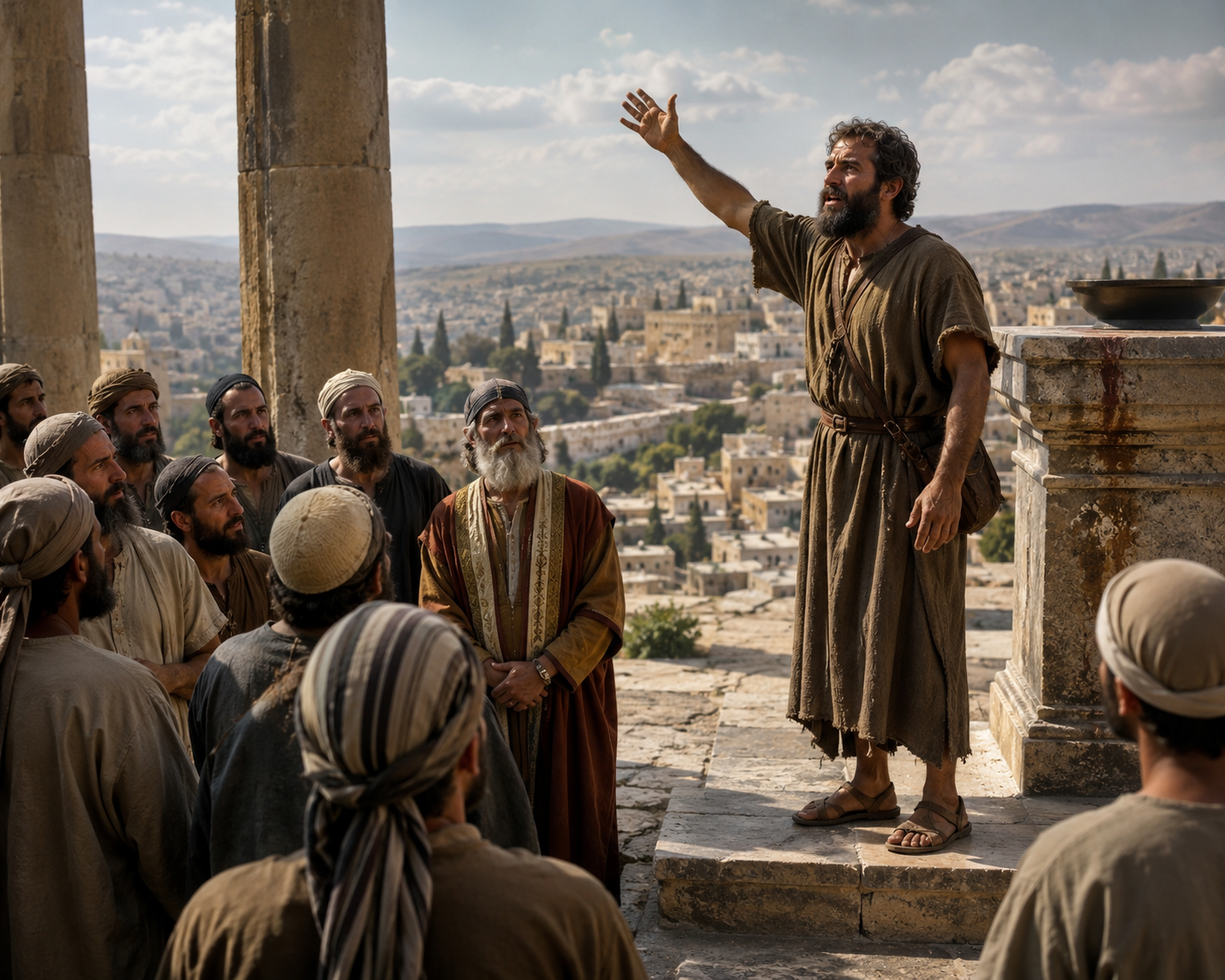
Amos 6–9 brings the prophecy of Amos to its solemn climax. The prophet exposes Israel’s complacency, luxury, false worship, oppression, and refusal to repent. God shows Amos visions of judgment, announces that Israel’s sinful kingdom will fall, and then closes the book with a promise of future restoration under the house of David. The tone is severe, but not hopeless. God judges sin, yet He keeps covenant promises to Israel.
Chapter Summaries
Amos 6 — Woe to the Careless and Comfortable
 Amos 6 opens with a strong rebuke:
“Woe to them that are at ease in Zion, and trust in the mountain of Samaria…”
— Amos 6:1
Though Amos primarily preached against the northern kingdom of Israel, Judah is also warned. “Zion” points to Jerusalem, while “Samaria” represents the northern kingdom. Both religious privilege and political confidence could not protect a sinful people from God’s judgment.
The people were living in luxury while ignoring coming judgment. They lay “upon beds of ivory,” stretched themselves “upon their couches,” ate “the lambs out of the flock,” chanted “to the sound of the viol,” drank wine “in bowls,” and anointed themselves with costly ointments, yet they were “not grieved for the affliction of Joseph” (Amos 6:4–6).
The sin here is not merely wealth itself, but selfish ease, pride, indulgence, and spiritual carelessness while the nation decayed morally. They were enjoying comfort while ignoring corruption. They were religious enough to feel secure, but not holy enough to repent.
God declares that their pride would be judged:
“The Lord GOD hath sworn by himself… I abhor the excellency of Jacob, and hate his palaces…”
— Amos 6:8
The chapter ends by showing the foolishness of Israel’s confidence. They had turned “judgment into gall” and “the fruit of righteousness into hemlock” (Amos 6:12). God would raise up a nation against them, historically fulfilled in Assyria’s oppression and conquest of the northern kingdom.
Flow of the chapter:
Complacency ? luxury ? lack of grief over sin ? divine oath of judgment ? national overthrow.
Amos 7 — Visions of Judgment and the Opposition of Amaziah
Amos 7 contains three visions and a confrontation.
First, Amos sees a vision of locusts devouring the latter growth. Amos intercedes:
“O Lord GOD, forgive, I beseech thee: by whom shall Jacob arise? for he is small.”
— Amos 7:2
The LORD repents concerning that judgment, meaning He relents from carrying it out at that time.
Second, Amos sees a vision of fire, and again he intercedes:
“O Lord GOD, cease, I beseech thee: by whom shall Jacob arise? for he is small.”
— Amos 7:5
Again, the LORD withholds that judgment.
Third, Amos sees the Lord standing upon a wall with a plumbline:
“Behold, I will set a plumbline in the midst of my people Israel: I will not again pass by them any more.”
— Amos 7:8
The plumbline represents God’s exact standard. Israel was not being measured by human opinion, national success, or religious activity, but by God’s righteousness. The verdict was clear: the high places would be desolate, the sanctuaries laid waste, and the house of Jeroboam judged with the sword.
Then Amaziah, the priest of Bethel, opposes Amos. Bethel was a center of false worship in the northern kingdom, tied to the calf worship established by Jeroboam I. Amaziah reports Amos to Jeroboam II and accuses him of conspiracy:
“Amos hath conspired against thee in the midst of the house of Israel…”
— Amos 7:10
Amaziah tells Amos to flee to Judah and prophesy there, but not to prophesy at Bethel:
“for it is the king’s chapel, and it is the king’s court.”
— Amos 7:13
That statement reveals the corruption of Israel’s religion. Bethel was not treated as the house of God, but as the king’s religious institution. Religion had become political, man-centered, and rebellious against the word of the LORD.
Amos answers humbly. He was not a professional prophet seeking gain:
“I was no prophet, neither was I a prophet’s son; but I was an herdman, and a gatherer of sycomore fruit.”
— Amos 7:14
God called him from ordinary labor and commanded him to prophesy. Amos then pronounces judgment upon Amaziah and his house.
Flow of the chapter:
Judgment visions ? prophetic intercession ? God’s plumbline ? religious opposition ? Amos’ divine calling defended ? judgment on Amaziah.
Amos 8 — The Basket of Summer Fruit and the Famine of Hearing God’s Words
Amos 8 begins with another vision:
“Behold a basket of summer fruit.”
— Amos 8:1
The meaning is that Israel was ripe for judgment. The end had come:
“The end is come upon my people of Israel; I will not again pass by them any more.”
— Amos 8:2
The songs of the temple would become howlings. Dead bodies would be many. God again condemns Israel’s oppression of the poor:
“Hear this, O ye that swallow up the needy, even to make the poor of the land to fail.”
— Amos 8:4
They were outwardly religious, waiting for the new moon and sabbath to pass so they could return to dishonest business. They made “the ephah small, and the shekel great,” falsifying measures and exploiting the weak (Amos 8:5). Their sin was practical atheism: they kept religious days outwardly, but their hearts loved covetousness.
God swears He will not forget their works:
“Surely I will never forget any of their works.”
— Amos 8:7
The land would tremble. Their feasts would turn into mourning. Their songs would become lamentation.
One of the most sobering judgments appears near the end:
“Behold, the days come, saith the Lord GOD, that I will send a famine in the land, not a famine of bread, nor a thirst for water, but of hearing the words of the LORD.”
— Amos 8:11
This is not merely the absence of preaching in general, but the withdrawal of divine revelation and prophetic answer. They had rejected God’s words when they had them; therefore a day would come when they would seek and not find. That is a fearful judgment. A nation may survive economic hardship more easily than the removal of God’s word.
Flow of the chapter:
Ripe fruit ? ripe judgment ? exposure of dishonest religion ? national mourning ? famine of hearing God’s words.
Amos 9 — The Lord at the Altar, Inescapable Judgment, and Future Restoration
Amos 9 begins with a vision of the Lord standing upon the altar:
“I saw the Lord standing upon the altar…”
— Amos 9:1
This is not comforting at first; it is terrifying. The place associated with worship becomes the place from which judgment is announced. The people cannot escape. Whether they dig into hell, climb to heaven, hide on Carmel, flee into the sea, or go into captivity, God will find them.
“Though they dig into hell, thence shall mine hand take them…”
— Amos 9:2
This teaches the omnipresence, sovereignty, and holiness of God. No sinner can hide from Him.
The Lord identifies Himself as the Creator:
“The Lord GOD of hosts is he that toucheth the land, and it shall melt…”
— Amos 9:5
He is not a tribal deity. He is the sovereign God of heaven and earth.
God declares that sinful Israel will be sifted among all nations:
“For, lo, I will command, and I will sift the house of Israel among all nations…”
— Amos 9:9
Yet God also says:
“yet shall not the least grain fall upon the earth.”
— Amos 9:9
This is important. Judgment is real, but preservation is also real. God will destroy “the sinful kingdom” but not utterly destroy “the house of Jacob” (Amos 9:8). This preserves the distinction between God’s judgment on sin and His covenant faithfulness to Israel.
The book closes with restoration:
“In that day will I raise up the tabernacle of David that is fallen…”
— Amos 9:11
This points to the restoration of Davidic rule and kingdom blessing. From a conservative premillennial Baptist understanding, this does not erase Israel or replace Israel with the Church. God will fulfill His covenant promises literally and nationally to Israel under the reign of the Messiah, the Lord Jesus Christ. The Church presently receives spiritual blessing through Christ, but Israel’s national restoration remains part of God’s prophetic program.
The closing verses describe agricultural abundance, restored cities, fruitful vineyards, and permanent possession of the land:
“And I will plant them upon their land, and they shall no more be pulled up…”
— Amos 9:15
The book that began with roaring judgment ends with covenant hope.
Flow of the chapter:
The Lord at the altar ? no escape from judgment ? Israel sifted among nations ? sinners judged ? David’s fallen tabernacle raised ? Israel restored in the land.
Key People and Places
Amos
A prophet from Tekoa in Judah, called by God to preach primarily against the northern kingdom of Israel. He was an herdman and gatherer of sycomore fruit, not a court prophet or religious professional. His authority came from God’s call, not institutional approval.
The Lord GOD / LORD God of hosts
God is presented as holy Judge, sovereign Creator, covenant-keeping Lord, and ruler over nations. He measures Israel by His own standard and executes judgment without partiality.
Israel / Jacob / Joseph
These names refer mainly to the northern kingdom in this section. “Joseph” often represents the northern tribes, especially Ephraim and Manasseh. Israel had privilege, but privilege did not excuse rebellion.
Judah / Zion
Judah is referenced in Amos 6:1 through “Zion.” Though the main burden falls on the northern kingdom, Judah is not free to be careless.
Samaria
Capital of the northern kingdom. It represents political strength, pride, wealth, and false security.
Bethel
A major center of false worship in the northern kingdom. Though its name means “house of God,” it had become a place of calf worship and religious rebellion.
Amaziah
The priest of Bethel who opposed Amos. He represents religious leadership that is loyal to political power rather than to the word of God.
Jeroboam
Jeroboam II, king of Israel during Amos’ ministry. Israel enjoyed outward prosperity under him, but inwardly the nation was corrupt and nearing judgment.
Bashan
Mentioned in Amos 6:1 indirectly through the broader setting of Israel’s luxury and strength. Bashan was known for richness and strength. In Amos, places of strength and prosperity become witnesses against careless sinners.
Carmel
A mountain known for beauty and hiding places. In Amos 9:3, even Carmel cannot hide sinners from God.
The House of David
In Amos 9:11, “the tabernacle of David” points to the fallen Davidic dynasty being raised up. This connects Amos with the larger kingdom promises of Scripture.
Main Doctrinal or Spiritual Themes
1. God’s Holiness Requires Judgment Against Sin
Amos 6–9 shows that God does not overlook sin because people are religious, prosperous, or nationally privileged. Israel had covenant light, but their disobedience made their guilt greater.
“I abhor the excellency of Jacob, and hate his palaces…”
— Amos 6:8
God’s hatred here is not sinful passion, but holy opposition to pride, corruption, and rebellion.
2. Religious Activity Cannot Replace Obedience
Israel had altars, sanctuaries, feasts, songs, and religious observances. Yet God condemned them because their worship was polluted by idolatry and injustice. They wanted ceremony without submission.
Bethel is especially important. It was religious, but not right. It had priests, but not truth. It had worship, but not obedience.
3. God Measures Men by His Plumbline
The plumbline in Amos 7 teaches that God’s standard is straight, fixed, and unchanging. Man does not set the standard; God does.
This applies doctrinally and practically. Churches, homes, preachers, and nations must be measured by Scripture, not by success, popularity, tradition, or emotional experience.
4. True Preaching Comes from God’s Call and God’s Word
Amos did not preach because it was convenient or profitable. He preached because God commanded him.
“Go, prophesy unto my people Israel.”
— Amos 7:15
Amaziah represents compromised religion. Amos represents faithful preaching. The preacher’s duty is not to please the king’s court, but to deliver the word of the LORD.
5. Rejecting God’s Word Leads to a Famine of Hearing God’s Word
Amos 8:11 is one of the most sobering verses in the book. When people reject light, God may remove light. When people despise preaching, God may give them silence.
This is a serious warning to any nation, church, or individual that treats the Bible lightly.
6. No One Can Escape God
Amos 9 teaches that sinners cannot hide from God’s presence or judgment. Height, depth, distance, darkness, captivity, and death itself cannot remove a man from God’s reach.
This is terrifying to the lost, but comforting to the saved. The same God from whom the rebel cannot escape is the God who keeps His own.
7. God Preserves a Remnant
Though Israel is judged, God does not utterly destroy the house of Jacob.
“yet will I not utterly destroy the house of Jacob, saith the LORD.”
— Amos 9:8
This is consistent with God’s covenant faithfulness. His chastening is real, but His promises are not forgotten.
8. Israel’s Future Restoration Is Literal and Covenantal
Amos 9:11–15 gives a future hope for Israel. The “tabernacle of David” will be raised. The land will be fruitful. The people will be planted upon their land.
From a conservative Baptist, dispensational, premillennial understanding, these promises should not be spiritualized away. The Church does not cancel Israel. God will fulfill His promises to Israel in connection with Messiah’s kingdom.
9. Prosperity Is Dangerous When It Produces Ease Without Repentance
Amos 6 shows people surrounded by comfort, music, food, wine, and luxury, yet unconcerned about spiritual ruin. Prosperity can become a narcotic to the soul when it dulls conviction and hides coming judgment.
Practical Applications or Lessons
1. Do Not Be “At Ease” While Sin Is Destroying the Nation, Church, or Home
Amos 6:1 warns against careless ease. Believers should not live comfortably indifferent while truth is rejected, families are broken, churches compromise, and souls perish.
The Christian life is not a call to panic, but it is a call to watchfulness, prayer, holiness, and witness.
2. Luxury Must Never Replace Burden
The people of Amos 6 enjoyed their beds, music, food, wine, and ointments, but they were “not grieved for the affliction of Joseph.” A believer may lawfully enjoy God’s provision, but he must not lose compassion, conviction, or spiritual concern.
A soft life can produce a hard heart.
3. Measure Everything by the Word of God
The plumbline of Amos 7 reminds us that God’s Word is the standard. A church is not right because it is large. A preacher is not right because he is popular. A family is not right because it looks respectable. Everything must be tested by Scripture.
For the English-speaking believer, we stand upon the preserved words of God in the King James Bible. As one of the uploaded KJV materials states plainly, “I believe that the King James Bible is God’s Word kept intact in English” . That conviction fits the spirit of Amos: God’s people must submit to God’s words, not correct them, evade them, or silence them.
4. Expect Opposition When Preaching Truth
Amaziah opposed Amos because the message threatened the religious-political system at Bethel. Faithful preaching often disturbs comfortable religion.
The answer is not to soften the message. Amos did not apologize. He simply declared that God had sent him.
5. Beware of Religion Controlled by Politics or Personal Gain
Amaziah called Bethel “the king’s chapel” and “the king’s court.” That is a tragic description. Worship had been captured by politics.
A church must belong to Christ, not to the state, not to culture, not to a wealthy donor, not to public opinion, and not to a preacher’s ego.
6. Do Not Despise the Hearing of God’s Word
Amos 8:11 warns of a famine “of hearing the words of the LORD.” A person who neglects preaching, ignores Scripture, and resists conviction may one day desire an answer and not find it.
When God gives light, respond. When God convicts, repent. When the Bible speaks, obey.
7. God’s Judgment May Be Delayed, But It Is Never Defeated
In Amos 7, God withholds the locusts and the fire after Amos intercedes. But by the plumbline vision, the time comes when God says, “I will not again pass by them any more.”
Mercy should lead to repentance, not presumption.
8. The Lost Must Not Think They Can Hide from God
Amos 9 makes clear that no man can escape God. Death, distance, religion, denial, and power cannot hide sin from the Lord.
The only refuge is not hiding from God, but coming to Him His way. Salvation is by grace through faith in the Lord Jesus Christ, apart from works. Judgment is certain for the unrepentant, but mercy is available in Christ.
9. God Keeps His Promises
The end of Amos is full of hope. God judges Israel, but He does not forget Israel. The fallen tabernacle of David will be raised. The land promises will be fulfilled. God’s covenant faithfulness stands.
That teaches believers today to trust God’s promises even when judgment, chastening, or national decline seems overwhelming.
10. True Hope Is Found After Repentance and Divine Restoration, Not Human Optimism
Amos does not end with shallow positivity. It ends with God restoring what sin ruined. Biblical hope is not based on man’s ability to improve himself. It is based on God’s faithfulness, God’s covenant, and God’s Messiah.
Concluding Summary
Amos 6–9 is a solemn passage about a privileged people who became proud, careless, religiously corrupt, and morally unjust. They had worship without obedience, prosperity without compassion, and confidence without repentance. God measured them by His plumbline and found them crooked.
Yet the book does not end in despair. God promises that the house of Jacob will not be utterly destroyed and that the tabernacle of David will be raised again. Judgment is real, but so is restoration. God is holy, but He is faithful.
The conservative Baptist lesson is plain: submit to the preserved Word of God, reject empty religion, preach truth without compromise, grieve over sin, and trust the Lord to keep every promise He has made.
How useful was this post?
Click on a star to rate it!
Average rating 0 / 5. Vote count: 0
No votes so far! Be the first to rate this post.
We are sorry that this post was not useful for you!
Let us improve this post!
Tell us how we can improve this post?
Comments are closed