
Chapter Summaries
2 Chronicles 4 — The Furnishings of the Temple
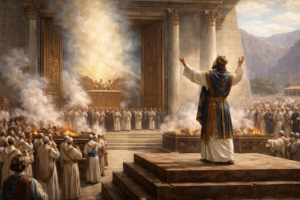 This chapter records the construction and placement of the sacred vessels for Solomon’s temple. The work is executed according to divinely established patterns consistent with earlier tabernacle worship, but on a grander scale befitting Israel’s established kingdom.
- The brasen altar, molten sea, ten lavers, candlesticks, tables, and court vessels are described in detail.
- The molten sea rests upon twelve oxen, symbolizing strength, order, and provision.
- Everything is made in abundance, emphasizing God’s holiness and the seriousness of approaching Him.
- The chapter concludes by noting that Solomon finished all the work of the house of the LORD and brought in the dedicated things of David his father.
Doctrinally, this chapter underscores that God is to be worshiped with reverence, preparation, and obedience to His revealed will—not human innovation.
2 Chronicles 5 — The Ark Brought into the Temple
This chapter marks the spiritual climax of the construction phase: the ark of the covenant is brought into the Most Holy Place.
- The elders and priests assemble at Jerusalem.
- The ark is placed beneath the wings of the cherubim in the oracle.
- When the priests come out, the house is filled with a cloud, so that they could not stand to minister.
- The cloud represents the glory of the LORD, visibly confirming God’s approval and presence.
This mirrors earlier manifestations of God’s glory in the tabernacle (Exodus 40) and reinforces that God alone sanctifies worship.
2 Chronicles 6 — Solomon’s Prayer of Dedication
Solomon publicly blesses the congregation and offers a lengthy prayer acknowledging God’s covenant faithfulness.
Key elements of the prayer include:
- Praise for God’s faithfulness to David.
- Acknowledgment that God cannot be contained in a house made with hands, yet graciously chooses to place His name there.
- Petitions for forgiveness, justice, and restoration when Israel sins and repents.
- Recognition that even strangers who seek the LORD may be heard.
- Emphasis on repentance, prayer toward the temple, and covenant obedience.
This prayer establishes the theological framework for Israel’s future blessings and chastisements.
Key People and Places
- Solomon — King of Israel; builder of the temple and intercessor for the nation.
- David — His preparations and dedication lay the foundation for the temple’s furnishings.
- Priests and Levites — Faithful ministers responsible for worship and sacrificial service.
- Jerusalem — Chosen city where God placed His name.
- The Temple — Central place of worship, sacrifice, and prayer.
- The Most Holy Place — Location of the ark and manifestation of God’s glory.
Main Doctrinal or Spiritual Themes
- God’s Holiness — Careful construction and sanctification of the temple vessels.
- God’s Presence — The visible glory filling the house.
- Covenant Faithfulness — God keeping His promise to David.
- Prayer and Repentance — Central means of restoration.
- Mediated Worship — God approached according to His ordained means.
- National Accountability — Blessing and judgment tied to obedience.
Practical Applications or Lessons
- God is worthy of our best preparation and reverence in worship.
- Visible success means nothing without God’s approving presence.
- Prayer must be grounded in humility, repentance, and obedience.
- God hears sincere prayer offered according to His will.
- Leadership carries spiritual responsibility for guiding others toward God.
Comments are closed