
Chapter Summaries
1 Kings 11 — Solomon’s Decline and God’s Judgment
Solomon’s reign turns from faithfulness to failure. Though greatly blessed with wisdom, riches, and peace, Solomon “loved many strange women” (11:1), including Moabites, Ammonites, Edomites, Zidonians, and Hittites—nations explicitly forbidden by the LORD. His wives “turned away his heart after other gods” (11:4), and Solomon built high places for Chemosh and Molech, directly violating the first commandment.
The chapter emphasizes that Solomon’s sin was not ignorance but deliberate disobedience. The LORD had appeared to him twice and warned him plainly. As judgment, God declares that the kingdom will be torn from Solomon’s house—but not in Solomon’s lifetime, and not entirely, for David’s sake and Jerusalem’s sake (11:12–13).
God raises adversaries:
-
Hadad the Edomite
-
Rezon of Damascus
-
Jeroboam, an Ephraimite servant whom God designates through the prophet Ahijah as future ruler over ten tribes
The chapter closes with Solomon’s death and the transfer of power to Rehoboam.
1 Kings 12 — The Kingdom Divided
 Rehoboam ascends the throne and travels to Shechem, where Israel seeks relief from Solomon’s heavy yoke. The elders counsel mercy, urging him to speak kindly and serve the people. The younger men advise harshness, encouraging him to assert dominance.
Rehoboam rejects godly counsel and answers arrogantly:
“My little finger shall be thicker than my father’s loins” (12:10).
This fulfills the LORD’s word. Ten tribes revolt, proclaiming:
“What portion have we in David?” (12:16)
Jeroboam becomes king over Israel (the northern kingdom), while Rehoboam reigns over Judah and Benjamin (the southern kingdom).
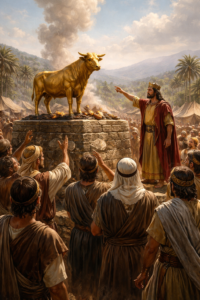
Jeroboam, fearing loss of control, commits grievous sin by:
-
Establishing golden calves at Bethel and Dan
-
Creating a false priesthood
-
Instituting a counterfeit feast
This chapter ends with the tragic institutionalization of state-sponsored idolatry, setting Israel on a path of continual rebellion.
Key People and Places
-
Solomon — Third king of Israel; wise yet spiritually compromised.
-
Rehoboam — Solomon’s son; proud and unteachable.
-
Jeroboam — First king of the northern kingdom; architect of idolatry.
-
Ahijah the Shilonite — Prophet announcing the division of the kingdom.
-
Shechem — Site of Israel’s assembly and political fracture.
-
Jerusalem — God’s chosen city; seat of David’s line.
-
Bethel and Dan — Centers of false worship established by Jeroboam.
Main Doctrinal and Spiritual Themes
-
Partial obedience is disobedience
-
Leadership failure brings national consequences
-
God keeps His covenant promises, even in judgment
-
Idolatry always begins in the heart
-
Rejecting godly counsel leads to destruction
-
Fear of man produces false religion
Practical Applications or Lessons
-
Spiritual privileges do not excuse spiritual compromise.
-
A strong start does not guarantee a faithful finish.
-
Leaders must heed godly counsel over pride.
-
Fear-driven worship leads people away from God, not toward Him.
-
God’s judgment is always just, but His mercy remains evident.
Comments are closed