The King, His Authority, Judgment, and the Great Commandment
 Matthew 21–22 records the Lord Jesus Christ’s public entrance into Jerusalem, His cleansing of the temple, His confrontation with the religious rulers, and a series of parables and questions that expose unbelief while displaying His divine wisdom and authority. The chapters move steadily from public acclaim of Jesus as “the Son of David” to increasing opposition from the chief priests, elders, Pharisees, Herodians, and Sadducees.
The central issue is the authority and identity of Jesus Christ. He enters Jerusalem in fulfillment of prophecy, exercises authority in the temple, receives Messianic praise, confronts fruitless profession, exposes religious hypocrisy, answers attempts to entangle Him, affirms the resurrection, summarizes God’s commandments, and finally confronts the Pharisees with the question of how David’s son can also be David’s Lord.
Chapter Summaries
Matthew 21 — The King Enters Jerusalem and Confronts Unbelief
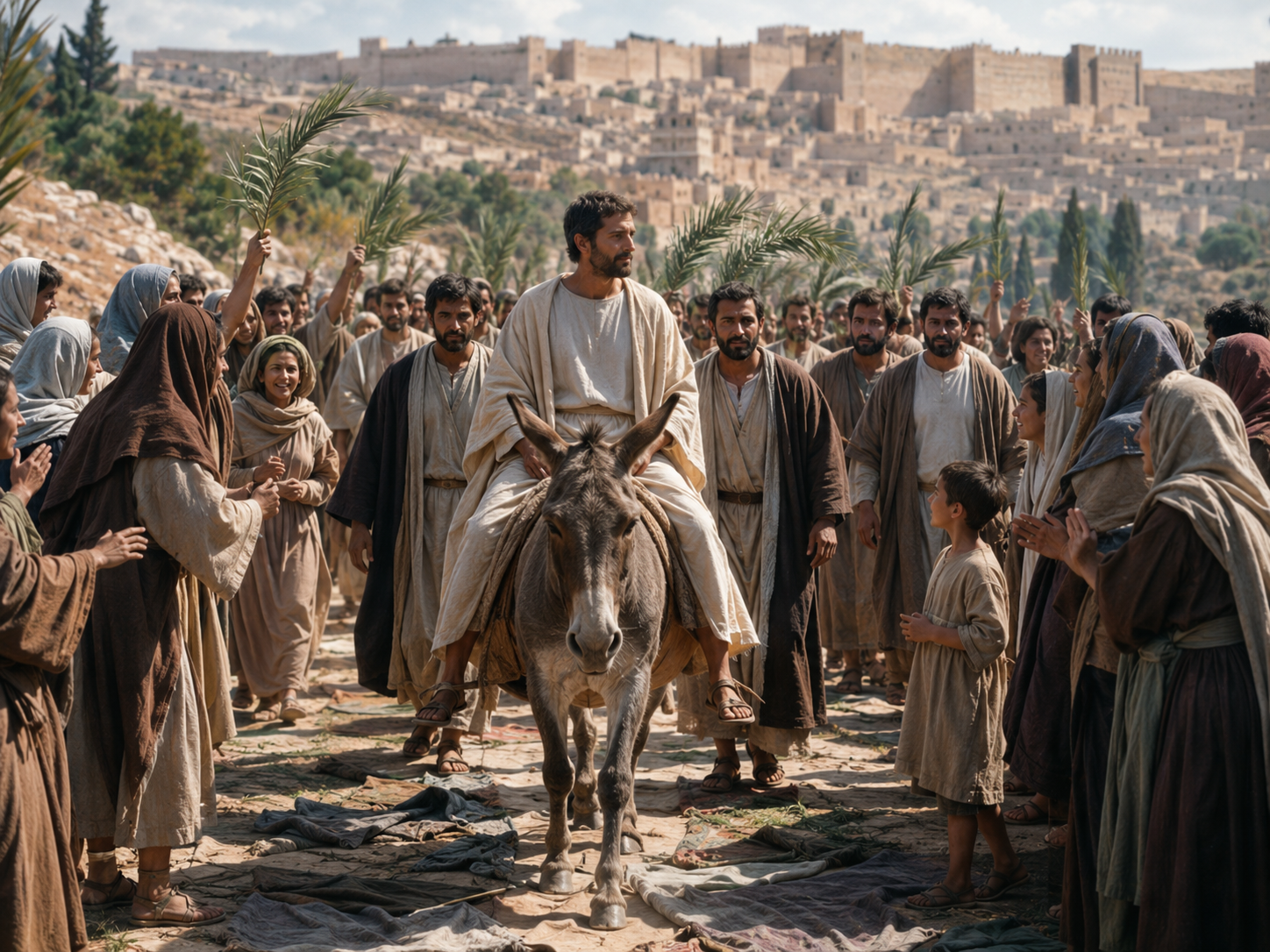
1. Christ enters Jerusalem as the promised King — Matthew 21:1–11
Jesus comes to Bethphage, near the mount of Olives, and sends two disciples to obtain an ass and a colt. Matthew explicitly states that this occurred in fulfillment of the prophetic word:
“Tell ye the daughter of Sion, Behold, thy King cometh unto thee, meek, and sitting upon an ass, and a colt the foal of an ass.” — Matthew 21:5
The prophecy corresponds to Zechariah 9:9. Matthew therefore does not leave the significance of the entrance to conjecture: Jesus enters Jerusalem in direct fulfillment of a prophecy concerning “thy King.”
The multitude spreads garments and branches in the way and cries:
“Hosanna to the Son of David: Blessed is he that cometh in the name of the Lord; Hosanna in the highest.” — Matthew 21:9
“Son of David” is a significant Messianic designation in Matthew. When Jerusalem asks, “Who is this?” the multitude answers:
“This is Jesus the prophet of Nazareth of Galilee.” — Matthew 21:11
The chapter therefore presents both the public recognition surrounding Christ and the prophetic testimony concerning His kingship.
2. Christ cleanses the temple — Matthew 21:12–17
Jesus enters “the temple of God” and casts out those buying and selling there. He overturns the tables of the moneychangers and the seats of those selling doves.
He declares:
“It is written, My house shall be called the house of prayer; but ye have made it a den of thieves.” — Matthew 21:13
Christ appeals directly to Scripture. Worship belonging to God had been corrupted by sinful activity, and Christ exercised unmistakable authority in the temple.
The blind and lame then come to Him in the temple, “and he healed them” (Matthew 21:14).
The chief priests and scribes become displeased when they see His works and hear the children crying:
“Hosanna to the Son of David.” — Matthew 21:15
When they object, Jesus answers with Scripture:
“Yea; have ye never read, Out of the mouth of babes and sucklings thou hast perfected praise?” — Matthew 21:16
Their objection is therefore answered by the written Word of God.
3. Jesus lodges in Bethany — Matthew 21:17
Jesus leaves Jerusalem and goes to Bethany, where He lodges.
Scripture states the location but does not identify in this verse whose home He entered. Any further identification would require information from other passages and should not be inserted into Matthew 21:17 itself.
4. The barren fig tree — Matthew 21:18–22
In the morning, Jesus hungers. Seeing a fig tree with no fruit, He says:
“Let no fruit grow on thee henceforward for ever.” — Matthew 21:19
The tree withers.
The disciples marvel at how quickly it occurs. Jesus then teaches them concerning faith and prayer:
“And all things, whatsoever ye shall ask in prayer, believing, ye shall receive.” — Matthew 21:22
The explicit lesson supplied by Christ in this immediate context concerns faith and believing prayer.
A traditional interpretation sees the barren fig tree as illustrating judgment upon fruitless religious profession and, more particularly, unbelieving Israel. Matthew Henry follows such a line and connects the tree with fruitlessness and judgment.
However, Matthew 21 does not explicitly say, “The fig tree represents Israel.” Therefore that identification should be treated as a possible inference, not as an explicit statement of Scripture. The certain facts are that Christ found no fruit, pronounced judgment upon the tree, and then instructed His disciples concerning faith.
5. Christ’s authority challenged — Matthew 21:23–27
While Jesus teaches in the temple, the chief priests and elders ask:
“By what authority doest thou these things? and who gave thee this authority?” — Matthew 21:23
Jesus answers their question with a question concerning the baptism of John:
“The baptism of John, whence was it? from heaven, or of men?” — Matthew 21:25
Their private reasoning reveals that their concern is not merely discovering truth. They fear the consequences of either answer.
They finally answer:
“We cannot tell.” — Matthew 21:27
Christ therefore refuses to answer their original question.
This passage warns against approaching divine truth with a heart concerned more about human reaction than about submission to what God has revealed.
6. The parable of the two sons — Matthew 21:28–32
A father commands two sons to work in his vineyard. One refuses but afterward repents and goes. The other says, “I go, sir,” but does not go.
Jesus asks which did the father’s will. They answer:
“The first.” — Matthew 21:31
Jesus then makes the application explicit:
“The publicans and the harlots go into the kingdom of God before you.” — Matthew 21:31
Why? Christ explains that John came “in the way of righteousness,” and the religious leaders did not believe him, while publicans and harlots did.
Even after seeing this, the leaders:
“repented not afterward, that ye might believe him.” — Matthew 21:32
The contrast is therefore not between respectable sinners and especially bad sinners. The issue is repentance and belief versus profession without obedience.
Matthew Henry similarly treats the parable as a rebuke of religious profession that speaks correctly but refuses God’s will.
7. The wicked husbandmen — Matthew 21:33–46
Jesus tells of a householder who plants a vineyard and lets it out to husbandmen. When he sends servants to receive the fruits, the husbandmen beat, kill, and stone them.
Finally the householder sends his son:
“They will reverence my son.” — Matthew 21:37
Instead, the husbandmen say:
“This is the heir; come, let us kill him, and let us seize on his inheritance.” — Matthew 21:38
They cast him out of the vineyard and kill him.
Jesus asks what the lord of the vineyard will do. His hearers answer that he will destroy those wicked men and let the vineyard to others who will render the fruits.
Jesus then cites Scripture concerning:
“The stone which the builders rejected” — Matthew 21:42
and says:
“Therefore say I unto you, The kingdom of God shall be taken from you, and given to a nation bringing forth the fruits thereof.” — Matthew 21:43
Two textual cautions are important.
First, the parable plainly concerns rejection of God’s messengers and finally the rejection of the Son. Verse 45 explicitly confirms that:
“the chief priests and Pharisees had heard his parables, they perceived that he spake of them.”
Second, Matthew 21:43 does not explicitly identify by name the “nation” to whom the kingdom is given. It therefore goes beyond the wording of this verse to construct an entire replacement-theology system from the word “nation.”
From a dispensational Baptist position, this passage should not be used to erase the biblical distinction between Israel and the Church or to cancel God’s covenanted purposes for Israel. Nothing in Matthew 21 says that God has permanently revoked every promise made to national Israel.
The emphasis of the immediate text is unmistakable: privilege without fruit will not shield rebellious men from divine judgment.
Henry likewise emphasizes accountability for the vineyard and the rejection of the Son.
Matthew 22 — The King Answers His Opponents and Reveals Their Inability to Answer Him
1. The parable of the marriage of the king’s son — Matthew 22:1–14
Jesus compares “the kingdom of heaven” to:
“a certain king, which made a marriage for his son.” — Matthew 22:2
The invited guests refuse to come.
Additional servants are sent with the message:
“Behold, I have prepared my dinner… and all things are ready: come unto the marriage.” — Matthew 22:4
Some make light of the invitation and return to their occupations. Others mistreat and kill the servants.
The king judges those murderers and sends servants into the highways:
“and as many as ye shall find, bid to the marriage.” — Matthew 22:9
The wedding is furnished with guests.
The king then sees a man without a wedding garment and asks:
“Friend, how camest thou in hither not having a wedding garment?” — Matthew 22:12
The man is speechless and is cast into outer darkness.
Jesus concludes:
“For many are called, but few are chosen.” — Matthew 22:14
The explicit teaching is that an invitation does not make contempt, rebellion, or presumption acceptable to the king. The king determines the conditions of his feast and judges those who reject or dishonor his invitation.
The passage does not explicitly define the wedding garment. It is therefore possible to draw doctrinal comparisons with righteousness and genuine salvation, but it should not be claimed that Matthew 22 itself directly says, “The garment is the imputed righteousness of Christ.”
Likewise, verse 14 should not be made to teach Calvinistic pre-faith regeneration. The passage itself emphasizes a genuine call, human rejection, accountability, and the sovereign judgment of the king.
Salvation elsewhere in the KJV is plainly declared to be:
“by grace… through faith… Not of works” — Ephesians 2:8–9
No parable should be interpreted so as to contradict that clear declaration.
Matthew Henry likewise sees the feast as emphasizing the gracious gospel invitation while warning against empty religious profession.
2. The tribute question — Matthew 22:15–22
The Pharisees plot:
“how they might entangle him in his talk.” — Matthew 22:15
Their disciples come with the Herodians and ask whether it is lawful to give tribute unto Caesar.
Jesus knows their wickedness and says:
“Why tempt ye me, ye hypocrites?” — Matthew 22:18
He asks for the tribute money and then asks whose image and superscription it bears.
They answer:
“Caesar’s.” — Matthew 22:21
Christ gives the famous answer:
“Render therefore unto Caesar the things which are Caesar’s; and unto God the things that are God’s.” — Matthew 22:21
Christ therefore recognizes legitimate civil obligation while maintaining the supreme claim of God.
Government does not become God, and civil duty does not cancel divine duty.
When the two conflict, Scripture elsewhere establishes the believer’s ultimate obligation:
“We ought to obey God rather than men.” — Acts 5:29
Matthew 22 itself, however, is addressing the tribute question rather than presenting a complete doctrine of civil government.
3. The Sadducees challenge the resurrection — Matthew 22:23–33
Matthew explicitly says of the Sadducees:
“which say that there is no resurrection.” — Matthew 22:23
They construct a question involving a woman who had successively been married to seven brothers and ask whose wife she will be “in the resurrection.”
Jesus answers:
“Ye do err, not knowing the scriptures, nor the power of God.” — Matthew 22:29
This identifies two sources of doctrinal error:
ignorance of the Scriptures and failure to reckon with the power of God.
Christ explains:
“For in the resurrection they neither marry, nor are given in marriage, but are as the angels of God in heaven.” — Matthew 22:30
He then proves the resurrection from God’s words concerning Abraham, Isaac, and Jacob:
“I am the God of Abraham, and the God of Isaac, and the God of Jacob.” — Matthew 22:32
Christ concludes:
“God is not the God of the dead, but of the living.”
Jesus treats the precise wording of Scripture as authoritative. His argument rests upon what God said.
This strongly supports a high view of verbal biblical authority: the Lord Jesus does not treat Scripture loosely or approximately.
4. The great commandment — Matthew 22:34–40
After Jesus silences the Sadducees, a lawyer among the Pharisees asks:
“Master, which is the great commandment in the law?” — Matthew 22:36
Jesus answers:
“Thou shalt love the Lord thy God with all thy heart, and with all thy soul, and with all thy mind.” — Matthew 22:37
He calls this:
“the first and great commandment.”
The second is:
“Thou shalt love thy neighbour as thyself.” — Matthew 22:39
Then:
“On these two commandments hang all the law and the prophets.” — Matthew 22:40
Biblical love therefore is not merely emotional affection. It is rooted in proper devotion toward God and proper treatment of one’s neighbor.
These commandments summarize man’s moral responsibility; they are not presented as a works-based plan of salvation. No sinner has perfectly loved God with all his heart, soul, and mind.
The law exposes sin rather than providing justification:
“Therefore by the deeds of the law there shall no flesh be justified in his sight: for by the law is the knowledge of sin.” — Romans 3:20
Salvation remains by grace through faith in Christ, apart from works.
5. Christ questions the Pharisees concerning David’s Son — Matthew 22:41–46
Jesus now asks the questions.
He says:
“What think ye of Christ? whose son is he?” — Matthew 22:42
They answer:
“The Son of David.”
Jesus then quotes David:
“The LORD said unto my Lord, Sit thou on my right hand, till I make thine enemies thy footstool.” — Matthew 22:44
He asks:
“If David then call him Lord, how is he his son?” — Matthew 22:45
No man can answer Him.
The question brings together two truths about the Messiah: He is David’s son, yet David calls Him Lord.
Within the larger testimony of the KJV, Jesus Christ is truly descended from David according to the flesh and is also divine. Matthew 22 does not develop a complete doctrine of the incarnation at this point; instead, Christ exposes the inadequacy of the Pharisees’ answer by confronting them with Psalm 110.
The chapter closes:
“Neither durst any man from that day forth ask him any more questions.” — Matthew 22:46
Their attempts to trap the Lord end with their own inability to answer Him.
Key People and Places
- Jesus Christ — The central Person of both chapters. He enters Jerusalem as the prophesied King, cleanses the temple, heals, teaches, judges hypocrisy, answers His adversaries, affirms the resurrection, and confronts the Pharisees concerning His identity.
- The disciples — They obey Christ concerning the ass and colt, observe the withered fig tree, and receive His teaching on faith.
- The multitudes — They spread garments and branches before Christ and cry, “Hosanna to the Son of David.”
- Children in the temple — They also cry, “Hosanna to the Son of David.”
- Chief priests — Religious leaders who challenge Christ’s authority and recognize that His parables speak concerning them.
- Scribes — They are displeased by the praise Christ receives in the temple.
- Elders of the people — They join the chief priests in questioning Christ’s authority.
- Publicans and harlots — Jesus specifically says they believed John while the unbelieving religious leaders did not repent and believe.
- John the Baptist — Christ appeals to John’s baptism when His own authority is challenged.
- Pharisees — They oppose Christ, seek to entangle Him in His words, and are finally questioned by Him concerning the Christ.
- Herodians — They accompany the Pharisees’ disciples in the tribute question. Matthew 22 does not explain their complete political position, so further description belongs to historical background rather than to the explicit text.
- Sadducees — Matthew explicitly states that they “say that there is no resurrection.”
- The lawyer — A Pharisee who asks Jesus which commandment is greatest.
- David — Cited by Christ from the Psalms concerning “my Lord.”
- Abraham, Isaac, and Jacob — Named in Christ’s argument for the resurrection.
- Caesar — The civil ruler named in the tribute controversy.
- Bethphage — The location reached as Jesus approaches Jerusalem.
- The mount of Olives — Associated with Bethphage in Matthew 21:1.
- Jerusalem — The city into which Christ publicly enters.
- The temple of God — The setting for Christ’s cleansing, healing, teaching, and confrontation with religious leaders.
- Bethany — The place where Jesus lodges after leaving Jerusalem.
- Nazareth of Galilee — The multitude identifies Jesus as “Jesus the prophet of Nazareth of Galilee.”
Main Doctrinal or Spiritual Themes
The Kingship and Messiahship of Jesus Christ
Matthew intentionally connects Christ’s entrance with the prophecy:
“Behold, thy King cometh unto thee.”
Jesus is not merely a moral instructor. The narrative presents Him in fulfillment of Messianic Scripture.
The Supreme Authority of Christ
The religious rulers ask where His authority comes from, yet the chapter itself has already displayed it. Christ commands His disciples, fulfills prophecy, cleanses the temple, heals the blind and lame, judges the fig tree, teaches concerning the kingdom, answers every adversary, and finally leaves His opponents unable to answer Him.
The Authority and Precision of Scripture
Repeatedly Jesus says or appeals to what is written:
“It is written…”
“Have ye never read…”
“Did ye never read in the scriptures…”
“Ye do err, not knowing the scriptures…”
“Have ye not read that which was spoken unto you by God…”
Christ’s treatment of Scripture leaves no room for the idea that God’s words are disposable approximations. The written Word is authoritative.
Religious Profession Without Obedience Is Empty
The second son says:
“I go, sir”
but does not go.
The religious leaders possessed outward position yet refused to believe John. Christ exposes the difference between saying and doing.
Profession is not a substitute for obedience.
God Requires Fruit
The vineyard passages repeatedly emphasize fruit. Privilege produces responsibility.
Matthew Henry similarly emphasizes this accountability in his treatment of Matthew 21.
This does not mean good works purchase salvation. Rather, biblical faith is not to be confused with empty religious profession.
Rejection of the Son Brings Judgment
The wicked husbandmen do not merely reject servants. They finally reject the son.
Their reasoning is deliberate:
“This is the heir; come, let us kill him.”
The parable demonstrates the seriousness of rejecting the One whom the Father has sent.
Christ Is the Rejected Stone
Jesus applies the Scripture:
“The stone which the builders rejected, the same is become the head of the corner.”
Human rejection cannot overturn the purpose of God.
God’s Invitation Must Not Be Treated Lightly
In Matthew 22:
“they made light of it.”
One goes to his farm and another to his merchandise.
The problem is not that the king has provided nothing. The feast is prepared and the invitation is sent. Their guilt lies in despising the king’s call.
There is a solemn warning here against allowing ordinary earthly concerns to become excuses for rejecting divine truth.
Civil Responsibility and Divine Sovereignty
Christ commands:
“Render therefore unto Caesar the things which are Caesar’s; and unto God the things that are God’s.”
A believer should not confuse loyalty to civil authority with worship. Human government has a sphere of legitimate authority, but God has the ultimate claim upon man.
The Bodily Resurrection Is Certain
Jesus directly contradicts the Sadducees.
Their rejection of resurrection is called error:
“Ye do err.”
Christ attributes that error to ignorance of Scripture and the power of God.
Historic Baptist doctrine therefore affirms the literal resurrection of the dead. It is not merely a symbol for personal improvement or spiritual renewal.
Marriage Does Not Continue as an Earthly Institution in the Resurrection
Christ explicitly states:
“in the resurrection they neither marry, nor are given in marriage.”
We should state no more and no less than Christ states. He does not say redeemed persons cease to know one another, nor does this verse describe every feature of resurrection relationships. It specifically says that marriage and giving in marriage do not continue in that state.
God Is the God of the Living
Christ’s argument from Abraham, Isaac, and Jacob establishes continuing personal existence and resurrection truth:
“God is not the God of the dead, but of the living.”
Death does not defeat the promises or power of God.
Love for God Comes First
The greatest commandment begins vertically:
“Thou shalt love the Lord thy God with all thy heart, and with all thy soul, and with all thy mind.”
Biblical morality cannot be reduced merely to being pleasant toward other people. Man’s first obligation is toward God.
Love for Neighbor Follows Love for God
“Thou shalt love thy neighbour as thyself.”
Proper human relationships flow from a proper relationship to God and submission to His Word.
Biblical love must therefore be defined by Scripture rather than by changing cultural standards.
The Law Cannot Save
Christ’s summary of the law displays its perfect standard. Fallen man does not fulfill that standard perfectly.
Therefore salvation cannot come through law-keeping.
“For by grace are ye saved through faith… Not of works, lest any man should boast.” — Ephesians 2:8–9
The sinner needs the saving grace of God through faith in Jesus Christ.
Jesus Christ Is Both David’s Son and David’s Lord
The Pharisees can identify Christ as David’s son, but they cannot explain why David calls Him “Lord.”
The complete KJV revelation shows that Jesus is genuinely descended from David according to the flesh and is also the eternal Son of God.
His humanity does not cancel His deity, and His deity does not make His true humanity unreal.
Practical Applications or Lessons
1. Receive Christ according to Scripture, not merely according to popular enthusiasm.
The multitudes cried “Hosanna,” but the chapter quickly turns to opposition and controversy. Public excitement is not the final measure of faithfulness. God’s written Word must determine what we believe about Christ.
2. Worship must remain holy.
Jesus would not tolerate the corruption He encountered in the temple.
The believer should never treat the things of God as common, commercial, or merely convenient.
“My house shall be called the house of prayer.”
3. Do not substitute religious words for obedience.
The son who said, “I go, sir,” sounded respectful but did not obey.
God is not impressed by correct religious vocabulary accompanied by deliberate disobedience.
4. Repentance must be genuine.
The first son refused his father but “afterward he repented, and went.”
The publicans and harlots believed John, while the religious leaders refused to repent even after seeing the evidence before them.
A sinful past does not place a sinner beyond the reach of God’s mercy, and an outwardly religious reputation does not eliminate the necessity of repentance and faith.
5. Spiritual privilege creates responsibility.
Those entrusted with the vineyard were expected to render fruit.
Access to preaching, Scripture, a Bible-believing church, Christian parents, or sound doctrine should never produce pride. Greater light brings greater accountability.
6. Never make light of God’s invitation.
Matthew 22:5 contains one of the saddest descriptions of man’s response to divine truth:
“But they made light of it.”
Farm and merchandise were not inherently sinful, but they became excuses for refusing the king.
Legitimate earthly matters can become spiritually destructive when they are allowed to crowd out God.
7. Do not approach Scripture merely to win an argument.
The chief priests, Pharisees, Herodians, and Sadducees repeatedly approach Jesus with challenges designed to trap Him.
A person can discuss theology while having no sincere desire to submit to truth.
Bible study should produce obedience, not merely ammunition for debate.
8. Error grows where Scripture is neglected.
Christ tells the Sadducees:
“Ye do err, not knowing the scriptures, nor the power of God.”
The remedy for doctrinal error is not human philosophy, speculation, mystical experience, or changing cultural opinion. God’s people must know the Scriptures.
9. Believe in the power of God.
The Sadducees judged resurrection according to the limitations of their earthly reasoning.
Jesus points them to “the power of God.”
The Creator who gave life is fully able to raise the dead.
10. Fulfill lawful civil responsibilities without surrendering what belongs to God.
“Render therefore unto Caesar the things which are Caesar’s; and unto God the things that are God’s.”
Christians should be honest citizens, but no earthly ruler possesses God’s place.
11. Love God wholly.
Christianity cannot properly be reduced to outward ceremonies.
God demands the heart:
“all thy heart… all thy soul… all thy mind.”
Anything less exposes how far fallen man comes short of God’s holy standard and how desperately he needs grace.
12. Love your neighbor biblically.
Love does not mean approving sin or abandoning truth. Since the first commandment is love toward God, love toward man must operate consistently with God’s revealed will.
True love seeks another person’s genuine good under the authority of Scripture.
13. Remember that Jesus Christ cannot be reduced to merely a human teacher.
The final question of Matthew 22 forces attention upon Christ Himself:
“If David then call him Lord, how is he his son?”
Every person must ultimately deal with the identity and authority of Jesus Christ.
He is not merely one religious voice among many. He is the Christ, the Son of David, and David’s Lord.
14. Human opposition cannot overthrow Christ.
At the beginning of Matthew 21 His enemies question Him. Throughout Matthew 22 they attempt to trap Him.
At the end:
“no man was able to answer him a word.”
Christ remains completely master of every encounter.
The believer therefore has no reason to be ashamed of His words or His authority.
Overall Message of Matthew 21–22
These chapters present Jesus Christ openly confronting Jerusalem with His authority.
He comes as the promised King. He cleanses His Father’s house. He receives Messianic praise. He demands fruit rather than empty profession. He exposes unbelieving religious leaders. He warns against rejecting the Son. He answers political and theological traps without error. He affirms the literal resurrection. He declares love for God to be the greatest commandment. Finally, He confronts His adversaries with the mystery they cannot answer: David’s Son is also David’s Lord.
Matthew 21–22 therefore presses a searching question upon every reader: What will you do with Jesus Christ and His authority?
Religious position cannot substitute for faith. Religious language cannot substitute for obedience. Intellectual arguments cannot overturn Scripture. Human authority cannot displace God. Death cannot defeat His power. And the rejection of men cannot prevent Christ from becoming:
“the head of the corner.”
The proper response is to believe God’s Word, receive Jesus Christ by faith, submit to His authority, and bring forth the fruit that becomes a life genuinely affected by biblical faith.
Supporting conservative commentary consulted: Matthew Henry’s Concise Commentary, particularly his treatment of the two sons, the wicked husbandmen, the marriage feast, tribute, and the resurrection.
Comments are closed