
Chapter Summaries
Jeremiah 18
 The Lord sends Jeremiah to the potter’s house so he can see a living illustration of divine sovereignty. As the potter works on the wheel, “the vessel that he made of clay was marred in the hand of the potter: so he made it again” (Jer. 18:4). God then applies the lesson to Israel: “as the clay is in the potter’s hand, so are ye in mine hand, O house of Israel” (v. 6). The point is not that God acts arbitrarily, but that He has full right and power to deal with nations according to their response to Him. If a nation repents, God may withhold announced judgment; if a nation turns to evil, God may remove promised blessing (vv. 7–10).
Jeremiah is then commanded to warn Judah and Jerusalem that the Lord is “framing evil” against them because of their sin, and to urge them, “Return ye now every one from his evil way, and make your ways and your doings good” (v. 11). The people answer stubbornly, “There is no hope: but we will walk after our own devices” (v. 12). That is one of the saddest statements in the book. They refuse both conviction and correction. Their backsliding is described as unnatural and shocking, like forsaking fresh waters from Lebanon (vv. 13–15).
The chapter ends with Jeremiah’s enemies plotting against him. They say, “Come, and let us devise devices against Jeremiah” (v. 18). Instead of repenting under the preached Word, they seek to silence the preacher. Jeremiah then lays the matter before the Lord. His prayer is not personal spite, but an appeal for divine justice against hardened rebellion.
Historically, this chapter fits the period when Judah was nearing judgment under Babylon, yet still refusing calls to repentance. Doctrinally, it shows both the absolute authority of God and the real responsibility of man.
Jeremiah 19
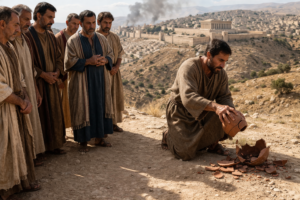
The message of the potter’s house is followed by the sign of the broken bottle. Jeremiah is told to take an earthen bottle and go to the valley of the son of Hinnom, near the entry of the east gate, with elders of the people and of the priests (vv. 1–2). There he is to declare the Lord’s judgment upon Judah because they had forsaken Him, polluted the place, burned incense unto other gods, and filled it with the blood of innocents (vv. 3–4). The chapter specifically mentions their abominable worship of Baal and the offering of their sons in the fire (v. 5), exposing the moral horror of idolatry.
God declares that the place will no longer be called Tophet or the valley of the son of Hinnom, but “The valley of slaughter” (v. 6). Jerusalem will be besieged, the people will fall by the sword, and such famine will come that cannibalism will occur during the siege (vv. 7–9). Then Jeremiah is to break the bottle before the witnesses and say, “Even so will I break this people and this city, as one breaketh a potter’s vessel, that cannot be made whole again” (v. 11). In chapter 18 the clay could still be remade; in chapter 19 the hardened vessel is shattered. The warning has moved from conditional mercy to settled judgment.
Jeremiah then stands in the court of the Lord’s house and repeats the message publicly (vv. 14–15). This shows the prophet’s courage. He does not confine hard truth to a private audience. He declares it openly in the place where the people claimed to worship God.
This chapter strongly emphasizes the seriousness of idolatry, the defilement of false religion, and the certainty of divine judgment when a people harden themselves against repeated calls to repent.
Jeremiah 20
Jeremiah’s faithful preaching brings persecution. Pashur, the son of Immer the priest, who was also chief governor in the house of the Lord, strikes Jeremiah and puts him in the stocks (vv. 1–2). This is a vivid example of religious leadership opposing God’s true messenger. The next day, when Jeremiah is brought forth, he announces that the Lord has renamed Pashur Magormissabib, meaning “fear round about” (v. 3). He and his friends will go into captivity, and Judah will be given into the hand of Babylon (vv. 4–6).
The rest of the chapter opens a deeply personal window into Jeremiah’s inner struggle. He says, “O LORD, thou hast deceived me, and I was deceived” (v. 7), expressing the anguish of a servant who feels overwhelmed by the burden of his calling. He has become “a derision daily” because he speaks of “violence and spoil” (v. 8). Yet though he considers remaining silent, he cannot: “his word was in mine heart as a burning fire shut up in my bones” (v. 9). This is one of the clearest statements in Scripture about the inward compulsion of a God-called preacher.
Jeremiah hears the whispering of enemies and even feels betrayed by acquaintances waiting for him to fall (v. 10). Still, faith rises above discouragement: “But the LORD is with me as a mighty terrible one” (v. 11). He can sing, “Sing unto the LORD, praise ye the LORD: for he hath delivered the soul of the poor from the hand of evildoers” (v. 13). Yet the chapter closes with profound sorrow as Jeremiah curses the day of his birth (vv. 14–18). This does not make him an unbeliever; it shows the heavy emotional toll of a hard ministry.
Practically and pastorally, this chapter teaches that faithful servants of God may know deep sorrow, opposition, and loneliness, yet still remain true to their calling.
Jeremiah 21
This chapter records a message during the crisis of Babylon’s siege. King Zedekiah sends Pashur the son of Melchiah and Zephaniah the son of Maaseiah the priest to inquire of Jeremiah, hoping perhaps that the Lord will work “according to all his wondrous works” and cause Nebuchadnezzar to withdraw (vv. 1–2). But Jeremiah’s answer is severe. God will not fight for Jerusalem; He will fight against it (vv. 4–5). The weapons in Judah’s hands will be turned back, and the city will suffer pestilence, sword, and famine (vv. 6–7).
Yet even in this judgment message there is a call set before the people: “Behold, I set before you the way of life, and the way of death” (v. 8). Those who remain in the city will die, but those who surrender to the Chaldeans will live, though going into captivity (v. 9). This was not cowardice; it was submission to God’s chastening hand. Refusal to submit would only multiply death.
The message then turns to the house of David. The king’s house is urged to “Execute judgment in the morning, and deliver him that is spoiled out of the hand of the oppressor” (v. 12). Even at this late hour, righteousness is still right. The chapter ends with a warning to Jerusalem, called “O inhabitant of the valley, and rock of the plain” (v. 13). Their false sense of security will not save them. God will punish them according to the fruit of their doings (v. 14).
This chapter reveals that when a nation has persistently rejected truth, there comes a time when judgment is no longer avertible in the short term. Yet even then, individuals are still responsible to respond rightly to God’s Word.
Key People and Places
Jeremiah
The prophet of the Lord, faithfully delivering messages of warning, judgment, and truth to Judah even under fierce opposition.
The Potter / Potter’s House
Used as the object lesson in chapter 18. The potter illustrates God’s sovereign authority over nations and peoples.
House of Israel / Judah / Jerusalem
The covenant people in their divided kingdom context, here especially Judah and Jerusalem, standing under judgment because of persistent rebellion.
Elders of the people and elders of the priests
Witnesses brought by Jeremiah in chapter 19 to hear and see the enacted prophecy of coming judgment.
Valley of the son of Hinnom / Tophet
A place associated with abominable idolatry and child sacrifice. It becomes a symbol of defilement and coming slaughter.
Baal
A false god worshiped by apostate Judah, connected with idolatrous rites condemned by the Lord.
Pashur the son of Immer
A priest and chief governor in the house of the Lord who smites Jeremiah and puts him in the stocks in chapter 20.
Magormissabib
The symbolic name Jeremiah gives to Pashur, meaning terror on every side.
Zedekiah
The last king of Judah, ruling during the Babylonian crisis. He seeks a favorable word from the Lord, but too late and without true repentance.
Pashur the son of Melchiah
Different from the Pashur in chapter 20. He is sent by Zedekiah to inquire of Jeremiah in chapter 21.
Zephaniah the son of Maaseiah
A priest sent with Pashur to hear Jeremiah’s message in chapter 21.
Nebuchadrezzar / Nebuchadnezzar king of Babylon
The instrument of God’s chastening judgment against Judah.
House of David
The royal line in Jerusalem, addressed with responsibility to execute justice even in a time of national collapse.
Main Doctrinal or Spiritual Themes
1. The Sovereignty of God
Jeremiah 18 is one of the clearest Old Testament passages on the Lord’s sovereign right over nations. God is the Potter; man is the clay. He is not subject to man’s will. He rules, shapes, judges, and shows mercy according to His holy nature.
2. Human Responsibility and Conditional Dealings
Though God is sovereign, the chapter also shows real moral responsibility. The nation’s conduct matters. Repentance brings mercy; rebellion brings judgment. This does not weaken divine sovereignty. It shows that God’s rule is moral, righteous, and purposeful.
3. The Hardening Power of Sin
By chapter 19 the vessel is not being reshaped but shattered. Long resistance to God hardens the heart. Repeated warnings rejected lead to deeper blindness and heavier judgment.
4. The Evil of Idolatry
Judah’s false worship was not harmless religious variety. It was spiritual adultery, moral corruption, and direct rebellion against the Lord. The connection between false doctrine and vile practice is plain in Tophet and the worship of Baal.
5. The Certainty of Divine Judgment
These chapters show that judgment is not an empty threat. When men refuse God’s Word, He will act. Babylon is not merely a political force; it is the rod of God’s chastening.
6. The Cost of Faithful Ministry
Jeremiah 20 especially reveals the pain of being true to God in an unfaithful age. God’s servants may be mocked, opposed, and emotionally burdened, but they must not quit.
7. The Inward Constraint of God’s Word
Jeremiah says the Word was like “a burning fire shut up in my bones.” A man truly called of God cannot be at peace suppressing divine truth. Biblical preaching is not merely professional speech; it is a heaven-sent burden.
8. The Necessity of Righteous Leadership
Jeremiah 21 reminds the house of David that rulers are accountable to God. National judgment does not erase the duty to do right. Authority must be exercised with justice.
9. Submission to God’s Chastening
In chapter 21, surrender to Babylon was actually the path of life because God had decreed chastisement. Sometimes the way of obedience is not escape from discipline, but humble submission under it.
Practical Applications or Lessons
1. Do not presume upon God’s patience
Judah had many warnings, many sermons, and many opportunities. Yet they continued in sin. It is dangerous to hear truth often and obey it little. Delayed judgment is not cancelled judgment.
2. Repentance must be real and immediate
The Lord said, “Return ye now every one from his evil way.” True repentance is personal, moral, and practical. It is not vague regret. It means turning from sin and correcting one’s ways.
3. False religion ruins people
Tophet stands as a dreadful witness that when people depart from the true God, moral corruption follows. Error in worship is not a small matter. What a man worships will shape how he lives.
4. God’s servants must preach truth whether men hear or refuse
Jeremiah was hated for telling the truth, but he kept speaking. Believers, especially preachers, teachers, and leaders, must not reshape God’s message to gain acceptance.
5. Discouragement is not the same as disobedience
Jeremiah struggled deeply, yet he continued in faithfulness. A burdened servant of God is not a failed servant of God. The answer to discouragement is not silence, but renewed confidence in the Lord.
6. The Word of God must burn in the heart
Jeremiah’s fire in the bones challenges cold, mechanical religion. Believers should seek hearts stirred by Scripture, not mere outward profession.
7. Sin brings consequences to nations as well as individuals
These chapters are addressed not only to persons but to a nation. God judges public wickedness, unjust leadership, bloodshed, and national rebellion. No nation is beyond His rule.
8. Obedience may require humbling ourselves under God’s hand
The people wanted miraculous deliverance without repentance. But the way of life was surrender to God’s chastening. Sometimes the hardest path is the right one.
9. Leaders bear serious responsibility before God
Kings, priests, and governors are all in view here. Spiritual and civil leaders who reject truth and abuse authority bring harm on many others. Leadership without righteousness invites judgment.
10. There is still mercy in hearing God’s warning
Even in these stern chapters, the fact that God speaks is itself mercy. Warnings are invitations to repent before it is too late.
Comments are closed