Introduction and Background
Habakkuk is one of the Minor Prophets, but his book is different in tone from many of the others. Instead of mainly preaching to the people, Habakkuk speaks to God about the condition of Judah. The book is a burden, a dialogue, a watchman’s lesson, and finally a prayer of faith.
Habakkuk likely ministered shortly before Babylon’s invasion of Judah. Judah was filled with violence, injustice, strife, and disregard for God’s law. The prophet struggled with a question many believers have asked: Why does God allow wickedness to continue? Then, when God answered, Habakkuk struggled with another question: How can God use a more wicked nation to judge His own people?
The great doctrinal turning point is Habakkuk 2:4:
“the just shall live by his faith.”
This truth is later used in the New Testament in Romans, Galatians, and Hebrews. In its immediate context, it teaches that the righteous man must trust God even when judgment is coming, circumstances are confusing, and the proud seem to prosper.
Chapter Summaries
Habakkuk 1 — The Prophet’s Burden and God’s Troubling Answer
 Habakkuk begins with “the burden which Habakkuk the prophet did see.” The word burden shows that this was not a light message. It was heavy upon the prophet’s heart.
Habakkuk’s First Complaint: Judah’s Sin Seems Unchecked
Habakkuk cries:
“O LORD, how long shall I cry, and thou wilt not hear!”
He sees violence, iniquity, grievance, spoiling, strife, and contention. The law appears powerless:
“the law is slacked, and judgment doth never go forth.”
This describes a society where God’s truth is known but ignored. Courts are corrupted. Righteous men are surrounded by wicked men. Justice is twisted:
“wrong judgment proceedeth.”
From a conservative Baptist perspective, this is not merely social frustration. It is a spiritual problem. When a nation rejects God’s law, disorder follows. Habakkuk is grieved because Judah is God’s covenant people, yet they are behaving like those who do not fear God.
God’s Answer: He Will Raise Up the Chaldeans
The Lord answers in a way Habakkuk did not expect:
“Behold ye among the heathen, and regard, and wonder marvellously.”
God says He will work a work so astonishing that they would not believe it if told. He will raise up the Chaldeans, the Babylonians:
“that bitter and hasty nation.”
They will march through the breadth of the land and possess dwellingplaces not theirs. They are described as terrible, dreadful, swift, violent, proud, and idolatrous. Their horses are “swifter than the leopards,” and “more fierce than the evening wolves.”
God’s answer shows that He had not ignored Judah’s sin. He was preparing judgment. However, the instrument of judgment would be Babylon, a cruel Gentile empire.
Habakkuk’s Second Complaint: How Can a Holy God Use Babylon?
Habakkuk knows God is eternal and holy:
“Art thou not from everlasting, O LORD my God, mine Holy One?”
He affirms that God is too pure to approve evil:
“Thou art of purer eyes than to behold evil, and canst not look on iniquity.”
Yet he is troubled that God would use the Chaldeans, who are more wicked than Judah, to punish Judah. He compares Babylon to fishermen catching men like fish in a net, then worshipping the net as if their military power were their god.
This chapter ends with Habakkuk waiting for an answer. His struggle is not unbelief in God’s existence; it is the burden of a believer trying to reconcile God’s holiness, God’s patience, and God’s judgment.
Habakkuk 2 — The Watchman, the Vision, and the Five Woes
Habakkuk says:
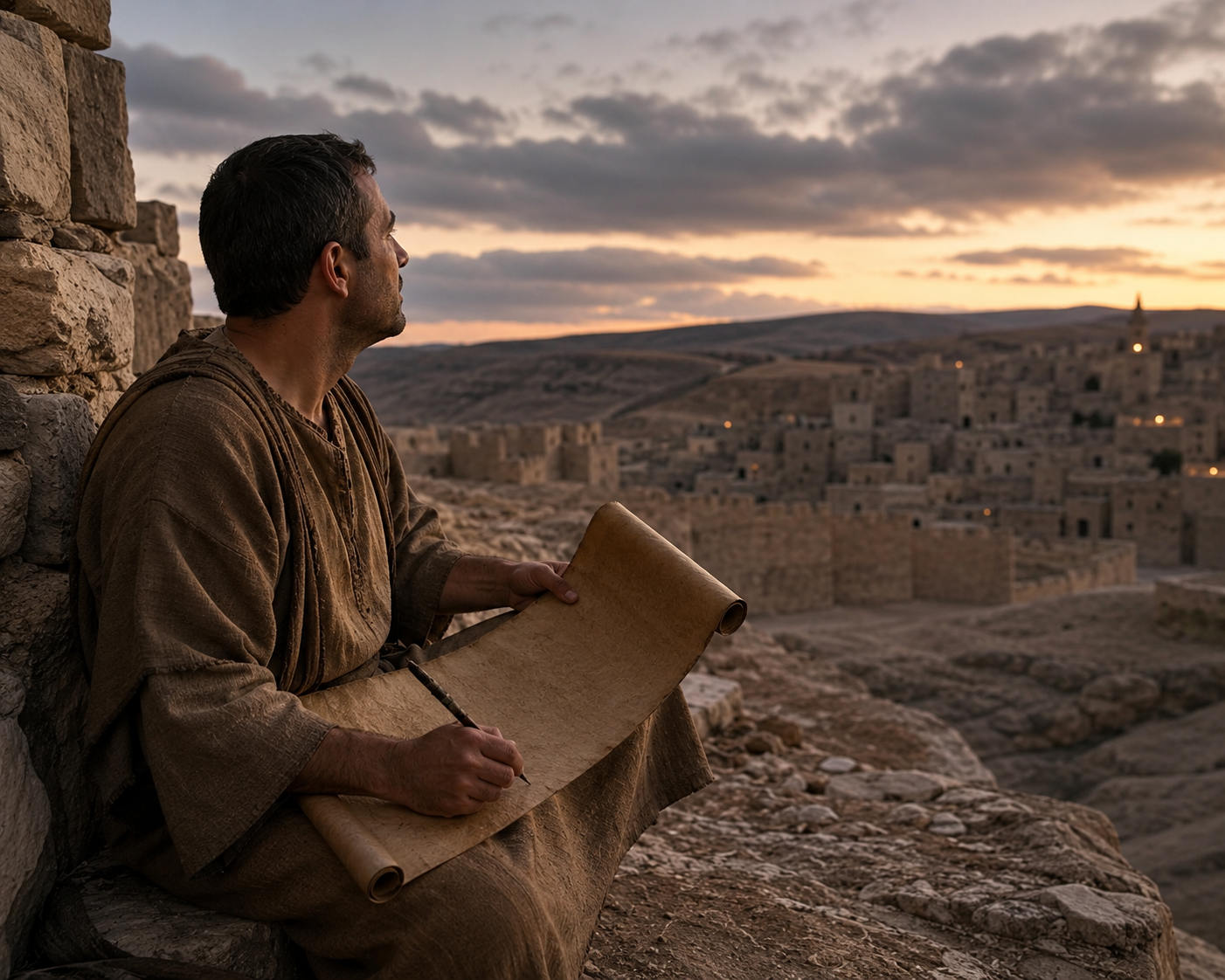
“I will stand upon my watch, and set me upon the tower.”
This is the posture of a faithful servant. He does not abandon God because he has questions. He waits for God’s answer.
The Vision Must Be Written
The Lord answers:
“Write the vision, and make it plain upon tables, that he may run that readeth it.”
God’s message was not to be hidden in confusion. It was to be plain, certain, and preserved. The vision had an appointed time. Though it seemed to delay, it would surely come:
“though it tarry, wait for it; because it will surely come, it will not tarry.”
This teaches that God’s timing may test faith, but His promises and judgments are never late. Man often thinks God is delayed because man sees only the present. God sees the appointed end.
The Proud Man and the Just Man
The central contrast is in verse 4:
“Behold, his soul which is lifted up is not upright in him: but the just shall live by his faith.”
The proud man is self-exalting, restless, never satisfied. Babylon is pictured as arrogant and greedy, enlarging desire “as hell” and gathering nations. But the just man lives by faith. He trusts God’s word when circumstances are dark.
This is one of the great faith statements of Scripture. It does not teach careless optimism. It teaches settled confidence in the character and promise of God.
The Five Woes Against Babylon
Though God would use Babylon to chasten Judah, Babylon would not escape judgment. God pronounces woes against them.
1. Woe Against Greedy Conquest
“Woe to him that increaseth that which is not his!”
Babylon took what did not belong to them. They piled up stolen wealth. God declares that their creditors and victims would rise against them. Sinful gain carries future judgment.
2. Woe Against Covetous Security
“Woe to him that coveteth an evil covetousness to his house.”
Babylon tried to build a secure dynasty through violence and greed. But God says they consulted shame to their own house. The stone and beam would cry out against them. Their very buildings would testify to their guilt.
3. Woe Against Building by Blood
“Woe to him that buildeth a town with blood, and stablisheth a city by iniquity!”
Empires built on cruelty do not last. Man may admire great cities, monuments, and military achievements, but God sees the blood and injustice behind them.
Then comes a great prophetic promise:
“For the earth shall be filled with the knowledge of the glory of the LORD, as the waters cover the sea.”
Babylon’s glory would fall. God’s glory will fill the earth. This looks beyond temporary kingdoms to the final triumph of the Lord.
4. Woe Against Shameful Corruption
“Woe unto him that giveth his neighbour drink.”
This woe condemns the deliberate corruption, humiliation, and exploitation of others. Babylon intoxicated and degraded nations. God says shame would come upon them. They would drink of the cup of the Lord’s right hand.
5. Woe Against Idolatry
“Woe unto him that saith to the wood, Awake; to the dumb stone, Arise.”
Idols cannot teach. They are covered with gold and silver, but there is no breath in them. This is a direct rebuke of false religion. Man-made gods are silent, helpless, and dead.
The chapter ends with a majestic statement:
“But the LORD is in his holy temple: let all the earth keep silence before him.”
After all the noise of violence, pride, idolatry, and human questioning, God remains enthroned. The proper response is reverence, submission, and holy fear.
Habakkuk 3 — The Prophet’s Prayer and the Triumph of Faith
Chapter 3 is a prayer of Habakkuk. It is written in poetic form and carries the tone of a psalm. The prophet has moved from complaint, to waiting, to worship.
A Prayer for Revival and Mercy
Habakkuk prays:
“O LORD, I have heard thy speech, and was afraid.”
He no longer argues against God’s answer. He trembles before it. Then he pleads:
“O LORD, revive thy work in the midst of the years.”
This is a strong revival prayer. Habakkuk does not ask God to ignore sin. He asks God to remember mercy in wrath:
“in wrath remember mercy.”
That is a deeply biblical prayer. God’s people need correction, but they also need mercy. Revival is not manufactured excitement. It is God reviving His own work among His people.
The Majesty of God in Judgment and Deliverance
Habakkuk describes the Lord coming in glory:
“God came from Teman, and the Holy One from mount Paran.”
His glory covers the heavens, and the earth is full of His praise. Brightness, power, pestilence, burning coals, mountains, rivers, and nations all appear under the authority of God.
The language recalls God’s mighty acts in Israel’s history: His power at Sinai, His judgments on enemies, His deliverance of His people, and His control over creation. The prophet sees that Babylon is not ultimate. God is.
God’s Salvation for His People
Habakkuk says:
“Thou wentest forth for the salvation of thy people, even for salvation with thine anointed.”
God’s judgment is not random. His wrath against wickedness is also connected to His covenant faithfulness. He will preserve His people and accomplish His purpose.
Habakkuk Trembles, Yet Trusts
Habakkuk admits the physical effect of the vision:
“my belly trembled; my lips quivered at the voice.”
He knows invasion and judgment are coming. He says:
“I might rest in the day of trouble.”
This is not rest because trouble is absent. It is rest in the day of trouble because God is sovereign.
The Great Statement of Rejoicing Faith
The book ends with one of the strongest statements of faith in the Old Testament:
“Although the fig tree shall not blossom, neither shall fruit be in the vines…”
Habakkuk lists complete agricultural and economic collapse: no figs, no grapes, no olives, failed fields, no flocks, no herds. In an agrarian society, this means devastation.
Yet he says:
“Yet I will rejoice in the LORD, I will joy in the God of my salvation.”
This is not shallow happiness. It is faith-rooted joy. The prophet’s joy is not in the fig tree, vine, olive, field, flock, or herd. His joy is in the Lord.
He closes:
“The LORD God is my strength.”
God makes his feet “like hinds’ feet” and enables him to walk upon high places. The book that began with confusion ends with confidence.
Key People and Places
Habakkuk
The prophet and human author of the book. He is a faithful servant of God who brings honest questions before the Lord without forsaking reverence. He is not a rebel; he is a burdened believer seeking God’s answer.
The LORD
The central Person of the book. He is holy, eternal, sovereign, just, merciful, and worthy of silent reverence. He judges Judah, judges Babylon, and strengthens His servant.
Judah
The southern kingdom of God’s covenant people. Habakkuk sees violence, injustice, and spiritual decline among them. They are the immediate nation under warning.
The Chaldeans / Babylon
The Gentile empire God would raise up to judge Judah. They are described as bitter, hasty, violent, proud, greedy, and idolatrous. Though God uses them as an instrument, He later judges them for their own wickedness.
The Heathen / Nations
The surrounding peoples affected by Babylon’s conquests and by God’s greater purpose. The book shows that God rules not only Judah but all nations.
Teman
A region associated with Edom. In Habakkuk 3, it is part of the poetic description of God coming in majesty and power.
Mount Paran
A wilderness-region reference connected with God’s majestic appearing. It recalls the awe of God’s presence and His past dealings with Israel.
The Watchtower
Not a named city, but an important prophetic image in Habakkuk 2. Habakkuk stands upon his watch, waiting for God’s answer. It pictures spiritual alertness and patient faith.
Main Doctrinal or Spiritual Themes
1. God’s Holiness
Habakkuk confesses:
“Thou art of purer eyes than to behold evil.”
God is not indifferent to sin. He does not excuse wickedness in Judah or Babylon. His holiness is the foundation for His judgment.
2. God’s Sovereignty Over Nations
God raises up the Chaldeans, controls the timing of judgment, and later pronounces judgment on Babylon. Human empires do not operate outside God’s rule.
3. The Certainty of Divine Judgment
Judah’s sin would be judged. Babylon’s cruelty would be judged. God may delay according to His appointed time, but His word will surely come.
4. The Life of Faith
“the just shall live by his faith.”
The believer lives by trusting God’s character and word, not by visible circumstances. Faith is especially necessary when God’s ways are hard to understand.
5. The Danger of Pride
Babylon is marked by a lifted-up soul, greed, conquest, and self-glory. God opposes proud nations and proud individuals.
6. The Emptiness of Idolatry
Habakkuk 2 exposes idols as lifeless things made by men. They cannot speak, breathe, guide, save, or judge. The Lord alone is God.
7. Revival and Mercy
Habakkuk’s prayer:
“revive thy work in the midst of the years”
shows the need for God’s people to seek spiritual renewal, especially when judgment is deserved.
8. Joy in God Above Circumstances
Habakkuk 3 teaches that true joy is not dependent on material prosperity. When the fields are empty and the herds are gone, the faithful man can still say:
“I will rejoice in the LORD.”
9. Reverence Before God
“let all the earth keep silence before him.”
Man does not sit in judgment over God. The proper posture before the Lord is humility, fear, worship, and obedience.
Practical Applications or Lessons
1. Bring Your Burdens to God Without Losing Reverence
Habakkuk asked hard questions, but he did not accuse God of evil or abandon faith. Believers may bring grief, confusion, and sorrow before the Lord, but they must do so humbly.
2. Do Not Mistake God’s Patience for Inaction
Habakkuk thought sin was going unanswered. God revealed that judgment was already appointed. God sees what men overlook.
3. A Nation Cannot Ignore God’s Law Without Consequences
Judah’s violence and injustice were spiritual problems. When God’s Word is rejected, judgment becomes twisted and society decays.
4. God Can Use Unlikely Instruments
God used Babylon, though Babylon itself was wicked. This does not mean God approved of Babylon’s evil. It means God is sovereign enough to use even proud nations while still holding them accountable.
5. Faith Must Rest in God’s Character, Not Present Circumstances
Habakkuk did not receive an easy answer. He received a revelation of who God is. The just live by faith because God is faithful even when life is painful.
6. Pride Always Leads to Judgment
Babylon’s expansion, greed, violence, and arrogance looked powerful for a time, but God pronounced woe upon them. The same principle applies to individuals, churches, and nations.
7. False Religion Cannot Save
The idol may be covered with gold and silver, but “there is no breath at all in the midst of it.” Anything man trusts in apart from the living God will fail.
8. Revival Should Be a Serious Prayer of God’s People
Habakkuk prayed, “revive thy work.” In days of sin, confusion, and judgment, believers should not merely complain about the times. They should seek God for revival.
9. Rejoicing in the Lord Is Possible Even in Loss
Habakkuk’s final testimony is not tied to prosperity. He rejoices when everything earthly is stripped away. That is mature faith.
10. God Is Enough
The closing lesson of the book is simple but deep: when the visible supports of life collapse, the Lord remains the believer’s strength.
Doctrinal Summary
Habakkuk teaches that God is holy, sovereign, just, and merciful. He does not overlook sin in His people, and He does not excuse wickedness in the nations. His judgments may seem delayed, but they are appointed and certain. The proud man lives by self-confidence and falls under judgment, but the just man lives by faith.
The book begins with a prophet troubled by unanswered questions and ends with a prophet worshipping God in confident trust. Habakkuk does not receive a promise that trouble will vanish. He receives something better: a clearer view of God.
The heart of the book is this truth:
The believer may not always understand what God is doing, but he can always trust who God is.
Comments are closed