Chapter Summaries
Ezekiel 47 — The Healing Waters and the Borders of the Land
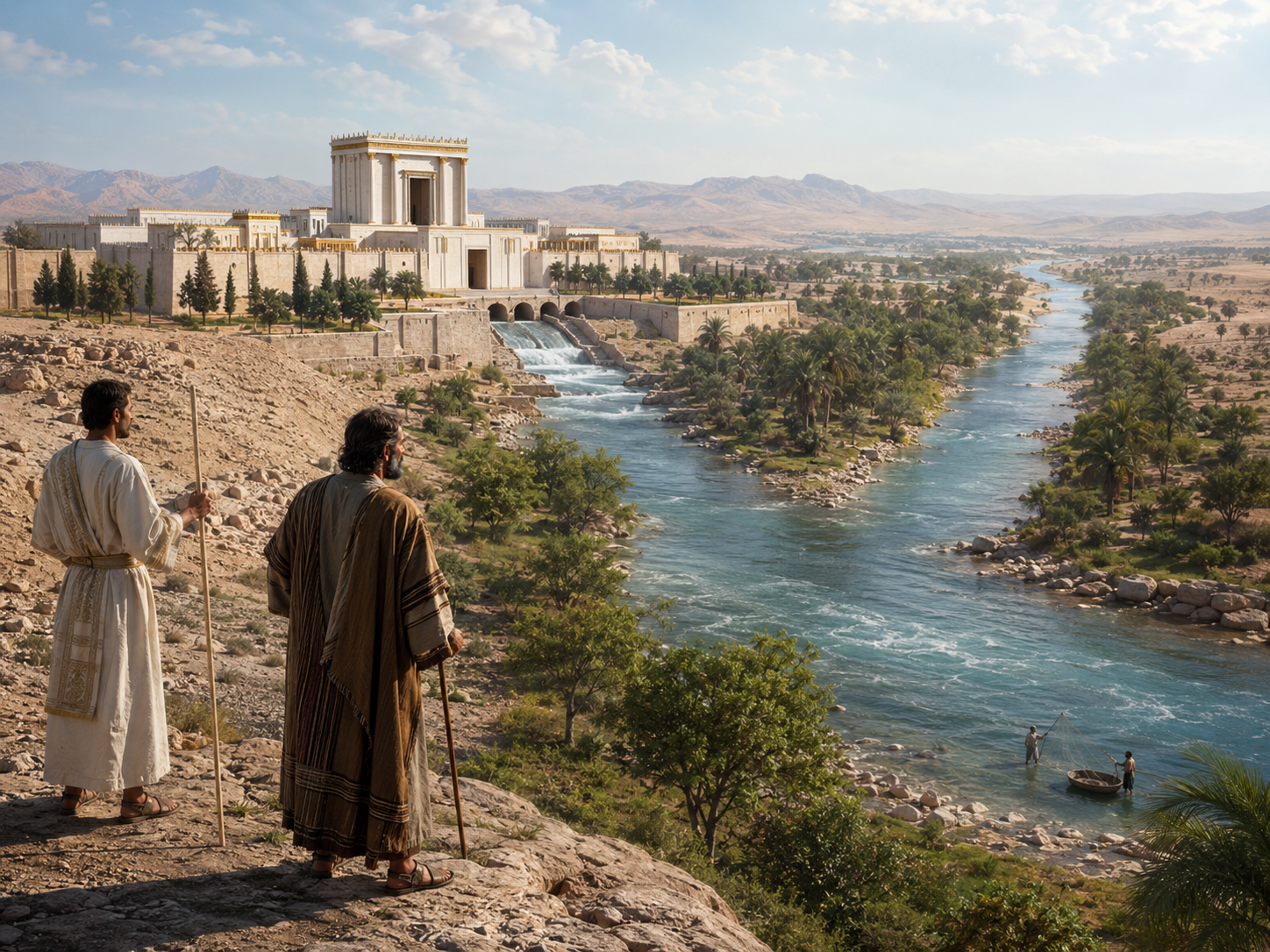
 Ezekiel 47 continues the vision of the millennial temple and the restored land of Israel. The prophet is brought back “unto the door of the house,” and he sees waters issuing “from under the threshold of the house eastward” (Ezekiel 47:1). These waters come from the sanctuary, showing that blessing, life, healing, and fruitfulness flow from the presence of God.
The waters increase as the man measures them. First they are “to the ankles,” then “to the knees,” then “to the loins,” and finally “waters to swim in, a river that could not be passed over” (Ezekiel 47:3–5). This is a literal river connected with the future temple, yet it also teaches a spiritual truth: the blessings of God are abundant, increasing, and beyond man’s ability to exhaust.
The river brings life wherever it goes. Ezekiel is told, “every thing shall live whither the river cometh” (Ezekiel 47:9). The waters go toward the desert and into the sea, and “the waters shall be healed” (Ezekiel 47:8). The Dead Sea region, now marked by barrenness, will be transformed by the power of God. Fishermen will stand “from Engedi even unto Eneglaim,” and there will be “a very great multitude” of fish (Ezekiel 47:10). This shows the literal renewal of creation under Messiah’s reign.
Yet the marshes and miry places “shall not be healed; they shall be given to salt” (Ezekiel 47:11). Even in a glorious age of blessing, God still makes distinctions. His blessing is not careless or indiscriminate. Holiness remains holy.
Along the river grow trees whose fruit does not fail. “The fruit thereof shall be for meat, and the leaf thereof for medicine” (Ezekiel 47:12). This anticipates the restored order under the reign of Christ, when life, health, and blessing flow from God’s appointed sanctuary.
The latter part of the chapter gives the borders of the land. God says, “This shall be the border, whereby ye shall inherit the land according to the twelve tribes of Israel” (Ezekiel 47:13). The land promise is not erased, spiritualized, or transferred to the church. It is given to Israel, tribe by tribe, according to God’s covenant faithfulness. The stranger who sojourns among them is also to receive an inheritance: “ye shall give him his inheritance, saith the Lord GOD” (Ezekiel 47:23). This shows righteousness, mercy, and order in the kingdom.
From a conservative Baptist and dispensational position, Ezekiel 47 is best understood as part of the future millennial kingdom. The temple, river, land, borders, and tribal inheritances are not merely symbols of the church. They belong to Israel’s future restoration under the literal reign of the Lord Jesus Christ.
Ezekiel 48 — The Tribal Inheritances and the Name of the City
Ezekiel 48 gives the division of the restored land among the twelve tribes of Israel. The chapter begins in the north with Dan, then Asher, Naphtali, Manasseh, Ephraim, Reuben, and Judah (Ezekiel 48:1–7). The arrangement is orderly and deliberate. God is not finished with Israel. The tribes are named, placed, and given inheritance.
A holy portion is then set apart. This portion includes an oblation for the LORD, the sanctuary, the priests, the Levites, the city, and the prince’s portion. The priests, “the sons of Zadok,” are given a special place because they “kept my charge, which went not astray when the children of Israel went astray” (Ezekiel 48:11). Faithfulness matters to God. He remembers obedience.
The Levites also receive their portion, but the priests’ portion is described as “most holy” (Ezekiel 48:12). The distinction between priests, Levites, prince, people, sanctuary, and city shows divine order. God’s kingdom is not confusion. It is structured by His holiness.
The city has its own portion, and workers from all the tribes serve it. The city is foursquare, with gates named after the tribes of Israel. On the north are the gates of Reuben, Judah, and Levi; on the east are Joseph, Benjamin, and Dan; on the south are Simeon, Issachar, and Zebulun; on the west are Gad, Asher, and Naphtali (Ezekiel 48:31–34). The names of the tribes on the gates show that Israel’s identity remains in the kingdom.
The chapter closes with one of the most glorious statements in Ezekiel: “and the name of the city from that day shall be, The LORD is there” (Ezekiel 48:35). This is the great answer to the tragedy of Ezekiel earlier in the book, where the glory of the LORD departed from the temple. Now, at the end, God is present among His restored people.
The final message is not merely land, borders, or architecture. The final message is the presence of Jehovah. The glory that departed returns. The people who were judged are restored. The land that was defiled is ordered. The city is named by the presence of the LORD Himself.
Key People and Places
The LORD / the Lord GOD
The central Person in the passage is the LORD Himself. He gives the vision, establishes the land, orders the tribes, blesses the river, and names the city by His presence: “The LORD is there” (Ezekiel 48:35).
Ezekiel
Ezekiel is the prophet who receives the vision. He is shown the temple waters, the land borders, the tribal divisions, the holy oblation, and the city.
The Man with the Measuring Line
The guide continues showing Ezekiel the measurements and arrangements. His measuring emphasizes that God’s future kingdom is precise, ordered, and certain.
The Twelve Tribes of Israel
The tribes are specifically named in Ezekiel 48. This is important doctrinally because it shows that Israel remains Israel. The promises to Israel are not absorbed into the church.
The Sons of Zadok
These priests are honored because they remained faithful when others went astray. Ezekiel 48:11 says they “kept my charge.” Their place in the holy portion shows that God rewards faithfulness.
The Prince
The prince receives his portion in connection with the holy oblation and the city. He is distinct from the LORD and from the priests. In Ezekiel’s temple vision, he has administrative and representative responsibilities in the restored order.
The Sanctuary
The sanctuary is the source area of the river in Ezekiel 47. It stands at the heart of the restored land, showing that worship and the presence of God are central in the kingdom.
The River
The river flows from the temple and brings healing, life, fruitfulness, and abundance. “Every thing shall live whither the river cometh” (Ezekiel 47:9).
The Dead Sea Region
The waters go into the sea and heal it. This is a remarkable picture of physical restoration in the land. What is barren becomes fruitful by the power of God.
Engedi and Eneglaim
These places mark the area where fishermen will stand, showing the transformation of the formerly dead waters into a place of life and provision.
The Land of Israel
The land is divided by borders and tribal inheritances. The text treats the land promise as real, geographical, and covenantal.
The City
The city has twelve gates named after the tribes and is finally called “The LORD is there.” Its name expresses the great blessing of restored fellowship with God.
Main Doctrinal or Spiritual Themes
1. The Literal Restoration of Israel
Ezekiel 47–48 should be read plainly. The chapters speak of land, borders, tribes, temple, priests, Levites, offerings, and a city. A conservative Baptist dispensational interpretation recognizes this as future and connected with the millennial reign of Christ. God has not cast away Israel permanently. He will keep His covenant promises.
2. The Presence of God Is the Greatest Blessing
The book ends with “The LORD is there” (Ezekiel 48:35). That is the climax. Land without God would not be enough. Temple ritual without God would not be enough. National restoration without God would not be enough. The supreme blessing is the presence of the LORD among His people.
3. Life Flows from God
The river comes from the house of God. It does not begin in human effort, government policy, military power, or natural fertility. The life comes from God’s sanctuary. “Every thing shall live whither the river cometh” (Ezekiel 47:9). This teaches that true life, healing, and fruitfulness come from the LORD.
4. God Keeps His Promises Literally
The tribal divisions show that God’s promises are not vague. He names tribes and borders. He remembers His covenant. This guards against the error of replacing Israel with the church. The church has heavenly blessings in Christ, but Israel still has earthly covenant promises that God will fulfill.
5. Holiness and Order Mark God’s Kingdom
The holy oblation, the priestly portion, the Levites’ portion, the prince’s portion, and the city’s portion all show order. God is not the author of confusion. His worship, His people, and His land are arranged according to His holiness.
6. Faithfulness Is Remembered
The sons of Zadok are honored because they remained faithful when others went astray. God does not forget obedience. In an age of compromise, this is a strong reminder that separation, loyalty, and obedience matter.
7. Judgment Does Not Cancel God’s Mercy
Ezekiel is a book full of sin, idolatry, warning, departure of glory, and judgment. Yet it ends with restoration and the LORD’s presence. God’s chastening of Israel was real, but His covenant mercy remains.
8. The Kingdom Will Affect the Physical Creation
The healed waters, abundant fish, and fruitful trees show that Messiah’s kingdom affects the earth itself. This agrees with the broader prophetic expectation that creation will be blessed under the righteous reign of Christ.
Practical Applications or Lessons
1. Stay Close to the Source of Life
The river begins at the house of God. Believers today must remember that spiritual life and fruitfulness come from the LORD, not from personality, programs, or worldly wisdom. A Christian life separated from fellowship with God becomes dry and barren.
2. Go Deeper with God
The waters deepen from ankles to knees to loins to waters to swim in. While the passage is prophetic and literal, there is a sound devotional lesson: believers should not be content with shallow fellowship. We ought to grow in obedience, prayer, Scripture, holiness, and service.
3. God Can Heal Barren Places
The waters heal the sea. What was lifeless becomes full of life. God can restore broken homes, cold hearts, defeated churches, and wasted years when people return to Him in repentance and obedience.
4. Do Not Despise God’s Order
Ezekiel 48 is full of measurements, portions, borders, and assignments. Modern man often dislikes boundaries, but God works by holy order. The believer should respect God’s order in the home, church, ministry, doctrine, and personal conduct.
5. Faithfulness in Dark Times Matters
The sons of Zadok were remembered because they kept God’s charge. A believer may live in a compromising generation, but he does not have to compromise. God sees the faithful servant who stands when others drift.
6. God’s Promises Are Sure
Israel’s restoration reminds believers that God does not forget His Word. What He promises, He performs. The Christian can rest in the promises of God concerning salvation, resurrection, Christ’s return, and eternal life.
7. Worship Must Be Central
The sanctuary is central in the restored land. Likewise, worship must be central in the believer’s life. God should not be placed at the edges of life. He deserves first place.
8. The Greatest Need Is the Presence of the LORD
The final name of the city is “The LORD is there.” That is still the greatest need of a church, a family, and an individual life. Without His presence, outward structure is empty. With His presence, there is blessing, peace, holiness, and hope.
9. Do Not Spiritualize Away Plain Scripture
Ezekiel 47–48 warns against careless interpretation. The passage gives real tribes, real land, real borders, and a real future restoration. Sound Bible study allows the Scripture to say what it says. The church should rejoice in her blessings in Christ without stealing Israel’s promises.
10. Look Forward to the Reign of Christ
These chapters point forward to a coming kingdom of righteousness, restoration, and divine presence. The believer today should live in hope, holiness, and expectancy, knowing that the Lord Jesus Christ will reign and God’s Word will be fulfilled.
Comments are closed