 Historical and Doctrinal Introduction
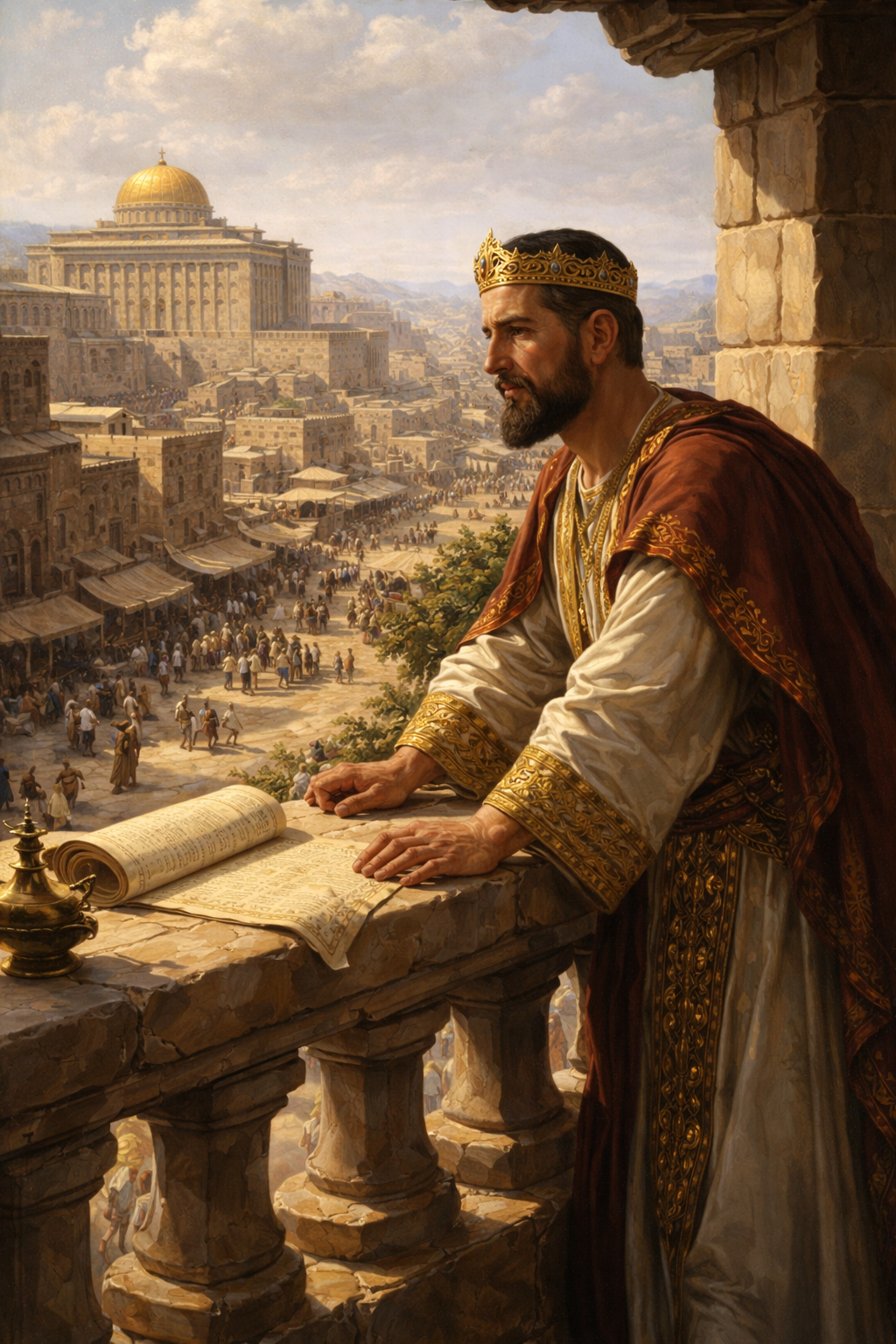
The book of Ecclesiastes is traditionally attributed to Solomon, the son of David and king in Jerusalem (Eccl. 1:1). The speaker calls himself “the Preacher” (Hebrew: Qoheleth), meaning one who gathers people to teach wisdom. Solomon writes near the end of his life, reflecting on decades of wealth, power, pleasure, knowledge, and human achievement.
The book examines life “under the sun”—that is, life viewed from an earthly perspective without reference to God’s eternal purposes. Solomon repeatedly declares such pursuits to be “vanity”, meaning emptiness, futility, or vapor-like transience.
Conservative Baptist interpretation understands Ecclesiastes not as pessimism but as a divinely inspired demonstration that life without God is meaningless. The book drives the reader toward the concluding truth later stated in Ecclesiastes 12:13: “Fear God, and keep his commandments.”
Chapters 1–4 establish the central theme: human wisdom, labor, and pleasure cannot satisfy the soul apart from God.
Chapter Summaries
Ecclesiastes 1
Solomon begins with the famous declaration:
“Vanity of vanities, saith the Preacher, vanity of vanities; all is vanity.” (1:2)
He observes the repetitive cycles of creation—generations come and go, the sun rises and sets, winds circulate, and rivers flow continually into the sea (1:4–7). These patterns illustrate the unchanging nature of the world contrasted with the fleeting nature of human life.
Human experience never fully satisfies:
“The eye is not satisfied with seeing, nor the ear filled with hearing.” (1:8)
Solomon emphasizes that history repeats itself:
“There is no new thing under the sun.” (1:9)
As king, he applied his heart to wisdom and knowledge. Yet the more wisdom he gained, the more he saw the burdens and sorrows of life:
“In much wisdom is much grief: and he that increaseth knowledge increaseth sorrow.” (1:18)
From a doctrinal perspective, this chapter teaches that human wisdom alone cannot resolve the spiritual emptiness caused by sin.
Ecclesiastes 2
Solomon next examines pleasure and human accomplishment.
He experiments with mirth, wine, great building projects, gardens, servants, wealth, and music. His prosperity exceeded all before him in Jerusalem (2:4–9).
Yet his conclusion remains sobering:
“Then I looked on all the works that my hands had wrought… and, behold, all was vanity and vexation of spirit.” (2:11)
Even wisdom proves limited because both the wise and the fool eventually die:
“How dieth the wise man? as the fool.” (2:16)
This leads Solomon to consider the futility of labor when one’s possessions must be left to another after death (2:18–21).
However, he also acknowledges a key truth:
“There is nothing better for a man, than that he should eat and drink… for this also I saw, that it was from the hand of God.” (2:24)
The ability to enjoy life is itself a gift from God, while sinners accumulate wealth only for the righteous to receive (2:26).
Ecclesiastes 3
This chapter contains one of the most well-known passages in Scripture:
“To every thing there is a season, and a time to every purpose under the heaven.” (3:1)
Solomon lists fourteen contrasting life events—birth and death, planting and harvesting, weeping and laughing, war and peace (3:2–8). These demonstrate that God sovereignly orders the events of life.
He further observes:
“He hath made every thing beautiful in his time.” (3:11)
God has also placed eternity in the human heart, yet man cannot fully comprehend God’s works.
Solomon encourages people to rejoice in their labor as a gift from God (3:12–13).
He then reflects on injustice in earthly courts (3:16), but affirms that:
“God shall judge the righteous and the wicked.” (3:17)
This reinforces the biblical doctrine of ultimate divine judgment.
The chapter concludes with the reminder that humans share mortality with animals in terms of physical death, highlighting the humility of human existence (3:18–20).
Ecclesiastes 4
Solomon now turns his attention to social injustice and human relationships.
He observes oppression under the sun, where the oppressed have no comforter while oppressors wield power (4:1). In his lament, he even states that the dead seem more fortunate than the living who witness such suffering (4:2–3).
He then addresses envy as a driving force behind much human labor:
“For this a man is envied of his neighbour.” (4:4)
Solomon contrasts laziness and overwork:
“Better is an handful with quietness, than both the hands full with travail and vexation of spirit.” (4:6)
He describes the loneliness of a man who works endlessly without family or companions (4:7–8). This leads to the famous teaching on companionship:
“Two are better than one… For if they fall, the one will lift up his fellow.” (4:9–10)
The chapter concludes with an illustration about the instability of political power—an old king may be replaced by a poor but wise youth (4:13–16), demonstrating again the temporary nature of earthly authority.
Key People and Places
Solomon / “The Preacher”
The king of Israel in Jerusalem who records these reflections late in life. Known for great wisdom, wealth, and building projects.
Jerusalem
The capital city of Israel where Solomon ruled. It was the center of political power and temple worship.
Human Society “Under the Sun”
Not a geographical location but a repeated phrase describing earthly life viewed apart from eternal perspective.
Main Doctrinal or Spiritual Themes
1. The Futility of Life Without God
The repeated phrase “vanity” demonstrates that wealth, pleasure, knowledge, and achievement cannot satisfy the soul apart from God.
2. The Limitations of Human Wisdom
Even the wisest man who ever lived recognized that human understanding alone cannot answer the deepest questions of life.
3. God’s Sovereignty Over Time
Ecclesiastes 3 teaches that every event in human history occurs within the timing and providence of God.
4. The Certainty of Divine Judgment
Though injustice exists on earth, God will ultimately judge both the righteous and the wicked.
5. The Gift of Enjoying God’s Blessings
Simple joys—food, labor, companionship—are meaningful when received as gifts from God.
6. The Reality of Human Mortality
Death equalizes the rich and poor, wise and foolish, reminding humanity of the brevity of earthly life.
Practical Applications or Lessons
1. Earthly Success Cannot Replace Spiritual Purpose
Many pursue wealth, pleasure, and accomplishment believing these will bring fulfillment. Ecclesiastes shows that without God these pursuits remain empty.
2. Life Must Be Viewed From an Eternal Perspective
Looking only “under the sun” leads to despair. Viewing life through the lens of God’s eternal purposes gives meaning to suffering and labor.
3. Accept God’s Timing
Believers must trust that God orders events according to His perfect schedule, even when circumstances seem confusing or difficult.
4. Enjoy God’s Daily Blessings
The ability to enjoy work, food, family, and fellowship is itself a gift from the Lord and should be received with gratitude.
5. Value Godly Relationships
Ecclesiastes 4 reminds believers that companionship, cooperation, and mutual support strengthen life and ministry.
6. Remember the Brevity of Life
The shortness of life should motivate believers toward obedience, service, and faithfulness to God.
Comments are closed