The Trial, Crucifixion, Death, and Burial of Jesus Christ
 Mark 15 records the final earthly sufferings of the Lord Jesus Christ before His burial. The chapter moves from Christ before Pilate, to His rejection in favor of Barabbas, His humiliation by the soldiers, His crucifixion at Golgotha, His death and the rending of the temple veil, the centurion’s confession, and finally His burial by Joseph of Arimathaea. The controlling truth throughout the chapter is that the innocent Lord Jesus willingly endures rejection, shame, crucifixion, and death while remaining exactly who He is: “THE KING OF THE JEWS” and “the Son of God.”
Chapter Summaries
Mark 15:1–5 — Jesus is delivered to Pilate. Early in the morning, “the chief priests held a consultation with the elders and scribes and the whole council,” bound Jesus, carried Him away, and delivered Him to Pilate. Pilate asks, “Art thou the King of the Jews?” Jesus answers, “Thou sayest it.” The chief priests accuse Him of many things, but Jesus gives no answer to their accusations, causing Pilate to marvel.
The text does not say that Christ was unable to defend Himself. His silence is deliberate in the narrative. Isaiah 53:7 supplies an important KJV cross-reference: “he is brought as a lamb to the slaughter, and as a sheep before her shearers is dumb, so he openeth not his mouth.” Thus the silence of Christ fits the prophetic portrait of the suffering Servant without requiring speculation about His motives beyond Scripture.
Mark 15:6–15 — Barabbas is released and Jesus is condemned. Mark states that Barabbas had participated in an insurrection and had “committed murder in the insurrection.” Pilate offers to release Jesus, whom he repeatedly identifies as “the King of the Jews.” Mark explicitly states that Pilate knew “that the chief priests had delivered him for envy.” Nevertheless, the chief priests move the people to request Barabbas. When Pilate asks, “Why, what evil hath he done?” the crowd cries even more strongly, “Crucify him.” Finally, Pilate, “willing to content the people,” releases Barabbas, scourges Jesus, and delivers Him to be crucified.
The contrast is severe: Mark identifies guilt in Barabbas, while Pilate’s own question concerning Jesus is, “what evil hath he done?” The passage itself does not explicitly call Barabbas a type of the sinner or state that his release was intended as an enacted picture of substitution. Such an application may be used illustratively, but it should not be presented as something Mark directly teaches.
Matthew Henry emphasizes the wickedness displayed in the rejection of the innocent Christ and warns against judging matters by popular clamor rather than truth. That observation agrees especially well with Mark’s explicit statement that Pilate acted because he was “willing to content the people.”
Mark 15:16–21 — Jesus is mocked by the soldiers. The soldiers take Jesus into “the hall, called Praetorium,” clothe Him in purple, place a crown of thorns upon Him, and mockingly salute Him: “Hail, King of the Jews!” They smite Him on the head with a reed, spit upon Him, bow their knees, and mock Him. They then restore His own clothes and lead Him out to be crucified. Simon, identified specifically as “a Cyrenian” and as the father of Alexander and Rufus, is compelled to bear Christ’s cross.
The soldiers intend mockery, yet the title they mock is true. Jesus is King. Mark does not record Him retaliating against His tormentors.
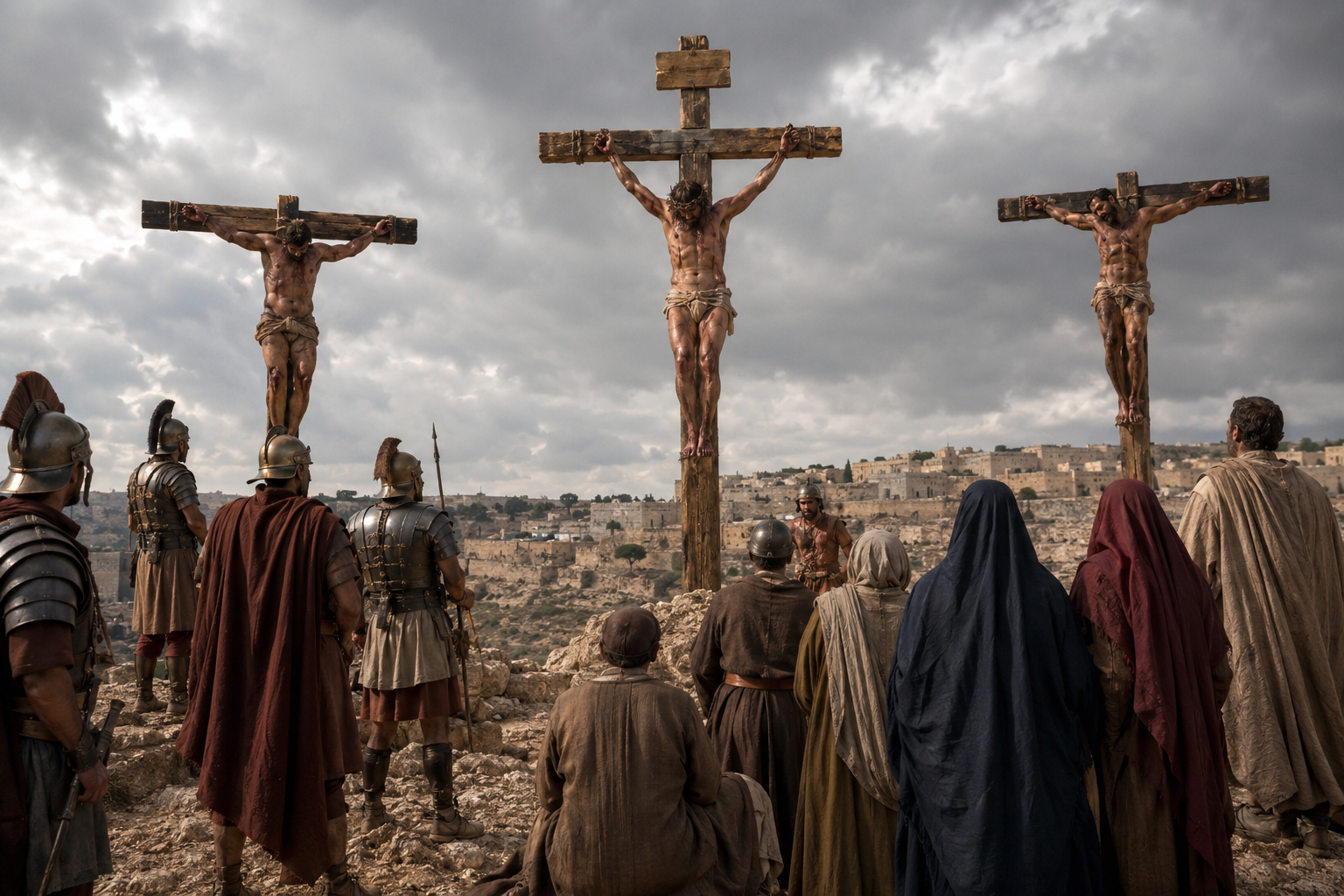
Mark 15:22–32 — Jesus is crucified at Golgotha. Jesus is brought to “Golgotha, which is, being interpreted, The place of a skull.” He is offered wine mingled with myrrh, but “he received it not.” Mark then states simply and solemnly, “And when they had crucified him…” His garments are divided by lot. Mark identifies the time as “the third hour.”
The accusation written over Him is:
“THE KING OF THE JEWS.”
Two thieves are crucified with Him, one on either side. Mark 15:28 explicitly interprets this event prophetically: “And the scripture was fulfilled, which saith, And he was numbered with the transgressors.” This corresponds directly to Isaiah 53:12. Here no inference is necessary—Mark himself says Scripture was fulfilled.
Those passing by rail against Christ. The chief priests and scribes mock Him with the words, “He saved others; himself he cannot save.” Their statement is intended as ridicule. It should not be turned into the claim that Christ literally lacked the power to come down from the cross. Scripture teaches elsewhere that He willingly laid down His life. John 10:18 says, “No man taketh it from me, but I lay it down of myself.”
Matthew Henry appropriately stresses the humiliation of the sinless Redeemer and connects Christ’s being “numbered with the transgressors” with the prophetic Scriptures.
Mark 15:33–37 — Darkness and the death of Christ. At the sixth hour, “there was darkness over the whole land until the ninth hour.” Mark records the darkness as fact but does not itself explain its physical mechanism. We therefore should not invent one.
At the ninth hour Jesus cries:
“Eloi, Eloi, lama sabachthani?”
Mark gives the interpretation:
“My God, my God, why hast thou forsaken me?”
These words correspond to Psalm 22:1. Mark then records that Jesus “cried with a loud voice, and gave up the ghost.”
The broader KJV revelation explains the saving significance of Christ’s death. Isaiah 53:5 says, “he was wounded for our transgressions, he was bruised for our iniquities.” First Peter 2:24 declares that Christ “his own self bare our sins in his own body on the tree.” Second Corinthians 5:21 says that God “hath made him to be sin for us, who knew no sin.”
Therefore, conservative Baptist doctrine rightly understands the cross as a substitutionary, sacrificial atonement. Christ did not die for His own sin; He was sinless. He died for sinners. Salvation is received by grace through faith, apart from human merit or religious works. The crucifixion does not teach sacramental salvation, baptismal regeneration, or salvation earned through personal suffering.
Mark 15:38 — The veil of the temple is rent. Immediately after Christ’s death, “the veil of the temple was rent in twain from the top to the bottom.” Mark states both the event and its direction—from top to bottom.
Mark 15 itself does not stop to explain the complete doctrinal meaning of the rent veil. Hebrews, however, supplies inspired interpretation concerning access to God through Christ’s blood. Hebrews 10:19–20 speaks of “boldness to enter into the holiest by the blood of Jesus” and “a new and living way.” Thus the doctrinal connection is supplied by Scripture interpreting Scripture, rather than by speculation.
Matthew Henry similarly associates the rent veil with access to God through Christ, although the doctrinal certainty rests finally upon the biblical text itself.
Mark 15:39 — The centurion’s confession. A centurion standing opposite Jesus sees how He cries out and dies and says:
“Truly this man was the Son of God.”
That is exactly what Mark records. We should not go farther and claim from this verse alone that the centurion was converted, eternally saved, baptized, or became a disciple. Scripture does not explicitly say those things here. What Scripture explicitly records is his confession concerning Christ: “this man was the Son of God.”
Mark 15:40–41 — Faithful women witness the scene. Mark names Mary Magdalene, Mary the mother of James the less and of Joses, and Salome. He says that these women had followed Jesus in Galilee and ministered unto Him. Mark also mentions “many other women which came up with him unto Jerusalem.”
Their presence is explicit. Any attempt to reconstruct their unrecorded conversations, emotions, or movements beyond what Scripture records would be inference and should not be presented as biblical fact.
Mark 15:42–47 — Joseph of Arimathaea buries Jesus. Because it was “the preparation, that is, the day before the sabbath,” Joseph of Arimathaea comes to Pilate. Mark describes Joseph explicitly as “an honourable counsellor, which also waited for the kingdom of God.” He goes “boldly unto Pilate” and requests the body of Jesus.
Pilate is surprised that Jesus is already dead and asks the centurion to verify the matter. After receiving confirmation, Pilate gives the body to Joseph. Joseph buys fine linen, takes Jesus down, wraps Him in the linen, lays Him “in a sepulchre which was hewn out of a rock,” and rolls a stone to its entrance. Mary Magdalene and Mary the mother of Joses observe where He is laid.
This portion is important because Mark does not describe a merely apparent death. Jesus “gave up the ghost” in verse 37; the centurion confirms His death to Pilate; and Joseph receives and buries His body. The chapter closes with Jesus genuinely dead and buried. The resurrection itself is not narrated in Mark 15; Mark 16 records it.
Key People and Places
| Person or Place | KJV-based context |
|---|---|
| Jesus Christ | The central Person of the chapter; identified as King of the Jews and confessed by the centurion as the Son of God. |
| Pontius Pilate | Receives Jesus from the council, questions Him, recognizes the priests’ envy, releases Barabbas, and delivers Jesus to be crucified. Matthew 27:2 explicitly calls Pilate “the governor.” |
| Chief priests, elders, scribes, and council | Consult together, deliver Jesus to Pilate, accuse Him, and move the people to request Barabbas. |
| Barabbas | A prisoner involved in insurrection who had committed murder; released instead of Jesus. |
| Roman soldiers | Mock Jesus as King, place the crown of thorns upon Him, abuse Him, and lead Him to crucifixion. |
| Simon a Cyrenian | Compelled to bear Christ’s cross; explicitly identified as father of Alexander and Rufus. |
| Centurion | Confirms Christ’s death to Pilate and declares, “Truly this man was the Son of God.” |
| Mary Magdalene | Watches from afar and later observes where Jesus is buried. |
| Mary, mother of James the less and Joses | Named among the women watching and later observes the burial place. |
| Salome | Named among the women who had followed and ministered to Jesus. |
| Joseph of Arimathaea | “An honourable counsellor” who “waited for the kingdom of God”; requests and buries Christ’s body. |
| Praetorium | Mark calls it “the hall, called Praetorium,” where the soldiers mock Jesus. |
| Golgotha | Explicitly interpreted by Mark as “The place of a skull”; the location of the crucifixion. |
| Jerusalem | The women are said to have come up with Jesus unto Jerusalem. |
| The temple | Its veil is rent “in twain from the top to the bottom” when Jesus dies. |
| The sepulchre | A tomb “hewn out of a rock” in which Joseph lays the body of Jesus. |
Main Doctrinal or Spiritual Themes
The sinlessness of Christ and the injustice of His condemnation. Pilate asks, “Why, what evil hath he done?” Mark presents accusations against Christ but records no crime proved against Him. The wider KJV testimony is unmistakable: Christ “did no sin” (1 Peter 2:22).
The substitutionary death of Christ. Mark vividly records the historical crucifixion; other inspired passages explain its saving meaning. Christ “bare our sins in his own body on the tree” (1 Peter 2:24). The cross is therefore not merely an example of courage or an unfortunate martyrdom. It is central to God’s provision of salvation for guilty sinners.
Christ’s true kingship. “King of the Jews” occurs repeatedly, sometimes spoken in mockery. Human ridicule does not change His identity. The title placed above the cross unwittingly announces a truth about the One being crucified.
Fulfilled Scripture. Mark explicitly states concerning Christ between the thieves, “And the scripture was fulfilled.” The crucifixion is not presented as an accident outside God’s revealed plan.
The depth of human sin. Envy, false accusation, pressure from the multitude, mockery, cruelty, and rejection surround the innocent Son of God. Mark 15 gives no support to an optimistic view of man’s natural righteousness.
The danger of pleasing men rather than doing right. Pilate knows the chief priests acted from envy, asks what evil Jesus has done, and yet acts “willing to content the people.” That wording makes the moral danger explicit.
The deity and Sonship of Christ. The chapter culminates in the centurion’s declaration: “Truly this man was the Son of God.” Mark does not portray Jesus as merely a religious teacher suffering a tragic death.
The reality of Christ’s physical death and burial. Jesus gives up the ghost; a centurion verifies His death; Joseph takes His body, wraps it in linen, and places it in a rock-hewn sepulchre. Christianity rests upon real events, not an allegorical crucifixion.
Access to God through Christ. Mark records the veil being torn from top to bottom. Hebrews supplies the doctrinal explanation that believers have access into God’s presence through the blood of Jesus.
Practical Applications or Lessons
Do not exchange truth for popularity. Pilate’s conduct provides a serious warning. He knew envy was involved and could ask, “what evil hath he done?” yet he yielded because he was “willing to content the people.” A Christian must not determine truth by the crowd.
Do not measure Christ by man’s treatment of Him. He was mocked, spat upon, scourged, and crucified. None of those things diminished His holiness, kingship, or deity. Human rejection is no measure of divine truth.
Remember what sin cost. The cross shows the seriousness of sin more clearly than sentimental language ever could. The believer should never treat lightly what required the sacrificial death of the sinless Son of God.
Rest salvation entirely upon Christ. Nothing in Mark 15 suggests that sinners supplement Christ’s sacrifice through works, sacraments, personal suffering, or religious merit. The saving work belongs to Christ. The gospel response is faith in Him.
Beware envy and religious hostility. Mark explicitly says the chief priests delivered Christ “for envy.” Religious office does not make envy holy. God’s people must judge attitudes and actions by Scripture rather than by position, tradition, or institutional prestige.
Be willing to identify with Christ when doing so is costly. Joseph goes “boldly unto Pilate” and asks for Christ’s body. The text does not describe all of Joseph’s thoughts, so those should not be invented. What it does explicitly commend to our attention is courageous action toward the crucified Christ when public sentiment was hostile.
Faithfulness is often quiet and practical. Joseph buys linen, handles the body, provides the sepulchre, and rolls the stone into place. Mary Magdalene and Mary the mother of Joses carefully observe where Jesus is laid. Their actions are stated without exaggeration or embellishment.
Let Scripture interpret the cross. Mark tells us what happened. Isaiah, Psalms, Hebrews, Peter, and Paul help explain why it matters. We do not need mystical inventions or allegorical reinterpretations when God has already supplied inspired interpretation.
Overall Message
Mark 15 places the reader before the rejected, mocked, crucified, and buried Lord Jesus Christ. Men condemn Him, but no evil is proved against Him. Soldiers ridicule His kingship, yet He remains King. He is crucified between transgressors, explicitly fulfilling Scripture. He gives up the ghost; the temple veil is rent; a centurion confesses Him as the Son of God; and Joseph of Arimathaea places His body in a rock-hewn sepulchre.
The conservative Baptist conclusion is clear: Jesus Christ is the sinless Son of God who truly died as the sacrifice for sinners. Salvation rests wholly in His finished redemptive work and is received by grace through faith, not earned through religious works. Mark 15 leaves no room for a merely symbolic cross or merely human Christ.
Comments are closed