Christ is risen. Believe the gospel. Obey the Lord.
Mark 16 brings the Gospel of Mark to its triumphant conclusion: Jesus Christ, who was crucified and buried, is risen; He appears to His followers; He commissions them to preach the gospel throughout the world; He ascends into heaven; and His disciples go forth preaching with the Lord working with them. The chapter moves from sorrow and fear at the sepulchre to resurrection certainty and worldwide gospel proclamation.
Chapter Summary
The Women Come to the Sepulchre — Mark 16:1–8
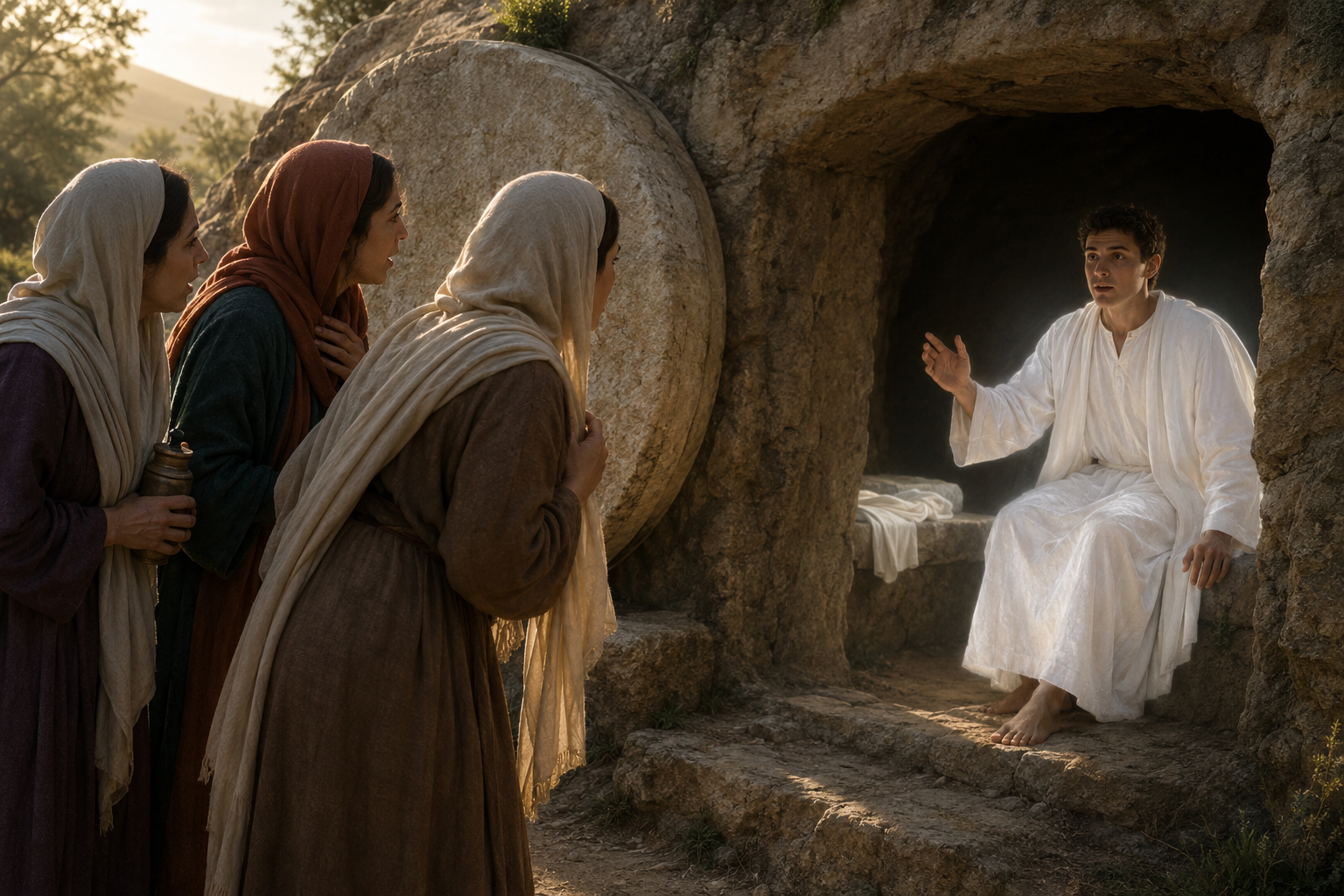
 After the sabbath was past, Mary Magdalene, Mary the mother of James, and Salome came to the sepulchre. Mark states that they “had bought sweet spices, that they might come and anoint him” (Mark 16:1).
They came “very early in the morning the first day of the week” at the rising of the sun (Mark 16:2). As they approached, they asked among themselves:
“Who shall roll us away the stone from the door of the sepulchre?” — Mark 16:3
Their concern was understandable because Mark specifically tells us that the stone “was very great” (Mark 16:4). Yet when they arrived, they discovered that the stone had already been rolled away.
Entering the sepulchre, they saw “a young man sitting on the right side, clothed in a long white garment,” and they were frightened. The young man immediately directed their attention to Jesus:
“Ye seek Jesus of Nazareth, which was crucified: he is risen; he is not here.” — Mark 16:6
The resurrection stands at the heart of Mark 16. The same Jesus who had been crucified was no longer in the place where His body had been laid. The announcement was not that His teachings survived or that His followers continued His cause. The declaration was direct: “he is risen.”
The young man then showed them “the place where they laid him.” The empty place corresponded with the message they had just heard.
They were commanded to tell His disciples, with Peter specifically named:
“But go your way, tell his disciples and Peter that he goeth before you into Galilee.” — Mark 16:7
The text explicitly singles out Peter. Scripture does not state in Mark 16 why Peter is named separately. In light of Peter’s earlier denial of Christ, this may suggest a particular word of gracious reassurance to him, but Mark does not explicitly give that explanation. What can be stated with certainty is that Peter was not omitted from the message to the disciples.
The women fled from the sepulchre because “they trembled and were amazed.” Mark says, “neither said they any thing to any man; for they were afraid” (Mark 16:8). This describes their immediate reaction as they fled the tomb; the following verses explicitly record Mary Magdalene subsequently reporting that Jesus was alive.
Jesus Appears to Mary Magdalene — Mark 16:9–11
Mark states:
“Now when Jesus was risen early the first day of the week, he appeared first to Mary Magdalene.” — Mark 16:9
Mark also identifies her as the woman “out of whom he had cast seven devils.” That fact is explicitly stated and should not be expanded into assumptions about her previous moral life that Scripture does not give.
Mary went and told those who had been with Jesus. They were mourning and weeping. When they heard from her “that he was alive, and had been seen of her,” they did not believe.
The passage therefore presents both the reality of the resurrection and the initial unbelief of some of Christ’s own followers.
Mary’s testimony was true even though others did not initially accept it.
Jesus Appears to Two Disciples — Mark 16:12–13
Afterward Jesus appeared “in another form unto two of them, as they walked, and went into the country.”
Mark does not name these two people or identify their destination. Other Gospel passages give additional resurrection accounts, but when explaining Mark 16 itself, we should not insert details into Mark that Mark does not state.
These two returned and told the others, but Mark again records:
“neither believed they them.” — Mark 16:13
The repeated unbelief prepares for Christ’s rebuke in the following verse.
Jesus Appears to the Eleven — Mark 16:14
Jesus afterward appeared “unto the eleven as they sat at meat.”
He “upbraided them with their unbelief and hardness of heart,” specifically because:
“they believed not them which had seen him after he was risen.”
This is an important spiritual point. Their problem was not presented as a lack of available testimony. Christ rebuked them because they did not believe the testimony that had been given concerning His resurrection.
The resurrection would soon become the central proclamation of the apostles. Before they were sent to proclaim it to others, however, Christ confronted their own unbelief.
The Great Commission — Mark 16:15–16
Jesus then gave one of the clearest missionary commands in Scripture:
“Go ye into all the world, and preach the gospel to every creature.” — Mark 16:15
The command contains both a message and a mission.
The message is the gospel.
The mission extends to all the world and every creature.
The church has no biblical authority to restrict the gospel according to nationality, social position, ethnicity, wealth, education, or geographic location. The scope Christ states is worldwide.
Mark 16:16 continues:
“He that believeth and is baptized shall be saved; but he that believeth not shall be damned.”
This verse should be read exactly as written.
Christ connects belief and baptism in the life of one who receives the gospel, which agrees with the normal New Testament order of belief followed by baptism.
However, the second half of the verse does not say, “he that is not baptized shall be damned.” It says:
“he that believeth not shall be damned.”
Therefore Mark 16:16 does not teach baptismal regeneration. Condemnation is explicitly connected with unbelief.
This agrees with other clear KJV passages concerning salvation. Acts 16:31 says, “Believe on the Lord Jesus Christ, and thou shalt be saved.” Ephesians 2:8–9 declares salvation to be “by grace…through faith” and “not of works.”
Baptism is an important command of Christ and the scriptural testimony of a believer’s identification with Him, but the water itself does not purchase, earn, or complete salvation.
Signs Following — Mark 16:17–18
Jesus continued by describing signs that would accompany believers:
“And these signs shall follow them that believe.”
The signs listed include casting out devils, speaking with new tongues, taking up serpents, being unharmed if they drank a deadly thing, and laying hands upon the sick so that they recovered.
Several restraints are important if we are going to remain strictly with the text.
First, the passage does not command Christians to deliberately handle poisonous snakes.
Second, it does not command Christians to drink poison.
Third, it does not say that every believer must personally demonstrate every listed sign.
Fourth, verse 20 explicitly explains an important purpose connected with the signs. The Lord was:
“confirming the word with signs following.”
Therefore believers should not turn these verses into a command to manufacture supernatural demonstrations or deliberately place themselves in danger.
The signs were works of God, not religious stunts.
The New Testament records examples of supernatural confirmation accompanying the apostolic proclamation of God’s Word. The emphasis in Mark 16 itself remains on preaching the gospel and on the Lord confirming His word.
The Ascension of Christ — Mark 16:19
After speaking to the disciples:
“he was received up into heaven, and sat on the right hand of God.”
Jesus’ earthly ministry did not end in defeat at the cross. The crucified Christ rose from the dead and was received into heaven.
His position “on the right hand of God” presents Christ in the place of exaltation and authority.
The Lord who sends His servants into the world is Himself enthroned in heaven.
The Disciples Go Forth — Mark 16:20
Mark closes with obedience to Christ’s commission:
“And they went forth, and preached every where.”
The disciples did not keep the resurrection message among themselves. They carried it outward.
Yet the final verse also makes clear that they were not working alone:
“the Lord working with them, and confirming the word with signs following.”
That is a fitting conclusion to Mark’s Gospel. Jesus has ascended to heaven, yet He is still actively working as His Word is proclaimed.
The chapter begins with women approaching a tomb wondering who will move a stone.
It ends with the gospel going “every where.”
The tomb is empty, Christ is risen, the gospel is to be preached, and the Lord continues His work through the proclamation of His Word.
Key People and Places
Jesus Christ / Jesus of Nazareth — The One who was crucified, buried, risen from the dead, seen by His followers, received into heaven, and seated at the right hand of God. He commands the worldwide preaching of the gospel.
Mary Magdalene — One of the women who came to the sepulchre. Mark states that Jesus had cast seven devils out of her and that the risen Christ appeared first to her.
Mary the mother of James — Came with Mary Magdalene and Salome to the sepulchre with sweet spices.
Salome — Came with the two Marys to the tomb early on the first day of the week.
The young man at the sepulchre — Seen sitting on the right side and clothed in a long white garment. He announced that Jesus was risen and instructed the women to tell the disciples and Peter.
Peter — Specifically named in the message, “tell his disciples and Peter.” Mark does not explicitly explain why Peter is separately mentioned.
The two disciples — Jesus appeared to two as they walked and went into the country. Mark does not name them or state their destination.
The eleven — Jesus appeared to them while they sat at meat and rebuked their unbelief and hardness of heart.
The sepulchre — The burial place to which the women came and where they learned that Jesus had risen.
Galilee — The disciples were told that Jesus would go before them into Galilee, “as he said unto you.”
Heaven — The Lord Jesus was received up into heaven following His resurrection appearances.
The right hand of God — The position where Mark explicitly says the risen Christ sat after His ascension.
All the world — The geographic scope of Christ’s commission.
Every creature — The stated scope of those to whom the gospel is to be preached.
Main Doctrinal or Spiritual Themes
The Bodily Resurrection of Jesus Christ
The central declaration of the chapter is:
“he is risen; he is not here.”
Christianity rests upon a living Savior. Jesus truly died, was laid in the sepulchre, and afterward was declared to be risen and appeared to His followers.
The resurrection confirms that Calvary was not Christ’s defeat. The crucified Savior lives.
As Paul later states in 1 Corinthians 15:17:
“And if Christ be not raised, your faith is vain; ye are yet in your sins.”
The resurrection is therefore essential to the gospel message.
The Reality and Danger of Unbelief
Mark 16 repeatedly records people refusing to believe testimony concerning Christ’s resurrection.
Those who heard Mary Magdalene “believed not.”
Those who heard the report of the two disciples did not believe them.
Jesus then rebuked the eleven for their “unbelief and hardness of heart.”
Unbelief is not treated as spiritually harmless. Christ confronted it directly.
The Gospel Is for the Whole World
Christ said:
“Go ye into all the world, and preach the gospel to every creature.”
Biblical Christianity is inherently missionary.
The gospel is not the possession of one nation or one culture. Those who have received the message are commanded to take it to others.
This gives scriptural authority and urgency to missions, evangelism, personal witnessing, gospel preaching, tract distribution, Bible ministry, and every legitimate means of carrying the gospel to people who have not heard.
Salvation Is Received Through Faith
Mark 16:16 places belief at the dividing line:
“he that believeth not shall be damned.”
This is consistent with the repeated teaching of the New Testament that salvation is received by faith in Christ rather than earned through religious works.
Baptism properly follows faith and publicly identifies the believer with Christ, but Mark 16 does not say that absence of baptism is what damns the sinner. It explicitly identifies unbelief.
Believer’s Baptism and Obedience
While baptism does not regenerate the sinner, neither should it be treated as unimportant.
Christ placed believing and baptism together in the expected response to the gospel. Throughout the book of Acts, those who received the gospel were baptized.
Biblical baptism is therefore an act of obedience following personal faith in Christ, not a substitute for that faith.
Divine Confirmation of God’s Word
Mark concludes by saying that the Lord was:
“confirming the word with signs following.”
The emphasis is significant. The signs served the Word; the Word did not serve the signs.
The biblical goal is never entertainment, spectacle, or the pursuit of supernatural experiences for their own sake.
God’s truth and the proclamation of the gospel remain central.
The Exaltation of Jesus Christ
Jesus was “received up into heaven” and “sat on the right hand of God.”
The risen Christ is not pictured as merely another religious teacher whose work ended at death.
He is the living and exalted Lord.
Christ Working With His Servants
The final verse contains a tremendous encouragement:
“the Lord working with them.”
The disciples preached, but the Lord worked.
They carried the message, but God supplied the power and confirmed His Word.
Christian ministry therefore requires both human obedience and divine dependence.
Practical Applications or Lessons
Believe God’s Word even when circumstances initially seem impossible. The women approached the sepulchre wondering how its great stone could be removed. When they arrived, the stone was already rolled away. Believers should not assume that an obstacle beyond their ability is beyond God’s ability.
Keep the resurrection central to the Christian message. Christianity is not merely a system of morals. The gospel announces a crucified and risen Savior.
Do not allow grief to blind you to God’s truth. Those who had followed Jesus were mourning and weeping, but their sorrow did not change the fact that Christ was alive. Feelings are real, but God’s revealed truth must govern faith.
Take unbelief seriously. Jesus rebuked His own disciples for refusing credible testimony concerning His resurrection. A hard heart toward God’s revealed truth is never presented as a virtue.
Carry the gospel beyond your own circle. Christ did not say to preach only where it is easy, familiar, or culturally comfortable. He said, “Go ye into all the world.”
Every Christian should have a part in gospel outreach, whether through personal witnessing, prayer, giving, missions, preaching, teaching, distributing Scripture, or other biblical means.
Preach the gospel rather than human philosophy. Christ’s command was not simply to improve society or offer inspirational thoughts. His command was to “preach the gospel.”
Trust Christ alone for salvation. Religious ceremonies cannot replace saving faith. Baptism is obedience for the believer, but salvation is by grace through faith.
Follow salvation with obedience. The fact that baptism cannot save does not make baptism optional in Christian discipleship. A believer should desire to obey the Lord who saved him.
Do not manufacture signs or tempt God. Nothing in Mark 16 commands a Christian to handle dangerous snakes, drink poison, or deliberately create hazardous circumstances in order to prove faith. The signs were acts of divine power, and verse 20 identifies them as confirmations of the Word.
Remember that ministry depends upon the Lord. Mark does not merely say that the disciples worked for Christ. It says that they preached with “the Lord working with them.”
No preacher, missionary, church, or individual believer can produce spiritual fruit merely through human ability.
Proclaim the Word faithfully and leave the results with God. The servants preached; the Lord worked and confirmed His Word.
Remember the significance of “and Peter.” Scripture explicitly includes Peter in the message from the empty tomb. Mark does not explain why he was separately named, so we should not state a reason as fact. Yet the wording may encourage believers who have failed to remember that failure does not place a person beyond the reach of Christ’s grace.
Live as a servant of the risen and exalted Christ. Jesus is not in the tomb. He has risen, ascended, and sits at the right hand of God. Christian service should therefore be marked by confidence in the living Lord rather than despair or defeat.
Keep evangelism urgent. Mark closes not with the disciples remaining at the empty tomb, but with them going forth and preaching everywhere. The proper response to the resurrection is proclamation.
Mark 16 therefore leaves the believer with a clear message and mission:
Christ is risen. Believe the gospel. Obey the Lord. Preach the gospel to every creature. Depend upon the risen Christ as you serve Him.
Comments are closed