Christ’s Authority, Faith, Judgment, and True Devotion
Chapter Summaries
Mark 11 — The King Enters Jerusalem, Cleanses the Temple, and Confronts Unbelief
 Mark 11 opens with Jesus approaching Jerusalem by way of Bethphage and Bethany, at the mount of Olives. He sends two disciples to obtain “a colt tied, whereon never man sat” (Mark 11:2). When questioned, they are instructed to say, “The Lord hath need of him” (Mark 11:3).
The disciples place their garments upon the colt, and Jesus enters Jerusalem while many spread garments and branches in the way. The multitude cries:
“Hosanna; Blessed is he that cometh in the name of the Lord: Blessed be the kingdom of our father David, that cometh in the name of the Lord: Hosanna in the highest.” — Mark 11:9–10
The text plainly presents Jesus receiving royal and messianic language connected with David’s kingdom. His entrance upon the colt also accords with the prophetic picture of the King in Zechariah 9:9. Mark itself does not pause to explain every prophetic connection, so conclusions beyond what the text states should be made carefully.
Jesus enters the temple, looks “round about upon all things,” and then goes to Bethany with the twelve because the hour is late (Mark 11:11).
The following day Jesus sees a fig tree having leaves. Finding no fruit upon it, He says, “No man eat fruit of thee hereafter for ever” (Mark 11:14). Mark specifically states, “for the time of figs was not yet” (Mark 11:13). The disciples later see that the tree has dried up from the roots.
The KJV text does not explicitly state that the fig tree represents Israel. Such an identification is an interpretation sometimes drawn from the broader biblical use of fig-tree imagery. Mark 11 itself explicitly records Christ’s authority over the tree and uses its later withering as the occasion for His teaching concerning faith, prayer, and forgiveness. Therefore, the safest interpretation begins with what Mark directly says rather than making the symbol more specific than Scripture does.
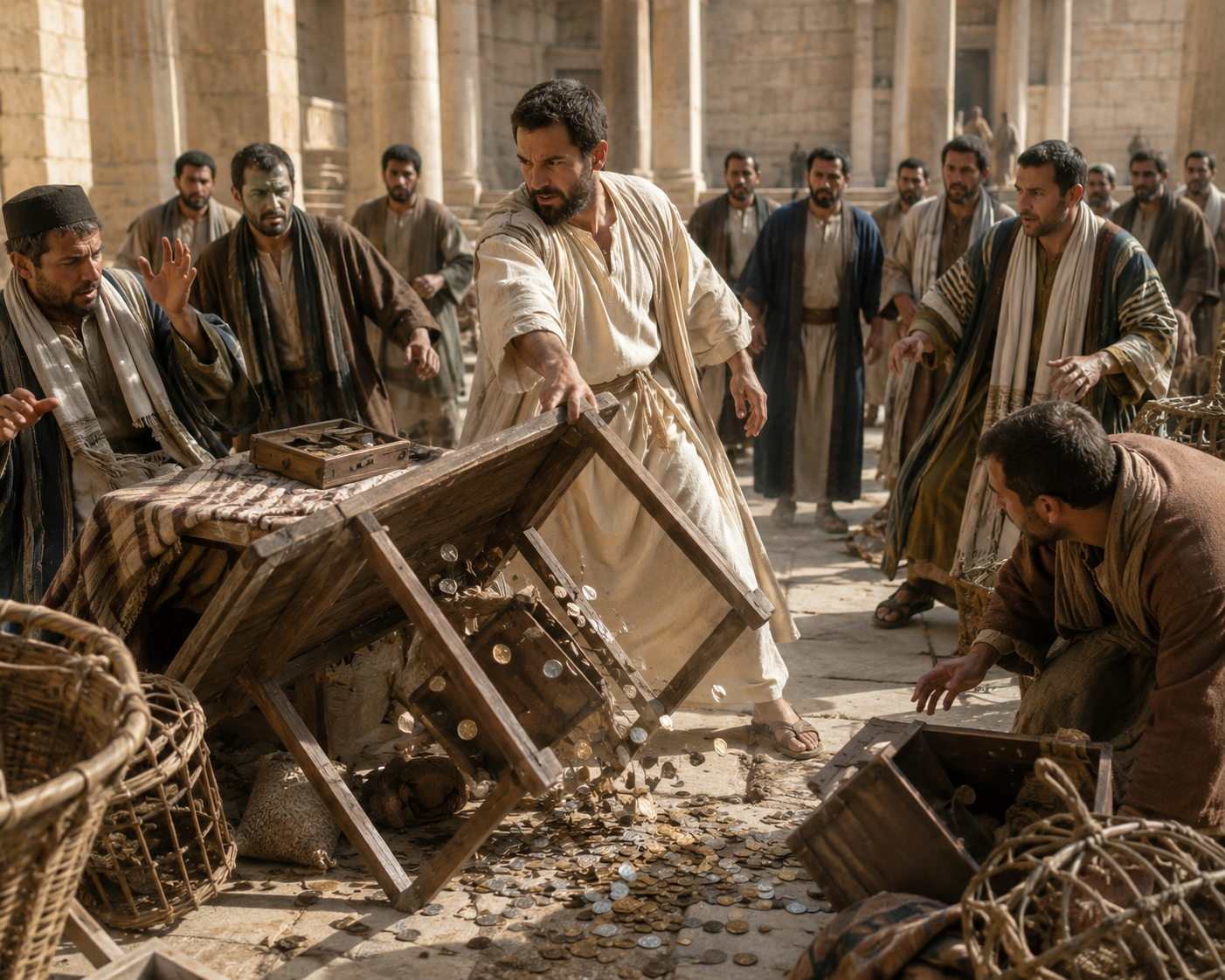
Jesus then enters the temple and drives out those who bought and sold. He overturns “the tables of the moneychangers, and the seats of them that sold doves” (Mark 11:15). He declares:
“Is it not written, My house shall be called of all nations the house of prayer? but ye have made it a den of thieves.” — Mark 11:17
Christ combines the language of Isaiah 56:7 and Jeremiah 7:11. The temple was not to be treated as a place for corrupt religious commerce. Christ demonstrates His authority over worship associated with His Father’s house and condemns religious activity that contradicts the holiness of God.
The scribes and chief priests hear Him and “sought how they might destroy him,” while fearing Him because “all the people was astonished at his doctrine” (Mark 11:18). Scripture states their intention plainly; it does not require speculation about additional motives.
When Peter later notices the withered fig tree, Jesus answers, “Have faith in God” (Mark 11:22). He teaches concerning believing prayer, including:
“What things soever ye desire, when ye pray, believe that ye receive them, and ye shall have them.” — Mark 11:24
This is not biblical authority for prosperity teaching or the idea that man can force God to satisfy every personal desire. Scripture interprets Scripture. Biblical prayer remains prayer directed toward God and governed by His will: “if we ask any thing according to his will, he heareth us” (1 John 5:14). Faith rests in God, not in human imagination or positive thinking.
Jesus immediately joins prayer with forgiveness. “When ye stand praying, forgive” (Mark 11:25). A believer cannot rightly seek mercy from God while cherishing deliberate bitterness toward others.
The chapter closes when the chief priests, scribes, and elders challenge Jesus: “By what authority doest thou these things?” (Mark 11:28). Jesus answers with a question concerning the baptism of John: was it “from heaven, or of men?” They reason among themselves but refuse to answer, saying, “We cannot tell” (Mark 11:33). Jesus therefore declines to answer their challenge directly.
Their difficulty was not merely a lack of information. The text records that they calculated how either possible answer would affect them before the people. Christ exposes the danger of approaching divine truth with political calculation rather than honest submission.
Mark 12 — The Rejected Son, Questions from Christ’s Enemies, and the Widow’s Offering
Mark 12 continues Christ’s confrontation with the religious leaders through the parable of the vineyard.
A man plants a vineyard, prepares it, and lets it out to husbandmen before going “into a far country” (Mark 12:1). At the proper season he sends servants to receive fruit. The husbandmen abuse the servants, beating some and killing others.
Finally the owner has “one son, his wellbeloved” and says, “They will reverence my son” (Mark 12:6). Instead, the husbandmen say:
“This is the heir; come, let us kill him, and the inheritance shall be ours.” — Mark 12:7
They kill the son and cast him out of the vineyard. Jesus asks what the lord of the vineyard will do and answers that he will destroy the husbandmen and give the vineyard to others.
The immediate application is made clear by Mark 12:12: the chief priests, scribes, and elders “knew that he had spoken the parable against them.”
This point should not be enlarged beyond the wording of the passage. The parable directly condemns the unfaithful leaders who rejected God’s messengers and, ultimately, His Son. It does not require the conclusion that God has permanently cancelled every covenant promise concerning national Israel. A dispensational reading maintains the distinction between God’s dealings with Israel and His present work through the Church while still recognizing the severe judgment pronounced upon unbelieving leadership.
Jesus then quotes:
“The stone which the builders rejected is become the head of the corner: This was the Lord’s doing, and it is marvellous in our eyes.” — Mark 12:10–11
This is drawn from Psalm 118:22–23. The rejected One is central to God’s purpose. Human rejection cannot overturn God’s purpose concerning His Son.
The Pharisees and Herodians next attempt to “catch him in his words” (Mark 12:13). They ask whether it is lawful to give tribute to Caesar. Jesus asks for a penny, points to Caesar’s image and superscription, and answers:
“Render to Caesar the things that are Caesar’s, and to God the things that are God’s.” — Mark 12:17
Christ recognizes legitimate civil obligation while maintaining God’s supreme claim upon man. Civil government does not become God, and obedience to government can never rightfully require disobedience to God. Acts 5:29 gives the governing principle when the two conflict: “We ought to obey God rather than men.”
The Sadducees, “which say there is no resurrection” (Mark 12:18), then propose a hypothetical case involving the law of marriage and ask whose wife a woman would be “in the resurrection.”
Jesus answers:
“Do ye not therefore err, because ye know not the scriptures, neither the power of God?” — Mark 12:24
He explains that in the resurrection people “neither marry, nor are given in marriage; but are as the angels which are in heaven” (Mark 12:25). Christ does not say resurrected saints become angels. He specifically compares their condition regarding marriage to that of the angels in heaven.
Jesus then proves resurrection truth from God’s words to Moses:
“I am the God of Abraham, and the God of Isaac, and the God of Jacob.” — Mark 12:26
His conclusion is direct: “He is not the God of the dead, but the God of the living” (Mark 12:27).
A scribe then asks which commandment is first of all. Jesus answers with Deuteronomy 6:4–5:
“Hear, O Israel; The Lord our God is one Lord: And thou shalt love the Lord thy God with all thy heart, and with all thy soul, and with all thy mind, and with all thy strength.” — Mark 12:29–30
He adds Leviticus 19:18:
“Thou shalt love thy neighbour as thyself.” — Mark 12:31
Love for God is first. Love for one’s neighbor follows from it. Biblical love is therefore not mere sentiment. It involves the whole heart, soul, mind, and strength and operates under God’s revealed truth.
When the scribe agrees that such love is “more than all whole burnt offerings and sacrifices,” Jesus tells him, “Thou art not far from the kingdom of God” (Mark 12:33–34).
The wording must be left exactly where Christ leaves it. Jesus does not say that the man was in the kingdom. Neither does Mark tell us in this passage what afterward happened to him. Any statement concerning his later spiritual condition would go beyond the text.
Jesus then asks how the scribes can say that Christ is the Son of David when David himself, speaking “by the Holy Ghost,” said:
“The LORD said to my Lord, Sit thou on my right hand, till I make thine enemies thy footstool.” — Mark 12:36
Jesus quotes Psalm 110:1. The Messiah is truly connected with David, yet David himself calls Him “Lord.” The passage directly demonstrates that the Messiah cannot be adequately understood as merely an ordinary descendant of David. In harmony with the rest of Scripture, it supports the truth of Christ’s divine identity.
Jesus then warns the people concerning scribes who desire public recognition, prestigious seats, and greetings while they “devour widows’ houses, and for a pretence make long prayers” (Mark 12:40). Religious appearance does not excuse covetousness, pride, or exploitation. Jesus says, “these shall receive greater damnation.”
The chapter closes with Jesus watching people cast money into the treasury. Many rich people give much, but a poor widow puts in “two mites, which make a farthing” (Mark 12:42).
Jesus says:
“This poor widow hath cast more in, than all they which have cast into the treasury.” — Mark 12:43
He explains the comparison:
“For all they did cast in of their abundance; but she of her want did cast in all that she had, even all her living.” — Mark 12:44
Christ evaluates giving differently from man. The amount alone does not reveal the cost of the gift.
The passage does not explicitly command every believer to give away every possession. It records Christ’s evaluation of this widow’s sacrificial giving. The proper lesson is that God sees the proportion, sacrifice, motive, and heart behind what is given.
Key People and Places
Jesus Christ is the central figure throughout both chapters. He enters Jerusalem, exercises authority in the temple, teaches concerning faith and prayer, answers His challengers, exposes false religion, teaches resurrection truth, identifies the greatest commandments, and evaluates the widow’s offering.
The twelve disciples accompany Christ. Two are sent for the colt, and Peter specifically speaks concerning the withered fig tree.
The chief priests, scribes, and elders challenge Christ’s authority and later recognize that the vineyard parable has been spoken against them.
The Pharisees and Herodians join in questioning Jesus concerning tribute to Caesar.
The Sadducees deny the resurrection and attempt to challenge Christ with a hypothetical marriage question.
The discerning scribe asks Jesus concerning the first commandment. Jesus tells him, “Thou art not far from the kingdom of God.”
The poor widow gives two mites, and Jesus uses her offering to demonstrate the difference between giving from abundance and giving sacrificially.
Jerusalem is the principal location. Jesus enters the city and ministers and teaches in connection with the temple.
The temple becomes a major setting for Christ’s exercise of authority, His condemnation of corruption, His teaching, His confrontations with religious leaders, and His observation of the treasury.
Bethphage and Bethany are named as villages near the route by which Jesus approaches Jerusalem.
The mount of Olives is specifically named in Mark 11:1 as part of the geographical setting.
Main Doctrinal or Spiritual Themes
The authority of Jesus Christ dominates these chapters. Men ask Him, “By what authority doest thou these things?” Yet His actions, teaching, wisdom, and use of Scripture continually display an authority that His opponents cannot successfully overthrow.
Christ is the promised King and Lord. He enters Jerusalem amid cries concerning “the kingdom of our father David,” and later demonstrates from Psalm 110 that David himself called the Messiah “Lord.” Christ cannot be reduced to a merely political or human deliverer.
God requires reality rather than empty religious appearance. The temple was active with religious commerce, the scribes maintained impressive public appearances, and the fig tree possessed leaves. Yet Christ repeatedly directs attention beyond appearance to what is actually present.
Care should be taken with the fig tree itself: Mark does not explicitly define it as a symbol for a particular nation or group. The broader principle that God looks for reality rather than mere outward display is nevertheless plainly illustrated throughout both chapters.
Worship must remain holy. Christ would not permit God’s house to be reduced to a marketplace corrupted by theft. “My house shall be called of all nations the house of prayer” establishes the seriousness with which God regards worship.
Faith must be faith in God. Jesus does not merely say, “Have faith.” He says, “Have faith in God” (Mark 11:22). Biblical faith has an object: the true God and His trustworthy Word.
Prayer and forgiveness belong together. Jesus joins believing prayer with the requirement to forgive others. A prayer life accompanied by deliberate bitterness contradicts the spirit of His instruction.
God judges rejection of His Son. The vineyard parable reaches its climax when the husbandmen reject and kill the owner’s wellbeloved son. Rejection of Christ is not a secondary theological matter. God’s Son stands at the center of man’s accountability before God.
Christ is the rejected stone who becomes the head of the corner. Human rejection does not defeat God’s plan. Psalm 118 is fulfilled in the One whom the builders rejected.
There is a proper distinction between civil and divine obligations. “Render to Caesar the things that are Caesar’s, and to God the things that are God’s” recognizes civil responsibility while preserving God’s absolute supremacy.
The bodily resurrection is certain. Christ directly corrects the Sadducees. Their denial arises from failure to know “the scriptures” and “the power of God.” Resurrection is not treated as an optional doctrine.
God’s Word is authoritative down to its precise wording. Christ’s argument concerning resurrection rests upon God’s statement, “I am the God of Abraham, and the God of Isaac, and the God of Jacob.” His reasoning treats the exact wording of Scripture as dependable and doctrinally significant.
Love for God is man’s highest duty. It involves the heart, soul, mind, and strength. Love for one’s neighbor follows from wholehearted love toward God.
External religion cannot substitute for inward truth. Long prayers, special garments, prestigious seating, and public recognition cannot hide hypocrisy from Christ.
God evaluates giving according to more than monetary amount. The rich gave much, yet Christ specifically commended the significance of the widow’s two mites because of what the gift cost her.
Practical Applications or Lessons
Believers should honor Christ as Lord rather than merely admiring Him as a teacher. Mark 11–12 repeatedly confronts the reader with Christ’s authority. His words are not suggestions to be considered alongside competing authorities.
Christians should beware of religious activity without spiritual fruit. Church attendance, religious language, public ministry, position, and outward appearance do not substitute for obedience to God.
God’s house and the work of God should never be treated chiefly as opportunities for personal profit, status, or exploitation. Christ’s response to the temple corruption and His condemnation of scribes who “devour widows’ houses” give a solemn warning to religious leaders.
Believers should pray with real faith while remaining submissive to God’s revealed will. “Have faith in God” is the foundation. Faith is not confidence in personal desire; it is confidence in God.
A healthy prayer life also requires a forgiving spirit. Christians who have been forgiven much should refuse to cultivate bitterness and revenge.
When confronted by Scripture, believers should respond honestly rather than calculating what answer is socially safe or personally advantageous. The leaders questioning John the Baptist’s authority reasoned about consequences rather than simply submitting to truth.
Christians should recognize that God’s Son has unique authority. In the vineyard parable, the son stands apart from the servants. The servants are sent; the wellbeloved son occupies a unique position.
Believers should fulfill legitimate civil responsibilities without giving government the worship, conscience, or obedience that belongs exclusively to God.
Christians should know Scripture well enough to recognize error. Jesus told the Sadducees that they erred because they knew neither the Scriptures nor the power of God. Biblical ignorance leaves people vulnerable to doctrinal error.
The believer’s relationship with God must involve the whole person: heart, soul, mind, and strength. Christianity is not merely emotional, merely intellectual, or merely outward.
Religious reputation must never replace genuine holiness. Christ sees the person beneath the garment, title, prayer, offering, and public reputation.
Giving should be approached as worship rather than mere arithmetic. God sees what remains as well as what is given. The widow’s two mites remind believers that heaven’s evaluation is not determined by the size of the number alone.
Above all, Mark 11–12 presents Jesus Christ as the authoritative Lord before whom religious leaders, civil questions, theological disputes, worship, prayer, giving, and the human heart must all be brought into submission.
Overall Emphasis
Mark 11–12 moves steadily toward open conflict between Jesus Christ and the religious leadership in Jerusalem. Christ enters as King, exercises authority in the temple, teaches His disciples, answers His opponents from Scripture, defends the resurrection, identifies wholehearted love for God as the first commandment, reveals Himself as more than merely David’s descendant, condemns hypocritical religion, and recognizes humble sacrificial devotion.
The chapters repeatedly contrast outward religion with inward reality, human authority with Christ’s authority, rejection with God’s purpose, doctrinal error with Scripture, and visible abundance with genuine sacrifice.
The reader is therefore brought back to the central issue: what will a person do with the authority and claims of Jesus Christ?
Comments are closed