The Crucifixion, Resurrection, and Great Commission
 Matthew 27–28 brings the Gospel of Matthew to its great historical and doctrinal climax. Matthew 27 records the condemnation, crucifixion, death, and burial of the Lord Jesus Christ. Matthew 28 records His bodily resurrection from the dead, His appearance to the women and disciples, the false report promoted concerning the empty tomb, and His commission to the eleven disciples.
The two chapters must be read together. The One who in Matthew 27 “yielded up the ghost” (Matthew 27:50) is declared in Matthew 28 to be risen exactly as He had said. The tomb was occupied, sealed, and watched; then it was found empty. Jesus did not merely live on in the memories of His followers. The KJV records that He rose bodily, spoke with His followers, allowed the women to hold Him by the feet, received worship, and commissioned His disciples.
Matthew Henry’s concise treatment likewise organizes these chapters around Christ’s condemnation, crucifixion, burial, resurrection, and commission, while emphasizing that the efforts to secure the sepulchre could not frustrate the purpose of God.
Chapter Summaries
Matthew 27 — The Crucifixion, Death, and Burial of Jesus Christ
Matthew 27 begins after the Jewish religious authorities have condemned Jesus. Matthew states:
“When the morning was come, all the chief priests and elders of the people took counsel against Jesus to put him to death: And when they had bound him, they led him away, and delivered him to Pontius Pilate the governor.”
— Matthew 27:1–2
Matthew explicitly identifies Pontius Pilate as “the governor.” The chapter therefore moves from the proceedings involving the chief priests and elders to the judgment of the Roman governor.
Judas and the Thirty Pieces of Silver — Matthew 27:3–10
Judas, “which had betrayed him,” saw that Jesus was condemned. Matthew says Judas “repented himself” and returned the thirty pieces of silver, saying:
“I have sinned in that I have betrayed the innocent blood.”
— Matthew 27:4
The KJV expressly records Judas’s acknowledgment of sin and of Christ’s innocence. It then records that Judas cast the silver down in the temple, departed, “and went and hanged himself” (Matthew 27:5).
The text does not call Judas’s remorse saving faith. Neither should more be claimed than Scripture says. His acknowledgment of guilt, return of the money, and subsequent suicide are explicitly stated; conclusions concerning every inward movement of his heart beyond those facts should be restrained.
The chief priests refused to put the money into the treasury because it was “the price of blood.” They bought the potter’s field “to bury strangers in,” and it became known as “The field of blood” (Matthew 27:6–8).
Matthew then specifically says this fulfilled what was “spoken by Jeremy the prophet” and records the prophecy concerning the thirty pieces of silver and the potter’s field (Matthew 27:9–10). The safest course is simply to retain Matthew’s inspired wording rather than attempt to correct or replace the attribution given in the KJV.
Jesus Before Pilate — Matthew 27:11–26
Pilate asked Jesus:
“Art thou the King of the Jews?”
— Matthew 27:11
Jesus answered:
“Thou sayest.”
The chief priests and elders accused Him, yet Jesus did not answer their accusations. Pilate “marvelled greatly” (Matthew 27:14).
Matthew records that the governor customarily released a prisoner at the feast. The people were offered a choice between Barabbas, described as “a notable prisoner,” and “Jesus which is called Christ” (Matthew 27:16–17).
Matthew explicitly says Pilate knew “that for envy they had delivered him” (Matthew 27:18). Pilate’s wife also sent him a warning concerning “that just man” because of what she had suffered in a dream (Matthew 27:19).
The chief priests and elders persuaded the multitude to ask for Barabbas and destroy Jesus.
When Pilate asked what should be done with Jesus, they answered:
“Let him be crucified.”
— Matthew 27:22
Pilate asked:
“Why, what evil hath he done?”
But the crowd cried out more strongly for crucifixion.
Pilate then washed his hands before the multitude and declared:
“I am innocent of the blood of this just person: see ye to it.”
— Matthew 27:24
The people present answered:
“His blood be on us, and on our children.”
— Matthew 27:25
That statement belongs to the people speaking in this particular scene. Scripture does not authorize hatred against Jewish people or make every Jew of every generation personally responsible for the particular actions of those present. Scripture ultimately teaches that Christ died for the sins of mankind and that sinners of every nation need the salvation He purchased.
Pilate released Barabbas, scourged Jesus, and “delivered him to be crucified” (Matthew 27:26). Washing his hands did not change the action that followed. Acts 4:27 later specifically includes “Pontius Pilate” along with Gentiles and the people of Israel among those gathered against Christ.
The Soldiers Mock Jesus — Matthew 27:27–31
The governor’s soldiers took Jesus into the common hall. They stripped Him, placed a scarlet robe upon Him, put a crown of thorns on His head, and a reed in His right hand.
They mocked Him:
“Hail, King of the Jews!”
— Matthew 27:29
They spat upon Him, struck Him with the reed, removed the robe, put His own garments back upon Him, and led Him away to be crucified.
Matthew presents their conduct as deliberate humiliation and mockery. Yet the title they mocked—King—was true.
The Way to Golgotha — Matthew 27:32–34
The soldiers compelled “a man of Cyrene, Simon by name” to bear Jesus’ cross.
They arrived at:
“a place called Golgotha, that is to say, a place of a skull”
— Matthew 27:33
Jesus was offered vinegar mingled with gall. Matthew says that after tasting it, “he would not drink.”
Scripture identifies Golgotha by name and gives its meaning. Claims about the exact physical appearance of the site should not be treated as biblical facts because Matthew does not describe the hill or site as physically resembling a skull.
Jesus Is Crucified — Matthew 27:35–44
Matthew states simply and solemnly:
“And they crucified him.”
— Matthew 27:35
His garments were divided by casting lots. Matthew connects this directly with prophecy:
“They parted my garments among them, and upon my vesture did they cast lots.”
Compare Psalm 22:18.
The written accusation placed above His head was:
“THIS IS JESUS THE KING OF THE JEWS.”
— Matthew 27:37
Two thieves were crucified with Him, “one on the right hand, and another on the left.”
Passersby mocked Him. The chief priests, scribes, and elders also mocked Him, saying:
“He saved others; himself he cannot save.”
— Matthew 27:42
Their words were intended as ridicule. Scripture teaches, however, that Christ’s voluntary death was part of His saving work. Earlier in Matthew, Jesus had said that the Son of man came:
“to give his life a ransom for many.”
— Matthew 20:28
And at the last supper He said:
“For this is my blood of the new testament, which is shed for many for the remission of sins.”
— Matthew 26:28
Christ therefore did not remain on the cross because He lacked power. His death was voluntary and redemptive.
Darkness and the Death of Christ — Matthew 27:45–50
Matthew records:
“Now from the sixth hour there was darkness over all the land unto the ninth hour.”
— Matthew 27:45
Near the ninth hour Jesus cried:
“Eli, Eli, lama sabachthani? that is to say, My God, my God, why hast thou forsaken me?”
— Matthew 27:46
These words correspond directly with Psalm 22:1.
Matthew then says:
“Jesus, when he had cried again with a loud voice, yielded up the ghost.”
— Matthew 27:50
His life was not finally taken from Him by human strength against His will. Jesus had previously declared:
“I lay down my life, that I might take it again. No man taketh it from me, but I lay it down of myself.”
— John 10:17–18
The crucifixion was a real historical death and, doctrinally, a sacrificial death for sinners.
Paul later summarizes the Gospel:
“Christ died for our sins according to the scriptures; And that he was buried, and that he rose again the third day according to the scriptures.”
— 1 Corinthians 15:3–4
Salvation therefore rests upon the finished work of Christ and is received by faith, not earned by works.
The Veil, Earthquake, Opened Graves, and the Centurion — Matthew 27:51–56
Immediately following Christ’s death:
“the veil of the temple was rent in twain from the top to the bottom”
— Matthew 27:51
Matthew also records an earthquake, rocks being rent, and graves being opened.
He says:
“many bodies of the saints which slept arose, And came out of the graves after his resurrection, and went into the holy city, and appeared unto many.”
— Matthew 27:52–53
Scripture does not identify these saints by name, specify precisely how long they remained, or tell us everything that subsequently happened to them. Those matters should therefore not be supplied by speculation.
The centurion and those watching Jesus saw the earthquake and the events surrounding His death. They “feared greatly,” saying:
“Truly this was the Son of God.”
— Matthew 27:54
Matthew also records that many women were watching from afar, including Mary Magdalene, Mary the mother of James and Joses, and the mother of Zebedee’s children.
The tearing of the temple veil is a real event in Matthew’s account. Its doctrinal significance is further illuminated by Hebrews 10:19–20, where believers are said to have boldness to enter “by the blood of Jesus,” through “a new and living way,” through the veil, “that is to say, his flesh.”
Joseph of Arimathaea and the Burial — Matthew 27:57–61
Matthew identifies Joseph as:
“a rich man of Arimathaea, named Joseph, who also himself was Jesus’ disciple”
— Matthew 27:57
Joseph went to Pilate and asked for Jesus’ body. Pilate ordered that it be delivered to him.
Joseph wrapped the body “in a clean linen cloth” and:
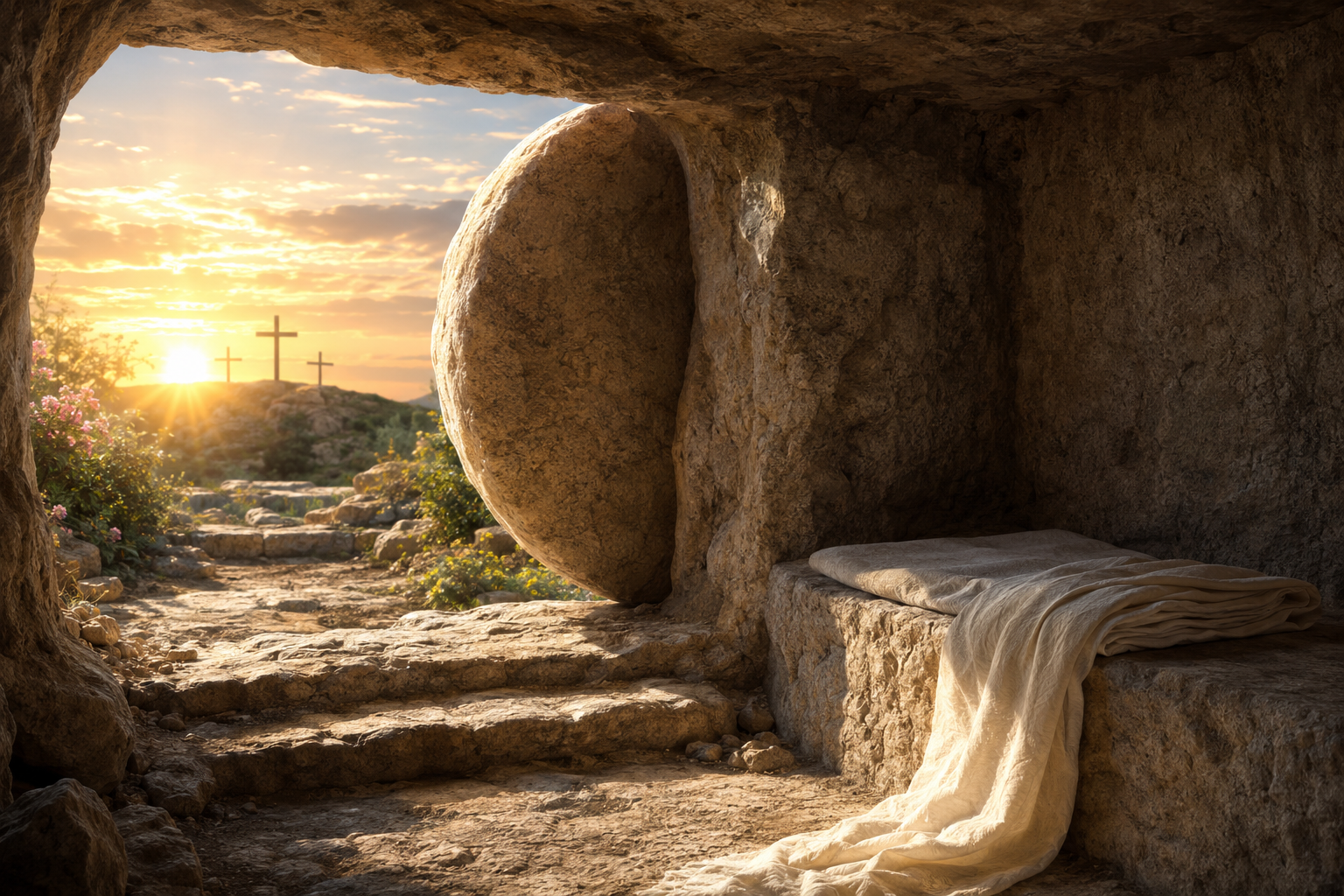
“laid it in his own new tomb, which he had hewn out in the rock”
— Matthew 27:60
He rolled a great stone to the door and departed.
This corresponds strikingly with Isaiah 53:9, which says of the Messiah:
“he made his grave with the wicked, and with the rich in his death.”
Mary Magdalene and “the other Mary” remained opposite the sepulchre.
Matthew Henry also notes the connection between the burial in the rich man’s tomb and Isaiah 53:9.
The Sepulchre Is Secured — Matthew 27:62–66
On the following day, the chief priests and Pharisees came to Pilate and remembered that Jesus had said:
“After three days I will rise again.”
— Matthew 27:63
They requested that the sepulchre be secured lest the disciples steal the body and claim He had risen.
Pilate answered:
“Ye have a watch: go your way, make it as sure as ye can.”
— Matthew 27:65
Matthew concludes:
“So they went, and made the sepulchre sure, sealing the stone, and setting a watch.”
— Matthew 27:66
Their precautions become important to the narrative of Matthew 28. The tomb was not portrayed as carelessly abandoned. It was sealed and watched.
Matthew Henry appropriately observes that human efforts to secure the tomb could not withstand the power of God.
Matthew 28 — The Resurrection and Great Commission
Matthew 28 opens with the resurrection of Jesus Christ and closes with the risen Lord claiming universal authority and commissioning His disciples to reach the nations.
The Empty Tomb — Matthew 28:1–8
Matthew says:
“In the end of the sabbath, as it began to dawn toward the first day of the week”
Mary Magdalene and the other Mary came to see the sepulchre.
There was “a great earthquake,” and:
“the angel of the Lord descended from heaven, and came and rolled back the stone from the door, and sat upon it.”
— Matthew 28:2
The angel’s countenance was “like lightning,” and his clothing was “white as snow.”
The keepers shook with fear “and became as dead men.”
The angel told the women:
“Fear not ye: for I know that ye seek Jesus, which was crucified. He is not here: for he is risen, as he said.”
— Matthew 28:5–6
This is the central declaration of the chapter:
“He is risen, as he said.”
The resurrection fulfilled Christ’s own repeated prediction. It was not an idea developed by the disciples after His death. According to Matthew, Jesus had said beforehand that He would rise, and the angel announced that He had done exactly that.
The women were invited to:
“Come, see the place where the Lord lay.”
They were then commanded:
“go quickly, and tell his disciples that he is risen from the dead.”
They departed “with fear and great joy.”
Matthew Henry emphasizes that Christ’s resurrection brings joy to His followers and that the women were sent promptly to carry the message to the disciples.
Jesus Appears to the Women — Matthew 28:9–10
As the women went to tell the disciples, Jesus Himself met them and said:
“All hail.”
Matthew records:
“And they came and held him by the feet, and worshipped him.”
— Matthew 28:9
This is strong textual evidence for a bodily resurrection. They held His feet. The risen Christ was not presented merely as an idea, influence, memory, or disembodied symbol.
Jesus told them:
“Be not afraid: go tell my brethren that they go into Galilee, and there shall they see me.”
— Matthew 28:10
He also received their worship. Matthew records no rebuke of that worship.
The False Report — Matthew 28:11–15
Some of the watch went into the city and told the chief priests “all the things that were done.”
After consulting with the elders, the rulers gave the soldiers “large money” and instructed them to say:
“His disciples came by night, and stole him away while we slept.”
— Matthew 28:13
They also promised to persuade the governor if the matter came to his attention.
Matthew says:
“So they took the money, and did as they were taught.”
— Matthew 28:15
The KJV explicitly presents the stolen-body story as a report purchased and instructed by the religious leaders, not as Matthew’s explanation for the empty tomb.
Matthew adds that this saying “is commonly reported among the Jews until this day.”
Matthew Henry points out the internal weakness in the allegation: men who were asleep could not reliably testify to what supposedly happened while they slept.
Jesus Appears to the Eleven — Matthew 28:16–17
The eleven disciples went:
“away into Galilee, into a mountain where Jesus had appointed them.”
— Matthew 28:16
Matthew says:
“And when they saw him, they worshipped him: but some doubted.”
— Matthew 28:17
The verse explicitly records both worship and doubt. Matthew does not specify in this verse exactly which individuals doubted or precisely what form that doubt took. It is therefore best not to go beyond the wording given.
The important point in the narrative is that the risen Jesus then speaks authoritatively to them.
The Great Commission — Matthew 28:18–20
Jesus declares:
“All power is given unto me in heaven and in earth.”
— Matthew 28:18
The word “all” is comprehensive. The risen Christ possesses authority in heaven and earth.
He commands:
“Go ye therefore, and teach all nations”
— Matthew 28:19
The commission is not restricted to Israel. The disciples are sent to all nations.
The command continues:
“baptizing them in the name of the Father, and of the Son, and of the Holy Ghost”
This verse explicitly places the Father, Son, and Holy Ghost together in the baptismal command and is an important biblical testimony to the doctrine of the Trinity.
Jesus then commands:
“Teaching them to observe all things whatsoever I have commanded you”
— Matthew 28:20
The Great Commission therefore involves more than obtaining professions of faith. It includes going, making disciples through the preaching of Christ, baptizing believers, and teaching them to observe Christ’s commands.
Within historic Baptist ecclesiology, this commission is understood as continuing through New Testament churches. Matthew 28 itself directly records the commission as spoken to the eleven disciples; the continuation of evangelism, baptism, and teaching in Acts shows these functions being carried out after Christ’s ascension.
Finally Jesus promises:
“and, lo, I am with you alway, even unto the end of the world. Amen.”
— Matthew 28:20
The Gospel that began by identifying Jesus as “Emmanuel,” meaning “God with us” (Matthew 1:23), appropriately closes with the risen Christ promising His continuing presence with His servants.
Key People and Places
- Jesus Christ — The central Person of both chapters: condemned, mocked, crucified, dead, buried, risen, worshipped, and possessing “all power…in heaven and in earth.”
- Judas Iscariot — The betrayer who acknowledged that he had “betrayed the innocent blood,” returned the silver, and hanged himself.
- Pontius Pilate — Identified by Matthew as the governor. He questioned Jesus, declared Him a “just person,” released Barabbas, and delivered Jesus to be crucified.
- Pilate’s wife — Warned Pilate to have nothing to do with “that just man” because she had suffered in a dream concerning Him.
- Barabbas — A “notable prisoner” released while Jesus was delivered for crucifixion.
- Chief priests and elders — Sought Christ’s death, persuaded the multitude concerning Barabbas, later requested that the tomb be secured, and in Matthew 28 paid the soldiers to promote a false account.
- Roman soldiers — Mocked Jesus before His crucifixion. Soldiers also guarded the sepulchre.
- Simon of Cyrene — Compelled to bear Jesus’ cross.
- The two thieves — Crucified with Jesus, one on each side.
- The centurion and those with him — Saw the events surrounding Christ’s death and confessed, “Truly this was the Son of God.”
- Mary Magdalene — Witnessed events surrounding the burial, came to the tomb, received the resurrection announcement, and met the risen Christ.
- The other Mary — Accompanied Mary Magdalene to the sepulchre and encountered the risen Lord.
- Joseph of Arimathaea — A rich man and disciple of Jesus who obtained Christ’s body and placed it in his own new tomb.
- The angel of the Lord — Descended at the sepulchre, rolled back the stone, and announced, “He is risen, as he said.”
- The eleven disciples — Met Jesus in Galilee, worshipped Him, and received the Great Commission.
- Jerusalem / “the holy city” — The setting surrounding Christ’s trial and crucifixion; Matthew also says the resurrected saints appeared in “the holy city.”
- Golgotha — “A place of a skull,” where Jesus was crucified.
- Arimathaea — Joseph’s place of origin.
- The sepulchre — Joseph’s new rock-hewn tomb in which Jesus’ body was laid; it was later sealed and guarded.
- Galilee — The region where Jesus directed His disciples to meet Him after His resurrection.
- The appointed mountain in Galilee — The specific mountain is not named in Matthew 28. Scripture says only that it was “a mountain where Jesus had appointed them.”
Main Doctrinal or Spiritual Themes
1. The Sinlessness and Innocence of Christ
Matthew repeatedly emphasizes Christ’s innocence.
Judas confessed:
“I have betrayed the innocent blood.”
— Matthew 27:4
Pilate called Him:
“this just person”
— Matthew 27:24
Pilate had also asked:
“Why, what evil hath he done?”
— Matthew 27:23
Christ suffered not for sins of His own, but as the sinless Saviour.
2. The Substitutionary Death of Christ
Matthew 27 records the historical death itself. Earlier statements in Matthew explain its purpose.
Jesus said He came:
“to give his life a ransom for many.”
— Matthew 20:28
And concerning His blood:
“which is shed for many for the remission of sins.”
— Matthew 26:28
The cross is therefore not merely an example of courage, suffering, or love. Christ gave Himself as the ransom for sinners.
This agrees with 1 Peter 2:24:
“Who his own self bare our sins in his own body on the tree.”
Salvation is received by faith in Christ, not earned by religious works, ceremonies, reform, or human merit.
3. Fulfilled Scripture
Matthew repeatedly presents the events surrounding Christ’s death as fulfillment of Scripture.
The thirty pieces of silver, the dividing of His garments, His burial with a rich man, and His cry from the cross all connect the passion of Christ with previous revelation.
The events were not outside God’s knowledge or redemptive purpose.
4. The Reality of Christ’s Death
Matthew does not portray Jesus as merely fainting or appearing to die.
He explicitly says:
“yielded up the ghost.”
Joseph then received His body and buried it. A great stone closed the tomb. The tomb was subsequently sealed and guarded.
The resurrection in Matthew 28 is therefore resurrection from death, not recovery from unconsciousness.
5. The Bodily Resurrection of Jesus Christ
The bodily resurrection is central to Matthew 28.
The tomb was empty.
The angel said:
“He is risen.”
The women:
“held him by the feet.”
They worshipped Him.
The eleven subsequently saw Him.
The risen Christ spoke with them.
This is historical resurrection, not allegory.
The bodily resurrection is essential to the Gospel. As 1 Corinthians 15:17 says:
“And if Christ be not raised, your faith is vain; ye are yet in your sins.”
But Christ is risen.
6. The Deity and Authority of Christ
Jesus receives worship after His resurrection and declares:
“All power is given unto me in heaven and in earth.”
His authority is not regional, temporary, or merely political. It extends to heaven and earth.
The centurion’s declaration also identifies Him as:
“the Son of God.”
7. The Trinity
Matthew 28:19 gives one of Scripture’s clearest Trinitarian formulas:
“in the name of the Father, and of the Son, and of the Holy Ghost”
Historic Baptist doctrine rightly confesses one God eternally existing as Father, Son, and Holy Ghost—distinct Persons, yet one God.
8. Evangelism and Missions
The risen Christ commands:
“Go ye therefore, and teach all nations.”
The Gospel is to be carried beyond one people or geographical region.
Biblical missions means preaching Christ and His saving Gospel to all people. Salvation remains by grace through faith, apart from works:
“For by grace are ye saved through faith…Not of works, lest any man should boast.”
— Ephesians 2:8–9
9. Believer’s Baptism and Discipleship
Those reached through the Gospel are to be baptized and taught.
The Great Commission joins evangelism with baptism and continued instruction:
“Teaching them to observe all things whatsoever I have commanded you.”
Baptism does not purchase salvation. Scripture distinguishes believing from the outward ordinance. In Acts, those who received the word were baptized (Acts 2:41). The biblical order is faith followed by baptism.
10. Human Opposition Cannot Defeat God’s Purpose
Christ’s enemies sealed the stone and set a watch.
Yet the next chapter begins with an earthquake, an angel, and an empty tomb.
Human authority could crucify Christ according to God’s permitted purpose, but human authority could not keep Him in the grave.
As Jesus had said:
“I have power to lay it down, and I have power to take it again.”
— John 10:18
11. Truth and Deliberate Unbelief
Matthew 28 presents a sobering contrast.
The guards experienced the events at the tomb and reported “all the things that were done.” Yet money was given to promote another explanation.
This demonstrates that rejection of truth is not always caused by lack of information. Sinful interests can lead people to resist evidence placed before them.
Matthew Henry makes the same practical observation concerning the bribed report and the unwillingness of men to receive plain evidence.
Practical Applications or Lessons
Christ Must Be Received as Saviour, Not Merely Admired
Matthew 27–28 demands more than admiration for Jesus’ courage or sympathy for His suffering.
He died for sinners and rose again.
The biblical response is faith:
“Believe on the Lord Jesus Christ, and thou shalt be saved.”
— Acts 16:31
A person is not saved by baptism, church membership, reform, sorrow, religious ceremony, or good works. Salvation is through faith in Christ and His finished work.
Acknowledging Guilt Is Not the Same as Trusting Christ
Judas said:
“I have sinned.”
That confession of wrongdoing is explicitly recorded. Yet Matthew immediately records his despair and suicide.
The passage does not present remorse, returning money, or acknowledging one’s wrongdoing as substitutes for saving faith. Conviction of sin should drive the sinner to Christ, where forgiveness is freely offered.
Pressure From the Crowd Does Not Make Wrong Right
Pilate knew envy was involved, heard his wife’s warning, questioned what evil Jesus had done, and publicly called Him a just person.
Nevertheless, he delivered Him to be crucified.
A believer must not allow social pressure, popularity, or fear of disturbance to replace obedience to truth.
Religious Leadership Can Oppose God
The chief priests and elders possessed religious office, yet Matthew records them opposing Christ, requesting the securing of His tomb, and afterward participating in the false report concerning His resurrection.
Religious position is therefore no guarantee of spiritual truth.
Everything must be tested by the Word of God.
Human Attempts to Suppress God’s Truth Ultimately Fail
The tomb was sealed.
A watch was stationed.
Money was later paid to circulate another explanation.
Nevertheless:
“He is risen, as he said.”
Believers need not manipulate circumstances in order to protect God’s truth. They are commanded to proclaim it faithfully.
The Resurrection Turns Fear Into Joy and Service
The women departed from the tomb:
“with fear and great joy”
and ran to bring the disciples word.
The knowledge of the risen Christ should move the believer toward faithful service rather than passive religious sentiment.
Worship Belongs to Christ
The women worshipped Jesus.
The disciples worshipped Jesus.
He accepted that worship.
The believer therefore rightly worships Jesus Christ as Lord and God, not merely as a teacher or prophet.
Every Christian Has an Interest in the Work of the Great Commission
Christ’s command reaches “all nations.”
While Matthew directly records these words as spoken to the eleven, the New Testament shows the work of Gospel preaching, baptism, and teaching continuing through Christ’s churches.
Believers should therefore care about soul winning, missions, sound doctrine, baptism, discipleship, and the establishment of faithful churches.
Converts Must Be Taught, Not Merely Counted
Christ did not stop with:
“Go.”
He commanded:
“Teaching them to observe all things whatsoever I have commanded you.”
Evangelism that produces a profession but neglects biblical teaching falls short of the full pattern of the Great Commission.
New believers need the Word of God, sound doctrine, a faithful New Testament church, and instruction in Christian obedience.
Christ’s Presence Gives Courage for Christian Service
Matthew closes with one of Scripture’s great promises:
“lo, I am with you alway, even unto the end of the world. Amen.”
The believer does not serve an absent or defeated Saviour.
The One who sends His servants possesses “all power…in heaven and in earth” and promises His presence with them.
Overall Message of Matthew 27–28
Matthew 27 presents man’s rejection of the King. He is betrayed, falsely accused, mocked, crucified, and buried.
Matthew 28 presents God’s triumphant answer:
“He is not here: for he is risen, as he said.”
The cross accomplished the saving work for which Christ came. The grave could not hold Him. The risen Christ possesses all authority and now sends His servants with the Gospel to all nations.
The closing movement of Matthew may therefore be summarized directly from the KJV:
Christ died. Christ was buried. Christ rose again. Christ is Lord. Christ is to be preached to all nations.
The proper response is not speculation but faith, worship, obedience, evangelism, and confidence in the risen Lord Jesus Christ.
Comments are closed