Chapter Summaries
Jeremiah 6
 Jeremiah 6 continues the warning of coming judgment upon Judah and Jerusalem. The chapter opens with an urgent call to flee out of Jerusalem because evil is about to break forth “from the north, and a great destruction” (Jer. 6:1). The enemy is pictured as shepherds with their flocks encamping against Zion, preparing to devour the city. The tone is one of alarm, because God is no longer merely warning in general terms; He is declaring that the invasion is appointed and certain because of Judah’s wickedness.
The sin of Jerusalem is described as continual and overflowing corruption. The city “casteth out her wickedness” like a fountain casts out waters (Jer. 6:7). Violence, spoil, grief, and wounds are before the Lord continually. This language shows that Judah’s sin was not occasional weakness but a settled condition. They had become spiritually diseased. God calls them to be instructed, but there is the solemn possibility that He will make Jerusalem desolate if they refuse correction (Jer. 6:8). This reveals both the holiness of God and His patience: He warns before He wounds, but He will not overlook persistent rebellion forever.
Jeremiah then speaks of the people’s refusal to hear the Word of God. “Their ear is uncircumcised, and they cannot hearken” (Jer. 6:10). The problem was not lack of truth but lack of heart. The Word of the LORD had become “a reproach” unto them; they had “no delight in it.” This is a key spiritual mark of apostasy. When men begin to despise the preached Word, judgment is not far behind. Jeremiah is full of the fury of the LORD and is weary with holding it in, because judgment must be proclaimed to all ages and classes, from children to old men (Jer. 6:11).
The chapter especially condemns corrupt leadership. “From the prophet even unto the priest every one dealeth falsely” (Jer. 6:13). They treated the nation’s mortal wound as though it were minor, saying, “Peace, peace; when there is no peace” (Jer. 6:14). This is one of the great themes of Jeremiah: false religion speaks soothing words when repentance is needed. These leaders were not ashamed of abominations and did not even know how to blush (Jer. 6:15). Such shamelessness reveals a hardened conscience.
Jeremiah 6 also contains a gracious call to return to old paths: “Stand ye in the ways, and see, and ask for the old paths, where is the good way, and walk therein” (Jer. 6:16). This is a call back to God’s revealed way, not to human tradition for its own sake, but to the ancient path of covenant obedience. Yet the people answered, “We will not walk therein.” Likewise, watchmen were set over them, but they refused to hearken to the trumpet warning (Jer. 6:17). God therefore calls the nations and the earth to hear that He will bring evil upon this people because they rejected His words and despised His law (Jer. 6:19).
The chapter closes by declaring that outward religious offerings could not substitute for obedience. Their incense from Sheba and sweet cane from a far country were unacceptable because their hearts were far from God (Jer. 6:20). The people would stumble under judgment, and the northern enemy would come cruelly and without mercy (Jer. 6:22–23). Jeremiah is told that he has been made a tester of the people, but they are found to be “reprobate silver” because “the LORD hath rejected them” (Jer. 6:30). The image is of metal that cannot be refined because the impurity is too deeply fixed. It is a fearful picture of a people who have resisted correction until only judgment remains.
Jeremiah 7
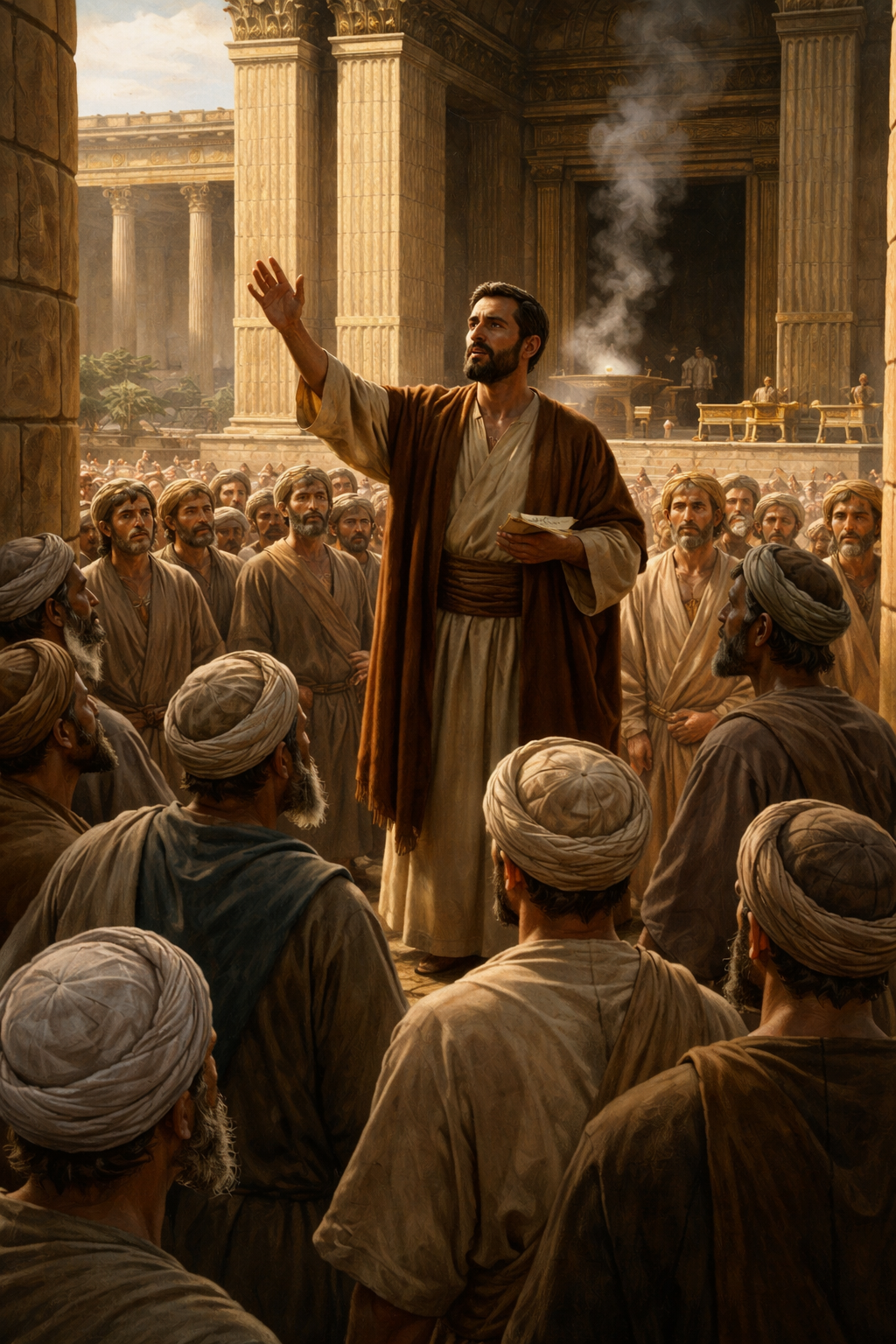
Jeremiah 7 records the famous temple sermon. Jeremiah is commanded to stand in the gate of the LORD’s house and preach to those who enter to worship (Jer. 7:2). This setting is important. The message is delivered not to pagans but to covenant people engaged in religious activity. God calls them to “Amend your ways and your doings” if they would remain in the land (Jer. 7:3). Their chief deception was misplaced confidence in the temple itself. They repeated, “The temple of the LORD, The temple of the LORD, The temple of the LORD, are these” (Jer. 7:4), as though possession of the sacred building guaranteed safety regardless of their conduct.
The Lord lays out what true repentance would involve: executing judgment between a man and his neighbour, refraining from oppressing the stranger, fatherless, and widow, not shedding innocent blood, and not walking after other gods (Jer. 7:5–6). God has always required moral obedience and covenant faithfulness, not mere ceremonial attachment. Yet the people were guilty of stealing, murdering, committing adultery, swearing falsely, burning incense unto Baal, and walking after other gods, then coming into the house called by God’s name and saying, “We are delivered to do all these abominations” (Jer. 7:9–10). They treated the temple like a religious cover for an ungodly life.
The Lord asks, “Is this house, which is called by my name, become a den of robbers in your eyes?” (Jer. 7:11). The temple was intended as a place of worship, but they had turned it into a refuge for hypocrites. The Lord points them back to Shiloh, where the tabernacle had once stood, and reminds them that He judged that place because of Israel’s wickedness (Jer. 7:12–14). The lesson is plain: sacred history and sacred structures do not protect a disobedient people. If God judged Shiloh, He can judge Jerusalem.
The chapter becomes even more solemn when God tells Jeremiah not to pray for this people, for He will not hear (Jer. 7:16). This does not mean prayer is ordinarily useless, but it shows that Judah had reached a stage of rebellion where national judgment was determined. The people were engaged in family-wide idolatry, making offerings to the “queen of heaven” and provoking the Lord to anger (Jer. 7:18). Their sin was public, organized, and domestic. Whole households were participating in false worship.
God also declares that sacrifice was never meant to be detached from obedience. The emphasis in Jeremiah 7:22–23 is not that sacrifice was unlawful, since it was commanded in the Mosaic system, but that God’s primary demand was always obedience: “Obey my voice, and I will be your God, and ye shall be my people.” Yet from the day God brought them out of Egypt they had not obeyed, but had walked “in the imagination of their evil heart” and went “backward, and not forward” (Jer. 7:24). That is a piercing description of spiritual decline.
The people are called a nation that “obeyeth not the voice of the LORD their God, nor receiveth correction” (Jer. 7:28). Truth had perished from them. Their idolatry had even invaded the temple precincts, and they had built the high places of Tophet in the valley of Hinnom to burn sons and daughters in the fire (Jer. 7:30–31). This was an abomination utterly contrary to the law of God. Therefore the place would no more be called Tophet, but “the valley of slaughter” (Jer. 7:32). The chapter ends with a terrible picture of widespread death, unburied bodies, and the silencing of mirth and joy in Judah and Jerusalem (Jer. 7:33–34). God’s judgment would strip the land of its false gladness.
Jeremiah 8
Jeremiah 8 continues the theme of judgment and exposes the stubbornness of the people in even more searching terms. The opening verses describe the dishonor that will come upon Judah after death: the bones of kings, princes, priests, prophets, and inhabitants of Jerusalem will be brought out of their graves and spread before the sun, moon, and host of heaven, the very things they had loved and served (Jer. 8:1–2). This is a shameful reversal. Those who honored idols will be publicly disgraced before the idols that could not save them. It demonstrates the folly of idolatry and the shame that accompanies apostasy.
The chapter says that death will be preferred to life by the residue that remain of this evil family (Jer. 8:3). The suffering brought by divine judgment will be so severe that survival itself will feel unbearable. Yet even then the Lord asks why this people persist in backsliding. Men ordinarily rise when they fall and return when they have gone astray, but Judah “hold fast deceit, they refuse to return” (Jer. 8:5). Their sin is irrational. It is not merely weakness; it is stubborn refusal.
God contrasts Judah’s conduct with the instinctive order of creation. Even the stork, turtle, crane, and swallow know their appointed times, “but my people know not the judgment of the LORD” (Jer. 8:7). Birds follow God’s created order better than covenant people follow His revealed Word. This is a devastating rebuke. The people boasted in their possession of the law, but the lying pen of the scribes had handled it falsely, and the wise men were ashamed because they had rejected the word of the LORD (Jer. 8:8–9). Again the leaders are condemned for falsehood, greed, and superficial healing: “Peace, peace; when there is no peace” (Jer. 8:11).
Jeremiah repeats that they were not ashamed at all, neither could they blush (Jer. 8:12). That line shows how far conscience can decay. When sin no longer produces shame, judgment is near. God declares that He will surely consume them; there will be no grapes on the vine, nor figs on the fig tree, and the leaf shall fade (Jer. 8:13). These are covenant-judgment images, showing fruitlessness, withering, and removal of blessing. The people perceive the coming danger and say, in effect, that they should gather into defenced cities and sit in silence, because the LORD has given them water of gall to drink, “because we have sinned against the LORD” (Jer. 8:14). Even this confession is overshadowed by the inevitability of judgment.
The enemy from the north is again pictured advancing, causing the whole land to tremble (Jer. 8:16). God says, “I will send serpents, cockatrices, among you, which will not be charmed, and they shall bite you” (Jer. 8:17). The judgment will be inescapable. Human devices will not stop it.
The last part of the chapter turns especially sorrowful. Jeremiah speaks as the weeping prophet, grieving over the hurt of his people: “When I would comfort myself against sorrow, my heart is faint in me” (Jer. 8:18). He hears the cry of the daughter of his people from a far country, asking, “Is not the LORD in Zion? is not her king in her?” (Jer. 8:19). Yet the answer is that they have provoked Him with graven images and strange vanities. Then comes the mournful line, “The harvest is past, the summer is ended, and we are not saved” (Jer. 8:20). Opportunity has slipped away; the season for repentance and deliverance has been squandered.
The chapter closes with one of Jeremiah’s most memorable laments: “Is there no balm in Gilead; is there no physician there? why then is not the health of the daughter of my people recovered?” (Jer. 8:22). The point is not that there is no healing power with God, but that Judah has not been spiritually healed because she has refused the only cure—repentance before the Lord. The disease is moral and spiritual, and they have rejected the divine remedy.
Key People and Places
Jeremiah
The prophet of the LORD, called to proclaim coming judgment, expose hypocrisy, and plead for genuine repentance.
The LORD (Jehovah)
The covenant God of Israel, holy, just, patient, and righteous in judgment. These chapters especially emphasize His hatred of hypocrisy and idolatry.
The prophets
Many in Judah were false prophets who spoke lies, promised peace, and strengthened the people in rebellion rather than calling them to repentance.
The priests
Religious leaders who should have taught truth, but many had become corrupt and deceitful.
Kings and princes of Judah
Mentioned especially in Jeremiah 8:1 as among those who would suffer shame and judgment.
The people of Judah / Jerusalem
The covenant nation addressed in these chapters, guilty of formal religion without heart obedience.
Children and households
In Jeremiah 7:18 whole families are shown participating in idolatry, showing how deeply corruption had spread through society.
Jerusalem / Zion
The capital city and center of worship, yet spiritually polluted and ripe for judgment.
The temple / house called by God’s name
The place in which the people falsely trusted while living in disobedience. It had become, in their eyes, a “den of robbers.”
Shiloh
Former location of the tabernacle. It serves as a historical warning that God had judged a previous worship center because of sin.
Tophet / Valley of Hinnom
A place associated with child sacrifice. It becomes a symbol of terrible judgment, later called “the valley of slaughter.”
The north
The direction from which invading judgment would come, referring historically to the Babylonian threat, though other northern powers had also troubled the land.
Sheba
Mentioned in connection with costly incense, showing that expensive offerings cannot replace obedience.
Gilead
Known for balm; used in Jeremiah 8:22 as an image of healing, pointing to the tragedy of a people spiritually beyond recovery because they refused God’s remedy.
Main Doctrinal or Spiritual Themes
1. God’s holiness and righteous judgment
These chapters strongly reveal that God is not indifferent to sin. Violence, deceit, idolatry, injustice, and hypocrisy all provoke His wrath. His judgments are not arbitrary; they are morally righteous and covenantally deserved.
2. The danger of religious hypocrisy
Jeremiah 7 especially shows that outward worship without inward obedience is offensive to God. Mere attendance at the temple, possession of religious forms, and verbal profession cannot cover a wicked life. God sees through ceremony to the heart.
3. The authority of God’s Word
The people rejected the Word, had no delight in it, and would not hear the trumpet warning. This rejection lies at the center of their downfall. A nation, church, or individual that despises God’s Word places itself in grave danger.
4. The deceitfulness of false peace
False prophets and priests said, “Peace, peace; when there is no peace.” This theme warns against soothing messages that remove repentance, judgment, holiness, or conviction. Peace without truth is a lie.
5. The necessity of repentance
Again and again the Lord calls Judah to amend her ways, return to the old paths, receive correction, and obey His voice. The people’s tragedy was not that God gave no call, but that they refused it.
6. The corruption of the human heart
These chapters describe a people who cling to deceit, cannot blush, and refuse to return. Sin is not only external behavior; it is inward rebellion. This agrees with the broader biblical doctrine that man’s heart is fallen and needs divine grace.
7. Judgment beginning with God’s people
Jeremiah is not addressing heathen nations first, but Judah. Covenant privilege increases responsibility. Those nearest the truth are especially accountable for rejecting it.
8. The failure of outward religion to save
Incense, offerings, temple attendance, and national religious identity could not save Judah. Obedience to God and true covenant faithfulness were required. This principle remains spiritually important: external religion cannot replace reality.
9. The sorrow of faithful ministry
Jeremiah faithfully declares God’s message even while grieving over the people’s ruin. True preaching includes both firmness and compassion. The prophet does not delight in judgment; he mourns over sinners.
Practical Applications or Lessons
1. It is dangerous to trust in religious form without a changed heart
A person may attend church, know religious language, and identify with truth outwardly, yet still be far from God. The temple could not save Judah, and empty form cannot save anyone today.
2. God’s people must love and receive the Word of God
When the Bible becomes a reproach instead of a delight, spiritual decline is already underway. Believers should cultivate a tender ear, a submissive spirit, and a hunger for truth.
3. False preaching is deadly
Messages that ignore sin, soften judgment, and promise peace apart from repentance do not help souls. Faithful preaching must deal honestly with sin and point men to God’s truth.
4. The old paths are still the good way
Jeremiah 6:16 teaches the value of God’s established way. For believers, this means returning continually to Scriptural doctrine, holy living, reverent worship, and obedience rather than chasing novelty.
5. Sin hardens when it is defended
Judah reached the point where they would not blush. Repeatedly excusing sin makes the conscience dull. Believers must respond quickly to conviction and keep short accounts with God.
6. Leadership carries serious responsibility
The prophets and priests misled the people. Teachers, pastors, fathers, and ministry leaders must speak truth plainly and live honestly before God, because others are affected by their faithfulness or compromise.
7. Family life should be guarded from idolatry
In Jeremiah 7 whole households participated in false worship. Modern believers must watch what is normalized in the home. False gods today may appear as money, pleasure, entertainment, ambition, or worldly compromise.
8. Opportunities to repent do not last forever
“The harvest is past, the summer is ended, and we are not saved” is a sobering reminder that neglected grace brings loss. Men should not presume upon future opportunities to get right with God.
9. Compassion should accompany warning
Jeremiah’s tears remind us that speaking truth should not make us cold or proud. A faithful servant of God warns plainly and grieves sincerely for those who are perishing.
10. God alone has the true remedy for spiritual disease
The question about balm in Gilead points us to the deeper truth that man’s greatest need is spiritual healing. Sin’s wound is real, and only the Lord can heal through repentance and faith in His provision.
Comments are closed