Chapter Summaries
Esther Chapter 1 — The Deposition of Queen Vashti
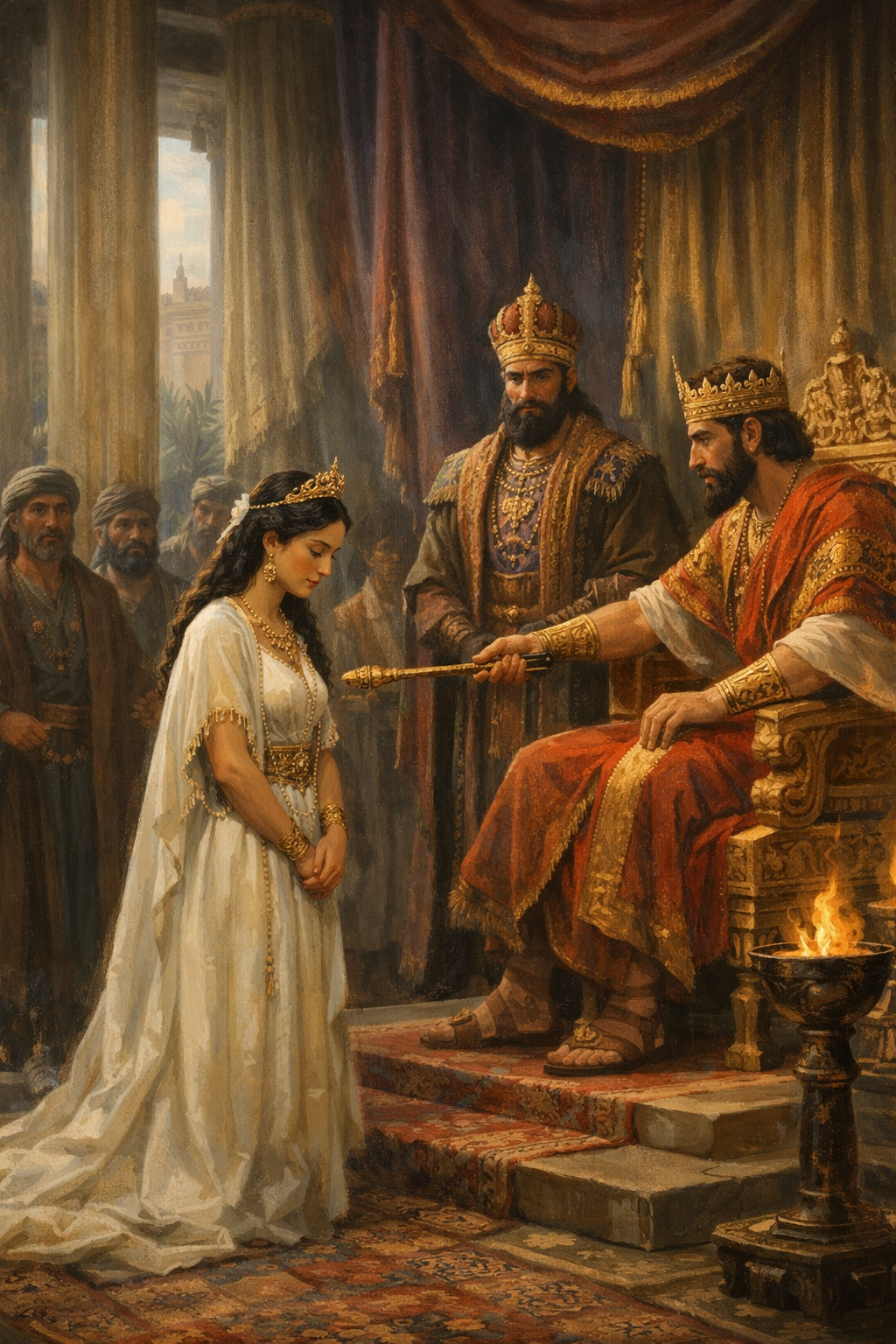
 King Ahasuerus (commonly identified with Xerxes I) reigns over a vast Persian empire, extending “from India even unto Ethiopia” (Esther 1:1, KJV). He hosts an extravagant feast for princes and nobles, displaying the wealth and glory of his kingdom. Afterward, he holds a seven-day feast in Shushan for the people present in the palace.
When the king, “merry with wine,” commands Queen Vashti to appear and display her beauty, she refuses. This act of disobedience is viewed not merely as personal defiance but as a threat to royal authority throughout the empire. Following counsel from his princes, Ahasuerus removes Vashti from being queen and decrees that her royal estate be given “to another that is better than she” (Esther 1:19, KJV).
Historical and doctrinal note:
Persian law emphasized the immutability of royal decrees. Vashti’s removal sets in motion God’s unseen providence, though His name is not mentioned in the book.
Esther Chapter 2 — Esther Chosen as Queen
Following Vashti’s removal, a search is conducted for fair young virgins throughout the empire. Among them is Esther, also called Hadassah, a Jewish orphan raised by her cousin Mordecai. Esther is taken into the king’s house but, at Mordecai’s instruction, conceals her Jewish identity.
Esther finds favor with Hegai, and ultimately with the king himself, who “loved Esther above all the women” and makes her queen (Esther 2:17, KJV).
At the chapter’s close, Mordecai uncovers a plot by two chamberlains to assassinate the king. The matter is reported through Esther, investigated, and recorded in the royal chronicles—an act that will later prove crucial.
Doctrinal note:
God’s providence is evident in the timing, favor, and recording of events. Though unseen, the Lord is actively preserving His covenant people.
Esther Chapter 3 — Haman’s Plot Against the Jews
Ahasuerus promotes Haman the Agagite to a position of great authority. All servants bow to him except Mordecai, who refuses. The text does not state Mordecai’s explicit reasoning, but his refusal is consistent with Jewish faithfulness and separation from idolatrous honor.
Enraged, Haman seeks not only Mordecai’s destruction but that of all Jews throughout the empire. Casting “Pur” (lots), he determines a date for their annihilation and secures the king’s approval through deceit, offering silver and framing the Jews as disobedient to the king’s laws.
A decree is issued to destroy, kill, and cause to perish all Jews in one day (Esther 3:13, KJV). While the city of Shushan is perplexed, Haman and the king sit down to drink.
Historical and doctrinal note:
Haman’s lineage as an Agagite links him to Israel’s ancient enemies (cf. Amalek), highlighting the ongoing conflict between God’s people and those who oppose His purposes.
Key People and Places
- Ahasuerus — Persian king whose decisions, though often fleshly, are used by God to fulfill His purposes.
- Vashti — Queen removed for disobedience, illustrating authority and consequence.
- Esther — Jewish maiden raised to queenship for such a time as this (anticipatory theme).
- Mordecai — Faithful Jew whose integrity and vigilance preserve the king and later the nation.
- Haman — Proud enemy of the Jews, motivated by hatred and ambition.
- ) — Capital city of Persia and primary setting of the narrative.
Main Doctrinal and Spiritual Themes
- The Providence of God
Though God is not named, His sovereign hand directs events, timing, and outcomes (cf. Proverbs 21:1). - Authority and Accountability
Rebellion against God-ordained authority brings consequences, yet God remains supreme over human rule. - Separation and Faithfulness
Mordecai’s refusal to bow reflects fidelity to God over cultural or political pressure. - Conflict Between God’s People and the World
Haman’s hatred toward the Jews exemplifies Satanic opposition to God’s redemptive line. - Preservation of Israel
God preserves His covenant people, ensuring the lineage through which Messiah would come.
Practical Applications or Lessons
- God is at work even when unseen. Believers must trust His providence when circumstances appear chaotic or unjust.
- Faithfulness matters in small things. Mordecai’s daily conduct and vigilance were used mightily by God.
- Pride leads to destruction. Haman’s self-exaltation becomes the seed of his downfall.
- Obedience to God outweighs fear of man. God honors those who stand firm without compromise.
- God keeps His promises. The survival of the Jewish people affirms the reliability of God’s covenant purposes.
Comments are closed