Chapter Summaries
1 Kings 9 — God’s Covenant Promise and Conditional Warning
After Solomon finishes the house of the LORD, his own house, and all his desire, the LORD appears to Solomon the second time (9:2), as He did at Gibeon. God confirms His promise to sanctify the temple where His name will be placed for ever, and His eyes and heart will be there perpetually (9:3).
Yet this assurance is paired with a solemn warning. If Solomon or Israel turn aside to serve other gods, the LORD will cut Israel off out of the land and make the house a proverb and a byword (9:6–9). Blessing is clearly tied to obedient faithfulness, not mere possession of sacred things.
The chapter also records Solomon’s administrative and building activities:
-
The exchange of cities with Hiram king of Tyre
-
The levying of tribute labor from the remaining Canaanite peoples
-
The organization of Israel’s workforce
-
Solomon’s continued worship, offering sacrifices at appointed seasons (9:25)
The chapter emphasizes that external prosperity and religious activity cannot replace obedience of heart.
1 Kings 10 — The Glory of Solomon and the Test of Wisdom
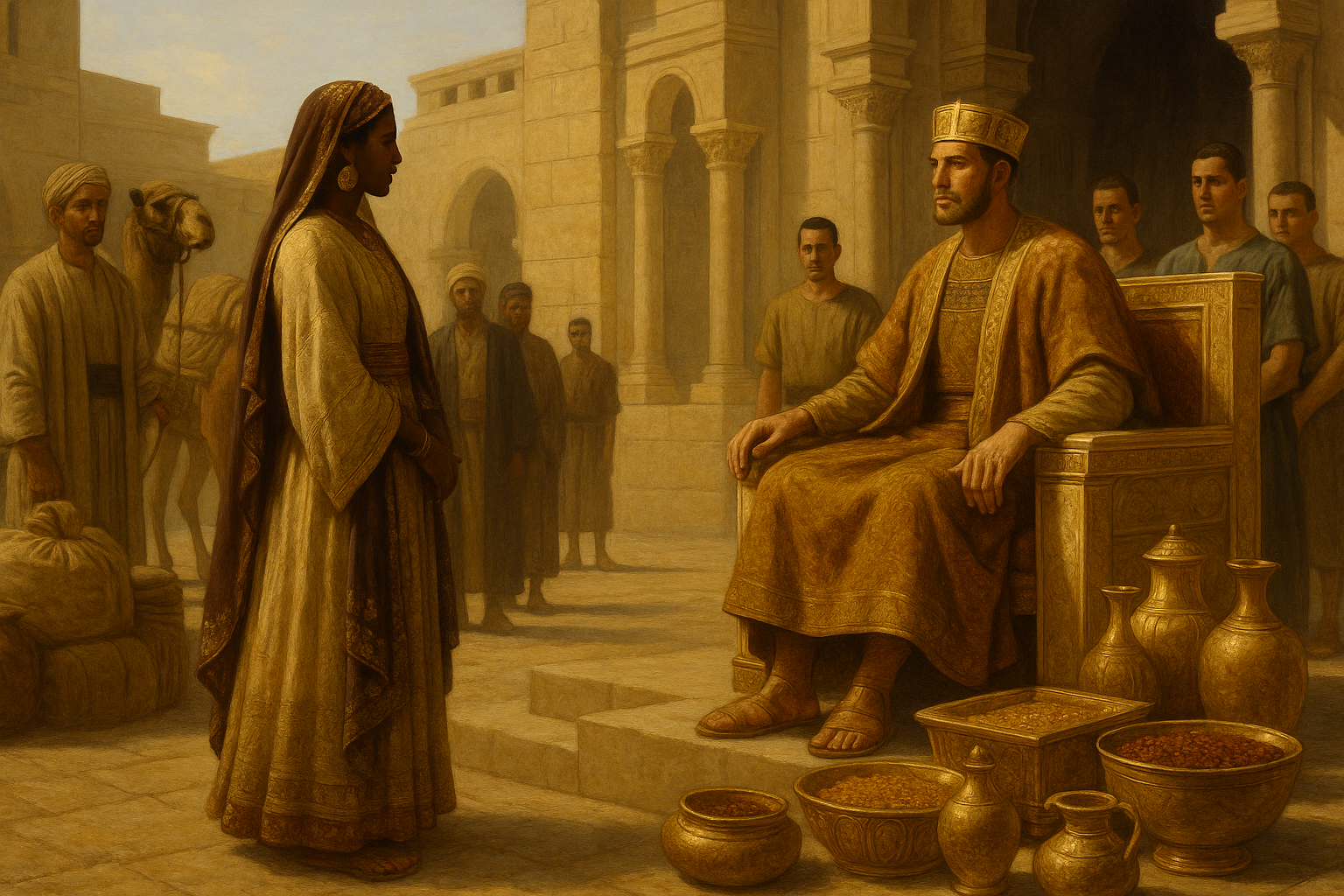
 This chapter highlights the height of Solomon’s earthly glory. The queen of Sheba comes to Jerusalem to test Solomon with hard questions, having heard of his fame concerning the name of the LORD (10:1). Solomon answers all her questions, and nothing is hidden from him.
She witnesses:
-
His wisdom
-
His orderly servants
-
His provision and administration
-
His ascent by which he went up unto the house of the LORD
Overwhelmed, she acknowledges that the LORD blessed Solomon and set him on the throne because of His love for Israel (10:9).
The chapter then details Solomon’s wealth:
-
Vast quantities of gold
-
Ivory throne overlaid with gold
-
Shields, vessels, and luxuries
-
International trade and honor
Yet the chapter subtly prepares the reader for later decline. The accumulation of gold, horses, and international alliances—though impressive—echoes warnings given earlier in Scripture concerning kings who multiply wealth and power beyond God’s design.
Key People and Places
-
Solomon — King of Israel; recipient of divine wisdom and blessing, yet under covenant obligation.
-
The LORD (Jehovah) — Covenant-keeping God who blesses obedience and judges apostasy.
-
— Gentile ruler drawn by Solomon’s God-given wisdom; a witness to God’s glory among the nations.
-
Hiram, king of Tyre — Ally in commerce and construction.
-
Jerusalem — Political and spiritual center of Israel.
-
The House of the LORD (Temple) — Central place of worship where God places His name.
Main Doctrinal or Spiritual Themes
-
Conditional Blessing under the Mosaic Covenant — God’s promises to Israel are real but tied to obedience.
-
God’s Holiness and Faithfulness — The LORD will not tolerate idolatry, even in a glorious kingdom.
-
Wisdom as a Testimony to the Nations — God’s wisdom displayed in His servant draws Gentiles to acknowledge Him.
-
Danger of Prosperity — Material abundance can precede spiritual decline if not governed by obedience.
-
God’s Name and Presence — The temple symbolizes God’s dwelling, but obedience sustains the relationship.
Practical Applications or Lessons
-
Spiritual privilege does not cancel moral responsibility.
-
Past blessings do not guarantee future faithfulness.
-
God’s wisdom should point others to the LORD, not to ourselves.
-
Prosperity must be stewarded with humility and obedience.
-
True worship involves obedience, not merely offerings or buildings.
Comments are closed