1 KINGS 8
CHAPTER SUMMARY
 1 Kings 8 records one of the most important moments in Old Testament history: the dedication of Solomon’s Temple. After seven years of construction (cf. 1 Kings 6:38), the ark of the covenant is brought from the city of David (Zion) to the completed Temple. Solomon gathers “all the elders of Israel” and “all the men of Israel” (v. 1–2) for this sacred event. The priests take up the ark, the tabernacle vessels, and the holy furnishings, placing them in the most holy place under the wings of the cherubim (vv. 3–7). Inside the ark are only “the two tables of stone” (v. 9), signifying God’s enduring covenant.
When the priests exit, “the cloud filled the house of the LORD” (v. 10). The glory of God is so overwhelming that the priests cannot stand to minister. This mirrors the cloud of God’s presence in Exodus 40:34–35, emphasizing that the Lord Himself accepts and sanctifies the Temple. Solomon then blesses the congregation, acknowledging that God has fulfilled His promise to David (vv. 14–21).
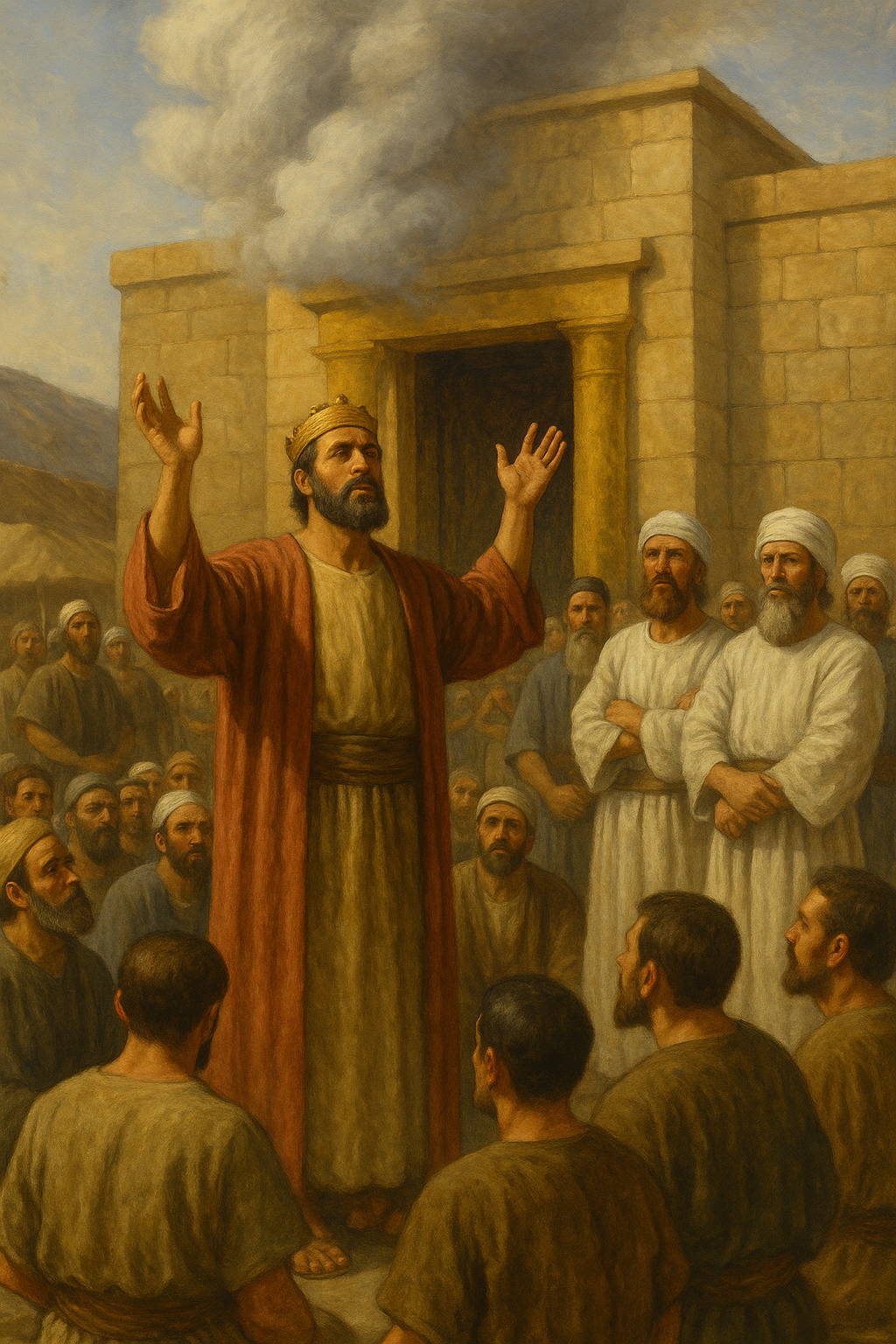
Solomon stands before the altar, spreads forth his hands toward heaven (v. 22), and prays a majestic dedication prayer. He proclaims that “there is no God like thee” (v. 23). He affirms God’s transcendence—“behold, the heaven and heaven of heavens cannot contain thee” (v. 27)—yet requests that God’s “eyes may be open” toward this place of prayer (v. 29). Solomon presents seven scenarios in which Israel might pray toward the Temple—each involving sin, repentance, chastening, or need—and asks God to hear and forgive (vv. 31–53). These include judgments between man and man, military defeat, drought, famine, pestilence, captivity, and foreigners seeking the true God.
After finishing the prayer, Solomon blesses the nation again, declaring, “Let your heart therefore be perfect with the LORD our God” (v. 61). The chapter ends with an immense sacrifice—22,000 oxen and 120,000 sheep (v. 63)—as Israel keeps a fourteen-day celebration of joy before the Lord (vv. 65–66).
KEY PEOPLE AND PLACES
Solomon
King of Israel, son of David, presides over the Temple dedication; his prayer demonstrates spiritual insight, humility, and covenant faithfulness.
The Priests and Levites
Carry the ark, minister during the dedication, and witness the overwhelming glory-cloud of God.
Israel (the Congregation)
“All Israel” gathers for this national spiritual moment, uniting around God’s presence and His appointed worship.
The Ark of the Covenant
Symbol of God’s covenant and presence, placed in the Most Holy Place under the wings of the cherubim.
The Temple in Jerusalem
Newly completed permanent house of worship replacing the portable tabernacle; the center of national spiritual life.
MAIN DOCTRINAL OR SPIRITUAL THEMES
1. God’s Holiness and Glory
The cloud filling the Temple demonstrates God’s absolute holiness. His glory overwhelms human ability and demands reverence.
2. God’s Faithfulness to His Promises
Solomon repeatedly notes that God fulfilled His word to David (vv. 15–20). God keeps covenant promises without fail.
3. The Sinfulness of Man
Solomon openly acknowledges, “there is no man that sinneth not” (v. 46). The dedication prayer is built around repeated need for divine forgiveness.
4. Prayer and Forgiveness
The Temple becomes the designated place toward which Israel should pray. Solomon emphasizes confession, repentance, and restoration.
5. God’s Universality and Exclusivity
Solomon declares there is none like God (v. 23), yet also prays that even “the stranger” who seeks the Lord may be heard (vv. 41–43). This is exclusivity of worship combined with the universal reach of God’s grace.
6. Obedience and Heart Devotion
Solomon urges Israel to “walk in all his ways” and keep His commandments (vv. 57–61). True worship requires obedience of heart, not ritual alone.
PRACTICAL APPLICATIONS OR LESSONS
1. God Deserves Reverence in Worship
The priests could not stand because of God’s glory. Modern believers should approach worship with humility, seriousness, and awe toward a holy God.
2. God Keeps His Promises
Just as He fulfilled His word to David, believers can trust God’s faithfulness today—whether in salvation, sanctification, or daily provision.
3. Prayer Must Be Rooted in Repentance
Solomon’s sevenfold prayer pattern shows that spiritual restoration begins with acknowledging sin, turning from it, and seeking God’s mercy.
4. God’s Presence Matters More Than Buildings
Even Solomon confessed the Temple could not contain God (v. 27). The church building is important, but it is not the measure of God’s power—His presence and Word are.
5. A Perfect (Whole) Heart Toward God
Solomon exhorts Israel to have a heart “perfect” (complete, loyal) toward the Lord. God desires wholehearted devotion from His people.
6. God Welcomes the Sincere Seeker
Even a foreigner praying toward the Temple would be heard. Salvation remains available to “whosoever” will call upon the Lord.
Comments are closed