Chapter Summaries
1 Kings 6 — The Building of the Temple
 This chapter records the construction of the Temple under King Solomon, in the fourth year of his reign, 480 years after Israel came out of Egypt (6:1). This precise dating emphasizes God’s faithfulness to His covenant promises. The Temple was built in Jerusalem on Mount Moriah, the site associated with Abraham and later David.
The structure followed God’s established pattern seen earlier in the tabernacle, yet on a permanent and glorious scale. The Temple was:
-
60 cubits long, 20 cubits wide, and 30 cubits high (6:2).
-
Constructed with stones made ready before they were brought, so that no hammer, axe, or tool of iron was heard in the house while it was in building (6:7). This reflects reverence, order, and separation unto God.
The inside was overlaid with pure gold, including:
-
The oracle (Most Holy Place) which housed the ark of the covenant.
-
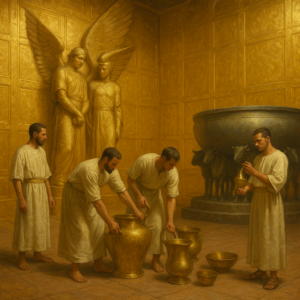
Two massive cherubims of olive wood, overlaid with gold, standing ten cubits tall with outstretched wings (6:23–28).
In verses 11–13, the LORD personally reminds Solomon that obedience is the condition for God’s dwelling among Israel:
“If thou wilt walk in my statutes… then will I perform my word with thee.”
The chapter closes by noting that the Temple took seven years to complete (6:38), underscoring patience, precision, and devotion.
1 Kings 7 — Solomon’s Palace and the Temple Furnishings
This chapter describes two major achievements:
1. Solomon’s Royal Buildings
Solomon built his own house and governmental complex over thirteen years—nearly double the time it took to build the Temple. These included:
-
The House of the Forest of Lebanon
-
The Porch of Judgment, where he rendered rulings
-
His personal residence
-
A house for Pharaoh’s daughter
These structures used massive cedars from Lebanon, stone foundations, and beams of great size—symbolizing national stability and royal authority.
2. The Temple Furnishings by Hiram
A skilled craftsman named Hiram from Tyre was commissioned to fashion the brass work. These included:
-
Two great pillars: Jachin (“He shall establish”) and Boaz (“In Him is strength”)
-
The molten sea (a massive basin for priestly cleansing)
-
Ten lavers
-
Numerous pots, shovels, bowls, and sacred furnishings
All construction followed divine order and symmetry. The chapter ends with the Temple fully furnished and prepared for worship.
Key People and Places
-
Solomon — King of Israel; builder of the Temple; acting under divine promise and responsibility.
-
Hiram (of Tyre) — Master craftsman who formed the brass furnishings.
-
Jerusalem — Location of the Temple and seat of worship.
-
Lebanon — Source of the cedars used in construction.
-
Tyre — Gentile city supplying labor and craftsmanship.
Main Doctrinal or Spiritual Themes
-
God’s Holiness — The Most Holy Place, separated and overlaid with gold, reflects the absolute holiness of God.
-
Conditional Fellowship — God promised His presence only if Solomon remained obedient (6:12–13).
-
Separation Unto God — The silent construction (no iron tools) pictures reverence and spiritual preparation.
-
Established Worship — The Temple replaced the tabernacle as the central place of worship, showing God’s desire for order in worship.
-
Divine Strength and Stability — The pillars Jachin and Boaz testify that God alone establishes and strengthens His work.
Practical Applications or Lessons
-
Reverence in Worship — God must be approached with honor, preparation, and obedience.
-
God Values Quiet Faithfulness — Just as the stones were prepared beforehand, believers are shaped privately before public service.
-
Obedience Sustains Blessing — God’s promises of presence are tied to walking in His statutes.
-
Spiritual Cleansing Is Essential — The molten sea reminds believers that daily cleansing is required for fruitful service.
-
God Builds for Eternity — The Temple’s precision and permanence reflect God’s eternal purposes, not temporary effort.
Comments are closed