
1 Samuel 28-31: Saul’s Fall and David’s Strength in the Lord
 First Samuel 28-31 records the closing events of Saul’s reign alongside David’s deliverance from a dangerous situation and his recovery of the captives taken from Ziklag. Saul faces the Philistine army with great fear and seeks forbidden spiritual counsel. David faces the loss of his household and the anger of his own men, but strengthens himself in the Lord and seeks God’s direction.
These chapters emphasize the seriousness of disobedience, the prohibition against consulting familiar spirits, the value of seeking the Lord, and the responsibility to treat others justly. They also record painful losses: Jonathan dies with his brothers, Saul takes his own life, and Israel suffers defeat.
Chapter Summaries
1 Samuel 28: Saul Seeks a Woman with a Familiar Spirit
The Philistine threat and David’s position
The Philistines gather their armies to fight Israel. Achish tells David that he and his men will accompany him in battle. David answers:
“Surely thou shalt know what thy servant can do.”
1 Samuel 28:2
Achish responds by making David the keeper of his head forever, placing him in a position of personal protection. David’s answer does not explicitly reveal what he intends to do in a battle against Israel. Claims that he certainly intended either to attack Israel or to turn against the Philistines go beyond the statement itself.
Saul’s fear and unanswered inquiry
Samuel is dead, and Israel has mourned and buried him in Ramah. Saul has also removed those with familiar spirits and the wizards from the land.
The Philistines camp at Shunem, while Saul gathers Israel at Gilboa. Seeing the Philistine host, Saul becomes afraid, and “his heart greatly trembled” (1 Samuel 28:5).
Saul inquires of the Lord, but the Lord does not answer him through dreams, Urim, or prophets (1 Samuel 28:6). The passage records God’s silence; it does not suggest that forbidden spiritual practices become permissible when an answer is withheld.
The forbidden visit to Endor
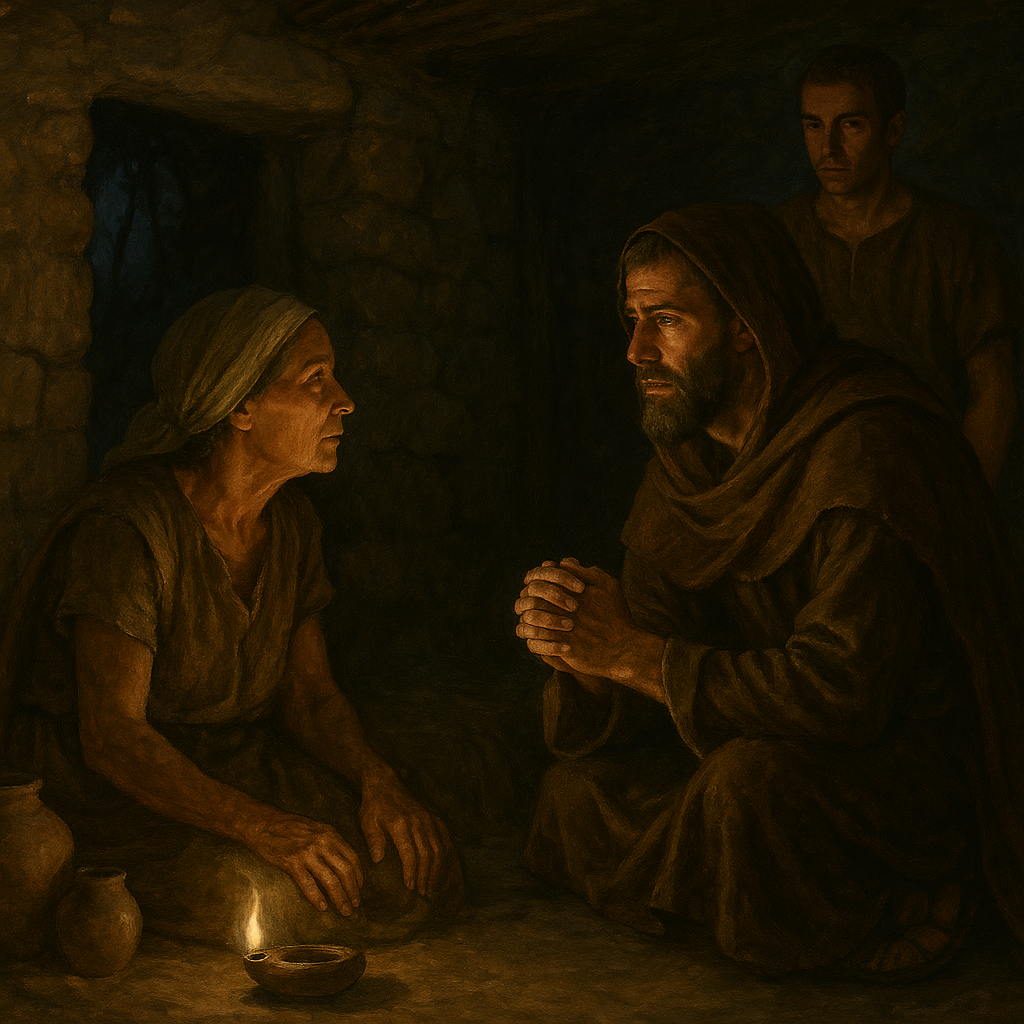
Saul asks his servants to find a woman with a familiar spirit. Disguised and accompanied by two men, he visits a woman at Endor by night.
The woman initially fears that the request is a trap because Saul has removed those who practice such things. Saul then swears by the Lord that she will not be punished. He invokes the Lord’s name while requesting an act prohibited by God’s law (Leviticus 19:31; 20:6; Deuteronomy 18:10-12).
Saul asks for Samuel. When the woman sees Samuel, she cries out and identifies her visitor as Saul. Scripture does not explicitly explain how she recognizes him.
The message concerning Saul’s judgment
The narrative repeatedly identifies the speaker as Samuel (1 Samuel 28:12, 15-16). The woman describes an old man covered with a mantle, and Saul perceives that it is Samuel.
The text does not explain the mechanism of this event or teach that the woman possesses independent power over the dead. It also does not identify the speaker as a demon impersonating Samuel. Faithful interpretation should preserve the narrative’s wording without constructing an explanation that Scripture does not provide.
Samuel declares that the Lord has departed from Saul and become his enemy. The kingdom has been given to David because Saul did not obey the Lord concerning Amalek (1 Samuel 28:16-18; compare 1 Samuel 15:19-28).
Samuel also announces Israel’s coming defeat and tells Saul:
“To morrow shalt thou and thy sons be with me.”
1 Samuel 28:19
This announces their impending death. The statement alone should not be used to determine Saul’s eternal condition or to construct a detailed account of the state of the dead.
Saul falls to the ground in fear and weakness. After initially refusing food, he accepts a meal at the urging of the woman and his servants. They depart that night. The chapter records his distress and departure but does not record a confession of sin or an expression of repentance.
1 Samuel 29: David Is Sent Away from the Philistine Army
The Philistine princes object
The Philistines assemble at Aphek, while the Israelites camp by a fountain in Jezreel. David and his men are with Achish in the rear of the Philistine force.
The Philistine princes object to the presence of these Hebrews. Achish defends David, saying that he has found no fault in him. This is Achish’s assessment; it is not a divine declaration that every action David has taken is right.
The princes fear that David might become their adversary during the battle and regain Saul’s favor by killing Philistines. They remember the saying:
“Saul slew his thousands, and David his ten thousands.”
1 Samuel 29:5
Their concern is explicitly stated. David’s actual plan is not.
David’s departure
Achish tells David to return peacefully because the princes will not accept him. David questions the decision, but Achish repeats the order and instructs him to depart early.
David and his men return toward the land of the Philistines, while the Philistine army goes up to Jezreel.
Their dismissal removes David and his men from the approaching battle against Israel. This may indicate God’s providential protection of David, although the chapter does not explicitly say that God caused the princes’ objection.
The passage illustrates how a decision made by others can remove a person from a dangerous situation. It does not justify the assumption that every rejection or disappointment is a specific sign of divine deliverance.
1 Samuel 30: David Seeks the Lord and Recovers the Captives
The devastation at Ziklag
On the third day, David and his men reach Ziklag and discover that the Amalekites have burned it and carried away the women and others who were there. The text specifically states that they killed none of the captives (1 Samuel 30:1-2).
David and his men weep until they have no strength left to weep. David’s wives, Ahinoam and Abigail, are among those taken.
The men speak of stoning David because each man is grieved over his sons and daughters. David is greatly distressed, but the chapter records a decisive response:
“But David encouraged himself in the LORD his God.”
1 Samuel 30:6
His strengthening is explicitly in the Lord, not merely in his own determination.
David asks for God’s direction
David asks Abiathar the priest to bring the ephod and inquires whether he should pursue the raiding force. The Lord answers:
“Pursue: for thou shalt surely overtake them, and without fail recover all.”
1 Samuel 30:8
David proceeds on the basis of this specific direction and promise.
Six hundred men begin the pursuit. At the brook Besor, two hundred are too exhausted to continue, so David goes on with four hundred. The text identifies the others’ physical weakness; it does not call them cowardly or rebellious.
An abandoned servant provides help
David’s men find an Egyptian in the field and bring him to David. They give him bread, water, figs, and raisins. He has gone without food and water for three days and nights.
The man explains that he is the servant of an Amalekite and that his master abandoned him when he became sick. He confirms his participation in the raids, including the burning of Ziklag.
After receiving assurance that David will neither kill him nor return him to his master, he guides David to the Amalekite company. The man they feed becomes their guide to the captives.
The recovery of all
David finds the Amalekites eating, drinking, and celebrating their spoil. He attacks them, and the text reports that four hundred young men escape on camels.
The chapter emphasizes the completeness of the recovery:
“David recovered all that the Amalekites had carried away.”
1 Samuel 30:18
Nothing is missing, including sons, daughters, spoil, and everything that had been taken (1 Samuel 30:19). God’s particular promise to David is fulfilled.
A just division of the spoil
When the returning force meets the two hundred men at Besor, certain men described as “wicked men and men of Belial” argue that those who did not continue should receive only their wives and children, with no share of the spoil.
David rejects their proposal. He credits the Lord with preserving them and delivering the raiding company into their hands. He establishes this rule:
“As his part is that goeth down to the battle, so shall his part be that tarrieth by the stuff: they shall part alike.”
1 Samuel 30:24
The rule becomes a statute and ordinance for Israel.
David also sends portions of the spoil to the elders of Judah, his friends, and places where he and his men had stayed. He identifies it as a blessing from the spoil of the Lord’s enemies (1 Samuel 30:26-31). The text records his generosity without explicitly stating every motive behind it.
1 Samuel 31: Saul and His Sons Die on Mount Gilboa
Israel’s defeat
The Philistines fight Israel, and the Israelites flee. Many fall slain on Mount Gilboa. The Philistines kill Jonathan, Abinadab, and Melchishua, three of Saul’s sons.
Jonathan’s death is particularly sobering in light of his earlier faith and his faithful friendship with David (1 Samuel 14:6; 18:1-4; 23:16-18). His presence among the dead should not be treated as proof that he shared Saul’s specific sins.
Saul’s death
The archers hit Saul, and he is badly wounded. He asks his armor bearer to kill him so that the Philistines will not thrust him through and abuse him.
The armor bearer refuses because he is greatly afraid. Saul then falls upon his own sword. When the armor bearer sees that Saul is dead, he also falls upon his sword and dies.
First Samuel 31:4-6 directly records Saul’s death. The Amalekite’s different account in 2 Samuel 1:6-10 is a reported claim made to David and must not replace the narrator’s explicit account here.
First Chronicles 10:13-14 supplies the divine explanation: Saul died for his transgression against the Lord, his failure to keep God’s word, and his inquiry of one with a familiar spirit.
Although 1 Samuel 28:6 records that Saul inquired of the Lord, 1 Chronicles 10:14 says that he “enquired not of the LORD.” Both statements must be retained. Saul’s recorded request for an answer does not overturn God’s concluding judgment on his conduct.
Disgrace and an act of courage
After the defeat, Israelites abandon cities, and the Philistines occupy them. Finding Saul and his sons, the Philistines strip Saul’s armor, cut off his head, and publish the news among their people and in the houses of their idols.
They place his armor in the house of Ashtaroth and fasten his body to the wall of Bethshan.
The valiant men of Jabeshgilead travel all night, recover the bodies of Saul and his sons, and bring them to Jabesh. They burn the bodies, bury the bones beneath a tree, and fast seven days.
Saul had previously delivered Jabeshgilead from the Ammonites (1 Samuel 11:1-11). Their action may suggest gratitude for that deliverance, but chapter 31 does not explicitly state their motive.
The book ends with defeat, death, burial, and mourning. It leaves the reader facing the solemn consequences of Saul’s disobedience.
Key People and Places
People
- Saul: Israel’s king, who seeks forbidden counsel and dies after defeat at Gilboa.
- David: Dismissed from the Philistine army; he seeks the Lord and recovers the captives taken from Ziklag.
- Samuel: The deceased prophet identified by the narrative as speaking judgment to Saul at Endor.
- The woman at Endor: An unnamed woman with a familiar spirit whom Saul consults.
- Achish: The Philistine ruler who trusts David but sends him away at the princes’ insistence.
- The Philistine princes: Leaders who fear David could turn against them during battle.
- Abiathar: The priest who brings the ephod when David seeks the Lord.
- Ahinoam and Abigail: David’s wives, taken captive and recovered.
- The Egyptian servant: Abandoned by his Amalekite master; he leads David to the raiding company.
- Jonathan, Abinadab, and Melchishua: Saul’s sons who die in the battle.
- Saul’s armor bearer: The unnamed attendant who refuses to kill Saul and afterward takes his own life.
- The men of Jabeshgilead: Men who recover and bury the remains of Saul and his sons.
Places
- Shunem: The Philistine encampment in 1 Samuel 28.
- Gilboa: Israel’s camp and the mountain where Saul and his sons die.
- Endor: The location of the woman Saul consults.
- Ramah: Samuel’s burial place.
- Aphek: The Philistine gathering place in 1 Samuel 29.
- Jezreel: The area of Israel’s camp toward which the Philistines advance.
- Ziklag: David’s residence, burned by the Amalekites.
- The brook Besor: Where two hundred exhausted men remain during the pursuit.
- Bethshan: Where the Philistines fasten Saul’s body.
- Jabeshgilead: The community whose men recover the bodies.
- Judah: The region containing the communities to which David sends portions of the spoil.
Main Doctrinal or Spiritual Themes
1. God’s Word Must Be Obeyed
Samuel connects Saul’s judgment to his disobedience concerning Amalek (1 Samuel 28:18). First Chronicles 10:13-14 confirms that Saul’s fall must be understood in relation to his transgression against the Lord.
Religious language, royal office, and requests for guidance do not substitute for obedience.
2. Forbidden Spiritual Counsel Remains Forbidden
Saul’s fear and unanswered inquiry do not authorize his visit to Endor. God’s prohibition against familiar spirits remains binding within the setting of the passage (Deuteronomy 18:10-12).
The Endor account records judgment; it provides no permission to seek messages from the dead.
3. Strength Is Found in the Lord
David grieves deeply and faces hostility from his own men, yet he strengthens himself in the Lord and seeks divine direction (1 Samuel 30:6-8).
Faith does not require the absence of sorrow. The passage places genuine grief alongside dependence upon God.
4. God’s Specific Promises Are Trustworthy
The Lord promises David recovery, and David recovers all (1 Samuel 30:8, 18-19).
This establishes God’s faithfulness to the promise He gave. It does not establish a universal promise that every believer will recover every earthly possession or relationship lost.
5. Victory Should Produce Humility and Fairness
David credits the Lord for preservation and victory and refuses to let the fighting men exclude those who remained behind (1 Samuel 30:23-25).
Receiving God’s help should discourage pride and promote just treatment of others.
6. Death and Judgment Are Solemn Realities
Saul’s position cannot protect him from the consequences announced by God. Jonathan’s death also shows that faithful people can suffer within a wider national disaster.
The passage calls for sober reflection without authorizing unsupported judgments about each individual’s eternal condition.
Practical Applications or Lessons
- Seek God without abandoning obedience. A desire for guidance should be accompanied by submission to what God has already said. Saul’s conduct warns against seeking an answer while turning to practices God forbids.
- Bring grief to the Lord. David and his men wept openly. Their tears are recorded without condemnation. In distress, believers can seek strength in God rather than treat sorrow as proof of spiritual failure.
- Let Scripture govern decisions. David acted upon God’s direction. Believers today should test choices by the written Word rather than treat impressions, unusual experiences, or convenient circumstances as unquestionable revelation.
- Do not condemn exhausted people without cause. The two hundred men were too faint to continue. David’s treatment of them warns against equating limited strength with disloyalty.
- Show kindness to vulnerable people. David’s men gave food and water to the abandoned Egyptian. His assistance followed, but the passage should not be turned into a promise that every act of kindness will bring an immediate benefit.
- Give God the credit for His help. David described the victory and preservation as gifts from the Lord. Gratitude helps restrain the pride that claims every success as personal achievement.
- Share fairly with those who serve in different ways. David’s rule recognized both those who fought and those who remained with the supplies. As an application, ministry support work deserves appreciation alongside more visible service.
- Treat leaders’ decisions as serious responsibilities. Saul’s judgment unfolded amid national defeat. The passage should encourage those with responsibility to consider how their conduct affects others.
- Show respect in times of loss. The men of Jabeshgilead acted courageously to recover the bodies and mourn the dead. Their conduct provides an example of honoring the deceased without requiring approval of everything they did in life.
Comments are closed