David Spares Saul: Faith and Restraint in 1 Samuel 21-24
 First Samuel 21-24 follows David as he flees from Saul, receives help, faces the consequences of deception, and repeatedly seeks the Lord’s direction. Saul’s pursuit brings suffering to others, including the priests at Nob. Yet Saul cannot deliver David into his own hand, for “God delivered him not into his hand” (1 Samuel 23:14).
These chapters do not present David as faultless. They record his misleading explanation to Ahimelech, his fear before Achish, and his acknowledgment of responsibility concerning the deaths of the priests. They also show his obedience in rescuing Keilah and his refusal to kill Saul when the opportunity arises. The account directs attention to God’s faithfulness, the seriousness of sin, and the responsibility to do right while suffering wrong.
Chapter Summaries
1 Samuel 21: David at Nob and Gath
David receives bread from Ahimelech (1 Samuel 21:1-6).
David comes to Nob, where Ahimelech the priest is afraid at meeting him and asks why he is alone. David claims that the king has sent him on secret business. This explanation conflicts with the preceding account: David is fleeing because Saul seeks his life (1 Samuel 20:30-33, 42).
The passage records David’s words without approving them. His difficult circumstances do not make the deception truthful.
David asks for five loaves of bread or whatever food is available. Ahimelech has no common bread, but he has hallowed bread. After questioning David about the young men’s separation from women, the priest gives him the shewbread that had been removed from before the Lord.
Leviticus 24:5-9 identifies the shewbread as holy and assigns it to Aaron and his sons to eat in the holy place. Jesus directly refers to this incident in Matthew 12:3-4, stating that David ate bread ordinarily lawful only for the priests. In answering the Pharisees, Jesus also declares, “I will have mercy, and not sacrifice” (Matthew 12:7).
The event therefore should not be explained as though the bread were ordinary food or as though God’s commands were unimportant. Christ Himself uses the account in His answer concerning hunger, mercy, and the Pharisees’ condemnation of His disciples.
Doeg is present, and David receives Goliath’s sword (1 Samuel 21:7-9).
Doeg the Edomite, the chief of Saul’s herdmen, is at Nob, “detained before the LORD” (1 Samuel 21:7). Scripture does not explicitly explain why he is detained there.
David asks for a spear or sword and repeats the claim that the king’s business required haste. Ahimelech tells him that Goliath’s sword is available, wrapped in a cloth behind the ephod. David answers, “There is none like that; give it me” (1 Samuel 21:9).
The sword is the weapon associated with David’s victory over Goliath in 1 Samuel 17:50-51. However, Scripture does not explicitly say that receiving it renews David’s faith or that carrying it proves he has abandoned dependence upon God. Either conclusion would go beyond the passage.
David fears Achish and feigns madness (1 Samuel 21:10-15).
David flees to Achish, king of Gath. Achish’s servants recognize him and recall the song celebrating his victories. They call him “David the king of the land” (1 Samuel 21:11). These are the servants’ words; David is not described here as reigning over Israel.
David takes their words to heart and becomes “sore afraid of Achish the king of Gath” (1 Samuel 21:12). He changes his behavior, feigns madness, scrabbles on the doors of the gate, and lets his spittle fall upon his beard. Achish objects to having a madman brought before him.
The chapter plainly records David’s fear and conduct. It does not say that God commanded him to feign madness.
1 Samuel 22: Refuge at Adullam and the Slaughter at Nob
David’s family and distressed men gather to him (1 Samuel 22:1-2).
David escapes to the cave Adullam. His brothers and his father’s household come to him. Others gather as well:
“And every one that was in distress, and every one that was in debt, and every one that was discontented, gathered themselves unto him.”
1 Samuel 22:2
David becomes captain over approximately four hundred men. The text describes their circumstances, but it does not say that every man is criminal, rebellious against God, or spiritually mature. Their hardships should not be turned into unsupported judgments about their character.
David seeks protection for his parents and obeys Gad (1 Samuel 22:3-5).
David goes to Mizpeh of Moab and asks the king of Moab to let his father and mother remain there:
“Till I know what God will do for me.”
1 Samuel 22:3
David’s concern for his parents is evident in this request. His words also acknowledge that he does not know how God will order his circumstances.
Ruth, David’s great-grandmother, was a Moabitess (Ruth 4:10, 17). That family connection may suggest a reason for seeking refuge in Moab, but Scripture does not explicitly give it as David’s reason.
The prophet Gad then tells David to leave the hold and enter the land of Judah. David obeys and goes to the forest of Hareth.
Saul accuses his servants, and Doeg reports David’s visit (1 Samuel 22:6-10).
Saul complains that his servants have conspired against him. He accuses Jonathan of stirring up David to lie in wait against him. The narrative has shown Jonathan helping David escape Saul’s violence; it has not shown Jonathan organizing an attack upon Saul.
Doeg reports that he saw David at Nob. He says that Ahimelech inquired of the Lord for David, provided food, and gave him Goliath’s sword.
Saul’s accusations illustrate the importance of distinguishing a person’s claims from the facts established by Scripture. The Bible faithfully records Saul’s speech without endorsing his interpretation of events.
Ahimelech answers Saul, but Saul orders the priests killed (1 Samuel 22:11-19).
Ahimelech speaks of David’s faithfulness, his relationship to the king, and his honorable position in Saul’s household. He denies knowing anything of the supposed conspiracy. Concerning inquiry of God for David, he asks, “Did I then begin to enquire of God for him?” (1 Samuel 22:15).
Saul nevertheless pronounces death upon Ahimelech and his father’s house. The king’s servants refuse to strike the priests of the Lord. Doeg obeys Saul’s command and kills eighty-five persons who wore a linen ephod. He also strikes Nob, including its inhabitants and livestock.
The passage records a terrible abuse of royal authority. Saul’s command does not make the killing righteous. His servants’ refusal also demonstrates that a ruler’s order does not remove personal responsibility for carrying it out.
Abiathar escapes, and David acknowledges responsibility (1 Samuel 22:20-23).
Abiathar, a son of Ahimelech, escapes and comes to David. After hearing what happened, David says:
“I have occasioned the death of all the persons of thy father’s house.”
1 Samuel 22:22
David states that he knew Doeg would surely tell Saul. He acknowledges his own part in the circumstances rather than denying any connection to the disaster.
This acknowledgment does not transfer Saul’s and Doeg’s guilt to David. Saul ordered the killing, and Doeg carried it out. David nevertheless recognizes the dreadful consequences connected with his visit to Nob and tells Abiathar to remain with him for protection.
1 Samuel 23: Deliverance at Keilah and Preservation in the Wilderness
David inquires of the Lord and rescues Keilah (1 Samuel 23:1-5).
David learns that the Philistines are fighting against Keilah and robbing the threshingfloors. He asks the Lord whether he should attack them. The Lord directs him to go and save Keilah.
David’s men express fear. David inquires again, and the Lord confirms the command:
“Arise, go down to Keilah; for I will deliver the Philistines into thine hand.”
1 Samuel 23:4
David and his men obey, defeat the Philistines, and save the inhabitants of Keilah. Although David is being pursued, he acts to help others in danger.
The Lord warns David about Saul and the men of Keilah (1 Samuel 23:6-13).
Abiathar has brought an ephod with him. When David learns that Saul intends to come against Keilah, he tells Abiathar to bring the ephod and asks the Lord about the danger.
Saul believes that God has delivered David into his hand because David has entered a city with gates and bars. The Lord’s answers to David expose the error of Saul’s conclusion.
The Lord tells David that Saul will come down and that the men of Keilah will deliver him up. David and approximately six hundred men leave the city. When Saul hears that David has escaped, he abandons that expedition.
The passage records what the Lord said would happen under the circumstances David asked about. It does not say that the men of Keilah actually surrendered David. David departed after receiving God’s warning.
Jonathan strengthens David in God (1 Samuel 23:14-18).
Saul seeks David daily, but the text gives the decisive explanation for David’s preservation:
“But God delivered him not into his hand.”
1 Samuel 23:14
Jonathan visits David in the wood and “strengthened his hand in God” (1 Samuel 23:16). He encourages David not to fear and speaks of David becoming king.
Jonathan also says that he will be next to David. That statement must be distinguished from a divine promise. First Samuel 31:2 records Jonathan’s death in battle; Scripture does not record him serving beside David during David’s reign.
David and Jonathan renew their covenant before the Lord, and Jonathan returns to his house.
The Ziphites inform Saul, and a Philistine invasion interrupts the pursuit (1 Samuel 23:19-29).
The Ziphites offer to deliver David into Saul’s hand. Saul directs them to discover his movements and hiding places.
In the wilderness of Maon, Saul and his men come close to surrounding David and his men. A messenger then tells Saul that the Philistines have invaded the land. Saul breaks off the pursuit to confront them.
The place is called Selahammahlekoth. David afterward goes to the strongholds at Engedi. The sequence records the means by which this immediate danger ends, while 1 Samuel 23:14 explicitly attributes David’s preservation from Saul to God.
1 Samuel 24: David Refuses to Kill Saul
Saul enters the cave where David and his men are hiding (1 Samuel 24:1-3).
After returning from pursuing the Philistines, Saul takes three thousand chosen men to seek David near the rocks of the wild goats.
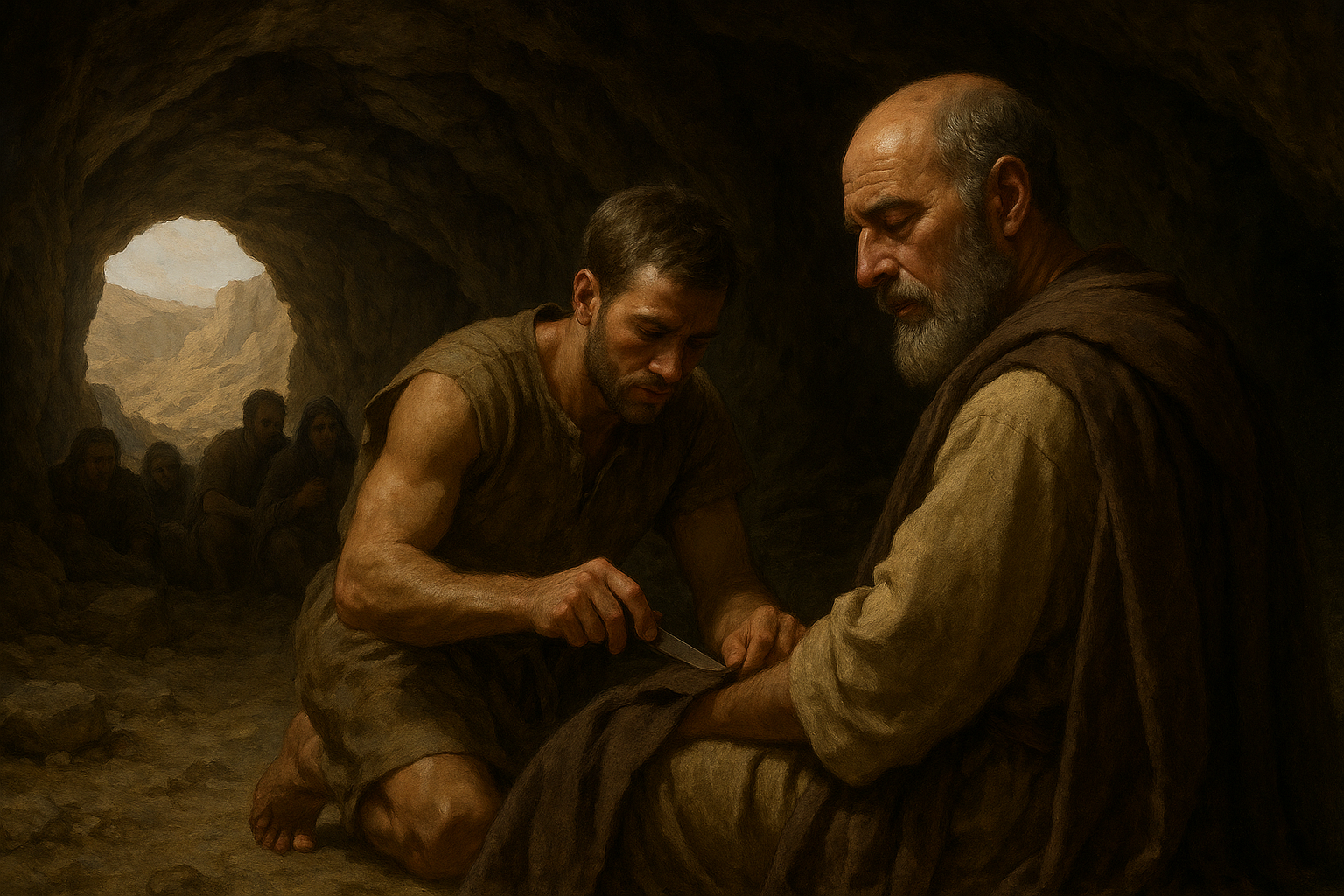
Saul enters a cave “to cover his feet,” while David and his men remain in the sides of that same cave (1 Samuel 24:3). The passage does not say that Saul is sleeping.
David rejects his men’s interpretation of the opportunity (1 Samuel 24:4-7).
David’s men identify the situation as the day when the Lord has delivered David’s enemy into his hand. Their statement should not be treated as an independently recorded command from God to kill Saul.
David cuts off the skirt of Saul’s robe privately. Afterward, “David’s heart smote him” for doing so (1 Samuel 24:5).
He tells his men:
“The LORD forbid that I should do this thing unto my master, the LORD’S anointed, to stretch forth mine hand against him.”
1 Samuel 24:6
David restrains his servants and does not permit them to rise against Saul. His refusal to kill Saul does not mean that Saul’s conduct is righteous. David expressly identifies the injustice in Saul’s pursuit when he speaks afterward.
David presents evidence and commits judgment to the Lord (1 Samuel 24:8-15).
After Saul leaves the cave, David follows and calls to him. David bows and explains that he spared Saul when he could have killed him. The piece of robe provides visible evidence that David came close enough to harm Saul but did not do so.
David denies plotting against Saul and declares:
“The LORD judge between me and thee, and the LORD avenge me of thee: but mine hand shall not be upon thee.”
1 Samuel 24:12
David seeks vindication from the Lord while refusing personal vengeance. He does not deny the wrong being done to him. He places the judgment of that wrong in God’s hands.
Saul acknowledges David’s righteousness and future kingship (1 Samuel 24:16-22).
Saul weeps and says:
“Thou art more righteous than I: for thou hast rewarded me good, whereas I have rewarded thee evil.”
1 Samuel 24:17
Saul acknowledges that David will be king and asks him not to destroy his descendants or his family name. David swears to him.
Saul returns home, while David and his men return to the hold. Saul’s words should not be presented as proof of lasting repentance. First Samuel 26:2 explicitly records another pursuit of David.
Key People and Places
People
- David: The man Samuel anointed in 1 Samuel 16:13, now fleeing Saul. These chapters record both his failures and his obedience.
- Ahimelech: The priest at Nob who gives David bread and Goliath’s sword. He denies knowingly participating in a conspiracy against Saul.
- Doeg the Edomite: Saul’s chief herdman, who reports David’s visit and carries out the killing of the priests.
- Achish: King of Gath, before whom David feigns madness.
- Saul: Israel’s king, who pursues David and orders the deaths of the priests.
- Abiathar: Ahimelech’s son, who escapes to David and brings an ephod.
- Gad: The prophet who directs David to leave the hold and enter Judah.
- Jonathan: Saul’s son, who strengthens David in God and renews their covenant.
- David’s parents: Family members for whom David seeks refuge in Moab.
- The Ziphites: People who disclose David’s location and offer to deliver him to Saul.
Places
- Nob: The city of the priests, where David receives bread and a sword.
- Gath: The city ruled by Achish, where David becomes afraid after being recognized.
- The cave Adullam: David’s refuge, where his family and approximately four hundred men gather.
- Mizpeh of Moab: The place where David asks the king of Moab to shelter his parents.
- The forest of Hareth: David’s destination after obeying Gad’s instruction.
- Keilah: The city David saves from the Philistines and leaves after receiving God’s warning.
- The wilderness of Ziph: A region where David hides and Jonathan visits him.
- The wilderness of Maon: The area where Saul nearly surrounds David.
- Selahammahlekoth: The place named when Saul breaks off his pursuit to confront the Philistines.
- Engedi: The area of strongholds where David goes before the cave encounter with Saul.
Main Doctrinal or Spiritual Themes
God’s Preservation and Human Responsibility
God preserves David from Saul, but David also takes action: he asks questions, heeds warnings, moves away from danger, and obeys the Lord’s commands.
First Samuel 23:14 plainly credits God with David’s preservation. The surrounding account also shows that trusting God is consistent with responding wisely to revealed danger. God’s care does not make obedience unnecessary.
God’s Knowledge Is Greater Than Man’s Understanding
Saul claims that God has delivered David into his hand at Keilah (1 Samuel 23:7). The Lord reveals otherwise through His answers to David.
Saul’s confident religious language does not establish that his judgment is correct. God’s word, rather than a person’s interpretation of favorable circumstances, supplies the trustworthy account of what is happening.
Scripture Records Sin Without Approving It
David’s deceptive account at Nob and Saul’s murderous orders are both recorded truthfully. Their inclusion in Scripture does not give believers permission to imitate them.
A biblical narrative must be read in light of God’s stated moral commands. Lying remains contrary to God’s instruction, including the command, “Lie not one to another” (Colossians 3:9). David’s position in God’s purpose does not make every action he takes righteous.
Personal Vengeance Belongs Outside the Believer’s Conduct
David refuses to kill Saul and commits judgment to the Lord. This agrees with the instruction:
“Dearly beloved, avenge not yourselves, but rather give place unto wrath: for it is written, Vengeance is mine; I will repay, saith the Lord.”
Romans 12:19
David’s restraint does not erase Saul’s guilt. It demonstrates that recognizing wrongdoing and refusing personal revenge can stand together.
Respect for Authority Does Not Require Participation in Evil
David recognizes Saul as the Lord’s anointed, but he does not assist Saul’s sinful pursuit. Saul’s servants also refuse to kill the priests at his command.
The passage should not be used to teach that a religious or civil leader is beyond correction. David openly identifies Saul’s wrongdoing. The broader biblical rule remains, “We ought to obey God rather than men” (Acts 5:29).
Godly Friendship Strengthens Faith
Jonathan “strengthened his hand in God” (1 Samuel 23:16). The stated direction of his encouragement matters: he strengthens David in relation to God.
For believers, friendship should include encouragement to trust the Lord and obey His Word. Such encouragement must distinguish God’s promises from personal expectations, as Jonathan’s statement about being next to David demonstrates.
Emotional Words Do Not Establish Lasting Repentance
Saul weeps, admits wrongdoing, and acknowledges David’s righteousness. Nevertheless, he pursues David again in 1 Samuel 26.
This account warns against treating tears or an immediate confession as sufficient evidence of an enduring change. Scripture calls for “fruits meet for repentance” (Matthew 3:8).
Practical Applications or Lessons
- Speak truthfully when you are under pressure. David’s danger does not make his explanation to Ahimelech accurate. Fear should lead believers to seek God’s help without abandoning truthfulness (1 Samuel 21:1-2; Ephesians 4:25).
- Acknowledge your part when your actions contribute to harm. David does not deny his connection to the disaster at Nob. His acknowledgment provides a lesson in accepting responsibility without excusing the sins of others (1 Samuel 22:22).
- Help others even while carrying burdens of your own. David is himself in danger when he obeys the Lord and rescues Keilah. Personal hardship does not remove every opportunity to serve (1 Samuel 23:1-5; Galatians 6:10).
- Seek God’s direction through the means He gives believers. David’s inquiries belong to the circumstances described in the passage, including the presence of the priest and ephod. Believers today should pray for wisdom and follow Scripture; this account does not authorize treating private impressions as infallible answers from God (James 1:5; 2 Timothy 3:16-17).
- Do not mistake an opportunity for permission. David’s men interpret Saul’s vulnerability as their moment to act. David refuses to kill him. A convenient opening does not make an otherwise sinful action right (1 Samuel 24:4-7).
- Encourage people with what God has actually said. Jonathan’s visit strengthens David in God. Believers should offer scriptural encouragement while avoiding promises about outcomes God has not revealed (1 Samuel 23:16-18).
- Refuse sinful commands. Saul’s servants will not kill the priests. Position, pressure, or personal loyalty cannot make obedience to an evil order righteous (1 Samuel 22:17; Acts 5:29).
- Leave revenge with the Lord while taking reasonable precautions. David spares Saul, speaks the truth, and returns to the hold. His conduct shows that refusing vengeance does not require placing himself in Saul’s power (1 Samuel 24:12, 22).
- Do not promise believers a life without suffering. Ahimelech is killed despite denying knowledge of the alleged conspiracy. These chapters record David’s preservation and the priests’ deaths. They do not teach that faithful people are always spared earthly harm (1 Samuel 22:14-19; 2 Timothy 3:12).
- Let God’s Word govern your response to mistreatment. David has strong personal reasons to resent Saul, but he restrains his own hand. Believers likewise are commanded, “Be not overcome of evil, but overcome evil with good” (Romans 12:21).
Comments are closed