1 Samuel 14-15: Faith, Obedience, and Saul’s Rejection as King
 In 1 Samuel 14-15, Jonathan expresses confidence in the LORD’s power to save, while Saul makes a rash oath and disobeys God’s command concerning Amalek. Israel receives deliverance from the Philistines, but military success does not excuse Saul’s disobedience. Samuel declares the central lesson plainly: “Behold, to obey is better than sacrifice” (1 Samuel 15:22).
These chapters distinguish dependence upon God from confidence in religious actions. They also show that a king remains accountable to the word of the LORD.
Chapter Summaries
1 Samuel 14: Jonathan’s Faith and Saul’s Rash Oath
Jonathan acts in confidence toward God
Jonathan tells his armor bearer that they should cross over to the Philistines’ garrison, but he does not tell his father. Saul remains in the uttermost part of Gibeah with about six hundred men. Ahiah, a priest descended from Eli’s family, is present wearing an ephod (1 Samuel 14:1-3).
The passage describes two sharp rocks, Bozez and Seneh, along the passage Jonathan intends to cross. One faces Michmash, and the other faces Gibeah (1 Samuel 14:4-5).
Jonathan’s words express both faith and restraint:
“It may be that the LORD will work for us: for there is no restraint to the LORD to save by many or by few.”
1 Samuel 14:6
Jonathan is certain that God possesses unlimited power, but he does not claim certainty that God will grant this particular undertaking success. His words, “It may be,” preserve that distinction. Faith acknowledges God’s ability without inventing a promise God has not given.
His armor bearer agrees to accompany him. Jonathan explains that if the Philistines tell them to come up, they will take that response as the sign that the LORD has delivered the enemy into their hand. The Philistines call them upward, and Jonathan climbs on his hands and feet, followed by his armor bearer. Together they strike down about twenty men in the first encounter (1 Samuel 14:7-14).
The LORD delivers Israel
Terror spreads through the Philistine host, and the earth quakes. Saul’s watchmen observe the multitude melting away. After discovering that Jonathan and his armor bearer are missing, Saul tells Ahiah to bring the ark of God. While Saul speaks to the priest, the noise in the Philistine host increases, and Saul says, “Withdraw thine hand” (1 Samuel 14:15-19).
Saul and his men enter the battle and find the Philistines fighting against one another. Hebrews who had been with the Philistines join Israel, and Israelites who had hidden in mount Ephraim come into the pursuit (1 Samuel 14:20-22).
The inspired account identifies the source of victory:
“So the LORD saved Israel that day: and the battle passed over unto Bethaven.”
1 Samuel 14:23
Jonathan and the other Israelites participate, but the deliverance belongs to the LORD.
Saul’s oath burdens the people
Saul places the people under an oath forbidding food until evening, saying that he must be avenged on his enemies. The chapter states that the men of Israel are distressed and that the people become faint (1 Samuel 14:24-28).
Jonathan has not heard the oath. He tastes honey, and his eyes are enlightened. When informed of the prohibition, he says, “My father hath troubled the land.” He explains that eating freely of the spoil would have strengthened the people for a greater defeat of the Philistines (1 Samuel 14:27-30).
Jonathan’s assessment is explicitly recorded. The passage does not present Saul’s prohibition as a command from God.
After pursuing the Philistines from Michmash to Aijalon, the exhausted people seize animals from the spoil and eat them with the blood. This violates God’s prohibition against eating blood (Leviticus 17:10-14; 1 Samuel 14:31-33).
Saul orders a great stone brought and directs the people to slaughter their animals there rather than sin against the LORD by eating with the blood. He also builds an altar, described as “the first altar that he built unto the LORD” (1 Samuel 14:33-35). The text does not establish Saul’s inward spiritual condition merely by recording this altar.
Jonathan is identified and rescued by the people
Saul proposes continuing the pursuit by night. The priest calls for approaching God, but when Saul asks whether he should pursue the Philistines, God does not answer him that day (1 Samuel 14:36-37).
Saul declares that whoever is responsible must die, even if it is Jonathan. The subsequent selection identifies Jonathan, who acknowledges tasting a little honey. Saul insists that Jonathan must die (1 Samuel 14:38-44).
The people intervene:
“Shall Jonathan die, who hath wrought this great salvation in Israel? God forbid.”
1 Samuel 14:45
They declare that Jonathan has worked with God that day, and they rescue him from death. Saul then stops the pursuit, and the Philistines return to their own place (1 Samuel 14:45-46).
Although the selection identifies Jonathan as the one who ate, the passage does not explicitly say that God approved Saul’s oath or commanded Jonathan’s execution. Identifying the violation of Saul’s prohibition must not be confused with establishing that the prohibition itself was righteous.
The chapter closes with Saul’s wars and household
The closing verses summarize Saul’s conflicts with surrounding enemies, identify members of his family, and name Abner as captain of his host. War with the Philistines continues throughout Saul’s days, and Saul gathers strong and valiant men to himself (1 Samuel 14:47-52).
These military accomplishments provide context for his reign, but they do not remove his responsibility to obey God.
1 Samuel 15: Disobedience and Rejection from Kingship
God gives a specific command concerning Amalek
Samuel reminds Saul that the LORD sent him to anoint Saul king. Therefore, Saul must listen to “the voice of the words of the LORD” (1 Samuel 15:1).
God declares judgment against Amalek for opposing Israel when Israel came up from Egypt. The background includes Amalek’s attack and God’s stated purpose to bring judgment upon that nation (Exodus 17:8-16; Deuteronomy 25:17-19).
The command in 1 Samuel 15:3 is explicit and severe, requiring the destruction of Amalek and its possessions. This is a particular divine judgment assigned to Saul and Israel. It does not authorize Christians to wage religious violence. Believers are instructed to refrain from personal vengeance and to leave vengeance to God (Romans 12:19-21).
Saul gathers his forces and warns the Kenites to separate from the Amalekites because they had shown kindness to Israel. The Kenites depart, and Saul attacks Amalek (1 Samuel 15:4-7).
Saul and the people spare what God commanded them to destroy
Saul takes Agag, king of the Amalekites, alive. Saul and the people also spare the best sheep, oxen, fatlings, lambs, and everything considered good. They destroy what is vile and refuse (1 Samuel 15:8-9).
The issue is not uncertainty about the command. The text states that they “would not utterly destroy them” (1 Samuel 15:9). Their actions substitute their own assessment of value for God’s instruction.
The LORD tells Samuel:
“It repenteth me that I have set up Saul to be king: for he is turned back from following me, and hath not performed my commandments.”
1 Samuel 15:11
Samuel is grieved and cries unto the LORD all night. His later confrontation with Saul follows this explicitly recorded grief and prayer.
Saul claims obedience while the evidence contradicts him
When Samuel arrives, Saul declares, “I have performed the commandment of the LORD.” Samuel responds by asking about the bleating sheep and lowing oxen he can hear (1 Samuel 15:13-14).
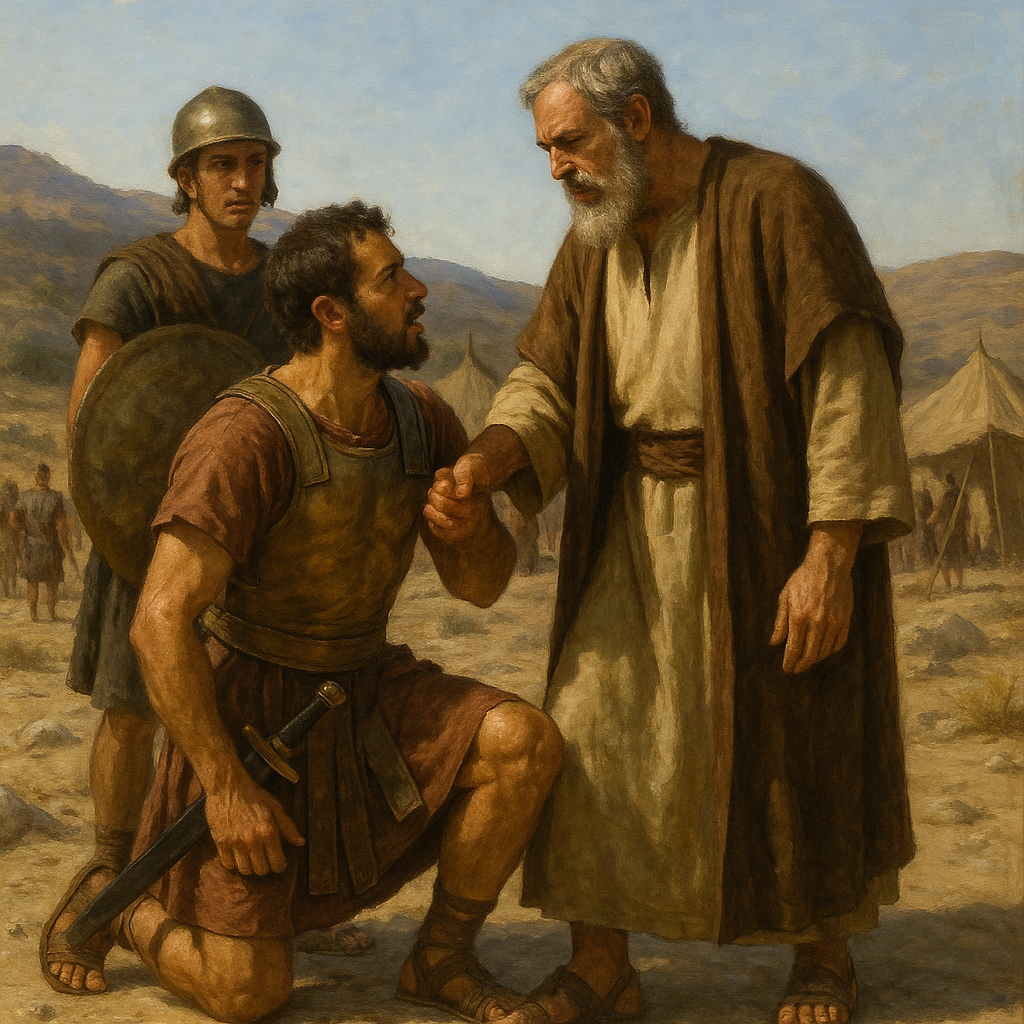
Saul attributes the sparing of the animals to the people and says that they intended to sacrifice them to the LORD. Samuel reminds him that God made him king and gave him a definite assignment. He then asks why Saul did not obey (1 Samuel 15:15-19).
Saul again claims obedience while acknowledging that he brought Agag back alive. He again points to the people and their proposed sacrifices (1 Samuel 15:20-21).
Samuel answers:
“Hath the LORD as great delight in burnt offerings and sacrifices, as in obeying the voice of the LORD? Behold, to obey is better than sacrifice, and to hearken than the fat of rams.”
1 Samuel 15:22
Sacrifice cannot make deliberate disobedience acceptable. Worship must be governed by God’s word.
Samuel continues:
“For rebellion is as the sin of witchcraft, and stubbornness is as iniquity and idolatry.”
1 Samuel 15:23
This comparison declares the seriousness of rebellion and stubbornness. It does not say that Saul practiced witchcraft during this event.
Because Saul has rejected the word of the LORD, the LORD has rejected him from being king (1 Samuel 15:23).
Saul admits sin, but the announced judgment remains
Saul acknowledges:
“I have sinned: for I have transgressed the commandment of the LORD, and thy words: because I feared the people, and obeyed their voice.”
1 Samuel 15:24
His own explanation identifies fear of the people as a reason for his disobedience. He asks Samuel to pardon his sin and return with him so that he may worship.
Samuel initially refuses. As Samuel turns away, Saul takes hold of the skirt of his mantle, and it tears. Samuel declares that the LORD has torn the kingdom from Saul and given it to a neighbor better than he (1 Samuel 15:25-28).
Samuel then states:
“And also the Strength of Israel will not lie nor repent: for he is not a man, that he should repent.”
1 Samuel 15:29
Verses 11 and 35 speak of the LORD repenting that He made Saul king; verse 29 declares that He will not lie or repent concerning the announced judgment. Both statements must be retained. The chapter presents God’s response to Saul’s disobedience while expressly distinguishing God from changeable man. It gives no basis for accusing God of sin, falsehood, or an unreliable verdict.
Saul again admits sin but also asks Samuel to honor him before the elders and Israel. Samuel returns with him, and Saul worships the LORD (1 Samuel 15:30-31). Saul’s concern for public honor is explicit. Scripture does not require us to claim complete knowledge of his inward motives beyond what it records.
Samuel carries out judgment upon Agag
Samuel orders Agag brought forward. He declares that Agag’s sword has made women childless and executes him before the LORD in Gilgal (1 Samuel 15:32-33).
Samuel returns to Ramah, and Saul goes to his house in Gibeah. The chapter closes by recording Samuel’s continued mourning for Saul and the LORD’s repentance that He had made Saul king (1 Samuel 15:34-35).
Saul’s rejection from kingship is explicit. This passage does not state that a saved person lost eternal salvation; its announced judgment concerns Saul’s royal position and kingdom.
Key People and Places
People
- Jonathan: Saul’s son, who trusts God’s power, attacks the Philistine garrison with his armor bearer, and unknowingly violates Saul’s food prohibition.
- Jonathan’s armor bearer: The unnamed companion who agrees to accompany Jonathan and follows him into the encounter.
- Saul: Israel’s king, whose military activity is accompanied by a rash oath and direct disobedience concerning Amalek.
- Samuel: The prophet who delivers God’s command, confronts Saul, announces his rejection, and mourns for him.
- Ahiah: A priest descended from Eli’s family, present with Saul and wearing an ephod (1 Samuel 14:3).
- Abner: Captain of Saul’s host (1 Samuel 14:50).
- Agag: King of the Amalekites, spared by Saul and executed by Samuel.
- The Kenites: People warned to leave the Amalekites because of their kindness toward Israel.
Places
- Gibeah: Associated with Saul’s position in chapter 14 and his home in chapter 15.
- Michmash: A location connected with the Philistine forces and Israel’s pursuit.
- Bozez and Seneh: The two sharp rocks described along Jonathan’s intended passage.
- Bethaven: The battle passes beyond this location during Israel’s deliverance.
- Mount Ephraim: The region where Israelites who had hidden hear of the Philistines’ flight.
- Aijalon: The endpoint named in the day’s pursuit from Michmash.
- Telaim: The location where Saul numbers the forces gathered against Amalek.
- Havilah and Shur: Locations marking the extent of Saul’s attack upon Amalek.
- Carmel: Where Samuel is told Saul had come and “set him up a place” before proceeding to Gilgal (1 Samuel 15:12).
- Gilgal: The setting of Samuel’s confrontation with Saul and judgment upon Agag.
- Ramah: Samuel’s destination after leaving Saul.
Main Doctrinal or Spiritual Themes
1. God’s power is not limited by human numbers.
Jonathan’s confession and Israel’s deliverance establish the chapter’s emphasis: the LORD can save “by many or by few” (1 Samuel 14:6, 23). Human strength does not determine the limits of divine power.
2. Faith must preserve the distinction between God’s ability and His promised action.
Jonathan says, “It may be that the LORD will work for us.” His confidence in God’s power does not become an unsupported claim that God must grant his chosen outcome (1 Samuel 14:6).
3. Human authority remains accountable to God’s word.
Saul’s position does not make every command he issues wise or righteous. His oath distresses the people, and his kingship does not exempt him from obedience (1 Samuel 14:24-30; 15:1, 17-19).
4. Religious activity cannot compensate for disobedience.
The proposed sacrifices do not justify sparing what God commanded Saul to destroy. “To obey is better than sacrifice” establishes God’s priority clearly (1 Samuel 15:22).
5. Rebellion is a serious offense against God.
Samuel’s comparison with witchcraft and idolatry forbids treating stubborn disobedience as a minor weakness. Rejecting God’s word is the stated reason for Saul’s rejection as king (1 Samuel 15:23).
6. Fear of people can lead to disobedience.
Saul explicitly admits that he feared the people and obeyed their voice. His confession illustrates the danger identified in Proverbs 29:25: “The fear of man bringeth a snare.”
7. God’s judgment must be distinguished from questions the passage does not answer.
These chapters address deliverance, sin, leadership, and Saul’s rejection from kingship. They must not be used to establish claims about the loss of eternal salvation that the text does not make. Christ’s promise concerning His sheep remains clear: “they shall never perish” (John 10:28).
Practical Applications or Lessons
- Trust God’s power without prescribing His answer. Jonathan’s words encourage confidence accompanied by humility. Bring your needs to the LORD while submitting your requests to His will (1 Samuel 14:6; 1 John 5:14).
- Do not make personal restrictions equal to God’s commandments. Saul’s oath burdened weary people. Leaders should evaluate their requirements by Scripture and consider how those requirements affect others (1 Samuel 14:24-30).
- Obey the instruction God has actually given. Saul preserved what seemed valuable while destroying what seemed worthless. Personal preference is no substitute for obedience (1 Samuel 15:9, 19-22).
- Accept responsibility for your own decisions. Saul repeatedly pointed to the people, but the command had been entrusted to him. Others’ involvement does not erase personal accountability (1 Samuel 15:1-3, 15, 20-24).
- Do not offer ministry activity as an excuse for known sin. Giving, service, and public worship cannot make disobedience acceptable. The principle of 1 Samuel 15:22 applies directly to religious service today.
- Value obedience above public approval. Saul admitted fearing the people and asked to be honored before the elders. Believers should seek God’s approval above preserving their reputation (1 Samuel 15:24, 30; Galatians 1:10).
- Respond to another person’s failure with truth and grief. Samuel plainly declared God’s judgment while also crying to the LORD and mourning for Saul. Faithfulness and sorrow appear together in his response (1 Samuel 15:11, 22-23, 35).
- Read accounts of judgment with textual restraint. Do not turn Saul’s rejection from office into a statement the passage does not make about eternal salvation. Let each passage speak with its own stated scope.
Comments are closed