1 Samuel 16-17: God Looks on the Heart and Gives the Victory
Chapter Summaries
1 Samuel 16: David Anointed and Brought into Saul’s Service
God sends Samuel to Bethlehem
 The chapter opens with the LORD addressing Samuel’s mourning over Saul:
“How long wilt thou mourn for Saul, seeing I have rejected him from reigning over Israel?” (1 Samuel 16:1).
God commands Samuel to fill his horn with oil and go to Jesse the Bethlehemite, declaring, “I have provided me a king among his sons” (1 Samuel 16:1). Saul’s rejection as king provides the background for this mission. Samuel had already told Saul that his rejection of the LORD’s word had brought God’s rejection of him as king (1 Samuel 15:23, 26).
Samuel expresses concern that Saul will kill him if he hears of the journey. The LORD instructs Samuel to take a heifer and announce that he has come to sacrifice. Samuel obeys, sanctifies Jesse and his sons, and calls them to the sacrifice (1 Samuel 16:2-5). The sacrifice is an actual part of the account, not merely an event Samuel pretends to arrange.
The LORD corrects judgment based on appearance
When Samuel sees Eliab, he thinks that the LORD’s anointed is before him. God corrects that conclusion:
“Look not on his countenance, or on the height of his stature; because I have refused him: for the LORD seeth not as man seeth; for man looketh on the outward appearance, but the LORD looketh on the heart” (1 Samuel 16:7).
Jesse brings seven sons before Samuel, but Samuel declares that the LORD has not chosen these. When Samuel asks whether all the children are present, Jesse explains that the youngest remains with the sheep (1 Samuel 16:8-11).
David is brought in, and the LORD tells Samuel, “Arise, anoint him: for this is he” (1 Samuel 16:12). The passage describes David’s appearance favorably, but God’s preceding instruction establishes that outward appearance is not the basis of His judgment.
Samuel anoints David “in the midst of his brethren,” and “the Spirit of the LORD came upon David from that day forward” (1 Samuel 16:13). David is anointed, while Saul continues to occupy the throne in the events that follow. The anointing does not mean that David begins ruling Israel in this chapter.
Saul is troubled, and David serves him
The text then records a solemn contrast:
“But the Spirit of the LORD departed from Saul, and an evil spirit from the LORD troubled him” (1 Samuel 16:14).
The wording must be preserved without explaining away either God’s sovereignty or the reality of Saul’s trouble. However, this passage does not teach that God is morally evil or tempts people to sin; James 1:13 expressly denies that God tempts anyone with evil. Nor does this account identify Saul’s condition with a particular modern medical diagnosis.
Saul’s servants suggest finding a skillful harp player. One servant recommends a son of Jesse, describing him as skillful in playing, mighty and valiant, a man of war, prudent in matters, comely, and accompanied by the LORD (1 Samuel 16:15-18). These descriptions are explicitly present in the text, although the chapter does not supply a history of military exploits explaining the servant’s words.
Saul sends for David. David enters his service, Saul loves him greatly, and David becomes his armor bearer (1 Samuel 16:19-22). When the evil spirit troubles Saul, David plays the harp:
“So Saul was refreshed, and was well, and the evil spirit departed from him” (1 Samuel 16:23).
The passage records the relief Saul received. It does not present music as a substitute for repentance or establish a universal treatment for spiritual affliction.
1 Samuel 17: David Faces Goliath in the Name of the LORD
Goliath defies the armies of Israel
The Philistines gather for battle at Shochoh in Judah and camp between Shochoh and Azekah, in Ephesdammim. Saul and Israel assemble by the valley of Elah, with the opposing armies standing on mountains separated by a valley (1 Samuel 17:1-3).
Goliath, the Philistine champion from Gath, comes forward. The KJV gives his height as “six cubits and a span” and describes his substantial armor and weapons (1 Samuel 17:4-7). His challenge calls for one Israelite to fight him, with the stated outcome determining which people will serve the other (1 Samuel 17:8-10).
Saul and all Israel hear his words and are “dismayed, and greatly afraid” (1 Samuel 17:11). Goliath presents himself morning and evening for forty days (1 Samuel 17:16).
David comes to the camp on his father’s errand
Jesse’s three eldest sons, Eliab, Abinadab, and Shammah, have followed Saul to the battle. David goes back and forth from Saul to feed his father’s sheep at Bethlehem (1 Samuel 17:12-15).
Jesse sends David with food for his brothers and cheeses for their captain, directing him to inquire after his brothers’ welfare. David rises early, leaves the sheep with a keeper, and carries out the errand (1 Samuel 17:17-20).
While David speaks with his brothers, Goliath repeats his challenge. Israel’s men flee in fear, but David focuses on the spiritual significance of the defiance:
“For who is this uncircumcised Philistine, that he should defy the armies of the living God?” (1 Samuel 17:26).
David’s words identify the central issue as Goliath’s defiance of the living God and His people.
Eliab angrily accuses David of pride and naughtiness of heart. These are Eliab’s accusations, not the narrator’s declaration of David’s motives. David answers, “What have I now done? Is there not a cause?” and continues speaking with the men (1 Samuel 17:28-30).
David remembers the LORD’s deliverance
When David is brought before Saul, he offers to fight Goliath. Saul objects that David is a youth and Goliath has been a warrior from his youth (1 Samuel 17:31-33). Scripture does not give David’s exact age here.
David recounts defending his father’s flock against a lion and a bear. He attributes his deliverance to the LORD:
“The LORD that delivered me out of the paw of the lion, and out of the paw of the bear, he will deliver me out of the hand of this Philistine” (1 Samuel 17:37).
His confidence rests on the LORD’s power and on the fact that Goliath has defied the armies of the living God (1 Samuel 17:36-37).
Saul clothes David with armor and provides a helmet and coat of mail. David tries to go but says, “I cannot go with these; for I have not proved them.” He removes them (1 Samuel 17:38-39). The stated reason is that he has not proved the equipment; Scripture does not say that it is too large or that wearing armor is inherently faithless.
The battle belongs to the LORD
David takes his staff, selects five smooth stones from the brook, places them in his shepherd’s bag, and approaches with his sling (1 Samuel 17:40). Scripture does not explain why he chooses five stones.
Goliath despises David, curses him by his gods, and threatens him. David answers:
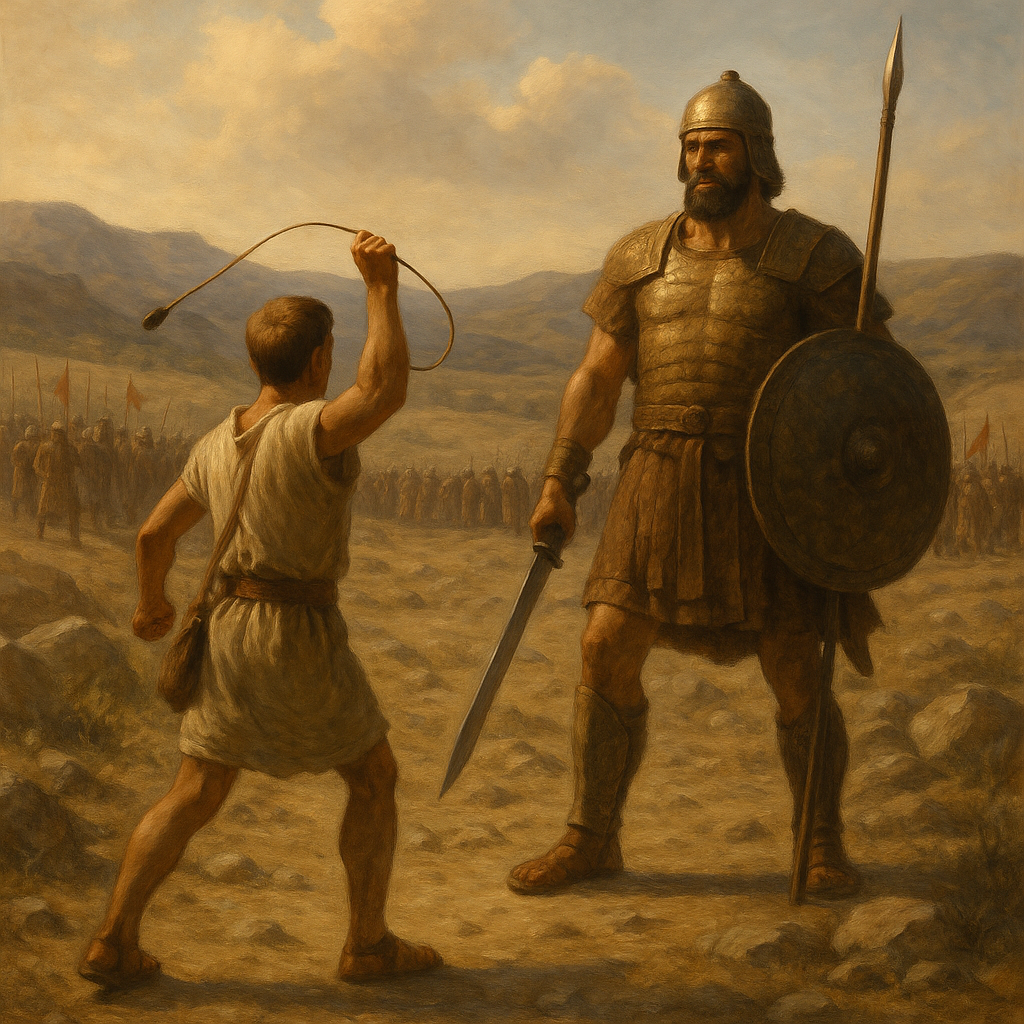
“Thou comest to me with a sword, and with a spear, and with a shield: but I come to thee in the name of the LORD of hosts, the God of the armies of Israel, whom thou hast defied” (1 Samuel 17:45).
David declares two purposes for the coming victory: that all the earth may know there is a God in Israel, and that the assembly may know the LORD does not save by sword and spear (1 Samuel 17:46-47).
His declaration reaches its central point:
“For the battle is the LORD’S, and he will give you into our hands” (1 Samuel 17:47).
David runs toward the army to meet Goliath, slings a stone, and strikes him in the forehead. Goliath falls facedown. The passage summarizes David’s victory with a sling and stone and records that David then uses Goliath’s own sword to slay him and cut off his head (1 Samuel 17:48-51).
When the Philistines see their champion dead, they flee. Israel and Judah pursue them, and the Israelites spoil their tents (1 Samuel 17:51-53). David brings Goliath’s head to Jerusalem and puts his armor in his tent (1 Samuel 17:54).
Saul asks about David’s father
The chapter closes with Saul questioning Abner and then David about whose son David is. David answers, “I am the son of thy servant Jesse the Bethlehemite” (1 Samuel 17:55-58).
First Samuel 16:19-23 has already described David’s service to Saul. The question in chapter 17 specifically concerns David’s parentage. Scripture does not explain why Saul requests this information again, so an explanation involving forgotten identity, illness, or a rearranged chronology should not be presented as established fact.
Key People and Places
People
- The LORD: Directs Samuel’s choice, looks on the heart, and receives the honor for the victory David announces.
- Samuel: The prophet who obeys God’s command to anoint David in Bethlehem.
- Saul: Israel’s reigning king, rejected from kingship by the LORD, troubled by an evil spirit, and fearful before Goliath’s challenge.
- David: Jesse’s youngest son, a shepherd, skillful harp player, Saul’s armor bearer, and the man anointed at God’s direction who defeats Goliath.
- Jesse: David’s father, a Bethlehemite who sends David to inquire after his brothers.
- Eliab: Jesse’s eldest son, whose appearance impresses Samuel and who angrily accuses David at the battlefield.
- Abinadab and Shammah: David’s brothers, named among Jesse’s sons and among the three eldest who follow Saul.
- Goliath: The heavily armed champion from Gath who defies Israel’s armies.
- Abner: Saul’s captain, questioned about David’s parentage and responsible for bringing David before Saul after the victory.
Places
- Bethlehem: Jesse’s home and the location of David’s anointing.
- Ramah: The place to which Samuel returns after anointing David.
- Shochoh, Azekah, and Ephesdammim: Locations identifying the Philistine gathering and encampment in Judah.
- Valley of Elah: The valley associated with Israel’s encampment and the confrontation between the armies.
- Gath: Goliath’s home city and one of the destinations toward which the defeated Philistines are pursued.
- Ekron: Another city named in the pursuit of the Philistines.
- Jerusalem: The place to which David brings Goliath’s head, according to 1 Samuel 17:54.
Main Doctrinal or Spiritual Themes
God’s Judgment Reaches Beyond Appearance
First Samuel 16:7 directly contrasts human attention to outward appearance with the LORD’s knowledge of the heart. Stature and appearance cannot establish a person’s spiritual fitness.
This does not mean that every desire of the heart is trustworthy. The emphasis is on God’s perfect knowledge, not man’s ability to declare his own heart righteous.
God’s Choice and the Spirit’s Work
God identifies the man Samuel is to anoint, and the Spirit of the LORD comes upon David (1 Samuel 16:12-13). David’s appointment rests on God’s direction.
The departure of the Spirit from Saul must not be turned into a claim that a New Testament believer loses salvation. These chapters concern Saul’s rejected kingship and David’s anointing; they do not declare that Saul lost eternal life. Christ explicitly promises His sheep, “they shall never perish” (John 10:28), and believers are “sealed unto the day of redemption” (Ephesians 4:30).
The Living God Is Greater Than Human Strength
Goliath’s size, experience, and equipment produce fear in Israel. David’s stated confidence is in the LORD of hosts (1 Samuel 17:11, 33, 45).
The lesson is not that preparation or equipment is always wrong. It is that human resources do not determine God’s ability to deliver: “the LORD saveth not with sword and spear” (1 Samuel 17:47).
Faith Acts on Confidence in God
David both confesses confidence in the LORD and takes action. He selects stones, carries his sling, approaches Goliath, and runs to meet him (1 Samuel 17:40, 48-49).
Faith is not presented as inactivity. Neither is it confidence in confidence itself. David names the LORD as his deliverer and gives Him the honor.
God’s Honor Is Central
David declares that the outcome will make known that “there is a God in Israel” (1 Samuel 17:46). The narrative’s stated purpose reaches beyond David’s personal success.
This is a historical account of God’s deliverance of Israel. It should not be reduced to a promise that believers will defeat every difficulty, achieve every ambition, or escape every painful outcome.
Practical Applications or Lessons
- Do not judge spiritual usefulness by appearance. Samuel’s initial conclusion about Eliab required correction. Seek character and faithfulness rather than being impressed chiefly by stature, polish, or public presence (1 Samuel 16:6-7).
- Be faithful in ordinary responsibilities. David tends sheep, serves Saul, and carries his father’s provisions. When he leaves the flock, he leaves it with a keeper. His conduct provides a practical example of taking assigned duties seriously (1 Samuel 16:21-23; 17:15, 20).
- Distinguish accusations from established facts. Eliab calls David proud, but the passage does not endorse that charge. Do not treat another person’s angry judgment as proof of someone’s motives (1 Samuel 17:28-30).
- Remember the LORD’s past help. David recalls deliverance from the lion and bear and expressly credits God. Remembering God’s help can encourage present trust, while avoiding claims that He must repeat a particular outcome in every circumstance (1 Samuel 17:34-37).
- Use available means while depending on God. David’s sling and stones are real instruments, but his declared confidence is in the LORD. Skill and preparation should serve obedience without becoming substitutes for dependence on God (1 Samuel 17:40, 45-47).
- Make God’s honor more important than personal recognition. David speaks of the earth knowing the God of Israel. Believers should likewise seek God’s glory in their conduct and service (1 Samuel 17:46; 1 Corinthians 10:31).
- Let courage remain subject to Scripture. David’s victory does not authorize reckless behavior or make every personal struggle equivalent to his battle. Christians must obey God’s revealed commands, including the command not to avenge themselves (Romans 12:19).
- Give the LORD the credit for deliverance. David identifies the battle as the LORD’s before the victory occurs. His words direct attention to God’s power rather than human boasting (1 Samuel 17:37, 47).
Comments are closed