Chapter Summaries
 Judges 14 — Samson’s Marriage and the Philistine Conflict Begins
Samson, already described in Judges 13 as a Nazarite from the womb, “went down to Timnath” and desired a Philistine woman (14:1). Though his parents questioned this (“Is there never a woman among the daughters of thy brethren?” v. 3), the Lord was overruling Samson’s choices to “seek an occasion against the Philistines” (v. 4). This does not justify compromise, but shows God’s sovereign ability to use even flawed human actions to advance His purposes.
On the way to Timnath, Samson is attacked by a young lion, and “the Spirit of the LORD came mightily upon him,” enabling him to tear it apart with his bare hands (v. 6). Later, he finds a swarm of bees and honey in the lion’s carcass and eats of it (v. 8–9), foreshadowing his future riddle.
At the wedding feast, Samson gives a riddle to the Philistines: “Out of the eater came forth meat, and out of the strong came forth sweetness” (v. 14). The Philistines cannot solve it and pressure Samson’s wife until she presses him “seven days” for the answer (v. 17). When they finally reveal it, Samson accuses them of cheating: “Ye had not plowed with my heifer…” (v. 18).
In anger, Samson slays thirty men of Ashkelon (v. 19) to pay the wager and returns home. His wife is then wrongfully given to “his companion” (v. 20), setting the stage for further conflict.
Judges 15 — Samson’s Vengeance and Victory at Lehi
Samson attempts to visit his wife, only to discover she has been given to another (15:1–2). In retaliation, he catches three hundred foxes (or jackals), ties them in pairs, fastens a firebrand between each pair, and burns the Philistines’ crops, vineyards, and olive groves (v. 4–5). This destruction causes the Philistines to kill Samson’s wife and father-in-law (v. 6), provoking Samson to strike them “hip and thigh with a great slaughter” (v. 8).
The Philistines then come to Judah seeking Samson, and three thousand men of Judah confront him at the rock Etam (v. 11). Tragically, instead of supporting God’s deliverer, Judah willingly hands him over. Samson allows himself to be bound, but when brought to Lehi, “the Spirit of the LORD came mightily upon him,” and the new ropes “became as flax” (v. 14).
He finds a fresh jawbone of a donkey and slays “a thousand men therewith” (v. 15). Afterward he names the place Ramath-lehi (“the hill of the jawbone”) and is refreshed by a miraculous spring God opens in the hollow place of Lehi (v. 19).
Samson judges Israel twenty years (v. 20).
Judges 16 — Delilah, Samson’s Fall, and His Final Act
Samson’s weakness for women again appears when he goes to Gaza to a harlot (16:1). The Philistines attempt to ambush him, but he escapes by carrying away the massive gates of the city to the hill before Hebron (v. 3).
He later loves Delilah, who is bribed by the Philistine lords to discover “wherein his great strength lieth” (v. 5). Samson deceives her three times with false explanations, but she continues pressing him “daily with her words” (v. 16). At last he reveals the truth: his hair is the outward sign of his Nazarite consecration — “I have been a Nazarite unto God from my mother’s womb” (v. 17).
While he sleeps, Delilah calls a man to shave off his hair, and the Lord’s empowering presence departs from him (v. 19–20). The Philistines take him, put out his eyes, bind him with brass fetters, and compel him to grind grain in the prison house (v. 21). Yet a hopeful phrase stands out: “Howbeit the hair of his head began to grow again” (v. 22).
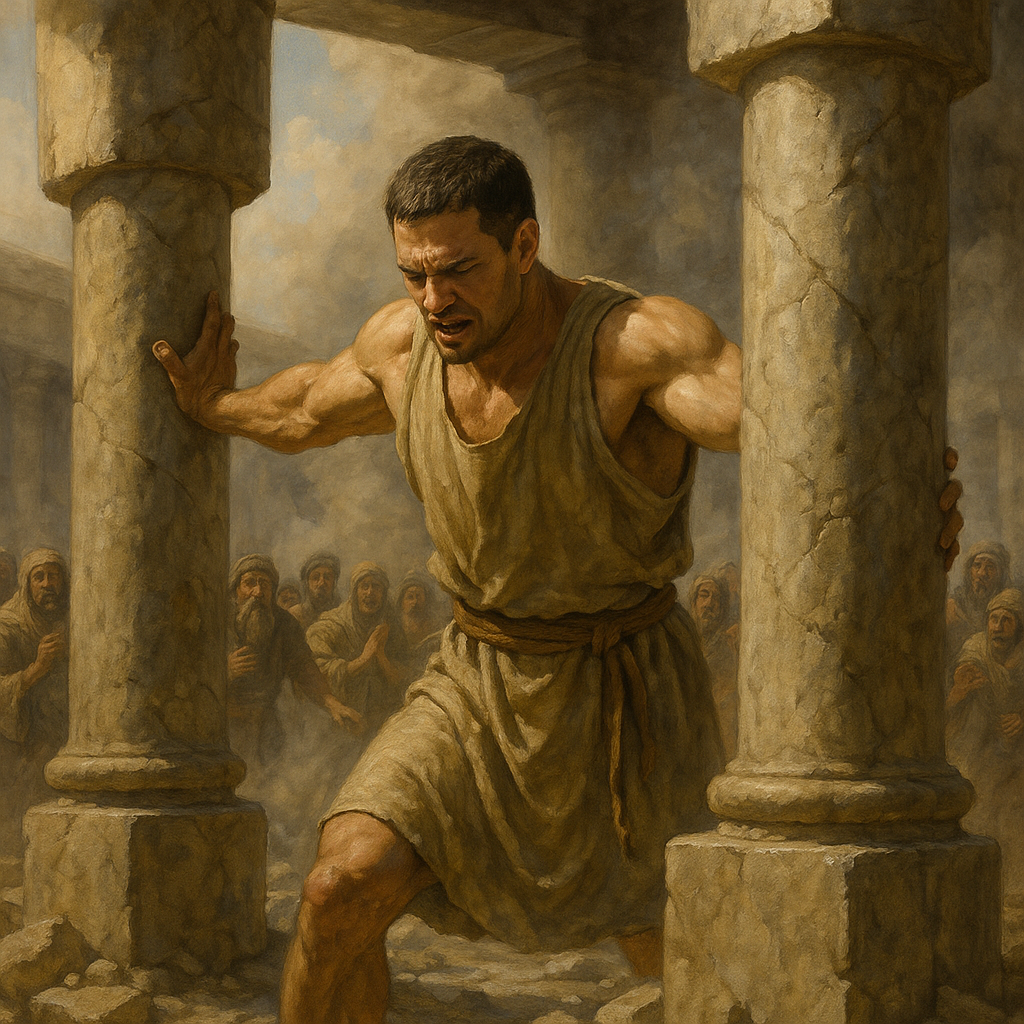
During a great pagan feast to Dagon, Samson is brought out as entertainment. Placed between two central pillars, he prays: “O Lord GOD, remember me, I pray thee, and strengthen me…” (v. 28). God answers, and Samson pushes down the pillars, causing the temple to collapse and killing more Philistines in his death than he had in his life (v. 30). His brethren retrieve his body and bury him between Zorah and Eshtaol.
Key People and Places
Samson — Nazarite judge empowered by God, yet marred by personal weakness.
Delilah — A Philistine woman who betrays Samson for money.
Timnath — A Philistine-controlled city where Samson sought a wife.
Lehi / Ramath-lehi — Site of Samson’s victory with the jawbone.
Gaza — Major Philistine city whose gates Samson carried off.
Dagon’s Temple — The pagan house where Samson’s final victory occurs.
Zorah and Eshtaol — Samson’s birthplace and burial region.
Main Doctrinal or Spiritual Themes
1. God’s Sovereignty Over Flawed Instruments
God used Samson — a man of inconsistent obedience — to begin delivering Israel (13:5). Divine purposes override human failures without ever condoning sin.
2. Separation and Holiness
Samson’s Nazarite status emphasizes God’s call for His people to be distinct. When Samson treated his consecration lightly, his power was compromised.
3. The Danger of Carnal Compromise
His repeated attraction to ungodly women shows the peril of unequally yoked relationships (cf. 2 Cor. 6:14 in broader doctrine). Each compromise moved him closer to defeat.
4. God’s Grace in Restoration
The phrase “the hair… began to grow again” illustrates restoration after repentance. Samson’s final prayer is one of humble dependence on God.
5. God Ultimately Receives the Glory
Samson’s last act demonstrates that victory belongs to the Lord, not human strength.
Practical Applications or Lessons
1. Believers Must Guard Their Consecration
Spiritual strength depends on obedience, purity, and closeness to God. Carelessness with sin leads to bondage.
2. Sin Always Blinds, Binds, and Grinds
Samson’s literal blinding and grinding symbolize the spiritual consequences of yielding to temptation.
3. Persistent Temptation Must Be Resisted Early
Delilah’s continual pressure (16:16) warns believers not to entertain sin or flirt with danger.
4. God Can Restore the Fallen
Samson’s final prayer shows that God answers the broken and repentant. Failure doesn’t need to be the final chapter.
5. Believers Should Seek God’s Strength, Not Their Own
Samson’s downfall came when “he wist not that the LORD was departed from him.” Confidence in self always leads to defeat.
Comments are closed