
The Land Divided, Caleb’s Inheritance, and Judah’s Portion
 Joshua 13–15 marks an important transition in the book of Joshua. The earlier chapters emphasize military campaigns; these chapters increasingly emphasize the distribution of the land God had promised Israel. The conquest was real, but the KJV also plainly records that territory and inhabitants remained to be possessed or driven out. The inheritance was therefore both God-given and accompanied by Israel’s responsibility to possess what God had given.
These chapters also highlight the faithfulness of Caleb, the special position of the Levites, the inheritance of Judah, and the sobering fact that some enemies remained within Israel’s allotted territory.
Chapter Summaries
 Joshua 13 — Much Land Yet to Be Possessed
Joshua 13 begins with a direct statement concerning Joshua:
“Now Joshua was old and stricken in years; and the LORD said unto him, Thou art old and stricken in years, and there remaineth yet very much land to be possessed.” — Joshua 13:1
This verse establishes two explicit facts: Joshua was advanced in age, and Israel had not yet possessed all the land God intended for them.
The LORD then identifies regions that remained, including territory associated with the Philistines, Geshurites, Canaanites, Sidonians, and portions extending toward Lebanon (Joshua 13:2–6).
God promises concerning the remaining inhabitants:
“Them will I drive out from before the children of Israel.” — Joshua 13:6
Joshua’s responsibility was therefore to distribute the land according to God’s command:
“only divide thou it by lot unto the Israelites for an inheritance, as I have commanded thee.” — Joshua 13:6
This shows an important distinction in the text. God could designate territory as Israel’s inheritance before every inhabitant of that territory had been removed.
The chapter then reviews the inheritance already assigned by Moses east of Jordan to:
- Reuben
- Gad
- Half the tribe of Manasseh
Their territory included lands formerly associated with Sihon king of the Amorites and Og king of Bashan.
Joshua 13:13 records a failure concerning particular inhabitants:
“Nevertheless the children of Israel expelled not the Geshurites, nor the Maachathites: but the Geshurites and the Maachathites dwell among the Israelites until this day.”
The verse explicitly states that these peoples were not expelled. Scripture does not give every reason for every instance in which an enemy remained, so it is best not to assign motives where the text does not.
A repeated truth of this chapter concerns Levi:
“Only unto the tribe of Levi he gave none inheritance; the sacrifices of the LORD God of Israel made by fire are their inheritance, as he said unto them.” — Joshua 13:14
And again:
“But unto the tribe of Levi Moses gave not any inheritance: the LORD God of Israel was their inheritance, as he said unto them.” — Joshua 13:33
The Levites were therefore distinguished from the other tribes concerning territorial inheritance. This does not mean they possessed no dwelling places; elsewhere Scripture assigns them cities. The point here is that they did not receive a tribal territorial inheritance in the same manner as the other tribes.
Joshua 14 — Caleb Requests Hebron
Joshua 14 returns to the division of Canaan west of Jordan.
The chapter identifies those responsible for distributing the inheritance:
“And these are the countries which the children of Israel inherited in the land of Canaan, which Eleazar the priest, and Joshua the son of Nun, and the heads of the fathers of the tribes of the children of Israel, distributed for inheritance to them.” — Joshua 14:1
The inheritance was divided:
“By lot was their inheritance, as the LORD commanded by the hand of Moses.” — Joshua 14:2
The text again explains why Levi did not receive a territorial portion like the other tribes. Joseph’s descendants were reckoned as two tribes, Manasseh and Ephraim, while the Levites received cities and suburbs rather than a tribal land allotment (Joshua 14:3–4).
The central figure of the chapter is Caleb the son of Jephunneh.
Caleb recalls the events surrounding the spying out of Canaan approximately forty-five years earlier. He says:
“Forty years old was I when Moses the servant of the LORD sent me from Kadeshbarnea to espy out the land; and I brought him word again as it was in mine heart.” — Joshua 14:7
He contrasts his conduct with that of others:
“Nevertheless my brethren that went up with me made the heart of the people melt: but I wholly followed the LORD my God.” — Joshua 14:8
That expression becomes the defining testimony of Caleb in the passage: he wholly followed the LORD.
Caleb then recalls the promise made through Moses:
“Surely the land whereon thy feet have trodden shall be thine inheritance, and thy children’s for ever, because thou hast wholly followed the LORD my God.” — Joshua 14:9
Caleb states that the LORD had preserved his life:
“And now, behold, the LORD hath kept me alive, as he said, these forty and five years…” — Joshua 14:10
He was now eighty-five years old.
Remarkably, Caleb does not describe himself as incapable:
“As yet I am as strong this day as I was in the day that Moses sent me…” — Joshua 14:11
This is an explicit statement of Caleb concerning his strength. Scripture does not require us to explain physiologically how this was so; the text simply records his testimony.
Caleb then asks:
“Now therefore give me this mountain…” — Joshua 14:12
He acknowledges that Anakims and fortified cities were there, but expresses dependence upon God rather than presumption:
“if so be the LORD will be with me, then I shall be able to drive them out, as the LORD said.” — Joshua 14:12
Joshua blesses Caleb and gives him Hebron for an inheritance.
The chapter concludes:
“Hebron therefore became the inheritance of Caleb the son of Jephunneh the Kenezite unto this day, because that he wholly followed the LORD God of Israel.” — Joshua 14:14
Hebron’s former name is identified as Kirjath-arba, and Arba is called “a great man among the Anakims” (Joshua 14:15).
Then comes a significant statement:
“And the land had rest from war.” — Joshua 14:15
This does not mean that every enemy had already been removed, because Joshua 13:1 says there remained “very much land to be possessed,” and Joshua 15 itself records additional fighting. The plain sense is that the major campaigns described earlier had produced a condition characterized as rest from war, while possession of allotted territories still involved further action.
Joshua 15 — Judah’s Inheritance
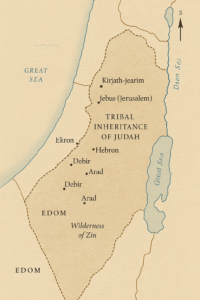
Joshua 15 gives the territorial inheritance of the tribe of Judah.
The chapter begins:
“This then was the lot of the tribe of the children of Judah by their families…” — Joshua 15:1
A substantial portion of the chapter carefully describes Judah’s boundaries.
The southern border ran toward the wilderness of Zin and Edom. The eastern boundary involved the Salt Sea. The northern and western borders are also described through numerous landmarks and locations.
The detail is significant. Israel’s inheritance was not merely an abstract spiritual promise. These were actual territories, boundaries, cities, valleys, mountains, and settlements.
From a dispensational standpoint, this reinforces the literal character of God’s promises concerning Israel and the land. The Church does not replace Israel in these territorial promises. Joshua is describing an actual inheritance given to the descendants of Israel in accordance with God’s covenant purposes.
The chapter then focuses upon Caleb’s possession within Judah:
“And unto Caleb the son of Jephunneh he gave a part among the children of Judah, according to the commandment of the LORD to Joshua…” — Joshua 15:13
Caleb expelled three sons of Anak:
“And Caleb drove thence the three sons of Anak, Sheshai, and Ahiman, and Talmai, the children of Anak.” — Joshua 15:14
Caleb then went against Debir, whose former name was Kirjath-sepher.
He declared:
“He that smiteth Kirjathsepher, and taketh it, to him will I give Achsah my daughter to wife.” — Joshua 15:16
Othniel accomplished the task:
“And Othniel the son of Kenaz, the brother of Caleb, took it: and he gave him Achsah his daughter to wife.” — Joshua 15:17
Achsah afterward requested a blessing from her father. Since she had received south land, she asked:
“give me also springs of water.” — Joshua 15:19
Caleb responded generously:
“And he gave her the upper springs, and the nether springs.” — Joshua 15:19
The chapter then records numerous cities belonging to Judah according to their families.
It closes with a sobering statement concerning Jerusalem:
“As for the Jebusites the inhabitants of Jerusalem, the children of Judah could not drive them out: but the Jebusites dwell with the children of Judah at Jerusalem unto this day.” — Joshua 15:63
The verse explicitly says that Judah “could not drive them out.” We should not substitute a different explanation for those words. Scripture elsewhere adds information about Jerusalem and the Jebusites, but Joshua 15:63 itself should be allowed to say precisely what it says.
Key People and Places
- Joshua — Israel’s leader. In Joshua 13:1 he is described as “old and stricken in years.” God directs him concerning the distribution of the remaining land.
- Eleazar the priest — Participates with Joshua and the tribal leaders in distributing the inheritance in Canaan.
- Moses — Had already assigned the eastern territories to Reuben, Gad, and half Manasseh.
- Caleb the son of Jephunneh — Faithful spy from the earlier generation. At eighty-five years old he requests Hebron and testifies repeatedly that he had wholly followed the LORD.
- Othniel the son of Kenaz — Takes Kirjath-sepher and receives Achsah as his wife.
- Achsah — Caleb’s daughter. She requests springs of water from her father and receives both upper and lower springs.
- Sheshai, Ahiman, and Talmai — The three sons of Anak whom Caleb drives from Hebron.
- Reuben — Receives territory east of Jordan previously assigned through Moses.
- Gad — Also receives territory east of Jordan.
- Half tribe of Manasseh — Receives territory associated especially with Bashan.
- Levi — Receives no tribal territorial inheritance comparable to the other tribes; the LORD is identified as their inheritance.
- Judah — Receives the territorial allotment described extensively in Joshua 15.
- Hebron — Caleb’s inheritance; formerly called Kirjath-arba.
- Kirjath-sepher / Debir — City conquered by Othniel.
- Jerusalem — Located within the territorial discussion of Judah; the Jebusites remained there according to Joshua 15:63.
- Jordan River — Major geographic divider between the eastern inheritances and Canaan proper.
- Salt Sea — A major boundary marker in Judah’s allotment.
- Bashan — Territory associated with the former kingdom of Og and included within the eastern inheritance.
- Mount Lebanon — Appears in the description of territory remaining to be possessed.
- Wilderness of Zin — Associated with Judah’s southern boundary.
Main Doctrinal or Spiritual Themes
1. God Keeps His Word
The distribution of the land rests upon promises God had previously made.
Joshua 13–15 repeatedly refers to what the LORD commanded through Moses and what He had promised concerning the inheritance.
Caleb specifically builds his request upon God’s prior word:
“the LORD hath kept me alive, as he said…” — Joshua 14:10
Biblical faith rests upon what God has said, not merely upon human optimism.
2. Divine Promise Does Not Cancel Human Responsibility
God said:
“Them will I drive out…” — Joshua 13:6
Yet He also commanded Israel to possess its inheritance.
There is no contradiction. God’s sovereignty and man’s responsibility are both present in the text. We should affirm both without forcing the passage into Calvinistic determinism or into a view that minimizes God’s power and purpose.
Israel did not earn the promised land by human strength, yet Israel was commanded to act in obedience concerning what God had given.
3. Wholehearted Obedience
Caleb’s most striking commendation is repeated:
“I wholly followed the LORD my God.” — Joshua 14:8
And:
“because that he wholly followed the LORD God of Israel.” — Joshua 14:14
Caleb is not presented as sinlessly perfect. The text praises the completeness of his allegiance to the LORD in the matter being discussed.
He provides an excellent example of steadfast faithfulness.
4. Faith Takes God at His Word
Caleb knew Anakims were present and the cities were fortified.
He did not deny those facts.
Instead he said:
“if so be the LORD will be with me, then I shall be able to drive them out, as the LORD said.” — Joshua 14:12
Biblical faith does not pretend obstacles do not exist. It looks at the difficulty through the certainty and sufficiency of God’s Word.
5. God’s Purposes Are Specific
Joshua 15 records boundaries with extraordinary precision.
This confirms that the inheritance was geographical and literal. Israel received identifiable territory.
From a conservative dispensational perspective, this supports maintaining the biblical distinction between Israel and the Church. Nothing in these chapters authorizes transferring Judah’s territorial inheritance to the New Testament Church.
Spiritual applications may certainly be drawn, but they must not erase the literal historical meaning.
6. The LORD Was Levi’s Inheritance
Joshua 13:33 states:
“the LORD God of Israel was their inheritance, as he said unto them.”
The Levites had a special calling in relation to the service of God.
For the Christian, this passage may remind us that fellowship with and service to God are more precious than earthly possessions. That is an application, however, rather than a statement that the Church has replaced Levi or Israel.
7. Incomplete Possession Had Consequences
Joshua 13:13 says certain peoples were not expelled.
Joshua 15:63 says:
“the children of Judah could not drive them out.”
The text therefore refuses to present the conquest as though every enemy disappeared at once.
This becomes important throughout Israel’s later history. We should be careful, however, not to claim a specific sinful motive in every case unless Scripture identifies it.
8. God’s Promises to Israel Are Literal
The detailed inheritance of Reuben, Gad, Manasseh, Judah, Caleb, and the other tribal families belongs to God’s historical dealings with national Israel.
These chapters strongly fit the plain, dispensational reading of Scripture: Israel is Israel, the land is actual land, and the tribal inheritances are real territorial inheritances.
The Church is a distinct body revealed in the New Testament and should not be inserted into these geographical promises.
Practical Applications or Lessons
Wholehearted service matters. Caleb’s testimony was not that he had followed the LORD occasionally or when circumstances were easy. He said:
“I wholly followed the LORD my God.”
A believer should not settle for divided allegiance.
Age does not excuse unfaithfulness. Caleb was eighty-five when he requested Hebron. Scripture specifically records that he remained ready for the responsibility before him. A Christian’s usefulness to God should not be measured merely by age.
Do not measure God’s promises by the size of the obstacle. Caleb knew there were Anakims and fortified cities. He nevertheless relied upon the LORD:
“then I shall be able to drive them out, as the LORD said.”
The foundation of his confidence was what “the LORD said.”
Finish what God gives you to do. Joshua 13 begins with “very much land to be possessed.” Receiving an assignment is not the same thing as completing it. Believers should guard against satisfaction with unfinished obedience.
This is a practical application from Israel’s experience; the Christian is not promised Israel’s land or commanded to conduct Israel’s conquest.
Do not become comfortable with what God commands you to put away. The presence of peoples whom Israel did not expel provides a solemn warning concerning incomplete obedience. In Christian application, known sin should not be accommodated.
Paul writes:
“Abstain from all appearance of evil.” — 1 Thessalonians 5:22
And:
“Let not sin therefore reign in your mortal body, that ye should obey it in the lusts thereof.” — Romans 6:12
The application concerns personal holiness, not the physical treatment of people.
Ask confidently while remaining dependent upon God. Caleb requested the mountain God had promised, but he did not speak as though victory came independently of the LORD:
“if so be the LORD will be with me…”
Confidence in God’s Word should produce dependence upon God rather than self-confidence.
Value spiritual inheritance above material advantage. Levi’s distinctive inheritance reminds the believer that knowing and serving God is more valuable than temporal possessions.
David expressed the broader principle:
“The LORD is the portion of mine inheritance and of my cup…” — Psalm 16:5
Parents should value the future welfare of their children. Caleb gave Achsah an inheritance and, when she requested springs, gave her “the upper springs, and the nether springs.” The passage explicitly records Caleb’s provision. It may suggest a useful picture of thoughtful parental generosity, though Scripture does not present this episode as a complete doctrine of parenting.
God’s people should remember what God has already done. Joshua 13 rehearses the defeat of Sihon and Og while discussing the inheritance. Remembering God’s past faithfulness strengthens confidence in His unchanging character.
Do not confuse possession with entitlement apart from obedience. Israel had been granted the land by God, yet there was still land “to be possessed.” In Christian life, knowing what Scripture commands is not the same thing as obeying it.
Overall Message of Joshua 13–15
Joshua 13–15 shows God faithfully distributing the inheritance He had promised Israel while requiring His people to act upon His Word.
Joshua 13 emphasizes the unfinished possession of Canaan and the eastern inheritances.
Joshua 14 places Caleb before us as a striking example of longstanding, wholehearted faith:
“I wholly followed the LORD my God.”
Joshua 15 records Judah’s inheritance, Caleb’s possession of Hebron, Othniel’s capture of Kirjath-sepher, Achsah’s request for springs, and the continuing presence of the Jebusites in Jerusalem.
Together these chapters teach that God’s Word is sure, His promises are dependable, faith must rest upon what He has said, wholehearted obedience honors Him, and unfinished obedience should never be treated casually.
The land promises belong literally to Israel; they should not be allegorized into promises made to the Church. At the same time, the faith, obedience, courage, dependence upon God, and perseverance displayed in the narrative provide legitimate moral instruction for believers today.
Comments are closed