 Numbers 18–20 moves from the ordered service of the priesthood, to God’s provision for cleansing from ceremonial defilement, and then to a sobering chapter of death, unbelief, divine provision, discipline, and transition in Israel’s leadership. Throughout these chapters, God emphasizes His holiness, the necessity of obeying His exact word, and the distinction He established between the priests, the Levites, and the rest of Israel.
Chapter Summaries
Numbers 18 — The Priesthood, the Levites, and Their Provision
Numbers 18 follows the rebellion surrounding Korah and the confirmation of Aaron’s priesthood in Numbers 16–17. In this setting, the LORD defines the responsibilities and boundaries of the priesthood and Levitical service.
The LORD says directly to Aaron:
“Thou and thy sons and thy father’s house with thee shall bear the iniquity of the sanctuary: and thou and thy sons with thee shall bear the iniquity of your priesthood.”
— Numbers 18:1
This establishes solemn responsibility for the sanctuary and priesthood. The expression “bear the iniquity” in this context places responsibility upon Aaron and those appointed with him concerning the holy service. The chapter does not say that Aaron was accomplishing eternal salvation or bearing sin in the same sense that Christ would bear sin.
The other Levites were to assist Aaron and his sons:
“And thy brethren also of the tribe of Levi, the tribe of thy father, bring thou with thee, that they may be joined unto thee, and minister unto thee…”
— Numbers 18:2
However, clear boundaries remained. The Levites could assist with the tabernacle, but they were not permitted to assume the priests’ work concerning the sanctuary and altar.
God describes the priesthood itself as something He had given:
“I have given your priest’s office unto you as a service of gift…”
— Numbers 18:7
This is particularly significant after the challenges to Aaron’s position in the preceding chapters. Aaron did not seize his office; God appointed him to it.
The priests were given portions of specified offerings, including holy things, firstfruits, and certain firstborn offerings. The Levites, meanwhile, received Israel’s tithes in connection with their service:
“And, behold, I have given the children of Levi all the tenth in Israel for an inheritance, for their service which they serve…”
— Numbers 18:21
The Levites themselves were then commanded to give a tenth of what they received:
“Ye shall offer up an heave offering of it for the LORD, even a tenth part of the tithe.”
— Numbers 18:26
Thus even those supported through Israel’s tithes were accountable to honor God from what they received.
A central statement concerning the Levites is:
“Thou shalt have no inheritance in their land, neither shalt thou have any part among them: I am thy part and thine inheritance among the children of Israel.”
— Numbers 18:20
Their distinctive position was directly tied to their service before God.
Doctrinal background
These regulations belong specifically to Israel under the Mosaic economy. The Aaronic priesthood and Levitical system should not be transferred wholesale to the New Testament church.
There is, however, a New Testament principle concerning the material support of gospel ministry. Paul writes:
“Even so hath the Lord ordained that they which preach the gospel should live of the gospel.”
— 1 Corinthians 9:14
That principle does not make a Baptist pastor an Aaronic priest or place the church under Israel’s Levitical law. Israel and the church must remain distinct.
Numbers 19 — The Red Heifer and the Water of Separation
Numbers 19 gives the ordinance of the red heifer.
The LORD commanded:
“Speak unto the children of Israel, that they bring thee a red heifer without spot, wherein is no blemish, and upon which never came yoke.”
— Numbers 19:2
The heifer was brought to Eleazar the priest and slain outside the camp. Eleazar took of its blood and sprinkled it seven times toward the tabernacle of the congregation.
The entire animal was burned, and cedar wood, hyssop, and scarlet were cast into the burning.
Its ashes were then retained:
“…for a water of separation: it is a purification for sin.”
— Numbers 19:9
The immediate subject is ceremonial cleansing, particularly in connection with contact with death.
Anyone touching a dead body became unclean seven days:
“He that toucheth the dead body of any man shall be unclean seven days.”
— Numbers 19:11
Purification was required on the third and seventh days. Failure to follow God’s appointed cleansing resulted in serious consequences because the person had defiled what belonged to God.
The law also addressed a death occurring within a tent, open vessels, bones, graves, and other forms of contact with death.
Significantly, cleansing itself had to occur according to God’s prescribed means. Human sincerity could not substitute for divine instruction.
New Testament doctrinal connection
Scripture itself supplies an inspired connection to Christ, so this is not speculative allegorizing. Hebrews says:
“For if the blood of bulls and of goats, and the ashes of an heifer sprinkling the unclean, sanctifieth to the purifying of the flesh:
How much more shall the blood of Christ…”
— Hebrews 9:13–14
Hebrews explicitly states that the ashes of the heifer dealt with “the purifying of the flesh,” and then contrasts that ceremonial purification with the vastly greater efficacy of Christ’s blood concerning the conscience.
Therefore, the ordinance should not be presented as if the red heifer itself gave eternal salvation. It did not. Its purpose in Numbers concerns ceremonial purification, while Hebrews uses it to demonstrate the superiority of Christ’s sacrifice.
Numbers 20 — Miriam’s Death, the Waters of Meribah, Edom, and Aaron’s Death
Numbers 20 contains several major turning points.
Miriam dies at Kadesh
The chapter opens:
“Then came the children of Israel, even the whole congregation, into the desert of Zin in the first month: and the people abode in Kadesh; and Miriam died there, and was buried there.”
— Numbers 20:1
The verse explicitly gives the first month, but it does not state the year.
Numbers 33:38 later explicitly states that Aaron died in “the fortieth year after the children of Israel were come out of the land of Egypt,” in the fifth month. Since Aaron’s death occurs later in Numbers 20, the broader chronology places that event in Israel’s fortieth year. We should not claim more concerning Miriam’s precise date than Scripture establishes.
Israel lacks water
There was no water for the congregation. The people gathered against Moses and Aaron and contended with them.
Their complaint echoed earlier wilderness murmurings. Moses and Aaron responded by going to the door of the tabernacle and falling upon their faces. Then:
“the glory of the LORD appeared unto them.”
— Numbers 20:6
God instructed Moses:
“Take the rod, and gather thou the assembly together, thou, and Aaron thy brother, and speak ye unto the rock before their eyes; and it shall give forth his water…”
— Numbers 20:8
The command was to speak unto the rock.
Instead Moses addressed the congregation:
“Hear now, ye rebels; must we fetch you water out of this rock?”
— Numbers 20:10
Then:
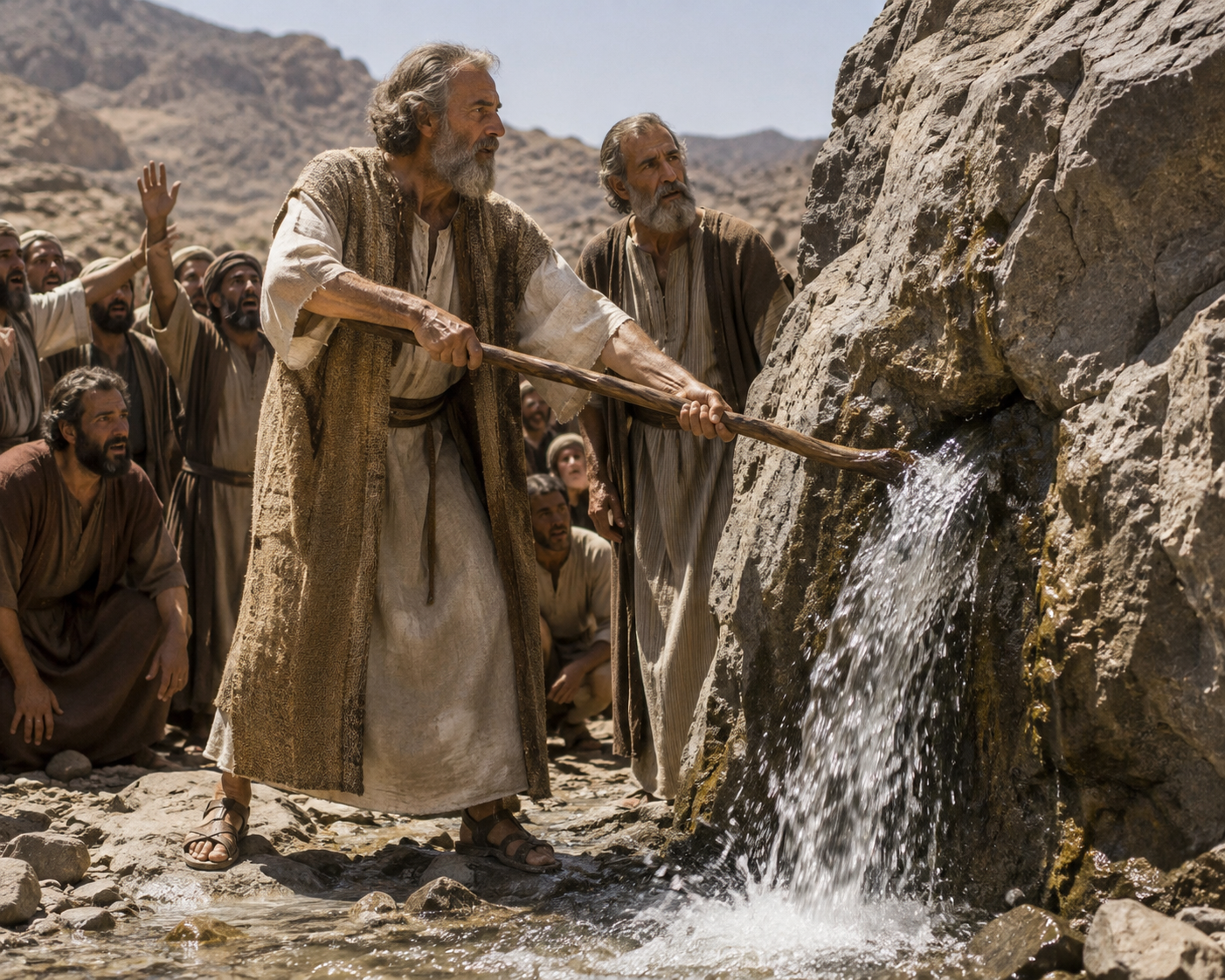
“Moses lifted up his hand, and with his rod he smote the rock twice…”
— Numbers 20:11
Nevertheless:
“the water came out abundantly, and the congregation drank, and their beasts also.”
God graciously supplied the water despite Moses’ failure.
But Moses and Aaron were disciplined:
“Because ye believed me not, to sanctify me in the eyes of the children of Israel, therefore ye shall not bring this congregation into the land which I have given them.”
— Numbers 20:12
This verse controls our interpretation of Moses’ failure.
God explicitly identifies the problem as unbelief and failure to sanctify Him in the eyes of Israel.
Various commentators have suggested additional significance in Moses striking the rock twice. First Corinthians 10:4 does say:
“…and that Rock was Christ.”
That inspired statement is important. However, Numbers 20:12 itself gives God’s stated reason for the judgment, and that reason must remain primary. We should not replace God’s explicit explanation with a typological theory that the text itself does not state.
The location received the name connected with Israel’s strife:
“This is the water of Meribah; because the children of Israel strove with the LORD…”
— Numbers 20:13
Edom refuses Israel passage
Moses sent messengers from Kadesh to the king of Edom asking permission to travel through his territory.
Israel promised not to pass through fields or vineyards and not to drink water from the wells, but to travel by the king’s highway.
Edom refused.
Israel requested passage again, but Edom came out against them:
“with much people, and with a strong hand.”
— Numbers 20:20
The result was:
“Thus Edom refused to give Israel passage through his border: wherefore Israel turned away from him.”
— Numbers 20:21
The chapter does not say Israel attacked Edom in response.
Aaron dies on Mount Hor
At Mount Hor, “by the coast of the land of Edom,” God announced that Aaron would be gathered unto his people and would not enter the land because of the rebellion at Meribah.
Moses was commanded to take Aaron and Eleazar up into Mount Hor.
There:
“Moses stripped Aaron of his garments, and put them upon Eleazar his son; and Aaron died there in the top of the mount…”
— Numbers 20:28
The transfer of the priestly garments visibly marks Eleazar’s succession to Aaron’s priestly office.
Israel then mourned:
“And when all the congregation saw that Aaron was dead, they mourned for Aaron thirty days, even all the house of Israel.”
— Numbers 20:29
Numbers 33:38 explicitly places Aaron’s death in the fortieth year after the Exodus.
Key People and Places
- Aaron — Israel’s high priest. Numbers 18 defines his priestly responsibilities and privileges. Numbers 20 records his participation in the failure at Meribah and his death on Mount Hor.
- Moses — Israel’s God-appointed leader. In Numbers 20 he disobeys God’s command concerning the rock and is told that he will not bring the congregation into the promised land.
- Eleazar — Aaron’s son. He participates in the ordinance of the red heifer in Numbers 19 and receives Aaron’s priestly garments in Numbers 20.
- Miriam — Sister of Moses and Aaron. Numbers 20:1 explicitly records her death and burial at Kadesh.
- The Levites — Given to assist Aaron and his sons in connection with the tabernacle while remaining distinct from the Aaronic priests.
- The children of Israel — The congregation receiving these laws, provisions, and judgments.
- The king of Edom — Refuses Israel permission to pass through Edomite territory.
- The LORD — The central authority throughout every chapter: appointing the priesthood, prescribing cleansing, providing water, establishing boundaries, judging disobedience, and directing Israel.
Places
- The tabernacle of the congregation — Central to priestly and Levitical service and to the purification regulations of Numbers 18–19.
- The desert of Zin — The region into which the congregation comes in Numbers 20:1.
- Kadesh — Israel’s location when Miriam dies and from which Moses sends messengers to Edom.
- Meribah — The waters associated with Israel’s striving and Moses and Aaron’s failure to sanctify the LORD before the congregation.
- Edom — Territory through which Israel requested passage but was denied.
- Mount Hor — The mountain near Edom where Aaron died and Eleazar received his garments.
Main Doctrinal or Spiritual Themes
1. God Determines How He Is to Be Served
Numbers 18 leaves no room for men to invent their own priesthood.
God chose Aaron. God appointed the Levites. God established the boundaries of their work.
“I have given your priest’s office unto you as a service of gift…”
— Numbers 18:7
Sacred service is governed by God’s word rather than personal ambition.
This is especially significant after Korah’s rebellion. Men could not make themselves priests merely because they desired equality with those whom God had appointed.
2. Greater Spiritual Responsibility Is a Solemn Matter
Aaron and his sons carried particular responsibility connected with the sanctuary and priesthood.
Numbers 20 further demonstrates that even Moses and Aaron were not exempt from accountability.
Their position did not excuse disobedience.
God said:
“Because ye believed me not, to sanctify me in the eyes of the children of Israel…”
God holds His servants accountable to honor Him publicly.
3. God Is Holy
Holiness runs through all three chapters.
There were boundaries around the sanctuary.
There were boundaries around priestly service.
There were prescribed procedures for purification.
There were exact instructions concerning the rock.
God’s holiness means His commands are not merely suggestions.
4. God Provides for Those He Calls to His Service
The Levites did not receive the same territorial inheritance as the other tribes.
Yet God said:
“I am thy part and thine inheritance among the children of Israel.”
God also provided materially for the Levites through Israel’s tithes.
The New Testament church is not Israel, but the New Testament independently establishes the principle of supporting gospel ministry:
“Even so hath the Lord ordained that they which preach the gospel should live of the gospel.”
— 1 Corinthians 9:14
5. Death Brings Defilement Under the Mosaic Ceremonial System
Numbers 19 repeatedly connects contact with death with ceremonial uncleanness.
This should first be understood exactly where the passage places it: within Israel’s ceremonial law.
Hebrews 9 then contrasts the external purification supplied by such ordinances with the far greater cleansing accomplished by Christ.
The law could cleanse ceremonially.
Only Christ’s blood provides the cleansing associated with eternal redemption.
6. Salvation and Cleansing Must Be on God’s Terms
The Israelite could not substitute another procedure for the water of separation and claim that sincerity was sufficient.
God prescribed the means.
That principle is important spiritually: sinful man does not determine the terms upon which he approaches God.
Regarding eternal salvation, the New Testament plainly places salvation in Christ and not in human works or ceremonies:
“For by grace are ye saved through faith; and that not of yourselves: it is the gift of God:
Not of works, lest any man should boast.”
— Ephesians 2:8–9
7. Partial Obedience Is Not Biblical Obedience
Moses did many things God commanded.
He took the rod.
He gathered the congregation.
He went to the rock.
But God had said:
“speak ye unto the rock”
Moses instead struck it twice.
Years of previous faithfulness did not turn this particular act of disobedience into obedience.
God’s own interpretation was:
“Because ye believed me not…”
This warns against the dangerous idea that long service gives a believer liberty to disregard God’s explicit word.
8. God’s Grace Does Not Eliminate His Discipline
Moses disobeyed, yet:
“the water came out abundantly”
The people received water because of God’s provision.
But Moses still experienced the announced consequence.
Grace and discipline are therefore not contradictory.
For the Christian, salvation is secure in Christ and is never earned by obedience; nevertheless, Scripture teaches that the Lord chastens His children. Hebrews 12:6 says:
“For whom the Lord loveth he chasteneth…”
9. God’s Work Continues Beyond Individual Servants
Miriam dies.
Aaron dies.
Moses is told that he will not bring the congregation into the land.
Yet God’s purpose for Israel continues.
Aaron’s garments pass to Eleazar.
The lesson should not be overstated into details Scripture does not give, but one fact is unmistakable: God’s program did not depend upon the earthly permanence of any one human servant.
10. Israel and the Church Must Remain Distinct
Numbers 18–20 concerns literal Israel, a literal Aaronic priesthood, literal Levites, literal ceremonial ordinances, and Israel’s literal journey.
The church has not replaced Israel in these passages.
The church should learn from these Scriptures, as Romans 15:4 teaches concerning things written aforetime, but those lessons do not erase the historical and dispensational distinctions established in the Bible.
Practical Applications or Lessons
Take God’s Word Exactly as He Gives It
Moses’ failure at Meribah is one of Scripture’s strongest warnings concerning precise obedience.
What God says matters.
Adding our own method, temper, or reasoning to His command can dishonor Him even when the outward result appears successful.
Water still came from the rock—but Moses’ conduct was still wrong.
Results therefore do not determine whether a method was biblical.
Never Treat Holy Things Casually
Numbers 18 repeatedly emphasizes limits, responsibilities, and holy things.
God’s work deserves reverence.
For believers today, this means preaching, teaching, worship, giving, and Christian service should never be reduced to mere entertainment, self-promotion, or personal ambition.
Give God His Due From What He Provides
The Levites received tithes and then gave from what they had received.
There was no class of servants who had reached a point where honoring God no longer applied to them.
Everything ultimately came from Him.
Beware of Anger When Representing God
Numbers 20 records Moses addressing the people:
“Hear now, ye rebels…”
Scripture elsewhere confirms that Moses’ conduct at the waters of strife was sinful. Psalm 106:32–33 says:
“They angered him also at the waters of strife, so that it went ill with Moses for their sakes:
Because they provoked his spirit, so that he spake unadvisedly with his lips.”
This gives explicit biblical commentary on the incident.
The people truly were rebellious, but their wrongdoing did not excuse Moses from representing God properly.
A preacher may speak truth and still need to guard his spirit, words, and manner.
Do Not Let Other People’s Sin Become an Excuse for Your Own
Psalm 106 states that Israel provoked Moses.
Numbers 20 nevertheless holds Moses responsible for his response.
Provocation explains the circumstances; it does not erase accountability.
This is an especially important lesson for Christian leadership.
God’s Provision Is Greater Than Man’s Failure
Israel complained.
Moses failed.
Yet God supplied abundant water.
“the water came out abundantly”
God remained faithful to His purposes even in the midst of human failure.
This should produce humility rather than presumption.
Respect the Boundaries God Establishes
When Edom refused Israel passage, Israel turned away rather than taking the route by force.
We should not invent motives for Edom or Israel beyond what the text states. The plain fact is that Edom refused passage and Israel did not force the issue at that time.
There are occasions when God’s people must accept a closed route rather than manufacture their own way forward.
Remember That Human Servants Are Temporary
The deaths of Miriam and Aaron soberly remind the reader that even prominent servants of God finish their earthly course.
Aaron’s garments passed to Eleazar.
The office continued, but Aaron did not.
A ministry should therefore be centered upon God and His Word rather than upon the personality of a particular man.
God’s Holiness and God’s Grace Stand Together
These chapters contain severe warnings:
- unauthorized approach brought judgment;
- ceremonial defilement required cleansing;
- Moses and Aaron were disciplined;
- Aaron died outside the promised land.
Yet they also contain abundant provision:
- God supplied His servants;
- God provided a means of ceremonial purification;
- God provided water abundantly;
- God continued leading Israel.
The God who is gracious is also holy. Biblical grace never requires diminishing God’s holiness, and biblical holiness never requires denying His mercy.
Overall Message of Numbers 18–20
Numbers 18–20 teaches that God alone determines the order of His worship, the means of approaching Him, and the standard of obedience expected from His servants.
Numbers 18 emphasizes holy service and divine order.
Numbers 19 emphasizes defilement and God-appointed cleansing.
Numbers 20 emphasizes unbelief, obedience, divine provision, discipline, and the passing of one generation of leadership.
The central warning may be seen in the LORD’s words to Moses and Aaron:
“Because ye believed me not, to sanctify me in the eyes of the children of Israel…”
— Numbers 20:12
God’s servants are called not merely to accomplish religious tasks but to believe God, obey His word, and sanctify Him before His people.
For the Christian, the greatest doctrinal contrast in these chapters is supplied by Hebrews: ceremonial cleansing could address “the purifying of the flesh,” but the blood of Jesus Christ accomplishes what the Mosaic ceremonies never could. Our salvation rests not in priestly ritual, Levitical service, or human obedience, but wholly in the finished work of Jesus Christ received by faith.
Numbers 18, Numbers 19, Numbers 20, Book of Numbers, Moses, Aaron, Eleazar, Miriam, Levites, children of Israel, priesthood, Aaronic priesthood, red heifer, water of separation, purification, Meribah, Kadesh, desert of Zin, Edom, king of Edom, Mount Hor, tabernacle, tithes, firstfruits, holiness, obedience, unbelief, divine discipline, biblical separation, Israel, wilderness, King James Bible, KJV Bible study, conservative Baptist Bible study
Comments are closed