 Numbers 21–23 records a decisive transition in Israel’s wilderness journey. The people still display unbelief and sin, yet the LORD continues to judge, preserve, guide, and give victory. Israel defeats Sihon and Og, causing Moab to fear. Balak king of Moab then attempts to hire Balaam to curse Israel, but God repeatedly prevents the curse and turns Balaam’s intended service to Balak into declarations of blessing.
These chapters emphasize that God judges sin, provides the remedy He appoints, keeps His word, rules over nations, and cannot be manipulated by divination, money, political power, or human intention.
Chapter Summaries
Numbers 21 — The Brazen Serpent and Victories over the Amorites
1. Israel defeats the Canaanites — Numbers 21:1–3
The chapter opens with king Arad the Canaanite, who had heard that Israel came “by the way of the spies.” He fought against Israel and took some of them prisoners.
Israel then vowed:
“If thou wilt indeed deliver this people into my hand, then I will utterly destroy their cities.”
— Numbers 21:2
The LORD answered:
“And the LORD hearkened to the voice of Israel, and delivered up the Canaanites.”
— Numbers 21:3
The place was called Hormah.
The explicit point is that the victory came because the LORD delivered the Canaanites into Israel’s hand. The text does not establish Israel’s vow as a general formula by which believers should bargain with God.
2. Israel complains and the LORD sends fiery serpents — Numbers 21:4–6
Israel then traveled from mount Hor by the way of the Red sea, going around the land of Edom.
The text says:
“and the soul of the people was much discouraged because of the way.”
— Numbers 21:4
Discouragement soon became sinful speech:
“And the people spake against God, and against Moses, Wherefore have ye brought us up out of Egypt to die in the wilderness? for there is no bread, neither is there any water; and our soul loatheth this light bread.”
— Numbers 21:5
Their complaint was not merely against difficult circumstances. The KJV explicitly says that they “spake against God, and against Moses.”
The LORD responded:
“And the LORD sent fiery serpents among the people, and they bit the people; and much people of Israel died.”
— Numbers 21:6
This was divine judgment upon their sin.
3. Confession and the serpent of brass — Numbers 21:7–9
The people acknowledged their guilt:
“We have sinned, for we have spoken against the LORD, and against thee.”
— Numbers 21:7
Moses prayed for them.
God then commanded Moses:
“Make thee a fiery serpent, and set it upon a pole: and it shall come to pass, that every one that is bitten, when he looketh upon it, shall live.”
— Numbers 21:8
Moses obeyed:
“And Moses made a serpent of brass, and put it upon a pole, and it came to pass, that if a serpent had bitten any man, when he beheld the serpent of brass, he lived.”
— Numbers 21:9
The text is very precise. The bitten Israelite did not devise his own remedy. God provided the remedy and stated the condition: “when he looketh upon it, shall live.”
Christ’s own interpretation
The connection to salvation in Christ is not an invented allegory. Jesus Christ Himself explicitly uses this event:
“And as Moses lifted up the serpent in the wilderness, even so must the Son of man be lifted up:
That whosoever believeth in him should not perish, but have eternal life.”
— John 3:14–15
Therefore, the brazen serpent legitimately pictures Christ according to the interpretation supplied by Christ Himself.
The bitten Israelites could not cure themselves; God provided the means of deliverance. Likewise, eternal life is received through believing on Christ, not through human works.
4. Israel continues toward Moab — Numbers 21:10–20
The chapter records several stages in Israel’s journey:
- Oboth
- Ije-abarim
- the valley of Zared
- the other side of Arnon
- Beer
- Mattanah
- Nahaliel
- Bamoth
- the top of Pisgah
At Beer, the LORD said:
“Gather the people together, and I will give them water.”
— Numbers 21:16
Israel responded with the song:
“Spring up, O well; sing ye unto it.”
— Numbers 21:17
Again, the provision is presented as coming from God.
5. Sihon refuses Israel passage — Numbers 21:21–30
Israel sent messengers to Sihon king of the Amorites, asking permission to pass through his land.
Israel promised:
“We will not turn into the fields, or into the vineyards; we will not drink of the waters of the well: but we will go along by the king’s high way, until we be past thy borders.”
— Numbers 21:22
Sihon refused.
Instead:
“Sihon gathered all his people together, and went out against Israel into the wilderness.”
— Numbers 21:23
Israel defeated him and possessed his land from Arnon unto Jabbok.
This detail becomes important in Numbers 22, because Balak’s fear is explicitly connected to what Israel had done to the Amorites.
6. Israel defeats Og king of Bashan — Numbers 21:31–35
After taking Amorite territory and Jazer, Israel went by the way of Bashan.
Og king of Bashan came against Israel with his people at Edrei.
The LORD told Moses:
“Fear him not: for I have delivered him into thy hand, and all his people, and his land.”
— Numbers 21:34
Israel defeated Og and possessed his land.
The emphasis is once again upon divine deliverance:
“I have delivered him into thy hand.”
These victories establish the immediate setting for the fear of Moab in the next chapter.
Numbers 22 — Balak Hires Balaam to Curse Israel
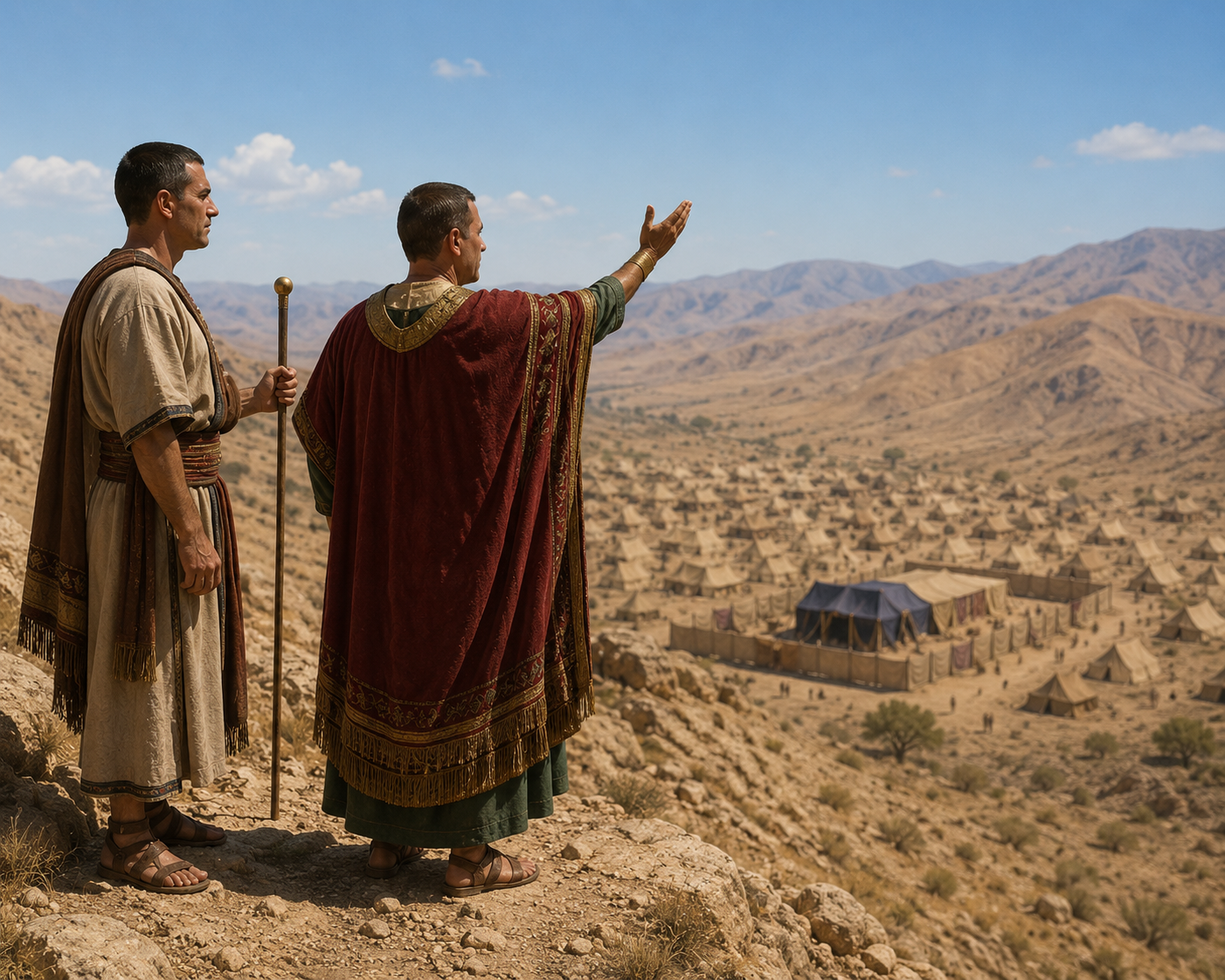
1. Moab fears Israel — Numbers 22:1–4
Israel camped:
“in the plains of Moab on this side Jordan by Jericho.”
— Numbers 22:1
Balak the son of Zippor saw what Israel had done to the Amorites.
The text explicitly states:
“And Moab was sore afraid of the people, because they were many: and Moab was distressed because of the children of Israel.”
— Numbers 22:3
Balak therefore sought supernatural assistance against Israel.
2. Balak sends for Balaam — Numbers 22:5–14
Balak sent messengers to Balaam the son of Beor, who was at Pethor, “by the river of the land of the children of his people.”
Balak requested:
“Come now therefore, I pray thee, curse me this people.”
— Numbers 22:6
Balak believed Balaam possessed unusual ability to bless and curse:
“for I wot that he whom thou blessest is blessed, and he whom thou cursest is cursed.”
The elders of Moab and Midian departed:
“with the rewards of divination in their hand.”
— Numbers 22:7
God’s answer to Balaam was unmistakable:
“Thou shalt not go with them; thou shalt not curse the people: for they are blessed.”
— Numbers 22:12
That is the controlling truth for everything that follows.
Israel was blessed because God said they were blessed. Balaam could not overturn God’s declaration.
3. Balak sends more honorable princes — Numbers 22:15–21
Balak refused to accept Balaam’s first answer and sent “princes, more, and more honourable” than the first group.
He promised:
“I will promote thee unto very great honour.”
— Numbers 22:17
Balaam answered:
“If Balak would give me his house full of silver and gold, I cannot go beyond the word of the LORD my God, to do less or more.”
— Numbers 22:18
God subsequently told Balaam:
“If the men come to call thee, rise up, and go with them; but yet the word which I shall say unto thee, that shalt thou do.”
— Numbers 22:20
Balaam then went with the princes of Moab.
An important textual restraint
Verse 22 immediately says:
“And God’s anger was kindled because he went.”
The KJV therefore records both God’s conditional permission in verse 20 and His anger in verse 22.
Scripture does not explicitly explain in verse 22 every aspect of why the conditional permission and God’s anger stand together. It would therefore be unwise to invent details about Balaam’s precise internal reasoning and state them as explicit facts.
What Scripture does explicitly reveal a little later is the angel’s declaration:
“behold, I went out to withstand thee, because thy way is perverse before me.”
— Numbers 22:32
That statement is sufficient.
4. Balaam, the ass, and the angel of the LORD — Numbers 22:22–35
As Balaam traveled, the angel of the LORD stood in the way.
The ass saw the angel before Balaam did.
Three times the animal reacted to the angel’s presence, while Balaam struck her.
Then:
“And the LORD opened the mouth of the ass.”
— Numbers 22:28
The account presents this as an actual supernatural event, not as a parable or allegory.
Afterward:
“Then the LORD opened the eyes of Balaam, and he saw the angel of the LORD standing in the way.”
— Numbers 22:31
Balaam confessed:
“I have sinned; for I knew not that thou stoodest in the way against me.”
— Numbers 22:34
The angel again restricted Balaam:
“only the word that I shall speak unto thee, that thou shalt speak.”
— Numbers 22:35
God remained completely in control of the message.
5. Balaam meets Balak — Numbers 22:36–41
Balak came to meet Balaam and questioned why Balaam had not come sooner.
Balaam warned him:
“the word that God putteth in my mouth, that shall I speak.”
— Numbers 22:38
Balak then took Balaam to Kirjath-huzoth, where sacrifices were offered, and afterward:
“Balak took Balaam, and brought him up into the high places of Baal.”
— Numbers 22:41
From there Balaam could see part of Israel.
The setting is now prepared for Balak’s repeated attempts to obtain a curse.
Numbers 23 — God Turns the Intended Curse into Blessing
1. Seven altars and the first prophecy — Numbers 23:1–12
Balaam instructed Balak:
“Build me here seven altars, and prepare me here seven oxen and seven rams.”
— Numbers 23:1
After the sacrifices, God met Balaam and:
“the LORD put a word in Balaam’s mouth.”
— Numbers 23:5
Balaam’s first declaration includes:
“How shall I curse, whom God hath not cursed? or how shall I defy, whom the LORD hath not defied?”
— Numbers 23:8
That is one of the central truths of these chapters.
Balak can hire Balaam.
Balaam can build altars.
Sacrifices can be offered.
A favorable location can be chosen.
But none of these things can force God to curse those whom He has determined to bless.
Balaam also says:
“lo, the people shall dwell alone, and shall not be reckoned among the nations.”
— Numbers 23:9
The verse explicitly treats Israel as a distinct people.
From a dispensational standpoint, this supports maintaining the biblical distinction concerning Israel rather than dissolving Israel into the Church. The verse itself is speaking of Israel, not of the New Testament Church.
Balaam concludes:
“Let me die the death of the righteous, and let my last end be like his!”
— Numbers 23:10
The statement expresses Balaam’s desire concerning his end. The verse by itself does not say that Balaam was righteous.
Indeed, later Scripture explicitly gives further information about his character and conduct. Second Peter 2:15 speaks of:
“Balaam the son of Bosor, who loved the wages of unrighteousness.”
Therefore his statement in Numbers 23:10 should not be turned into a declaration that Scripture calls Balaam a righteous man.
2. Balak tries a different location — Numbers 23:13–17
Balak assumed that another viewpoint might produce a different result.
He took Balaam:
“into the field of Zophim, to the top of Pisgah.”
— Numbers 23:14
Seven more altars were built, with an ox and a ram offered upon every altar.
Once again:
“the LORD met Balaam, and put a word in his mouth.”
— Numbers 23:16
Changing location did not change God’s word.
3. The second prophecy — Numbers 23:18–24
Balaam declared:
“God is not a man, that he should lie; neither the son of man, that he should repent: hath he said, and shall he not do it? or hath he spoken, and shall he not make it good?”
— Numbers 23:19
The immediate context concerns God’s declared blessing upon Israel.
Balak cannot persuade God to reverse His word.
“That he should repent”
Numbers 23:19 should be read according to its context. It does not permit us to ignore other KJV passages in which Scripture itself uses the word “repent” concerning the LORD.
Here the point is expressly joined to:
“hath he said, and shall he not do it?”
God is not like sinful man—lying, unreliable, or susceptible to Balak’s attempts to make Him reverse His declared purpose.
Balaam continues:
“Behold, I have received commandment to bless: and he hath blessed; and I cannot reverse it.”
— Numbers 23:20
That sentence summarizes the whole episode.
God had blessed. Balaam could not reverse it.
4. “He hath not beheld iniquity in Jacob” — Numbers 23:21
Balaam says:
“He hath not beheld iniquity in Jacob, neither hath he seen perverseness in Israel: the LORD his God is with him, and the shout of a king is among them.”
This statement must not be interpreted as though Israel had never sinned.
Numbers 21 itself has already explicitly said:
“And the people spake against God, and against Moses.”
— Numbers 21:5
The people themselves confessed:
“We have sinned.”
— Numbers 21:7
Therefore, whatever the precise force of Numbers 23:21 in Balaam’s prophetic blessing, it cannot mean that Israel was personally or historically sinless.
The immediate context emphasizes God’s determination to bless Israel rather than permit Balaam to pronounce the curse Balak desired.
Going beyond that into a detailed theory of exactly how God was “beholding” Israel in this verse would require care, because the verse does not itself provide such a theological formula.
5. God cannot be overcome by enchantment — Numbers 23:22–24
Balaam says:
“God brought them out of Egypt; he hath as it were the strength of an unicorn.”
— Numbers 23:22
Then:
“Surely there is no enchantment against Jacob, neither is there any divination against Israel.”
— Numbers 23:23
This fits the entire narrative.
Balak is attempting to obtain a supernatural curse through Balaam, but Israel’s future is not controlled by pagan divination. It is controlled by the LORD.
The verse continues:
“according to this time it shall be said of Jacob and of Israel, What hath God wrought!”
The glory belongs to God.
6. Balak’s frustration and another attempt — Numbers 23:25–30
Balak finally protested:
“Neither curse them at all, nor bless them at all.”
— Numbers 23:25
Balaam reminded him:
“All that the LORD speaketh, that I must do.”
— Numbers 23:26
Yet Balak tried once more, taking Balaam to:
“the top of Peor, that looketh toward Jeshimon.”
— Numbers 23:28
Seven more altars were built and sacrifices offered.
Numbers 23 ends there. The prophecy associated with this location belongs to Numbers 24, so it should not be imported into the summary of chapter 23 as though it were already spoken here.
Key People and Places
Moses
God’s appointed leader of Israel. In Numbers 21 he intercedes after Israel confesses its sin, and he obeys God’s command to make the serpent of brass.
Israel
The covenant nation traveling toward the land promised by God. These chapters show both Israel’s sinfulness and God’s continuing faithfulness to His declared purposes.
King Arad
A Canaanite ruler who fought Israel and took prisoners before the LORD delivered the Canaanites into Israel’s hand.
Sihon
King of the Amorites. He refused Israel peaceful passage, attacked Israel, and was defeated.
Og
King of Bashan. He came out against Israel at Edrei and was defeated after the LORD told Moses, “Fear him not.”
Balak
Son of Zippor and king of Moab. He feared Israel and hired Balaam in an attempt to have Israel cursed.
Balaam
Son of Beor, from Pethor. In Numbers 22–23 God repeatedly restricts him to speaking only what God gives him to speak.
Later KJV Scripture explicitly reveals serious evil connected with Balaam. Second Peter 2:15 says he:
“loved the wages of unrighteousness.”
Numbers 31:16 also explicitly refers to:
“the counsel of Balaam.”
Those later passages should govern any attempt to portray Balaam as a faithful prophet merely because God put true words in his mouth.
The angel of the LORD
Stood in Balaam’s way because, according to Numbers 22:32:
“thy way is perverse before me.”
Balaam’s ass
The LORD opened her mouth in a literal supernatural event recorded in Numbers 22.
Hormah
The place named following Israel’s victory over the Canaanites in Numbers 21:3.
Arnon
A major geographic boundary appearing during Israel’s journey and conquest east of Jordan.
Heshbon
City of Sihon king of the Amorites, taken by Israel.
Jazer
An Amorite location whose villages Israel took.
Bashan
The kingdom associated with Og.
Edrei
Location where Og came against Israel.
Plains of Moab
Israel’s encampment “on this side Jordan by Jericho” at the beginning of Numbers 22.
Pethor
The place from which Balaam was summoned.
Kirjath-huzoth
A location to which Balak brought Balaam.
High places of Baal
The location from which Balak first showed Balaam part of Israel.
Field of Zophim / top of Pisgah
Location of Balak’s second effort to obtain a curse.
Peor
The final location mentioned in Numbers 23, overlooking Jeshimon, where another set of altars was prepared.
Main Doctrinal or Spiritual Themes
1. Sin brings divine judgment
Israel’s discouragement did not excuse sinful speech.
The people:
“spake against God.”
The LORD therefore sent the fiery serpents.
God is holy. Human discomfort does not make rebellion acceptable.
2. Confession does not devise the remedy—God does
Israel confessed:
“We have sinned.”
But confession did not permit them to invent their own cure.
God determined both the remedy and the response:
“when he looketh upon it, shall live.”
This points directly to Christ because Christ Himself applies the event that way in John 3:14–15.
3. Salvation is received by faith, not human merit
The brazen serpent is especially important because Christ uses it when teaching eternal life.
“That whosoever believeth in him should not perish, but have eternal life.”
— John 3:15
The sinner does not earn eternal life through works, sacraments, moral reform, or religious achievement. Eternal life is received by believing in Christ.
The historical event in Numbers concerned physical deliverance from the serpent bite; its application to eternal salvation is warranted because Jesus Himself makes that connection.
4. God’s word cannot be bought
Balak offered Balaam honor and material reward.
But God’s word remained fixed.
“he hath blessed; and I cannot reverse it.”
— Numbers 23:20
Money cannot purchase divine approval.
Political influence cannot alter Scripture.
A preacher has no authority to modify God’s message to satisfy the person paying him, honoring him, or pressuring him.
5. God is truthful and faithful
“God is not a man, that he should lie.”
— Numbers 23:19
The reliability of God’s word rests upon God’s own character.
What He has truly declared, man cannot invalidate.
6. God’s purposes cannot be defeated by occult power
“Surely there is no enchantment against Jacob, neither is there any divination against Israel.”
— Numbers 23:23
Numbers 22–23 does not present divination as an alternative spiritual power equal to God.
The LORD rules the entire situation.
Balak seeks a curse.
Balaam is summoned to produce a curse.
Yet the words coming from Balaam’s mouth are placed there by God.
7. Israel remains a distinct people in the text
“the people shall dwell alone, and shall not be reckoned among the nations.”
— Numbers 23:9
The passage is explicitly about Israel.
A sound dispensational reading therefore leaves Israel as Israel rather than replacing Israel with the Church.
Nothing in Numbers 23 identifies Jacob or Israel as a figurative name for the New Testament Church.
8. God’s blessing does not mean God overlooks actual sin
Numbers 21 shows God judging Israel’s sin.
Numbers 23 shows God refusing to permit Balak to reverse His blessing upon Israel.
Both truths stand together.
Therefore divine chastening and divine covenant faithfulness are not opposites.
9. God rules over kings and nations
Arad, Sihon, Og, and Balak all appear as rulers with genuine earthly power.
Yet none controls the final outcome.
Sihon and Og cannot stop Israel when the LORD gives victory.
Balak cannot produce a curse when the LORD has determined blessing.
10. A man may speak true words without being a faithful man
Balaam speaks remarkable truth because:
“the LORD put a word in Balaam’s mouth.”
— Numbers 23:5
That fact alone does not establish Balaam’s righteousness.
Later Scripture explicitly condemns his course.
This is an important warning: truth belongs to God, and God can sovereignly cause His truth to be spoken even through a compromised messenger.
Practical Applications or Lessons
Guard the heart when the way is difficult
Israel was:
“much discouraged because of the way.”
Difficulty itself was real, but discouragement became sinful when the people turned against God and despised His provision.
A believer should therefore take discouragement seriously before it produces complaining, bitterness, or rebellion against the Lord.
Do not despise God’s provision
Israel said:
“our soul loatheth this light bread.”
What God had graciously supplied became something they despised.
There is a warning here against developing contempt for the ordinary provisions, duties, and blessings God has given.
Agree with God about sin
Israel finally said:
“We have sinned.”
That is the proper response when Scripture exposes wrongdoing—not justification, excuse, or blame shifting.
Look to God’s appointed remedy
The dying Israelite was not instructed to study the poison, perform a religious work, or prove personal worthiness.
God said to look.
Christ then said:
“That whosoever believeth in him should not perish.”
The gospel directs the sinner away from self and toward Christ.
Do not fear what God has already placed under His authority
Before Israel fought Og, God said:
“Fear him not.”
The command rested upon God’s promise:
“for I have delivered him into thy hand.”
Biblical courage is not confidence in oneself. It rests upon what God has actually said.
Never modify God’s word to please powerful people
Balak was a king.
He offered honor.
He repeatedly changed locations and sacrifices.
But Balaam was still forced to acknowledge:
“All that the LORD speaketh, that I must do.”
A preacher must likewise preach what God has written rather than reshape Scripture for wealth, position, applause, political pressure, or cultural acceptance.
Repetition cannot force God to change truth
Balak kept trying.
Different location.
More sacrifices.
Another attempt.
Yet:
“he hath blessed; and I cannot reverse it.”
Religious ceremony does not control God.
God is not manipulated by ritual.
Separate biblical certainty from human assumption
The unusual sequence in Numbers 22—God permitting Balaam to go conditionally and then expressing anger because he went—is an excellent reminder not to fill every silence in Scripture with confident theories.
Where God explains, we should speak clearly.
Where He has not explained every detail, reverence requires restraint.
Do not mistake giftedness for godliness
Balaam spoke prophetic truth, yet later Scripture explicitly condemns his way.
A man’s ability to preach, teach, speak impressively, or possess unusual influence does not prove that his heart and conduct are right with God.
The Word of God—not charisma—is the standard.
Overall Message of Numbers 21–23
Numbers 21 begins with Israel’s weakness and sin but also demonstrates God’s judgment, mercy, provision, and power. The brazen serpent gives one of the clearest Old Testament events that Christ Himself later uses to illustrate faith in Him.
The chapter then records Israel’s victories over Sihon and Og.
Those victories lead directly into Numbers 22, where Moab fears Israel and Balak attempts to hire Balaam to curse God’s people.
But the governing declaration has already been made:
“thou shalt not curse the people: for they are blessed.”
— Numbers 22:12
By Numbers 23, Balaam must confess:
“How shall I curse, whom God hath not cursed?”
and:
“he hath blessed; and I cannot reverse it.”
The central lesson is not that Israel was sinless. Numbers 21 proves otherwise. Rather, God remains sovereign over judgment, deliverance, nations, kings, prophets, blessing, and His own spoken word.
Man may oppose what God has said, but man cannot make God’s truth cease to be true.
Comments are closed