
Exodus 1–3 moves from Israel’s oppression in Egypt, to the preservation and early life of Moses, and finally to God’s appearance to Moses at Horeb and His commission to bring Israel out of Egypt. The controlling truth of these chapters is not Moses’ ability, but the faithfulness, holiness, compassion, and presence of the LORD.
The text deals explicitly with “the children of Israel” and with God’s covenant dealings concerning Abraham, Isaac, and Jacob (Exodus 2:24; 3:6, 15–16). Israel should therefore be understood literally here, rather than being allegorically replaced by the New Testament Church.
Chapter Summaries
 Exodus 1 — Israel Oppressed, Yet Multiplying
Exodus begins by connecting directly with Genesis. Jacob’s sons who came into Egypt are named, and the text states:
“And all the souls that came out of the loins of Jacob were seventy souls: for Joseph was in Egypt already.” — Exodus 1:5
Joseph and his generation died, but Israel did not disappear. Instead:
“And the children of Israel were fruitful, and increased abundantly, and multiplied, and waxed exceeding mighty; and the land was filled with them.” — Exodus 1:7
A major change then occurred:
“Now there arose up a new king over Egypt, which knew not Joseph.” — Exodus 1:8
Scripture does not explicitly name this Pharaoh. Attempts to identify him with a particular Egyptian ruler depend upon historical reconstruction and should not be presented as though Exodus names him.
Pharaoh feared Israel’s numerical strength and said that they were “more and mightier than we” (1:9). He therefore imposed taskmasters upon them and afflicted them with burdens. Israel built “treasure cities, Pithom and Raamses” for Pharaoh (1:11).
But oppression could not stop their increase:
“But the more they afflicted them, the more they multiplied and grew.” — Exodus 1:12
The Egyptians consequently made Israel’s lives “bitter with hard bondage” in mortar, brick, and field labor (1:14).
Pharaoh then commanded the Hebrew midwives, Shiphrah and Puah, to kill the male Hebrew children at birth. They refused:
“But the midwives feared God, and did not as the king of Egypt commanded them, but saved the men children alive.” — Exodus 1:17
Their conduct establishes an important biblical principle: human authority is not absolute when it commands what is contrary to God. Scripture later states the principle plainly: “We ought to obey God rather than men” (Acts 5:29).
Because the midwives feared God, Exodus says:
“Therefore God dealt well with the midwives…” — Exodus 1:20
Pharaoh then broadened his murderous policy:
“Every son that is born ye shall cast into the river, and every daughter ye shall save alive.” — Exodus 1:22
The chapter therefore closes with Israel under severe oppression and with male Hebrew infants specifically marked for death.
Exodus 2 — Moses Preserved, Moses in Midian, God Hears Israel
A man of the house of Levi took a daughter of Levi as his wife, and she bore a son. Exodus says:
“And when she saw him that he was a goodly child, she hid him three months.” — Exodus 2:2
Hebrews 11:23 gives additional inspired information, stating that Moses was hidden “by faith” and that his parents “were not afraid of the king’s commandment.”
When he could no longer be hidden, his mother made an ark of bulrushes, covered it with slime and pitch, placed Moses inside it, and laid it among the flags by the river’s brink. His sister watched from a distance.
Pharaoh’s daughter found the child. She immediately recognized:
“This is one of the Hebrews’ children.” — Exodus 2:6
Through the intervention of Moses’ sister, Moses’ own mother was called to nurse him. Pharaoh’s daughter later received him as her son and named him Moses:
“Because I drew him out of the water.” — Exodus 2:10
The chapter then moves forward to Moses as a grown man. Exodus 2 itself simply says, “when Moses was grown” (2:11). Stephen later gives the additional detail that Moses was forty years old at the time described in this period of his life (Acts 7:23). Acts 7:22 also explicitly says:
“And Moses was learned in all the wisdom of the Egyptians, and was mighty in words and in deeds.”
Moses saw an Egyptian smiting a Hebrew. After looking “this way and that way,” Moses killed the Egyptian and hid him in the sand (Exodus 2:12).
The following day Moses encountered two Hebrews striving together. When Moses reproved the one who did wrong, the man answered:
“Who made thee a prince and a judge over us? intendest thou to kill me, as thou killedst the Egyptian?” — Exodus 2:14
Moses then knew that his deed was known. Pharaoh sought to kill him, and Moses fled to Midian.
At a well in Midian, Moses defended the seven daughters of the priest of Midian from shepherds who drove them away. Moses then helped water their flock. He was brought into the household, became content to dwell there, and was given Zipporah as his wife.
She bore Moses a son:
“And he called his name Gershom: for he said, I have been a stranger in a strange land.” — Exodus 2:22
Later the king of Egypt died, but Israel’s bondage continued. The children of Israel sighed and cried unto God.
The closing verses are especially important:
“And God heard their groaning, and God remembered his covenant with Abraham, with Isaac, and with Jacob.
And God looked upon the children of Israel, and God had respect unto them.” — Exodus 2:24–25
“God remembered” does not mean that God had previously forgotten the covenant. Scripture consistently presents God as knowing all things. Here the language announces that God is acting in faithfulness to the covenant He had made.
Exodus 3 — The Burning Bush, the Holy God, and Moses’ Commission
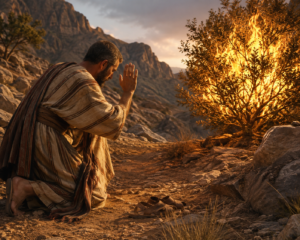
Moses was keeping the flock of Jethro, his father-in-law, when he came:
“to the mountain of God, even to Horeb.” — Exodus 3:1
There:
“the angel of the LORD appeared unto him in a flame of fire out of the midst of a bush.”
Moses saw that the bush burned but “was not consumed” (3:2).
The passage then says that “the LORD saw” Moses turn aside and that “God called unto him out of the midst of the bush” (3:4). Thus the text itself unmistakably presents the encounter as a divine revelation.
Some conservative interpreters identify appearances of “the angel of the LORD” with the preincarnate Christ. Exodus 3 itself does not explicitly use the words “Jesus Christ” or state that identification, so it is best not to make the identification stronger than the wording God gave.
God called:
“Moses, Moses.”
Moses answered:
“Here am I.” — Exodus 3:4
God immediately established the holiness of the encounter:
“Draw not nigh hither: put off thy shoes from off thy feet, for the place whereon thou standest is holy ground.” — Exodus 3:5
God then identified Himself:
“I am the God of thy father, the God of Abraham, the God of Isaac, and the God of Jacob.” — Exodus 3:6
Moses hid his face because “he was afraid to look upon God.”
God next declared that Israel’s suffering was fully known to Him:
“I have surely seen the affliction of my people which are in Egypt, and have heard their cry… for I know their sorrows.” — Exodus 3:7
God announced His purpose:
“And I am come down to deliver them out of the hand of the Egyptians…” — Exodus 3:8
He promised to bring them into the land of the Canaanites, Hittites, Amorites, Perizzites, Hivites, and Jebusites, described as:
“a land flowing with milk and honey.”
God then commissioned Moses:
“Come now therefore, and I will send thee unto Pharaoh, that thou mayest bring forth my people the children of Israel out of Egypt.” — Exodus 3:10
Moses responded:
“Who am I, that I should go unto Pharaoh…?” — Exodus 3:11
The text records this as a question. It is safer to call it Moses’ question rather than assigning motives to him that Scripture does not explicitly state.
God’s answer is central:
“Certainly I will be with thee.” — Exodus 3:12
Moses’ sufficiency would therefore rest upon God’s presence, not Moses’ natural qualifications.
Moses then asked what he should tell Israel if they asked concerning God’s name. God answered:
“I AM THAT I AM: and he said, Thus shalt thou say unto the children of Israel, I AM hath sent me unto you.” — Exodus 3:14
God continued:
“The LORD God of your fathers, the God of Abraham, the God of Isaac, and the God of Jacob… this is my name for ever, and this is my memorial unto all generations.” — Exodus 3:15
The KJV therefore places great emphasis upon God’s self-revelation as “I AM THAT I AM” and upon “the LORD God” of Israel’s fathers.
God instructed Moses to gather the elders of Israel and tell them that the LORD had visited His people and seen what had been done to them in Egypt.
God also told Moses beforehand that Pharaoh would resist:
“And I am sure that the king of Egypt will not let you go, no, not by a mighty hand.” — Exodus 3:19
God would therefore stretch out His hand and smite Egypt with His wonders. Afterward Pharaoh would let Israel go.
The chapter ends with God promising Israel favor in the sight of the Egyptians and saying:
“ye shall spoil the Egyptians.” — Exodus 3:22
This was not Moses’ private scheme; it was something God Himself declared would happen.
Key People and Places
- The children of Israel — The descendants of Jacob living in Egypt. They multiply greatly despite severe oppression.
- Pharaoh / the king of Egypt — The ruler who fears Israel’s growth, imposes bondage, orders the killing of Hebrew boys, and whose personal name is not given in Exodus 1–3.
- Shiphrah and Puah — Hebrew midwives who “feared God” and refused Pharaoh’s command to kill the male children.
- Moses’ father and mother — Both are identified here as belonging to Levi’s line. Their names are not supplied in Exodus 2, though Exodus 6:20 later names Amram and Jochebed.
- Moses — Preserved from Pharaoh’s death decree, raised in connection with Pharaoh’s household, later flees to Midian, and is called by God to bring Israel from Egypt.
- Moses’ sister — Watches over the ark and arranges for Moses’ mother to nurse him. Exodus 2 does not name her here.
- Pharaoh’s daughter — Finds Moses, has compassion upon him, and receives him as her son.
- Zipporah — Daughter of the priest of Midian and wife of Moses.
- Gershom — Son of Moses and Zipporah. His name is connected by Moses with being “a stranger in a strange land.”
- Jethro — Moses’ father-in-law, identified in Exodus 3:1 as “the priest of Midian.”
- Egypt — Place of Israel’s multiplication, bondage, and oppression.
- Pithom and Raamses — Treasure cities Israel built for Pharaoh under forced labor.
- The river — The location associated with Pharaoh’s command against the Hebrew sons and with Moses’ preservation as an infant.
- Midian — The land to which Moses fled from Pharaoh.
- Horeb — Called “the mountain of God” in Exodus 3:1; location of the burning bush encounter.
- The promised land — Described as the land of the Canaanites and other named peoples and as “a land flowing with milk and honey.”
Main Doctrinal or Spiritual Themes
1. God Is Faithful to His Covenant
The theological turning point occurs in Exodus 2:24:
“God remembered his covenant with Abraham, with Isaac, and with Jacob.”
Israel’s deliverance begins with the faithfulness of God. His promises do not fail because circumstances become severe.
This is literally God’s covenant dealing with Israel and the patriarchs. It should not be reassigned to the Church through allegory.
2. Persecution Cannot Overthrow God’s Purposes
Pharaoh attempted to reduce Israel through forced labor and then through the killing of male children. Yet:
“the more they afflicted them, the more they multiplied and grew.” — Exodus 1:12
The chapter does not teach that believers will always prosper materially when persecuted. It does show that human rulers cannot frustrate what God has determined to accomplish.
3. The Fear of God Must Be Greater Than the Fear of Man
The midwives are commended because:
“the midwives feared God.”
Their example shows that obedience to government has a biblical boundary. When a ruler commands direct wickedness, God must be obeyed.
4. God Sees and Knows the Affliction of His People
God says:
“I have surely seen…”
“I have heard their cry…”
“I know their sorrows.” — Exodus 3:7
The LORD is neither absent nor ignorant when His people suffer.
The passage does not say that Israel understood everything God was doing during those years. It says that God saw, heard, knew, remembered, and acted.
5. God Is Holy
The first requirement placed upon Moses at the bush concerns reverence:
“put off thy shoes from off thy feet, for the place whereon thou standest is holy ground.”
God’s holiness is not casual. Moses hid his face and was afraid to look upon God.
Biblical worship therefore calls for reverence rather than flippancy.
6. God Reveals Himself
God does not permit Moses to invent a conception of deity. God tells Moses who He is:
“I AM THAT I AM.”
He further identifies Himself as:
“The LORD God of your fathers, the God of Abraham, the God of Isaac, and the God of Jacob.”
Biblical faith rests upon God’s revelation of Himself, not upon man creating a god after his own imagination.
7. God’s Presence Is the Servant’s Sufficiency
When Moses asks, “Who am I?”, God does not respond by building Moses’ self-esteem. He says:
“Certainly I will be with thee.”
The answer to human insufficiency in service is not confidence in self, but confidence in the God who sends.
8. God Is the Deliverer
God repeatedly speaks in the first person:
“I have surely seen…”
“I have heard…”
“I know…”
“I am come down to deliver…”
“I will send thee…”
Moses would be God’s commissioned servant, but God Himself was the Deliverer.
Israel’s deliverance from Egypt is a literal national and physical deliverance. It should not be confused with New Testament justification, which is salvation by grace through faith apart from works. Nevertheless, the passage certainly displays the same God who alone possesses power to save and deliver.
9. God Knows Opposition Before His Servants Encounter It
God told Moses:
“I am sure that the king of Egypt will not let you go…”
Pharaoh’s resistance would not surprise God. God already knew the opposition and had already declared what He would do.
10. God’s Word Determines the Outcome
Before Moses returned to Egypt, God had already announced that He would bring Israel out and would smite Egypt with His wonders.
The certainty of the mission rested upon what God said, not upon what circumstances appeared to promise.
Practical Applications or Lessons
- Fear God above man. Shiphrah and Puah faced a direct command from a powerful ruler, yet “the midwives feared God.” No earthly authority has the right to command disobedience to God.
- Do not measure God’s faithfulness by present circumstances. Israel was suffering terribly when God declared, “I have surely seen… I have heard… I know their sorrows.” Divine silence from man’s perspective does not mean divine ignorance.
- Reverence God as holy. The command concerning holy ground reminds believers that familiarity with biblical truth should never produce casualness toward God.
- Let Scripture tell you who God is. Exodus 3 does not begin with Moses defining God. God reveals Himself. Sound doctrine begins with what God has spoken.
- Do not make personal inadequacy the final consideration in service. Moses asked, “Who am I?” God answered, “Certainly I will be with thee.” The servant’s confidence must rest in the Lord rather than in personality, education, eloquence, or natural strength.
- Remember that opposition does not invalidate God’s call. God told Moses beforehand that Pharaoh would resist. Difficulty was not proof that Moses had misunderstood God.
- God can preserve His servants in circumstances where men intend destruction. Moses lived during a royal decree aimed specifically at Hebrew sons. Exodus plainly records his preservation, though we should not invent details concerning every means by which God arranged it.
- Sinful power eventually answers to God. Pharaoh appears dominant in Exodus 1, but Exodus 3 makes clear that the LORD has seen Egypt’s oppression and is preparing to act.
- God keeps His promises across generations. Abraham, Isaac, and Jacob were dead, but God’s covenant was not dead. Human generations pass; the Word of God does not fail.
- Biblical service begins with listening to God. Moses’ commission came from God’s revealed word. Christian ministry likewise must be governed by Scripture rather than by personal ambition, cultural pressure, or human tradition.
Overall Emphasis
Exodus 1–3 begins with an earthly king attempting to control the future of Israel and ends with the LORD declaring what He will do.
Pharaoh says, in effect, that Israel must be restrained.
God says:
“I am come down to deliver them.” — Exodus 3:8
Moses asks:
“Who am I?” — Exodus 3:11
God answers:
“Certainly I will be with thee.” — Exodus 3:12
And when Moses asks what name he should give to Israel, God declares:
“I AM THAT I AM.” — Exodus 3:14
The foundation of Exodus is therefore not the greatness of Moses, but the greatness and faithfulness of the LORD: the holy God who sees, hears, remembers His covenant, knows the sorrows of His people, calls His servant, promises His presence, and declares beforehand that He will deliver Israel.
Conservative Baptist conclusion: Exodus 1–3 should be received as literal history concerning Israel, Egypt, Moses, and God’s covenant dealings. Its spiritual lessons should arise from what the text actually says, without replacing Israel with the Church, turning historical details into unsupported allegories, or making traditional interpretations more certain than the words of Scripture themselves.
Tags: Exodus 1, Exodus 2, Exodus 3, King James Bible, KJV, Moses, Pharaoh, children of Israel, Shiphrah, Puah, Pharaoh’s daughter, Zipporah, Gershom, Jethro, Abraham, Isaac, Jacob, Egypt, Midian, Horeb, mountain of God, burning bush, I AM THAT I AM, LORD God, Israel in Egypt, Hebrew midwives, Pithom, Raamses, bondage in Egypt, covenant, holiness of God, fear of God, call of Moses, deliverance of Israel, conservative Baptist Bible study, Independent Baptist, KJV Bible study
Comments are closed