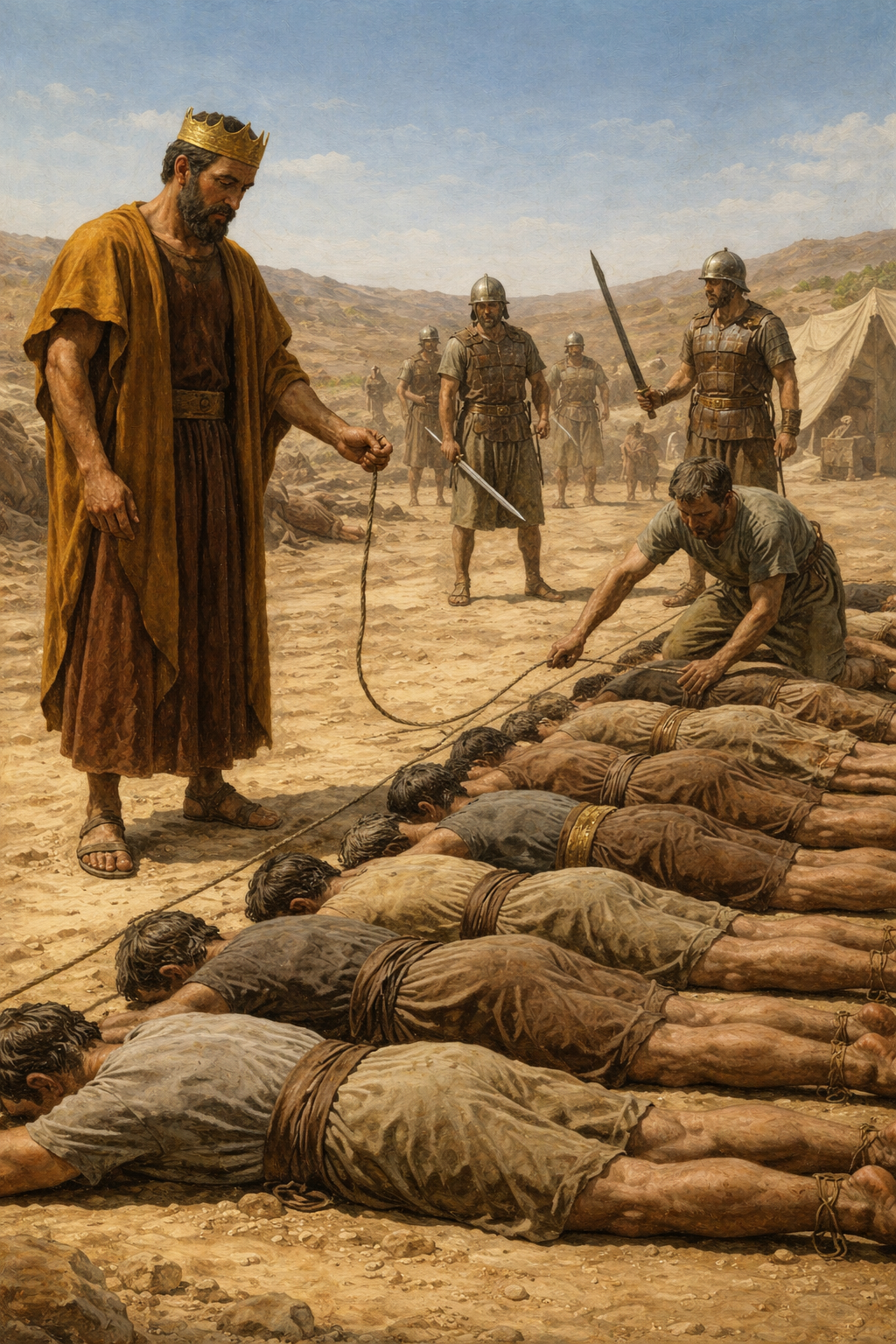
The expression “one line for life and another for death” comes from 2 Samuel 8:2.
THE PHRASE YOU’RE ASKING ABOUT: “LINE TO LIFE / LINE TO DEATH”
This wording appears when David deals with Moab:
2 Samuel 8:2 (KJV)
“And he smote Moab, and measured them with a line, casting them down to the ground; even with two lines measured he to put to death, and with one full line to keep alive.”
This is where the “lines of life and death” concept comes from.
Where it does NOT appear
There is no “line to life / line to death” wording in 2 Samuel 10.
Chapter 10 is about:
-
David sending comfort to Hanun
-
The ambassadors being humiliated
-
Joab fighting Ammon and Syria
-
Joab saying:
“Let the Lord do that which seemeth him good.” (2 Sam 10:12)
No measuring lines appear in that chapter.
 WHAT THE “LINES” MEANT IN 2 SAMUEL 8:2
David used a measuring line to determine Moabite captives’ fate:
-
Two lines = execution
-
One full line = spared
This was an ancient Near Eastern method for assigning judgment after war.
The passage emphasizes:
-
God’s judgment on Moab (who had mistreated David’s family—1 Sam 22:3–4 background)
-
David acting under divine authority as king
-
The seriousness of rebellion against Israel’s God-appointed ruler
It was not random cruelty, but war judgment consistent with God’s justice during that era.
? In short:
“Line to life” and “line to death” ? 2 Samuel 8:2, not 10.
If you want, I can break down exactly:
-
Why David judged Moab this way
-
How this aligns with conservative Baptist doctrine
-
What the “line” physically looked like
-
How ancient kings used measuring lines in warfare
Just tell me.
Here is the clear, practical, physical explanation of the “line” in 2 Samuel 8:2 — what it actually looked like, and how David used it.
WHAT THE “LINE” LOOKED LIKE (PHYSICALLY)
A measuring line in the ancient Near East was:
-
A long, durable cord or rope
-
Usually made of flax, hemp, or woven leather strips
-
Knotted at regular intervals to mark measurements
-
Typically 50–100 feet long for land measuring
-
Straight, lightweight, and rolled up when not used
Think of it as the ancient equivalent of a surveying tape measure, but made of natural cord.
It was a standard military and construction tool used for:
-
Surveying land
-
Measuring boundaries
-
Organizing building dimensions
-
Dividing spoils, captives, or territory
HOW THE LINE WAS USED TO JUDGE THE MOABITES
2 Samuel 8:2 (KJV)
“Even with two lines measured he to put to death, and with one full line to keep alive.”
This describes a method of sorting prisoners after battle.
Here’s how the procedure worked physically:
? STEP 1 — The captives were laid on the ground
The Moabite prisoners were forced to lie down side by side on the ground in rows.
This is consistent with:
-
Assyrian records
-
Egyptian war reliefs
-
Babylonian chronicles
All show captives prostrated for identification or judgment.
? STEP 2 — The measuring line was stretched across them
David’s men stretched the cord across the length of the row of captives.
-
The rope would be pulled taut
-
It would mark off distinct intervals (like “sections”)
-
Each interval determined the fate of the men beneath it
? STEP 3 — Two sections (two lines) were marked for execution
“Two lines measured he to put to death”
That means:
-
The first two measured sections/intervals = the men under those sections were executed
-
The executions would be immediate (usually by sword)
This method ensured:
-
No favoritism
-
No bribery
-
No chaos
-
No random selection
It was precise.
? STEP 4 — One section (one full line) was marked for life
“One full line to keep alive.”
Meaning:
-
The third measured section = the men under that section were spared
-
They became servants or subjects under Israel
This produced a 2-to-1 ratio:
-
Two parts judged
-
One part spared
The term “full line” may also imply the spared group was measured generously—possibly slightly larger than the first two intervals.
WHY USE A MEASURING LINE? (HISTORICAL PRACTICE)
This method was:
? Impartial
Boundaries were set by a uniform line, not personal decisions.
? Efficient
Quickly sorted large groups of prisoners.
? Common in ANE warfare
Assyrians, Hittites, and Egyptians used lines or rods to:
-
Divide captives
-
Separate tribute
-
Determine land boundaries
? Symbolic of Divine Judgment
In Scripture:
-
Measuring lines symbolize judgment or allocation (Isaiah 34:11; Lamentations 2:8; Amos 7:17)
So David’s act is both:
-
A practical military action
-
A symbolic act of divine justice
SUMMARY IN ONE SENTENCE
The “line” was a long knotted measuring cord, stretched across rows of Moabite captives so David could divide them into measured groups—two measured sections for execution and one for mercy—as a precise, impartial method of judgment after battle.
Why did he decide two thirds would die and not all of them?
The Bible does not say why David chose a two-thirds execution / one-third spared ratio.
But Scripture and conservative commentary give four solid, defensible reasons that fit the text and the era.
? 1. Because God did not command him to wipe Moab out entirely
There is no divine mandate in 2 Samuel 8 requiring total destruction of Moab.
Moab was:
-
Not one of the Canaanite nations under the Deuteronomic “utterly destroy” command
-
Not occupying Israel’s covenant land
-
Not under a herem (“ban”) like the Amalekites
So total extermination was not required by God.
David was using kingly judgment, not executing a divine ban.
? 2. Because Moab had not committed the kind of sin requiring total judgment
In Scripture, total judgment fell on nations who committed:
-
Child sacrifice
-
Gross abominations
-
Open war against God
-
Corruption of Israel
Moab had sinned politically, not ritually:
-
They betrayed David (likely after previously protecting his family in 1 Sam 22)
-
They opposed Israel militarily
-
They supported enemies like the Ammonites
This deserved judgment — but not annihilation.
? 3. Because David wanted to break Moab’s military power, not erase the nation
A 2-to-1 execution ratio:
-
Destroys the fighting strength
-
Breaks resistance
-
Crushes rebellion
-
Prevents future uprisings
BUT…
-
Leaves enough survivors to serve
-
Keeps Moab as a vassal nation
-
Produces tribute and manpower
This is 100% consistent with ancient Near Eastern military strategy.
If he killed them all:
-
The land becomes unproductive
-
There is no one left to pay tribute
-
It creates a vacuum that enemy nations could exploit
Ancient kings rarely exterminated entire populations unless commanded by their deity.
A weakened, submissive Moab was far more useful to the kingdom of Israel.
? 4. Because David was fulfilling justice — not vengeance
David’s goal was measured judgment, not emotional revenge.
A line-based, measured approach shows:
-
Deliberation
-
Restraint
-
Order
-
Impartiality
If David wanted all Moabites dead:
He would not have measured them.
The measuring line itself proves:
-
The punishment was controlled
-
The sentence was intentional
-
The proportion was deliberate
-
The goal was justice balanced with mercy
This aligns with the summary statement in 2 Samuel 8:15:
“David executed judgment and justice unto all his people.”
It was judgment, not genocide.
? In Short
David killed two-thirds and spared one-third because:
-
God did not command total destruction.
-
Moab’s offenses required punishment, not eradication.
-
A reduced Moab was useful as a vassal state.
-
Measured judgment, not emotional slaughter, fits David’s kingship.
This method demonstrates both justice and controlled mercy — a biblical balance found throughout David’s reign.
How useful was this post?
Click on a star to rate it!
Average rating 0 / 5. Vote count: 0
No votes so far! Be the first to rate this post.
We are sorry that this post was not useful for you!
Let us improve this post!
Tell us how we can improve this post?
Comments are closed