James L. Melton
“And it came to pass, when Jesus had made an end of commanding his twelve disciples, he departed thence to teach and to preach in their cities.” (Mat. 11:1)
“And daily in the temple, and in every house, they ceased not to teach and preach Jesus Christ.” (Acts 5:42)
I open with these two verses in order to show that God’s word makes a clear distinction between teaching and preaching. While there is obviously some overlap, it is a mistake to confuse the two and to assume that both terms refer to the same practice. Preaching is one thing, and teaching is something else, which is why God’s word mentions preaching about 140 times and teaching about 230 times.
As as a preacher and teacher of God’s word, one of my responsibilities is to clear-up confusion when I see the devil using people to sow corrupt seeds of discord and misinformation. Lord willing, I hope to engage in a bit of that in this message. Clearing up confusion, that is, not sowing discord.
For many years I have heard various people make the claim that “expository” preaching is the only kind of preaching that we really need and that “topical” preaching is the reason for so much ignorance among God’s people. I find it strange that they never use the term “expository TEACHING.” They seem to have the idea that “preaching” is the all-inclusive term that involves everything done in the pulpit. Yet, when we turn to the scriptures, that’s not the case at all.
In fact, when we look at the “model example” often given for what is called “expository preaching,” we do not see preaching being mentioned at all, even though the passage is the only one in the Bible that mentions a “pulpit” in the context! That is, a man isn’t always “preaching” when he speaks the word of God from a pulpit, because sometimes he’s teaching, and there would be far less confusion, if the brethren would respect that clear scriptural distinction.
The passage in question is Nehemiah 8:1-8, which says,
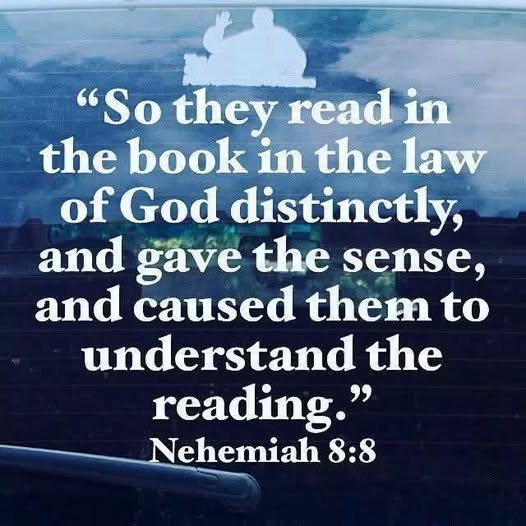
“And all the people gathered themselves together as one man into the street that was before the water gate; and they spake unto Ezra the scribe to bring the book of the law of Moses, which the LORD had commanded to Israel. And Ezra the priest brought the law before the congregation both of men and women, and all that could hear with understanding, upon the first day of the seventh month. And he read therein before the street that was before the water gate from the morning until midday, before the men and the women, and those that could understand; and the ears of all the people were attentive unto the book of the law. And Ezra the scribe stood upon a pulpit of wood, which they had made for the purpose; and beside him stood Mattithiah, and Shema, and Anaiah, and Urijah, and Hilkiah, and Maaseiah, on his right hand; and on his left hand, Pedaiah, and Mishael, and Malchiah, and Hashum, and Hashbadana, Zechariah, and Meshullam. And Ezra opened the book in the sight of all the people; (for he was above all the people;) and when he opened it, all the people stood up: And Ezra blessed the LORD, the great God. And all the people answered, Amen, Amen, with lifting up their hands: and they bowed their heads, and worshipped the LORD with their faces to the ground. Also Jeshua, and Bani, and Sherebiah, Jamin, Akkub, Shabbethai, Hodijah, Maaseiah, Kelita, Azariah, Jozabad, Hanan, Pelaiah, and the Levites, caused the people to understand the law: and the people stood in their place. So they read in the book in the law of God distinctly, and gave the sense, and caused them to understand the reading.”
Nowhere does the text say that Ezra actually preached. In fact, preaching is NEVER mentioned in connection with Ezra anywhere in God’s word, although TEACHING is mentioned in connection with him three times. I’ll CAPITALIZE for emphasis:
“For Ezra had prepared his heart to seek the law of the LORD, and to do it, and to TEACH in Israel statutes and judgments.” (Ezra 7:10)
“And thou, Ezra, after the wisdom of thy God, that is in thine hand, set magistrates and judges, which may judge all the people that are beyond the river, all such as know the laws of thy God; and TEACH ye them that know them not.” (Ezra 7:25)
“And Nehemiah, which is the Tirshatha, and Ezra the priest the scribe, and the Levites that TAUGHT the people, said unto all the people, This day is holy unto the LORD your God; mourn not, nor weep. For all the people wept, when they heard the words of the law.” (Neh. 8:9)
Had the brethren included Nehemiah 8:9 in their “model example” of “expository preaching,” instead of stopping at verse 8, perhaps they would have noticed the word “taught” in the text instead of the word “preached,” but I guess they were too busy “expounding.” So, as it turns out, the model example of what they call “expository preaching” doesn’t concern preaching at all! How’s THAT for an exposition?!
Another classic example of what they call “expository preaching” is Jesus speaking to the Emmaus disciples in Luke 24. Verse 27 says, “And beginning at Moses and all the prophets, he expounded unto them in all the scriptures the things concerning himself.” Sure he did, but it doesn’t call it PREACHING. Preaching is one thing and teaching is another, which is why God’s word uses BOTH terms, not just one. If we would respect that distinction and speak as the scriptures speak, we would have less confusion and more understanding, which I thought was the goal of “expository preaching” in the first place! Or was it? Who knows?!
I have an idea: Let’s promote Bible understanding by respecting and using Bible terminology! You don’t have to say “soteriology, pneumatology and eschatology.” You can just say that you’re gonna study salvation, the Holy Spirit and the end times.
Somebody’s always trying to sound smart, and it’s usually someone who isn’t smart at all. As Mr. Limbaugh used to say, they practice SYMBOLISM OVER SUBSTANCE. (You don’t have to BE real, if you can get away with APPEARING real.) Let’s just stick with God’s word and God’s WORDING, and we’ll have enough reality and understanding for everyone.
Now, I want to give you some very clear differences between preaching and teaching. God doesn’t mention one word under 150 times and the other word over 230 times because they’re the same. The words are spelled differently, they’re used differently in the scriptures, and any respected dictionary will define the words differently. Yet, far too many brethren fail to respect the differences, and the end result is just more confusion. So, here we go with PREACHING VS. TEACHING. Both are scriptural, and both are necessary, but they are NOT the same . . .
I. PREACHING AIMS FOR THE HEART, BUT TEACHING AIMS FOR THE HEAD
Preaching in the Bible targets the will of man and expects a decision, whereas teaching aims to instruct and to explain things in order to establish better understanding. Preaching says to DO something, but teaching says to KNOW something. The two can work together, but are certainly not the same. Preaching aims for the heart, while teaching targets the head.
For instance, the first preaching in the New Testament said, “Repent ye: for the kingdom of heaven is at hand.” (Mat. 3:1-2) Nothing was actually taught or expounded, only proclaimed with authority. It was purely preaching, and like it or not, it was TOPICAL preaching where John took his text from two verses in Isaiah 40 and didn’t even mention the other verses in the passage. John the Baptist was never called a teacher, but he preached so faithfully at the hearts of men that it cost him his life.
II. PREACHING IS ONE-WAY, BUT TEACHING IS TWO-WAY
I could have said monological and dialogical to make myself sound smart, but that’s not my goal with this message. My goal is to clear up confusion, not create it, so we’ll content ourselves with one-way and two-way. By that I mean preaching, being a proclamation, doesn’t usually involve back and forth interaction. John the Baptist didn’t ask for feedback; he just told them what to do. Yet, Jesus often taught and encouraged feedback by saying things like “What is written in the law? how readest thou?” and “What think ye of Christ? whose son is he?” (Luke 10:26; Mat. 22:42). That’s teaching, not preaching. Sure, there are overlaps occasionally, but that’s the general rule. Preaching is one-way, and teaching can be both ways, because helping people to understand is the goal of teaching.
III. PREACHING CAN BE BRIEF, BUT TEACHING TAKES TIME
Jonah had an eight word message that led to thousands of people repenting, and this was called preaching (Jon. 3:2-4). It wasn’t called teaching, and it wasn’t called “expository preaching.” Jonah’s message dealt with the TOPIC of sounding a warning and nothing else. He didn’t teach and expound anything. He preached, “Yet forty days, and Nineveh shall be overthrown.” (Jon. 3:4) Both Jesus’ and John’s kingdom message was “Repent . . . for the kingdom of heaven is at hand,” and this was called preaching, not teaching or expounding (Mat. 3:1-2; 4:17). So, preaching can be brief due to the straight-forward simplicity of the message.
Teaching obviously takes longer, due to the amount of scripture and explanation needed. The reason for some preaching often being “long-winded” is that the preacher sees the need for both preaching and teaching, although most will just call it all preaching. Fifty people are listening, yet some need more teaching than preaching, so he tries to feed everyone. That’s hard to do in twenty minutes, so he takes forty to sixty minutes. He combines preaching and teaching, as Jesus often did, but technically speaking, these are two different practices, which is why our opening texts said, “teach” AND “preach.”
IV. TOO MUCH PREACHING PRODUCES SHALLOW, EMOTIONAL RELIGION, BUT TOO MUCH TEACHING PRODUCES PUFFED-UP, PROUD MINDS
Paul said that knowledge puffs up, but that charity edifies (I Cor. 8:1), yet he encouraged knowledge throughout his epistles. So, he clearly believed in a good balance. An ignorant believer who has spent all his time at camp meetings and gospel singings needs to be taught sound doctrine, but a proud believer who has spent too much time having theological debates at Bible institute or on social media probably needs to attend a few camp meetings and maybe even do some street preaching as well. Both preaching and teaching have their purposes.
When people are saved and living right, then they need more teaching than preaching, which is where sound doctrine comes into play. That’s why several verses of scripture mention teaching in connection with doctrine, yet only one verse (II Tim. 4:2) mentions doctrine and preaching together. When people are not living right, then preaching needs to be a priority in hopes that the goal of repentance will be reached. Both preaching and teaching are necessary, but only a spiritually-discerning preacher can maintain the right balance, which is one reason why Paul doesn’t recommend a novice for the pulpit in I Timothy 3:6.
As already stated, there’s nothing wrong with blending teaching and preaching together so long as a healthy balance is maintained, and this can be done by always remembering that God’s word makes a clear distinction between the two. No one should teach only, and no one should preach only, and most “expository preaching” is really nothing other than teaching or teaching blended with preaching. But if a man is already teaching verse-by-verse to his church two or three times per week, then he is already doing a great deal of expositing and it might not be so necessary in his preaching. The key is BALANCE, and if that is maintained, then all is well whether it’s expository, topical, or both.
So, these guys who keep sowing discord by saying that preaching should be expository are mixing apples with oranges and calling them all apples without knowing exactly what any particular church actually needs. Some folks just need to plow their own rows, mind their own business, and let the rest of us do the same.
Comments are closed