 Matthew 15–17 records a decisive stretch in the earthly ministry of the Lord Jesus Christ. These chapters emphasize the authority of Christ over human tradition, disease, demons, nature, and death; the necessity of genuine faith; Israel’s continuing unbelief; the growing understanding of the disciples; the first explicit announcement in Matthew of Christ’s coming death and resurrection; and the revelation of His glory in the transfiguration.
A major transition occurs in Matthew 16. Peter confesses Jesus as “the Christ, the Son of the living God” (Matthew 16:16), after which the Lord begins plainly to tell His disciples that He must go to Jerusalem, suffer, be killed, and rise again. Matthew 17 then gives three disciples a visible demonstration of Christ’s majesty upon the mount, followed by His return to the needs and unbelief found below.
Throughout these chapters, the KJV text continually places Christ above tradition, Christ above human reasoning, Christ above religious opposition, and Christ above every created power.
Chapter Summaries
Matthew 15 — The Heart, Faith, Compassion, and Divine Provision
1. Christ rebukes tradition that makes void the commandment of God
Matthew 15:1–9
Scribes and Pharisees from Jerusalem confront Jesus concerning His disciples:
“Why do thy disciples transgress the tradition of the elders? for they wash not their hands when they eat bread.”
— Matthew 15:2
Jesus does not permit their tradition to stand as equal with Scripture. Instead He exposes how their traditions could directly contradict God’s commandment.
He gives the example of honoring father and mother. Their religious reasoning allowed a man to avoid his responsibility toward his parents while claiming religious justification.
Christ concludes:
“Thus have ye made the commandment of God of none effect by your tradition.”
— Matthew 15:6
He then applies Isaiah’s words to them:
“This people draweth nigh unto me with their mouth, and honoureth me with their lips; but their heart is far from me.”
— Matthew 15:8
And:
“But in vain they do worship me, teaching for doctrines the commandments of men.”
— Matthew 15:9
Doctrinal significance
God’s Word stands above religious tradition.
This passage does not condemn every custom or practice merely because it is traditional. The specific problem is tradition that contradicts or supplants the commandment of God.
That distinction is important. A conservative Christian should not reject something merely because it is old, nor accept something merely because it is traditional. The question is whether it agrees with Scripture.
The authority is the Word of God.
2. Defilement proceeds from the heart
Matthew 15:10–20
Jesus tells the multitude:
“Not that which goeth into the mouth defileth a man; but that which cometh out of the mouth, this defileth a man.”
— Matthew 15:11
When Peter asks for an explanation, Christ says:
“For out of the heart proceed evil thoughts, murders, adulteries, fornications, thefts, false witness, blasphemies.”
— Matthew 15:19
The point is moral and spiritual. Sin originates within fallen man.
External ceremony cannot cleanse a corrupt heart.
Jesus says:
“These are the things which defile a man: but to eat with unwashen hands defileth not a man.”
— Matthew 15:20
This directly answers the controversy that opened the chapter.
Spiritual truth
Biblical holiness must reach farther than outward religious appearance. A man may observe ceremonies, customs, and religious forms while his heart remains far from God.
At the same time, this passage should not be stretched into teaching that outward conduct is unimportant. Christ condemns the wicked things that proceed from the heart precisely because they manifest themselves in sinful actions and speech.
True godliness begins inwardly and produces outward obedience.
3. The woman of Canaan demonstrates remarkable faith
Matthew 15:21–28
Jesus enters “the coasts of Tyre and Sidon.”
A woman of Canaan cries:
“Have mercy on me, O Lord, thou Son of David; my daughter is grievously vexed with a devil.”
— Matthew 15:22
Jesus initially:
“answered her not a word.”
— Matthew 15:23
The disciples ask Him to send her away.
Christ states:
“I am not sent but unto the lost sheep of the house of Israel.”
— Matthew 15:24
This is an important dispensational statement concerning the primary direction of Christ’s earthly ministry at that time.
The woman nevertheless comes and worships Him:
“Lord, help me.”
— Matthew 15:25
Jesus replies concerning the children’s bread and the dogs. Her humble response is:
“Truth, Lord: yet the dogs eat of the crumbs which fall from their masters’ table.”
— Matthew 15:27
Christ answers:
“O woman, great is thy faith: be it unto thee even as thou wilt.”
— Matthew 15:28
Her daughter is healed “from that very hour.”
Textual restraint
Scripture explicitly calls her faith great.
Scripture does not explicitly tell us everything she understood doctrinally concerning Christ, nor should additional conclusions be imposed upon the passage.
What the text clearly reveals is that she recognized her need, appealed to Christ for mercy, persisted in her appeal, accepted His words humbly, and received His commendation.
Israel and the Gentiles
The passage preserves the distinction between Israel and the Gentiles rather than erasing it. Christ specifically refers to “the lost sheep of the house of Israel.”
At the same time, His mercy extends to this Gentile woman.
This anticipates the wider blessing that would go to the Gentiles without teaching that Israel and the Church are the same entity.
4. Christ heals great multitudes
Matthew 15:29–31
Jesus comes near the sea of Galilee and sits upon a mountain.
Great multitudes bring:
“those that were lame, blind, dumb, maimed, and many others”
and:
“he healed them.”
The people glorify:
“the God of Israel.”
The miracles are real physical miracles in the plain sense of the text.
They demonstrate Christ’s power and compassion and provide visible testimony to His divine authority.
5. Feeding the four thousand
Matthew 15:32–39
Jesus says:
“I have compassion on the multitude, because they continue with me now three days, and have nothing to eat.”
— Matthew 15:32
The disciples again confront what appears humanly impossible.
They possess seven loaves and “a few little fishes.”
Jesus gives thanks, breaks the food, and gives it to the disciples for distribution.
The result:
“And they did all eat, and were filled.”
— Matthew 15:37
Seven baskets of remaining food are gathered.
The number fed is:
“four thousand men, beside women and children.”
— Matthew 15:38
This miracle should not be confused with the feeding of the five thousand recorded previously in Matthew 14. Matthew presents them as separate events, and Christ Himself later refers to both separately in Matthew 16:9–10.
That settles the matter from the text itself.
Matthew 16 — Revelation, the Church, the Cross, and Discipleship
1. The Pharisees and Sadducees seek a sign
Matthew 16:1–4
These groups approach Jesus:
“tempting desired him that he would shew them a sign from heaven.”
Christ exposes their inconsistency. They can interpret weather indications but fail to discern:
“the signs of the times.”
He says:
“A wicked and adulterous generation seeketh after a sign.”
They had already witnessed abundant evidence through His words and works. Their problem was not simply absence of evidence.
Christ again refers to:
“the sign of the prophet Jonas.”
In Matthew’s Gospel, Matthew 12:40 explains this sign in connection with Christ’s coming burial and resurrection.
2. The leaven of the Pharisees and Sadducees
Matthew 16:5–12
Jesus warns:
“Take heed and beware of the leaven of the Pharisees and of the Sadducees.”
The disciples initially think He is speaking about bread.
Christ reminds them of the two miraculous feedings.
Matthew then explicitly explains:
“Then understood they how that he bade them not beware of the leaven of bread, but of the doctrine of the Pharisees and of the Sadducees.”
— Matthew 16:12
Here Scripture itself tells us what the “leaven” represents: their doctrine.
Therefore no speculative symbolism is necessary.
False doctrine spreads and corrupts. Believers must guard both personal conduct and doctrinal purity.
3. Peter confesses Jesus Christ
Matthew 16:13–17
Jesus comes:
“into the coasts of Caesarea Philippi.”
He asks:
“Whom do men say that I the Son of man am?”
Various answers are given—John the Baptist, Elias, Jeremias, or one of the prophets.
Then Jesus makes the question personal:
“But whom say ye that I am?”
Peter answers:
“Thou art the Christ, the Son of the living God.”
— Matthew 16:16
Jesus declares:
“Blessed art thou, Simon Bar-jona: for flesh and blood hath not revealed it unto thee, but my Father which is in heaven.”
Peter’s confession is central: Jesus is not merely a prophet, moral teacher, or miracle worker.
He is the Christ, and He is the Son of the living God.
4. “Upon this rock I will build my church”
Matthew 16:18–20
Jesus says:
“And I say also unto thee, That thou art Peter, and upon this rock I will build my church; and the gates of hell shall not prevail against it.”
— Matthew 16:18
The conservative Baptist position rejects the Roman Catholic claim that this verse establishes Peter as the supreme earthly head of the universal church or gives him a succession of infallible popes.
Christ says:
“I will build my church.”
The church belongs to Christ.
The immediate context centers upon Peter’s confession of the identity of Christ.
At minimum, the passage cannot rightly be used to place a human ecclesiastical ruler over Christ’s church.
Christ alone is the Head and foundation of His church.
Jesus also speaks of:
“the keys of the kingdom of heaven.”
The text gives Peter genuine delegated responsibility, but it does not state that Peter becomes Christ’s replacement or an infallible ruler over all believers.
5. Christ begins explicitly to reveal His coming suffering, death, and resurrection
Matthew 16:21–23
Matthew marks a clear transition:
“From that time forth began Jesus to shew unto his disciples, how that he must go unto Jerusalem, and suffer many things of the elders and chief priests and scribes, and be killed, and be raised again the third day.”
— Matthew 16:21
This is explicit.
The cross was not an accident.
Christ says He must go to Jerusalem, must suffer, would be killed, and would be raised again.
Peter rebukes Him:
“Be it far from thee, Lord: this shall not be unto thee.”
Jesus answers sharply:
“Get thee behind me, Satan.”
Peter had just confessed Christ correctly, yet now he opposes Christ’s revealed path to the cross.
This demonstrates that a believer can speak correctly at one moment and reason wrongly at another.
Christ explains the problem:
“thou savourest not the things that be of God, but those that be of men.”
Human reasoning must submit to divine revelation.
6. The cost of discipleship
Matthew 16:24–28
Jesus says:
“If any man will come after me, let him deny himself, and take up his cross, and follow me.”
— Matthew 16:24
This passage concerns discipleship and following Christ.
It must not be distorted into a works-based plan of salvation.
Eternal salvation is by grace through faith, apart from works. Following Christ faithfully involves surrender, self-denial, and possible suffering.
Those doctrines must be distinguished rather than confused.
Jesus asks:
“For what is a man profited, if he shall gain the whole world, and lose his own soul?”
— Matthew 16:26
No earthly achievement compensates for eternal loss.
Matthew 17 — The King in Glory, Human Need, Faith, and the Son’s Liberty
1. The transfiguration
Matthew 17:1–8
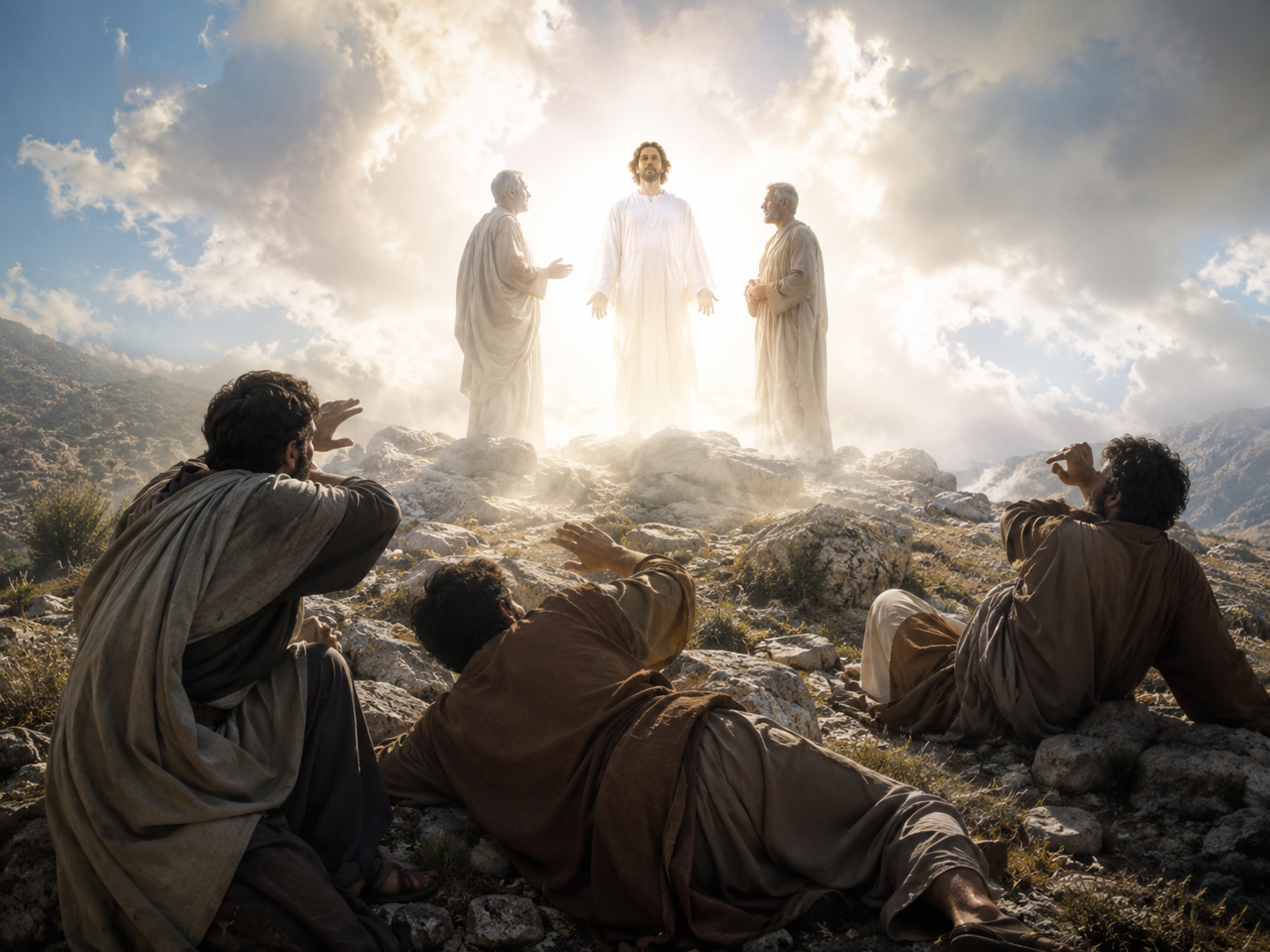
After six days Jesus takes:
- Peter
- James
- John
into:
“an high mountain apart.”
The KJV does not identify the mountain by name.
Therefore claims that it was a specific mountain are historical proposals rather than explicit biblical statements.
Jesus:
“was transfigured before them: and his face did shine as the sun, and his raiment was white as the light.”
— Matthew 17:2
Moses and Elias appear and talk with Him.
Peter proposes making three tabernacles.
Then:
“a bright cloud overshadowed them.”
The Father speaks:
“This is my beloved Son, in whom I am well pleased; hear ye him.”
— Matthew 17:5
The disciples fall on their faces in fear.
Jesus touches them and says:
“Arise, and be not afraid.”
Then:
“when they had lifted up their eyes, they saw no man, save Jesus only.”
That final expression is spiritually striking without needing allegorical embellishment:
“Jesus only.”
The Father directs attention to His Son:
“hear ye him.”
Moses and Elias have important places in biblical revelation, but Christ stands supreme.
2. Elias and John the Baptist
Matthew 17:9–13
As they descend the mountain, Jesus commands them not to tell the vision:
“until the Son of man be risen again from the dead.”
The disciples ask about the scribes’ teaching that Elias must first come.
Jesus says:
“Elias truly shall first come, and restore all things.”
He then says:
“But I say unto you, That Elias is come already, and they knew him not.”
Matthew adds:
“Then the disciples understood that he spake unto them of John the Baptist.”
We should retain the exact wording.
The disciples understood Christ to be speaking of John the Baptist in this statement. Other prophetic questions concerning Elijah should be handled by comparing all relevant KJV passages rather than forcing this one verse beyond its wording.
3. Christ delivers the demon-possessed boy
Matthew 17:14–21
A father comes kneeling to Jesus and says:
“Lord, have mercy on my son: for he is lunatick, and sore vexed.”
He explains:
“I brought him to thy disciples, and they could not cure him.”
Jesus rebukes the devil:
“and he departed out of him: and the child was cured from that very hour.”
The disciples privately ask why they could not cast him out.
Jesus answers:
“Because of your unbelief.”
Then He says:
“If ye have faith as a grain of mustard seed…”
and concludes:
“Howbeit this kind goeth not out but by prayer and fasting.”
— Matthew 17:21
The passage emphasizes dependence upon God rather than confidence in previously exercised ability.
Spiritual ministry cannot be reduced to technique.
Prayer, fasting, faith, and dependence upon God matter.
This does not mean that believers may demand anything whatsoever merely by generating sufficient confidence. Biblical faith rests upon God and His will rather than human presumption.
4. Christ again foretells His death and resurrection
Matthew 17:22–23
Jesus tells His disciples:
“The Son of man shall be betrayed into the hands of men: And they shall kill him, and the third day he shall be raised again.”
The disciples:
“were exceeding sorry.”
Again, Christ’s resurrection is explicitly included in His prediction.
His death was not the end of the revelation He gave them.
5. The tribute money and the coin in the fish
Matthew 17:24–27
At Capernaum, those who receive tribute money ask Peter:
“Doth not your master pay tribute?”
Peter answers:
“Yes.”
Jesus then teaches Peter through the comparison of earthly kings and their sons.
He concludes:
“Then are the children free.”
Yet He adds:
“Notwithstanding, lest we should offend them…”
Peter is instructed to go to the sea, cast a hook, and take the first fish. In its mouth he will find:
“a piece of money.”
Jesus tells him:
“that take, and give unto them for me and thee.”
The miracle displays Christ’s supernatural knowledge and authority over creation.
It also demonstrates willingness to relinquish a legitimate liberty in order to avoid unnecessary offense.
This principle should not be abused to require compromise with sin or false doctrine. Christ did not compromise truth; He voluntarily yielded a liberty.
Key People and Places
Jesus Christ
The central Person throughout all three chapters.
He is explicitly presented as:
- “the Son of man” — Matthew 16:13
- “the Christ” — Matthew 16:16
- “the Son of the living God” — Matthew 16:16
- “my beloved Son” — Matthew 17:5
He possesses authority over disease, demons, creation, religious tradition, and the destiny of His church.
He also foretells His own death and resurrection.
Peter
One of the twelve disciples and especially prominent in Matthew 16–17.
He:
- asks Christ to explain the teaching concerning defilement,
- confesses Christ as “the Son of the living God,”
- is blessed for the revelation given him,
- wrongly rebukes Christ concerning the cross,
- witnesses the transfiguration,
- speaks concerning the tribute money.
Peter’s experiences illustrate both genuine faith and genuine human weakness.
James and John
Together with Peter, they accompany Jesus onto the mount of transfiguration.
Matthew does not record them speaking during the event.
The woman of Canaan
A Gentile woman whose daughter is vexed with a devil.
Jesus explicitly commends her:
“O woman, great is thy faith.”
Her name is not given in Matthew.
The Pharisees
Religious opponents of Christ.
In these chapters they are associated with:
- elevating tradition above God’s commandment,
- hypocrisy,
- demanding a sign,
- false doctrine.
The Sadducees
They join the Pharisees in tempting Jesus concerning a sign.
Christ specifically warns His disciples against their doctrine.
Moses
Appears with Christ at the transfiguration.
Scripture explicitly says he talks with Jesus, though Matthew does not record the content of the conversation.
Elias
Appears with Moses at the transfiguration.
The disciples subsequently ask Christ concerning the scribes’ teaching about Elias.
John the Baptist
Although already dead by this point in Matthew’s narrative, he is referenced when the disciples understand Jesus’ statement about Elias.
The father and his afflicted son
The father approaches Jesus because the disciples had been unable to cure his son.
Christ delivers the boy.
The passage emphasizes Christ’s power and the disciples’ need for faith and dependence upon God.
Important Places
Jerusalem
The scribes and Pharisees in Matthew 15:1 come “from Jerusalem.”
Jesus later explicitly says He must:
“go unto Jerusalem”
where He will suffer and be killed.
Tyre and Sidon
Matthew 15:21 says Jesus:
“departed into the coasts of Tyre and Sidon.”
The woman of Canaan appears in this setting.
Sea of Galilee
Jesus comes near:
“the sea of Galilee”
before healing the multitudes and feeding the four thousand.
Magdala
Matthew 15:39 says Jesus:
“came into the coasts of Magdala.”
Caesarea Philippi
The setting for Peter’s confession:
“Thou art the Christ, the Son of the living God.”
The high mountain
The location of the transfiguration.
Matthew does not identify the mountain by name.
Any proposed identification therefore may suggest a possible location historically, but Scripture does not explicitly say which mountain it was.
Capernaum
The setting of the tribute-money incident in Matthew 17:24–27.
Main Doctrinal or Spiritual Themes
1. Scripture stands above human tradition
Matthew 15 establishes an essential principle:
“Thus have ye made the commandment of God of none effect by your tradition.”
Religious authority must remain subordinate to Scripture.
No church tradition, scholar, preacher, denomination, confession, or institution possesses authority to nullify what God has said.
2. The true problem of man is the heart
Christ says:
“For out of the heart proceed evil thoughts…”
Sin cannot ultimately be cured by ceremonial religion, outward respectability, education, or social reform.
Man needs inward spiritual salvation.
3. Genuine faith humbly depends upon Christ
The woman of Canaan does not demand that Christ recognize some supposed merit in her.
She appeals:
“Lord, help me.”
Her faith is humble, persistent, and directed toward Christ.
Jesus calls it:
“great…faith.”
4. Christ has compassion
Before feeding the four thousand, Jesus says:
“I have compassion on the multitude.”
Biblical doctrine does not present Christ as cold or indifferent.
His compassion is repeatedly expressed through His actions.
5. Christ is the Son of the living God
Peter’s confession is fundamental:
“Thou art the Christ, the Son of the living God.”
Christianity stands or falls upon the identity of Jesus Christ.
He is not merely another religious teacher.
6. Christ will build His church
Jesus declares:
“I will build my church.”
The church is Christ’s possession and Christ’s work.
The true strength of a church is therefore not human personality, popularity, money, political influence, or organizational machinery.
Christ builds His church.
7. The cross was necessary in God’s plan
Jesus says:
“he must go unto Jerusalem.”
The word must is significant.
His suffering and death were not unforeseen accidents.
The cross stands at the center of God’s redemptive purpose.
8. The resurrection is inseparable from Christ’s prediction of His death
Both Matthew 16:21 and Matthew 17:23 include His resurrection.
He would:
“be raised again the third day.”
The gospel message does not end with a dead Christ.
Jesus Christ rose bodily from the dead.
9. Discipleship involves self-denial
Jesus says:
“let him deny himself, and take up his cross, and follow me.”
This describes the cost of following Christ faithfully.
It must not be confused with the means of justification.
Salvation is the gift of God received by faith; discipleship concerns the believer’s walk of obedience and surrender.
10. Christ possesses divine glory
At the transfiguration:
“his face did shine as the sun.”
The Father declares:
“This is my beloved Son, in whom I am well pleased; hear ye him.”
The event reveals rather than creates Christ’s glory.
Jesus did not become the Son of God on that mountain. He was already the Son of God.
11. Christ is superior to every human religious authority
Moses and Elias appear, but the Father says concerning Christ:
“hear ye him.”
Then the disciples see:
“no man, save Jesus only.”
Christ occupies the supreme position.
12. Unbelief hinders spiritual effectiveness
To His disciples Christ says:
“Because of your unbelief.”
Previous victories did not eliminate their need to continue depending upon God.
The believer never reaches a stage of Christian life where faith, prayer, and dependence upon the Lord become unnecessary.
13. Prayer and fasting belong to serious spiritual dependence
Jesus says:
“this kind goeth not out but by prayer and fasting.”
The passage teaches dependence rather than spiritual self-confidence.
Christian service requires more than human preparation or natural ability.
14. Christian liberty may sometimes be voluntarily surrendered
Concerning the tribute Jesus says:
“Notwithstanding, lest we should offend them…”
Christ does not surrender truth. He does willingly refrain from insisting upon His liberty in this matter.
This provides a sound principle: liberty should not become an excuse for unnecessary offense.
Practical Applications or Lessons
Keep God’s Word above tradition
Every religious teaching should be tested against Scripture.
A practice may be ancient and still be wrong. A practice may also be traditional and perfectly biblical.
The deciding question is:
What saith the Scripture?
Guard the heart, not merely the appearance
Christ traced wicked conduct to the heart.
Believers should therefore seek more than external conformity.
We need sincere devotion, clean motives, truthful speech, moral purity, and a heart submitted to God.
“This people draweth nigh unto me with their mouth… but their heart is far from me.”
Lip service is not enough.
Come humbly to Christ
The woman of Canaan prayed simply:
“Lord, help me.”
There are times when elaborate language is unnecessary.
The important thing is the Object of faith.
Her hope was in Christ.
Do not measure God’s ability by visible resources
Seven loaves and a few fishes appeared inadequate for thousands of people.
They were inadequate in human strength.
They were sufficient when placed into the hands of Christ.
This should not be turned into a promise that God will miraculously multiply every material possession. The explicit miracle belongs to Christ in this historical setting.
But the spiritual lesson is sound: believers must not measure divine ability merely by human resources.
Beware false doctrine
Jesus explicitly warns:
“beware of the leaven of the Pharisees and of the Sadducees.”
Matthew tells us He referred to:
“the doctrine of the Pharisees and of the Sadducees.”
Doctrine matters.
False teaching is not harmless simply because it is religious.
Know personally who Christ is
Jesus asks:
“But whom say ye that I am?”
That question cannot be answered safely by public opinion.
The crowds had several theories.
Peter gave the true confession:
“Thou art the Christ, the Son of the living God.”
Never correct God with human reasoning
Peter attempted to tell Christ that the cross should not happen.
His motives may have appeared protective, but his words opposed the revealed will of God.
Jesus replied:
“thou savourest not the things that be of God, but those that be of men.”
Sincerity does not make error correct.
Human reasoning must bow before revelation.
Do not confuse salvation and discipleship
Christ says:
“If any man will come after me, let him deny himself…”
That is the language of following Christ.
It should not be turned into a requirement that a sinner promise a lifetime of obedience before he may be justified.
Salvation is by grace through faith apart from works. The saved believer should then follow Christ faithfully.
Remember the value of the soul
Jesus asks:
“what shall a man give in exchange for his soul?”
Money, possessions, status, achievement, and earthly power cannot compensate for eternal loss.
Eternity must govern earthly priorities.
Hear Christ above every human authority
The Father said:
“hear ye him.”
Preachers can help us.
Teachers can help us.
Commentaries can help us.
But none stands beside Christ as an equal authority.
And every preacher, teacher, and commentary must ultimately be judged by the written Word of God.
Spiritual victories do not eliminate the need for dependence
The disciples had previously ministered with supernatural authority, yet in Matthew 17 they could not cast out the devil.
Christ identified:
“your unbelief.”
Past usefulness does not guarantee present spiritual power.
The servant of God must continue walking in faith and dependence.
Prayer must remain central
Christ joins the lesson about faith with:
“prayer and fasting.”
A ministry may possess activity without spiritual power.
Biblical service requires dependence upon God.
Avoid needless offense without compromising truth
Christ willingly pays the tribute:
“lest we should offend them.”
There is a difference between standing firmly for truth and insisting unnecessarily upon personal rights.
The Christian should never compromise Scripture to avoid offense, but neither should he create needless offense merely to prove his liberty.
The Flow of Matthew 15–17
These three chapters form a striking progression.
Matthew 15: Christ exposes false religion and reveals true heart righteousness, great faith, compassion, healing power, and provision.
Matthew 16: Christ exposes false doctrine, receives Peter’s confession, speaks of His church, and plainly announces His coming cross and resurrection.
Matthew 17: Christ reveals His glory, receives the Father’s testimony, demonstrates power over demonic oppression, again announces His death and resurrection, and displays supernatural authority in the tribute-money miracle.
Taken together, the chapters move from the question of what truly defiles a man, to who Jesus truly is, to what the glorified Son must accomplish through His suffering, death, and resurrection.
The central Person is unmistakably Jesus Christ:
“Thou art the Christ, the Son of the living God.”
And the Father’s command concerning Him remains decisive:
“hear ye him.”
How useful was this post?
Click on a star to rate it!
Average rating 0 / 5. Vote count: 0
No votes so far! Be the first to rate this post.
We are sorry that this post was not useful for you!
Let us improve this post!
Tell us how we can improve this post?
Comments are closed