 Matthew 13–14 records a major portion of the Lord Jesus Christ’s Galilean ministry. Matthew 13 centers on the mysteries of the kingdom of heaven, presented largely through parables, while Matthew 14 records growing opposition, the death of John the Baptist, Christ’s feeding of the five thousand, His walking upon the sea, Peter’s attempt to come to Him upon the water, and further healings in the land of Gennesaret.
The chapters together show a striking contrast: men may reject, misunderstand, or oppose the truth, but Christ remains the sovereign King, the compassionate Shepherd, and the sufficient Lord.
Chapter Summaries
Matthew 13 — The Mysteries of the Kingdom of Heaven
1. The Parable of the Sower — Matthew 13:1–23
Jesus leaves the house, sits by the sea, and because of the great multitude enters into a ship while the people stand on the shore.
He begins:
“Behold, a sower went forth to sow;” — Matthew 13:3
The seed falls upon four kinds of ground:
- The way side
- Stony places
- Among thorns
- Good ground
Jesus later gives the interpretation Himself. Therefore, there is no need to speculate concerning the principal elements of the parable.
The seed represents “the word of the kingdom” (Matthew 13:19). The different soils describe differing responses to that word.
The way-side hearer hears but does not understand, and:
“then cometh the wicked one, and catcheth away that which was sown in his heart.” — Matthew 13:19
The stony-ground hearer receives the word with joy but has no root in himself. When:
“tribulation or persecution ariseth because of the word”
he is offended.
The thorny-ground hearer permits:
“the care of this world, and the deceitfulness of riches”
to choke the word.
The good-ground hearer:
“heareth the word, and understandeth it; which also beareth fruit”
with differing degrees of fruitfulness.
The parable emphasizes the reception of God’s Word and the fruit associated with receiving it rightly.
It should not be pressed beyond Christ’s own explanation. Scripture explicitly identifies the seed and explains the reactions of the hearers; conclusions beyond those statements should be held with restraint.
2. Why Jesus Spoke in Parables — Matthew 13:10–17
The disciples ask:
“Why speakest thou unto them in parables?”
Jesus answers:
“Because it is given unto you to know the mysteries of the kingdom of heaven, but to them it is not given.” — Matthew 13:11
A mystery in this context concerns truth concerning the kingdom that Christ was revealing to His disciples.
Jesus connects the people’s condition with Isaiah’s prophecy:
“By hearing ye shall hear, and shall not understand; and seeing ye shall see, and shall not perceive:” — Matthew 13:14
He also says:
“For this people’s heart is waxed gross, and their ears are dull of hearing, and their eyes they have closed…” — Matthew 13:15
The text therefore places responsibility upon the hearers themselves. Their spiritual dullness is not presented as innocent ignorance.
Jesus contrasts them with His disciples:
“But blessed are your eyes, for they see: and your ears, for they hear.” — Matthew 13:16
Doctrinal background
From a conservative dispensational standpoint, the kingdom of heaven in Matthew must be interpreted according to its context rather than automatically equated with the Church.
Matthew 13 reveals conditions associated with the kingdom program during a period in which the King is being rejected. The parables include genuine and false profession, good and evil existing side by side, and a future separation by divine judgment.
Scripture does not explicitly say in Matthew 13 that Israel has permanently lost all national promises. Such a conclusion would conflict with the broader biblical distinction between Israel and the Church and with the future fulfillment of God’s covenants with Israel.
3. The Wheat and the Tares — Matthew 13:24–30, 36–43
A man sows good seed in his field, but:
“his enemy came and sowed tares among the wheat”
The servants ask whether they should gather the tares immediately.
The householder answers:
“Nay; lest while ye gather up the tares, ye root up also the wheat with them.” — Matthew 13:29
They are permitted to grow together:
“until the harvest.”
Jesus explains the parable explicitly:
“He that soweth the good seed is the Son of man;
The field is the world;
the good seed are the children of the kingdom;
but the tares are the children of the wicked one;
The enemy that sowed them is the devil;
the harvest is the end of the world;
and the reapers are the angels.” — Matthew 13:37–39
This interpretation should govern the doctrine drawn from the parable.
One especially important textual point is that Jesus says:
“The field is the world”
—not “the field is the church.”
Therefore, using this passage to forbid biblical church discipline would go beyond Christ’s explanation. Other passages expressly require local churches to exercise discipline when necessary.
At the conclusion:
“The Son of man shall send forth his angels”
and there is a separation between the wicked and the righteous.
The chapter therefore teaches that present mixture will not prevent eventual divine judgment.
4. The Mustard Seed — Matthew 13:31–32
Jesus compares the kingdom of heaven to:
“a grain of mustard seed”
which grows from small beginnings into something much larger.
The KJV explicitly says that it:
“becometh a tree, so that the birds of the air come and lodge in the branches thereof.”
The point of remarkable outward growth is clear.
Some interpreters have connected the birds here with the wicked one because birds appeared earlier in the chapter and Christ explained them in connection with Satan’s work. That may suggest an unfavorable element within the outward growth, but Scripture does not explicitly interpret the birds in the mustard-seed parable. Therefore that conclusion should not be stated with the same certainty as Christ’s explanation of the Sower.
5. The Leaven — Matthew 13:33
“The kingdom of heaven is like unto leaven, which a woman took, and hid in three measures of meal, till the whole was leavened.”
Leaven frequently symbolizes corruption elsewhere in Scripture, including warnings concerning false doctrine and moral evil.
That broader biblical use may indicate that the parable pictures corrupting influence spreading through the outward sphere of the kingdom.
However, Matthew 13:33 itself does not give an inspired interpretation of the leaven. Therefore the safest wording is that corruption is a possible inference consistent with other biblical uses of leaven, rather than claiming Matthew 13:33 explicitly defines it that way.
6. The Hidden Treasure — Matthew 13:44
Jesus says:
“Again, the kingdom of heaven is like unto treasure hid in a field; the which when a man hath found, he hideth…”
The man then:
“goeth and selleth all that he hath, and buyeth that field.”
The verse plainly teaches the extraordinary worth attached to the treasure in the parable.
Some dispensational interpreters have identified the treasure with Israel because Israel is called God’s peculiar treasure elsewhere in Scripture. That may suggest such an interpretation, but Matthew 13:44 does not explicitly identify the treasure as Israel. It should therefore not be stated as certain.
7. The Pearl of Great Price — Matthew 13:45–46
A merchant seeks goodly pearls and, having found:
“one pearl of great price”
he:
“went and sold all that he had, and bought it.”
Again, the text plainly emphasizes surpassing value.
Some interpreters understand the pearl as representing the Church. That is a possible inference, particularly within certain dispensational treatments of the chapter, but Matthew 13 itself does not explicitly identify the pearl with the Church.
The safest primary emphasis is therefore the tremendous worth represented by the pearl and the total commitment associated with acquiring it.
8. The Dragnet — Matthew 13:47–50
The kingdom of heaven is compared to:
“a net, that was cast into the sea, and gathered of every kind”
When it is full, the fishermen separate the good from the bad.
Jesus explains:
“So shall it be at the end of the world: the angels shall come forth, and sever the wicked from among the just,” — Matthew 13:49
and the wicked are cast:
“into the furnace of fire: there shall be wailing and gnashing of teeth.”
The judgment described is real and solemn. Christ repeatedly teaches personal accountability and final separation.
9. Things New and Old — Matthew 13:51–52
After asking whether the disciples understood, Jesus says:
“Therefore every scribe which is instructed unto the kingdom of heaven is like unto a man that is an householder, which bringeth forth out of his treasure things new and old.”
A disciple instructed in divine truth should be able to draw profitably from what God has revealed.
This provides a useful principle for Bible teaching: new instruction should not cause a believer to discard previously revealed truth.
10. Jesus Rejected in His Own Country — Matthew 13:53–58
Jesus returns:
“into his own country”
and teaches in the synagogue.
The people recognize His wisdom and mighty works but respond with familiarity and unbelief:
“Is not this the carpenter’s son?”
They refer to His mother Mary, His brethren James, Joses, Simon, and Judas, and His sisters.
The passage says:
“And they were offended in him.” — Matthew 13:57
Jesus replies:
“A prophet is not without honour, save in his own country, and in his own house.”
Matthew concludes:
“And he did not many mighty works there because of their unbelief.” — Matthew 13:58
The text does not say that Christ lacked power. It states that He did not perform many mighty works there because of their unbelief.
Matthew 14 — Opposition, Compassion, Provision, and Divine Power
1. Herod Hears of Jesus — Matthew 14:1–2
Herod the tetrarch hears of Christ’s fame and says:
“This is John the Baptist; he is risen from the dead; and therefore mighty works do shew forth themselves in him.”
This was Herod’s conclusion. Scripture records what he said; it does not affirm that his explanation was correct.
Matthew then gives the circumstances surrounding John’s imprisonment and death.
2. John the Baptist Imprisoned and Killed — Matthew 14:3–12
Herod had taken Herodias:
“his brother Philip’s wife.”
John had told him plainly:
“It is not lawful for thee to have her.” — Matthew 14:4
John demonstrates the duty of God’s servant to speak truth even when truth confronts powerful people.
Herod wanted to put John to death but:
“he feared the multitude, because they counted him as a prophet.”
At Herod’s birthday celebration, the daughter of Herodias danced before him and pleased him. Herod made a rash oath.
At her mother’s instruction she requested:
“Give me here John Baptist’s head in a charger.”
The king was sorry, yet:
“for the oath’s sake, and them which sat with him at meat, he commanded it to be given her.”
John was executed, and his disciples:
“came, and took up the body, and buried it, and went and told Jesus.”
The passage presents John as a faithful witness who refused to redefine morality for a ruler.
It also exposes the danger of immoral relationships, pride, rash promises, fear of men, and the pressure of public reputation.
3. Jesus Withdraws and the Multitudes Follow — Matthew 14:13–14
When Jesus hears what has happened:
“he departed thence by ship into a desert place apart”
but the people follow Him on foot.
When He sees the multitude:
“he was moved with compassion toward them, and he healed their sick.” — Matthew 14:14
Christ’s compassion is explicit.
He does not regard the multitude merely as an inconvenience. He ministers to their need.
4. Feeding the Five Thousand — Matthew 14:15–21
As evening approaches, the disciples want Jesus to send the multitude away so they may obtain food.
Jesus answers:
“They need not depart; give ye them to eat.”
They have only:
“five loaves, and two fishes.”
Jesus says:
“Bring them hither to me.” — Matthew 14:18
After commanding the multitude to sit down:
“he took the five loaves, and the two fishes, and looking up to heaven, he blessed, and brake”
and the food is distributed.
The text says:
“And they did all eat, and were filled”
and twelve baskets of fragments remain.
Those eating were:
“about five thousand men, beside women and children.”
The miracle demonstrates Christ’s supernatural power and His complete sufficiency.
The text does not expressly explain the significance of the twelve baskets. Connections with Israel’s twelve tribes or the twelve disciples may be suggested, but Matthew does not explicitly assign symbolic meaning to the number here.
5. Jesus Sends the Disciples Across the Sea — Matthew 14:22–24
Jesus:
“constrained his disciples to get into a ship”
while He sends the multitude away.
Then:
“he went up into a mountain apart to pray.”
Meanwhile:
“the ship was now in the midst of the sea, tossed with waves: for the wind was contrary.”
An important practical truth appears here: the disciples encountered a storm while doing what Christ had directed them to do.
Therefore adversity does not necessarily prove that a believer is outside the will of God.
6. Jesus Walks on the Sea — Matthew 14:25–27
“And in the fourth watch of the night Jesus went unto them, walking on the sea.”
The disciples are troubled and say:
“It is a spirit”
and cry out for fear.
Jesus immediately responds:
“Be of good cheer; it is I; be not afraid.” — Matthew 14:27
The passage displays Christ’s authority over creation.
The sea that troubles the disciples presents no obstacle to Him.
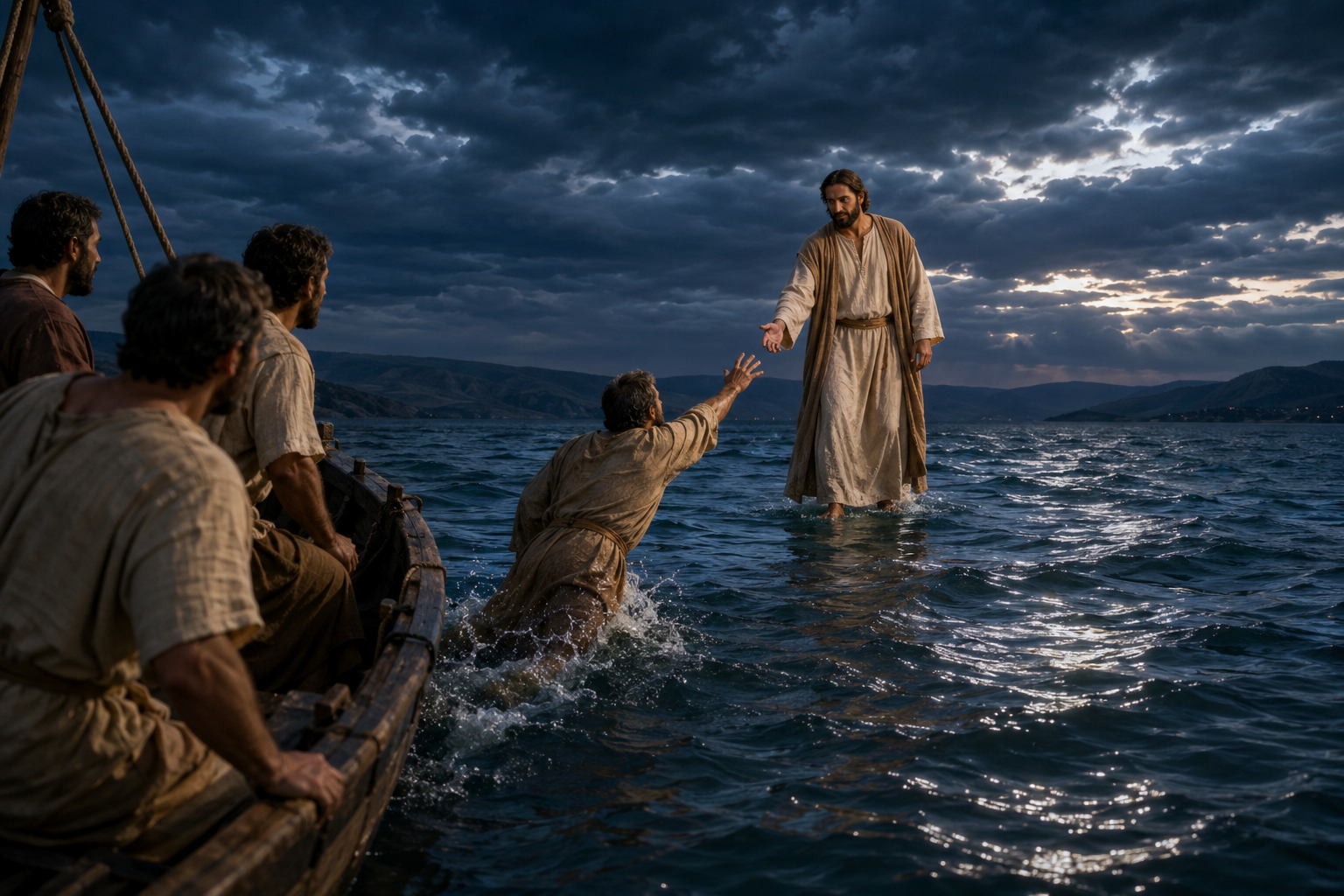
7. Peter Walks on the Water — Matthew 14:28–31
Peter says:
“Lord, if it be thou, bid me come unto thee on the water.”
Jesus gives one word:
“Come.”
Peter:
“walked on the water, to go to Jesus.”
That fact should not be overlooked. Peter genuinely walked upon the water by Christ’s enabling power.
Then:
“when he saw the wind boisterous, he was afraid”
and beginning to sink cried:
“Lord, save me.”
The response is immediate:
“And immediately Jesus stretched forth his hand, and caught him”
and said:
“O thou of little faith, wherefore didst thou doubt?”
The primary problem identified by Jesus is doubt.
The lesson should therefore remain closely tied to the text: Peter acted upon Christ’s command, but fear and doubt interrupted his confidence in the Lord.
8. “Of a Truth Thou Art the Son of God” — Matthew 14:32–33
When Jesus and Peter enter the ship:
“the wind ceased.”
Those in the ship worship Him and confess:
“Of a truth thou art the Son of God.”
Their response is appropriate to the revelation they have just witnessed.
Matthew repeatedly presents Jesus as far more than a mere teacher or prophet. He exercises authority over sickness, creation, demonic powers, and ultimately life and death.
9. Healings in Gennesaret — Matthew 14:34–36
They arrive:
“into the land of Gennesaret.”
The people recognize Jesus and:
“sent out into all that country round about, and brought unto him all that were diseased”
They ask simply to touch:
“the hem of his garment”
and:
“as many as touched were made perfectly whole.”
The emphasis remains upon the power of Christ. The garment itself should not be treated superstitiously. The narrative presents Jesus as the One from whom healing comes.
Key People and Places
Jesus Christ
The central Person of both chapters. He teaches the mysteries of the kingdom, interprets His own parables, heals the sick, feeds the multitude, walks upon the sea, rescues Peter, and receives worship as the Son of God.
The Disciples
They receive further explanation of the parables and witness Christ’s miraculous provision and authority.
Peter
One of Christ’s disciples. Matthew 14 explicitly records that he walks on the water at Christ’s command, becomes afraid when he sees the boisterous wind, begins to sink, cries to Christ, and is immediately rescued.
John the Baptist
The prophet who openly tells Herod:
“It is not lawful for thee to have her.”
He is imprisoned and executed because of events surrounding Herod, Herodias, and her daughter.
Herod the Tetrarch
The ruler who imprisons John and later orders his execution.
This Herod is commonly identified historically as Herod Antipas. Matthew 14 itself calls him “Herod the tetrarch”; the fuller name comes from historical identification rather than from this chapter.
Herodias
The woman whom John identifies as:
“his brother Philip’s wife.”
She opposes John because of his condemnation of the relationship.
Herodias’s Daughter
Matthew does not give her name. Historical tradition commonly identifies her as Salome, but Scripture does not explicitly say this, so her biblical designation should remain “the daughter of Herodias.”
Jesus’ Brethren
Matthew 13 names:
- James
- Joses
- Simon
- Judas
His sisters are also mentioned but not named.
The Sea
Matthew 13 begins beside the sea, and Matthew 14 includes the disciples crossing it during the storm.
The body of water is understood from the Gospel setting as the Sea of Galilee, though Matthew 14 repeatedly uses the term “sea” in the immediate narrative.
Jesus’ Own Country
Matthew 13:54 says:
“when he was come into his own country”
The parallel Gospel accounts identify the setting with Nazareth. Matthew itself does not name Nazareth in Matthew 13:54, so this identification comes from comparing Scripture with Scripture.
Desert Place
Jesus withdraws to:
“a desert place apart.”
“Desert” in biblical usage does not necessarily require a vast sand desert; it can describe a solitary or relatively uninhabited place.
Gennesaret
The land reached after the crossing of the sea, where many diseased people are brought to Christ.
Main Doctrinal or Spiritual Themes
1. The Authority and Power of the Word of God
The Sower places great emphasis upon:
“the word of the kingdom.”
The problem is never presented as a deficiency in the seed. The differing results occur in connection with the condition and response of the hearers.
God’s Word must therefore be heard, understood, received, and allowed to bear fruit.
2. Human Responsibility in Hearing Truth
Jesus says of certain hearers:
“their eyes they have closed.”
Matthew 13 therefore does not picture mankind as merely passive when rejecting divine truth.
Men are accountable for what they do with the Word of God.
3. Truth Can Be Revealed and Rejected
The people in Jesus’ own country had substantial exposure to Him, yet:
“they were offended in him.”
Familiarity with religious truth does not equal faith.
A person can hear much truth and still refuse the One about whom the truth speaks.
4. Genuine and False Profession Exist Side by Side
The Wheat and Tares and the Dragnet both portray eventual separation.
For the present, genuine and false elements coexist within the broader sphere described by Christ, but God will distinguish them perfectly at judgment.
Human beings may be deceived; God is not.
5. Final Judgment Is Certain
Matthew 13 repeatedly speaks of:
“the end of the world”
and of angels separating the wicked from the just.
Jesus also describes:
“wailing and gnashing of teeth.”
The doctrine of judgment comes from Christ Himself and should neither be softened nor dismissed.
6. The Kingdom Program Has a Divine Purpose
Matthew 13 speaks of:
“the mysteries of the kingdom of heaven.”
The rejection of Christ does not overthrow God’s purposes.
From a dispensational perspective, Israel and the Church must remain distinct in biblical interpretation. The existence of the Church does not cancel God’s covenant promises concerning Israel, and the kingdom promises will ultimately be fulfilled under Christ’s rule.
Matthew 13 should therefore not be used to erase the prophetic distinctions found elsewhere in Scripture.
7. Biblical Morality Does Not Change for Powerful Men
John tells Herod:
“It is not lawful for thee to have her.”
The standard of morality did not change because Herod possessed political authority.
God’s preacher is responsible to declare the truth without altering it to protect social standing or gain the favor of rulers.
8. Fear of Man Produces Spiritual Compromise
Herod feared the multitude earlier, and later permitted concern for his oath and those sitting with him to influence his decision.
Proverbs 29:25 states:
“The fear of man bringeth a snare: but whoso putteth his trust in the LORD shall be safe.”
Matthew 14 provides a sobering illustration of the danger of permitting reputation and social pressure to govern moral decisions.
9. Christ Is Compassionate
Matthew explicitly says:
“he was moved with compassion toward them.”
Biblical compassion is not mere sentiment. Christ’s compassion results in action—He heals the sick and provides for the hungry multitude.
10. Christ Is Sufficient
Five loaves and two fishes appear inadequate for the multitude.
Yet when placed into Christ’s hands:
“they did all eat, and were filled.”
The lesson is not that believers possess limitless resources in themselves. The emphasis is upon the sufficiency and power of Christ.
11. Christ Has Authority Over Creation
He walks upon the sea.
The wind ceases when He enters the ship.
The disciples respond:
“Of a truth thou art the Son of God.”
The miracle reveals divine authority belonging to Christ.
12. Faith Must Rest Upon Christ’s Word
Peter did not step upon the water without authorization. Christ said:
“Come.”
Peter’s action therefore rested upon Christ’s explicit word.
Biblical faith is not presumption. It responds to what God has actually said.
This distinction is important. A believer cannot use Peter’s experience to justify reckless behavior and then call it “faith.” Peter had a direct command from Christ.
13. Christ Responds to the Cry for Deliverance
Peter cries:
“Lord, save me.”
Then:
“immediately Jesus stretched forth his hand, and caught him.”
In its immediate context this is physical rescue from drowning, not a detailed presentation of the doctrine of justification.
Nevertheless, the incident beautifully demonstrates Christ’s ability and willingness to deliver the one who calls upon Him.
For salvation doctrine itself, Scripture plainly teaches salvation by grace through faith, apart from human works. Matthew 14 should not be forced into a salvation formula beyond what the narrative explicitly states.
Practical Applications or Lessons
Receive the Word with a Prepared Heart
The issue in the Parable of the Sower is not the quality of the seed.
Believers should therefore examine how they hear Scripture.
Jesus repeatedly says:
“He that hath ears to hear, let him hear.”
Bible reading should not be casual. The goal is not merely exposure to Scripture but understanding, obedience, and fruit.
Guard Against Spiritual Shallowness
The stony-ground hearer receives the word quickly but lacks root.
Excitement is not the same thing as spiritual depth.
A strong Christian life requires continued grounding in the Word of God.
Beware the Choking Influence of the World
Jesus names:
“the care of this world, and the deceitfulness of riches.”
Neither anxiety nor material prosperity should be permitted to crowd out spiritual fruitfulness.
The danger is not merely possessing material things but allowing them to dominate the heart.
Do Not Mistake Religious Familiarity for Faith
The people of Jesus’ own country knew His family background and had heard His teaching, yet they were offended at Him.
Knowing facts about Jesus is not the same as receiving Him.
Speak the Truth Even When It Costs Something
John Baptist did not revise God’s moral standard to accommodate Herod.
There remains a need for preaching that can say plainly:
“It is not lawful.”
Biblical preaching must deal with sin honestly while also faithfully proclaiming the grace of God through Jesus Christ.
Avoid Rash Promises
Herod’s oath placed him in a terrible position, but his previous words did not make wickedness righteous.
A sinful commitment should never be treated as morally binding merely because it was publicly made.
God’s Word remains the higher authority.
Never Let an Audience Govern Your Conscience
Herod was influenced by:
“them which sat with him at meat.”
A believer must not permit a crowd, family, workplace, political movement, or social pressure to override Scripture.
Bring Limited Resources to Christ
The disciples saw five loaves and two fishes.
Christ saw no impossible situation.
The believer should use whatever God has placed in his hand faithfully rather than refusing service because the available resources appear small.
Obedience Does Not Guarantee an Easy Path
The disciples entered the ship because Jesus directed them to do so, yet:
“the wind was contrary.”
Difficulty does not automatically prove disobedience.
Sometimes the believer encounters opposition while walking precisely where the Lord has directed through His Word.
Keep the Attention on Christ Rather Than the Storm
Peter:
“saw the wind boisterous”
and became afraid.
The wind was real; Peter’s danger was real.
Faith does not deny circumstances. Faith recognizes that Christ is greater than the circumstances.
Cry to the Lord When You Are Failing
Peter’s prayer was extremely short:
“Lord, save me.”
Christ responded:
“immediately.”
There are times when a long prayer is appropriate, but Scripture shows that earnest prayer need not be lengthy to be genuine.
Worship Christ for Who He Is
After the wind ceases, those in the ship say:
“Of a truth thou art the Son of God.”
The miracles of Matthew 14 are not merely displays of supernatural ability. They direct attention to the identity of Jesus Christ.
The right response is worship, faith, and submission to Him.
Overall Message of Matthew 13–14
Matthew 13 reveals that the proclamation of divine truth produces different responses. Some reject it, some receive it superficially, some allow worldly concerns to choke its fruitfulness, and some hear, understand, and bear fruit.
The chapter also reveals that evil will exist alongside good until God’s appointed judgment. The King has not lost control merely because opposition exists.
Matthew 14 then demonstrates that opposition to truth can become severe. John Baptist loses his life because he refuses to compromise God’s moral standard. Yet the chapter immediately directs attention back to Christ.
Christ is compassionate toward the multitude.
Christ is sufficient for their need.
Christ rules the sea.
Christ commands the wind.
Christ rescues the sinking disciple.
Christ receives worship as:
“the Son of God.”
Taken together, these chapters call the believer to hear the Word, receive the Word, bear fruit, stand for truth, reject fear of man, trust Christ in adversity, and recognize the absolute sufficiency and authority of the Lord Jesus Christ.
They also warn that hearing truth without receiving it can harden rather than help. The final separation between the righteous and wicked is certain, and therefore the truths Christ taught are matters of eternal consequence.
Comments are closed