
Gideon’s Call and God’s Victory
 Judges 6-7 records Israel’s oppression under Midian, God’s call of Gideon, the destruction of an altar to Baal, and the defeat of the enemy through three hundred men. The central emphasis is God’s power and faithfulness. He identifies Israel’s disobedience, commissions a deliverer, and deliberately reduces the army so Israel cannot claim, “Mine own hand hath saved me” (Judges 7:2).
These chapters show both Gideon’s obedience and his fear. The account does not require us to overlook either. God’s promise, “Surely I will be with thee,” supplies the foundation for Gideon’s commission and the coming deliverance (Judges 6:16).
Chapter Summaries
Judges 6: Oppression, God’s Rebuke, and Gideon’s Call
Israel suffers because of its disobedience (Judges 6:1-6).
The chapter begins with God’s assessment: “And the children of Israel did evil in the sight of the LORD” (Judges 6:1). The LORD delivers them into Midian’s hand for seven years.
The oppression is severe. Israelites make hiding places in the mountains, caves, and strongholds. When Israel sows, the Midianites, Amalekites, and children of the east enter the land and destroy its produce. Their livestock, tents, and innumerable camels accompany the invading multitude. Israel becomes “greatly impoverished” and cries unto the LORD (Judges 6:6).
The passage explicitly connects this particular oppression with Israel’s evil. It does not establish that every hardship experienced by every believer is punishment for a particular sin.
God sends a prophet to explain Israel’s spiritual problem (Judges 6:7-10).
In response to Israel’s cry, the LORD sends an unnamed prophet. His message recalls God’s deliverance from Egypt, rescue from oppressors, and gift of the land.
The rebuke concludes:
“I am the LORD your God; fear not the gods of the Amorites, in whose land ye dwell: but ye have not obeyed my voice.”
Judges 6:10
Israel’s trouble involves more than an invading army. God explicitly identifies disobedience to His voice. His past faithfulness leaves Israel without justification for turning toward other gods.
The passage records Israel’s cry for help, but it does not explicitly describe a complete national repentance at this point.
The LORD commissions Gideon (Judges 6:11-16).
The angel of the LORD appears at Ophrah, where Gideon is threshing wheat by the winepress “to hide it from the Midianites” (Judges 6:11). The greeting is striking:
“The LORD is with thee, thou mighty man of valour.”
Judges 6:12
Gideon asks why these troubles have come if the LORD is with Israel. He recalls the miracles recounted by their fathers and says the LORD has forsaken them and delivered them to Midian.
Gideon’s question must be read alongside the prophet’s message. God has already explained Israel’s disobedience in Judges 6:8-10. Gideon’s words express his concern; they do not replace God’s explanation of the nation’s condition.
The LORD commands him to go and save Israel from Midian. Gideon responds that his family is poor in Manasseh and that he is the least in his father’s house. Scripture records these as Gideon’s statements; it does not give his age or explicitly identify him as the youngest son.
God answers with His presence:
“Surely I will be with thee, and thou shalt smite the Midianites as one man.”
Judges 6:16
The commission rests upon God’s sending and accompanying Gideon.
God gives a sign and speaks peace (Judges 6:17-24).
Gideon asks for a sign and prepares a kid, unleavened cakes, and broth. At the angel’s direction, he places the flesh and cakes upon a rock and pours out the broth. The angel touches the food with his staff, and fire rises from the rock and consumes it.
When Gideon recognizes that he has seen an angel of the LORD, he fears for his life. The LORD replies:
“Peace be unto thee; fear not: thou shalt not die.”
Judges 6:23
Gideon builds an altar unto the LORD and calls it Jehovah-shalom.
The narrative speaks of “the angel of the LORD” and also identifies the speaker as “the LORD” (Judges 6:12-16). These features support understanding the encounter as a divine appearance. Identifying the figure specifically as the preincarnate Christ is a theological inference; the chapter does not explicitly name Him as Jesus Christ.
Gideon obeys God’s command concerning Baal worship (Judges 6:25-32).
That same night, God commands Gideon to tear down his father’s altar to Baal, cut down the grove beside it, and build an altar unto the LORD. He must offer the second bullock as a burnt sacrifice, using the wood of the grove.
Gideon takes ten servants and obeys. Scripture plainly states that he acts at night because he fears his father’s household and the men of the city (Judges 6:27). His obedience is real, and his fear is also real.
When the townsmen discover what happened, they demand Gideon’s death. Joash answers:
“If he be a god, let him plead for himself, because one hath cast down his altar.”
Judges 6:31
Gideon receives the name Jerubbaal in connection with this challenge: “Let Baal plead against him” (Judges 6:32).
Joash’s response defends Gideon and challenges Baal’s ability to defend his own altar. Scripture does not explicitly describe Joash’s complete spiritual condition or record a personal conversion here.
The Spirit empowers Gideon, and God grants the fleece requests (Judges 6:33-40).
The enemy forces assemble in the valley of Jezreel. Then “the Spirit of the LORD came upon Gideon” (Judges 6:34). Gideon blows a trumpet, and Abiezer gathers after him. Messengers summon Manasseh, Asher, Zebulun, and Naphtali.
Gideon then asks God to confirm that He will save Israel by his hand, twice referring to what God has already said. First, he requests dew upon the fleece while the surrounding ground remains dry. Next, he requests a dry fleece while dew covers the ground. God grants both requests.
The fleece concerns confirmation of an already stated promise. This passage does not command believers to establish similar tests as their normal method of determining God’s will.
Judges 7: God Delivers Israel Through Three Hundred Men
God reduces the army to prevent boasting (Judges 7:1-8).
Gideon and his men camp beside the well of Harod. The Midianite host lies north of them, by the hill of Moreh in the valley.
God declares that Gideon’s army is too large:
“The people that are with thee are too many for me to give the Midianites into their hands, lest Israel vaunt themselves against me, saying, Mine own hand hath saved me.”
Judges 7:2
Those who are fearful and afraid are permitted to leave. Twenty-two thousand depart, and ten thousand remain.
God then reduces the force again through a distinction in how the men drink water. Three hundred lap, putting their hands to their mouths; the rest bow upon their knees to drink.
God declares:
“By the three hundred men that lapped will I save you, and deliver the Midianites into thine hand.”
Judges 7:7
Scripture does not say that the three hundred are chosen because they are more alert, more courageous, or better soldiers. Such explanations go beyond the stated account. The explicit purpose of reducing the army is to prevent Israel from taking credit for God’s deliverance.
God strengthens Gideon through what he hears in the enemy camp (Judges 7:9-15).
That night, the LORD tells Gideon to go down against the host, assuring him that He has delivered it into his hand. God also provides an encouragement: if Gideon fears to go down, he may take Phurah his servant and listen to what the enemy says.
Gideon goes with Phurah and hears a man recount a dream in which a cake of barley bread overturns a tent. The man’s companion interprets it as the sword of Gideon and declares that God has delivered Midian and the entire host into Gideon’s hand.
The text supplies the interpretation of this particular dream. It does not authorize assigning spiritual meanings to every detail of ordinary dreams.
Upon hearing the dream and its interpretation, Gideon worships. He returns to Israel’s camp and announces:
“Arise; for the LORD hath delivered into your hand the host of Midian.”
Judges 7:15
The three hundred obey, and the LORD confounds the enemy (Judges 7:16-22).
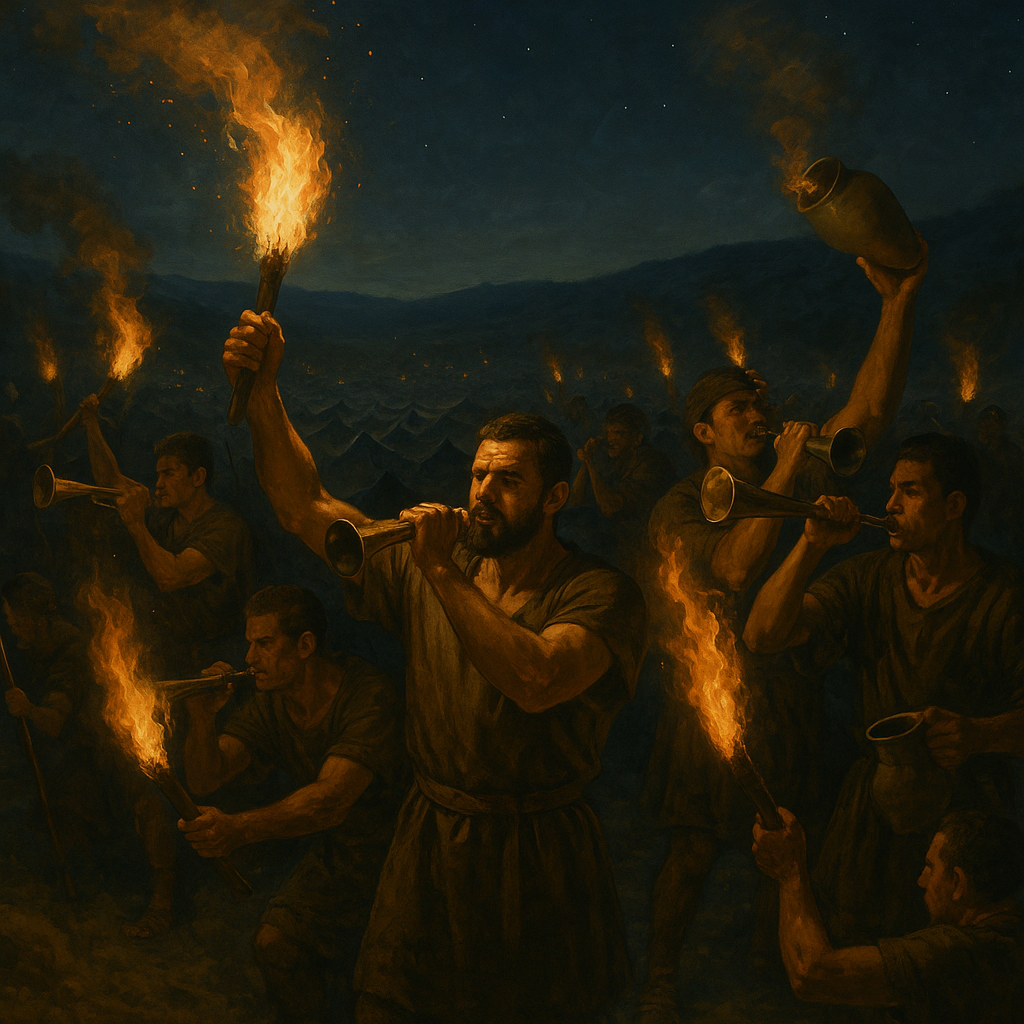
Gideon divides the three hundred into three companies. Each man receives a trumpet and an empty pitcher containing a lamp. Gideon instructs them to follow his example.
At the beginning of the middle watch, just after the enemy has set the watch, Gideon and his company blow their trumpets and break their pitchers. The other companies do likewise. Holding lamps in their left hands and trumpets in their right hands, they cry:
“The sword of the LORD, and of Gideon.”
Judges 7:20
The Israelites stand in their places around the camp. The enemy runs, cries out, and flees. The decisive statement is that “the LORD set every man’s sword against his fellow, even throughout all the host” (Judges 7:22).
The passage attributes the enemy’s confusion to the LORD. The trumpets, pitchers, and lamps are part of Gideon’s instructions, but the victory must not be reduced to an explanation about clever tactics.
Other Israelites join the pursuit (Judges 7:23-25).
Men from Naphtali, Asher, and Manasseh gather to pursue the Midianites. Gideon also summons Ephraim to take the waters unto Beth-barah and Jordan.
The Ephraimites capture and kill Oreb and Zeeb, two princes of Midian, and bring their heads to Gideon on the other side of Jordan.
The three hundred have a distinct role in the initial victory, but they are not the only Israelites involved in the subsequent pursuit. Chapter 7 ends while the pursuit continues; the account extends into Judges 8.
Key People and Places
Key people and groups
- Gideon: Son of Joash, commissioned by the LORD to deliver Israel from Midian. His questions, fear, obedience, and worship are all recorded (Judges 6:11-16, 27; 7:15).
- Jerubbaal: The name given to Gideon after he destroys Baal’s altar (Judges 6:32; 7:1).
- The angel of the LORD: Appears to Gideon and gives the sign involving fire from the rock. The encounter includes statements explicitly attributed to the LORD (Judges 6:11-23).
- The unnamed prophet: Delivers God’s rebuke concerning Israel’s disobedience (Judges 6:7-10).
- Joash: Gideon’s father, an Abiezrite. The altar to Baal belongs to him, and he challenges the men demanding Gideon’s death (Judges 6:11, 25-31).
- Phurah: Gideon’s servant, who accompanies him to the enemy camp (Judges 7:10-11).
- The three hundred: The men retained according to God’s direction after the water test (Judges 7:5-8).
- Midianites, Amalekites, and children of the east: The forces that invade Israel and assemble in the valley of Jezreel (Judges 6:3-5, 33).
- Oreb and Zeeb: Two princes of Midian captured and killed by the Ephraimites (Judges 7:24-25).
- Manasseh, Asher, Zebulun, Naphtali, and Ephraim: Tribes named in the gathering of forces or pursuit of the enemy (Judges 6:35; 7:23-24).
Key places
- Ophrah of the Abiezrites: Location of Gideon’s encounter with the angel and the altar called Jehovah-shalom (Judges 6:11, 24).
- Egypt: Recalled in the prophet’s message as the land from which God delivered Israel (Judges 6:8-9).
- Gaza: Named in the description of the extent of the invaders’ destruction (Judges 6:4).
- Valley of Jezreel: Gathering place of the enemy forces (Judges 6:33).
- Well of Harod: Gideon’s campsite at the opening of Judges 7 (Judges 7:1).
- Hill of Moreh: Landmark near the Midianite camp, north of Gideon’s position (Judges 7:1).
- Mount Gilead: Named in the proclamation allowing the fearful to depart (Judges 7:3).
- Beth-shittah, Zererath, Abel-meholah, and Tabbath: Places named along the enemy’s flight (Judges 7:22).
- Mount Ephraim, Beth-barah, and Jordan: Locations associated with the summons to Ephraim and the interception of the Midianites (Judges 7:24-25).
Main Doctrinal or Spiritual Themes
1. God’s Holiness and the Seriousness of Disobedience
Israel’s conduct is evaluated “in the sight of the LORD” (Judges 6:1). The nation’s own preferences do not determine whether its worship and behavior are acceptable.
God’s rebuke, “ye have not obeyed my voice,” identifies the issue plainly (Judges 6:10). Religious heritage and memories of past deliverance do not excuse present disobedience.
2. God’s Mercy Toward an Oppressed People
The people who did evil cry unto the LORD, and He sends both a prophetic rebuke and a commissioned deliverer (Judges 6:1, 6-14). His response includes truth about their sin as well as provision for their rescue.
This deliverance concerns Israel’s rescue from Midianite oppression. It should not be confused with an explanation of how an individual receives eternal salvation. The New Testament expressly teaches salvation by grace through faith, “Not of works, lest any man should boast” (Ephesians 2:8-9).
3. God’s Presence Is the Foundation of Gideon’s Commission
Gideon points to his family’s poverty and his own low position. God answers, “Surely I will be with thee” (Judges 6:15-16).
The passage directs attention to the One who sends Gideon. It provides no basis for teaching that self-confidence or personal greatness produces God’s power.
4. True Worship Requires Rejection of Idolatry
God commands Gideon to destroy Baal’s altar and build an altar unto the LORD (Judges 6:25-26). The command does not permit combining the worship of the LORD with the worship of Baal.
For Christians, the direct command is, “Wherefore, my dearly beloved, flee from idolatry” (1 Corinthians 10:14). Gideon’s specific commission does not authorize believers to destroy other people’s property or impose worship by force.
5. Divine Empowerment and Human Obedience Work Together
“The Spirit of the LORD came upon Gideon,” and Gideon then summons the people (Judges 6:34-35). In chapter 7, the men follow their instructions while the LORD brings confusion upon the enemy (Judges 7:19-22).
Dependence upon God does not mean refusing to act. Neither does obedience permit taking credit for what God accomplishes.
6. God Excludes Human Boasting
The reason for the army’s reduction is explicit: Israel must not claim, “Mine own hand hath saved me” (Judges 7:2).
The lesson is not that small numbers are always spiritually superior. God chose a small force for this particular deliverance to make His power unmistakable. The broader principle is that His people must give Him the glory.
7. Fear Does Not Erase Every Act of Faith
Gideon fears the household and townsmen, yet obeys God’s command concerning the altar (Judges 6:27). God also provides encouragement before the battle (Judges 7:9-15).
Hebrews 11:32 includes Gideon, spelled “Gedeon” in the KJV, among its examples of faith. That recognition does not require calling every question or request he makes an example believers should imitate. Scripture allows us to acknowledge both his faith and the weaknesses recorded in his conduct.
Practical Applications or Lessons
Hear God’s correction when asking for His help. Israel cries because of oppression, and God’s prophet addresses disobedience (Judges 6:6-10). When praying for relief, believers should also examine their conduct in the light of Scripture. This does not mean assuming that every trouble proves a particular sin.
Begin with the obedience God has already made clear. Gideon receives a definite command concerning the altar in his father’s possession (Judges 6:25-27). A practical application is to address known sin in our own lives rather than discussing obedience only in broad or distant terms.
Do not make freedom from fear a condition of obedience. Gideon obeys while the text still records his fear (Judges 6:27). Believers can acknowledge apprehension honestly while doing what God’s Word requires.
Do not make a fleece your rule for guidance. Gideon’s requests refer to a promise God has already spoken (Judges 6:36-40). Christians should not use self-selected circumstances to overturn clear biblical instruction. “Thy word is a lamp unto my feet, and a light unto my path” (Psalm 119:105).
Refuse to measure God’s ability by available numbers. The LORD delivers through three hundred men after declaring the larger army too numerous for His stated purpose (Judges 7:2-7). Limited resources do not limit God. This is an encouragement to trust Him, not a promise that every small undertaking will succeed.
Worship God as you act upon His Word. After hearing the dream and its interpretation, Gideon worships and then returns to prepare his men (Judges 7:15-18). His recorded response joins reverence with action.
Fulfill your assigned responsibility faithfully. The three hundred “stood every man in his place round about the camp” (Judges 7:21). Their conduct provides a practical illustration of carrying out an assigned duty. It does not establish a hidden symbolic meaning for every feature of the battle.
Give God the credit for what He accomplishes. God explicitly guards against Israel’s boasting (Judges 7:2). Whether serving in a church, teaching Scripture, or sharing the gospel, believers should practice the principle, “He that glorieth, let him glory in the Lord” (1 Corinthians 1:31).
Yoast SEO Details
Comments are closed