
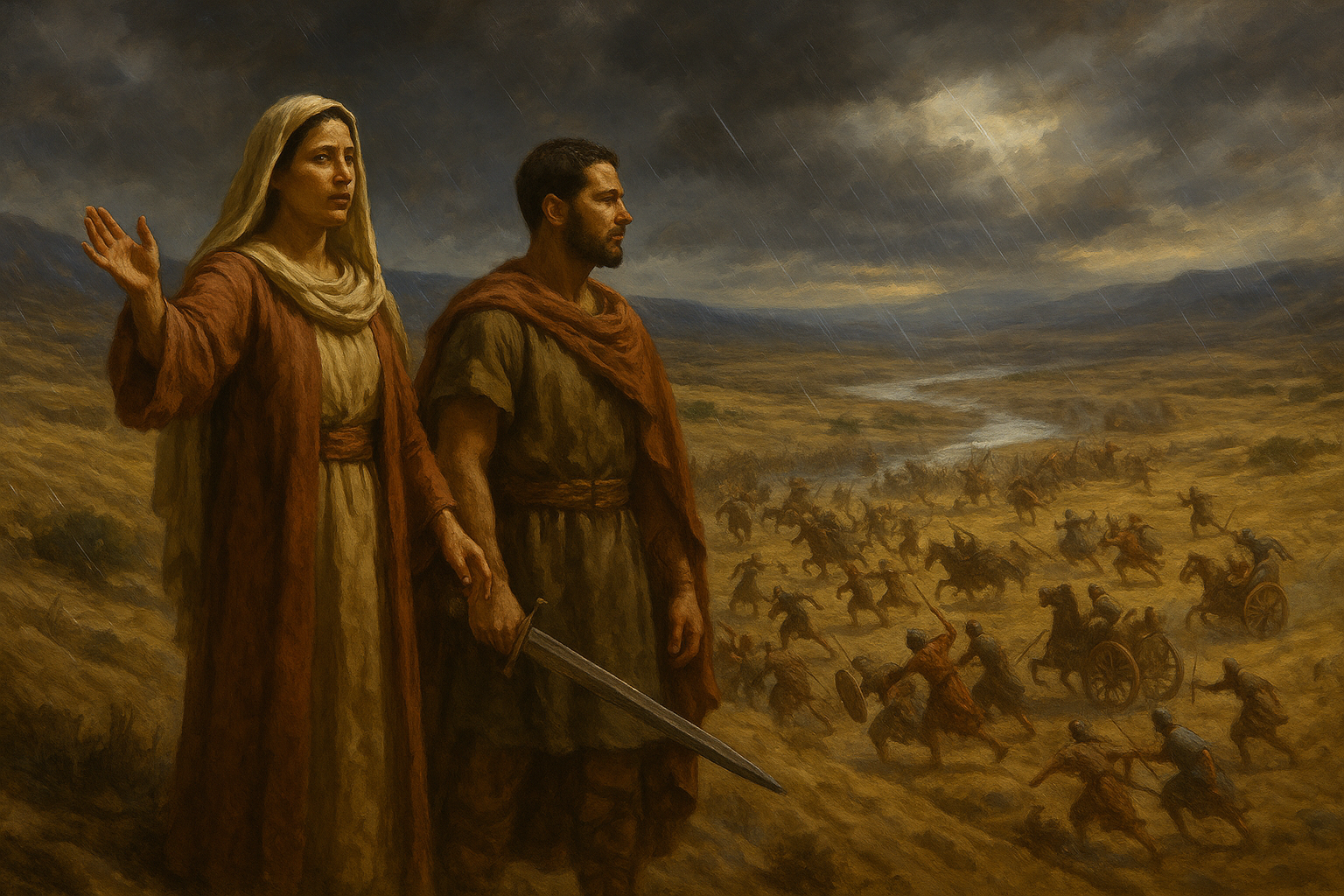
Deborah, Barak, and God’s Deliverance
 Judges 4 and 5 describe Israel’s deliverance from Canaanite oppression through two complementary accounts. Chapter 4 records the events surrounding Deborah, Barak, Sisera, and Jael. Chapter 5 presents the song of Deborah and Barak, praising the LORD and identifying both willing service and neglected responsibility.
The central truth is stated plainly: “So God subdued on that day Jabin the king of Canaan before the children of Israel” (Judges 4:23). Human obedience mattered, but God received the credit for deliverance. These chapters reveal the seriousness of Israel’s sin, the certainty of God’s word, and the importance of responding willingly when He commands.
Chapter Summaries
Judges 4: God Delivers Israel from Canaanite Oppression
Renewed evil and twenty years of oppression, verses 1-3
The chapter begins, “And the children of Israel again did evil in the sight of the LORD, when Ehud was dead.” The word “again” identifies repeated disobedience. Israel’s conduct must be evaluated by God’s judgment, rather than by what the people considered acceptable.
The LORD sold Israel into the hand of Jabin, king of Canaan, who reigned in Hazor. Sisera commanded his army and dwelt in Harosheth of the Gentiles. With nine hundred chariots of iron, the oppressing power held Israel under severe pressure for twenty years.
Israel cried unto the LORD. The passage explicitly records their distress and their cry, but it does not describe a detailed national confession or establish the spiritual condition of every individual. We should acknowledge the appeal for deliverance without adding a repentance account that these verses do not supply.
Deborah communicates God’s command, verses 4-7
Deborah was a prophetess, the wife of Lapidoth, and a judge in Israel. The people came to her for judgment beneath the palm tree of Deborah, between Ramah and Bethel in mount Ephraim.
She called Barak, the son of Abinoam, from Kedeshnaphtali and declared the LORD’s command. He was to take ten thousand men from Naphtali and Zebulun toward mount Tabor. God promised to draw Sisera, his chariots, and his multitude to the river Kishon and deliver him into Barak’s hand.
The command and promise belonged together. Barak was given a definite responsibility, and the promised outcome rested upon the LORD.
Deborah’s position is explicitly stated. Scripture does not say that she became judge because no man would accept the position. That familiar explanation should not be presented as a biblical fact.
Barak’s condition and Deborah’s answer, verses 8-10
Barak answered:
“If thou wilt go with me, then I will go: but if thou wilt not go with me, then I will not go” (Judges 4:8).
Deborah agreed to accompany him, but announced that the journey would not be for his honor, because the LORD would sell Sisera into the hand of a woman.
Barak made his participation conditional upon Deborah’s presence. This may indicate hesitation or a desire for the reassurance of her presence as God’s prophetess. Scripture does not explicitly explain his inner motive.
We must also consider Hebrews 11:32-34, which includes Barak among those associated with deeds accomplished through faith. His conditional response should not be ignored, but neither should his entire character be reduced to cowardice or unbelief. He gathered the men and proceeded with the task.
The LORD defeats Sisera’s army, verses 11-16
The narrative introduces Heber the Kenite, who had separated himself from the other Kenites and pitched his tent near Kedesh. This prepares the reader for the account involving his wife, Jael.
Sisera gathered his nine hundred iron chariots and his forces at the river Kishon. Deborah then told Barak:
“Up; for this is the day in which the LORD hath delivered Sisera into thine hand: is not the LORD gone out before thee?” (Judges 4:14).
Barak descended from mount Tabor with ten thousand men. The LORD “discomfited Sisera, and all his chariots, and all his host.” Sisera abandoned his chariot and fled on foot, while Barak pursued the army to Harosheth of the Gentiles.
God’s promised victory did not remove Barak’s responsibility to act. The LORD went before him, and Barak went down into the battle.
Jael and the fulfillment of Deborah’s prophecy, verses 17-22
Sisera fled to Jael’s tent because there was peace between Jabin and the house of Heber the Kenite. Jael invited him inside, covered him, and gave him milk when he requested water.
Sisera asked her to deny his presence if anyone inquired. The text records his request, but it does not record Jael making that denial to anyone.
While Sisera was asleep and weary, Jael killed him with a tent nail and a hammer. When Barak arrived in pursuit, she showed him the dead commander. Sisera’s death at the hand of a woman fulfilled the specific announcement in Judges 4:9.
The chapter does not reveal all of Jael’s thoughts or explain every motive behind her conduct. Chapter 5 does, however, explicitly pronounce a blessing upon her.
Jabin’s power is broken, verses 23-24
God subdued Jabin that day. Israel then continued to prevail against him until they destroyed him.
The text distinguishes the decisive defeat of Sisera’s forces from Israel’s continuing success against Jabin. It does not specify how long that subsequent struggle lasted.
Judges 5: Deborah and Barak Praise the LORD
Praise for deliverance and willing service, verses 1-5
Deborah and Barak sang “on that day.” Their song begins:
“Praise ye the LORD for the avenging of Israel, when the people willingly offered themselves” (Judges 5:2).
The praise is directed to the LORD, while the willingness of the people is also recognized. The song calls kings and princes to hear and describes the majesty of God’s going forth from Seir and Edom, with the earth trembling and the mountains melting before Him.
The LORD God of Israel is presented as the One before whom creation responds. The victory must be understood in relation to His power.
The condition of Israel before deliverance, verses 6-8
The song describes abandoned highways, travelers using byways, and the cessation of village life. These statements portray the disruption of ordinary life during that period.
Deborah says that she arose “a mother in Israel.” This describes her place in the nation’s deliverance; it does not establish whether she had biological children.
The spiritual problem is stated directly: “They chose new gods; then was war in the gates.” The song also asks whether a shield or spear was seen among forty thousand in Israel. This emphasizes Israel’s military vulnerability, but it does not explain precisely why those weapons were absent.
Willing leaders and public remembrance, verses 9-13
Deborah expresses affection for the governors who offered themselves willingly. The people are called to speak of the LORD’s righteous acts, including at the places where they drew water.
Deliverance was to become a subject of public remembrance. The song joins gratitude for God’s work with recognition of those who willingly participated.
Participation and failure among the tribes, verses 14-18
The song names Ephraim, Benjamin, Machir, Zebulun, and Issachar in connection with the response. Zebulun and Naphtali receive particular recognition as people who “jeoparded their lives unto the death.”
Reuben is associated with “great thoughts of heart” and “great searchings of heart,” yet remained among the sheepfolds. Gilead remained beyond Jordan, Dan remained in ships, and Asher continued by the seashore.
The contrast is between those who participated and those who remained away. Scripture identifies their conduct without explaining every individual’s private reasoning.
The LORD’s victory and the curse upon Meroz, verses 19-23
The kings of Canaan fought at Taanach by the waters of Megiddo. The song declares:
“They fought from heaven; the stars in their courses fought against Sisera” (Judges 5:20).
It then states that the river Kishon swept them away. These declarations establish that the victory involved divine intervention beyond Israel’s military effort.
A storm and flooding may explain aspects of the defeat, especially when the references to water and Kishon are considered together. However, Scripture does not explicitly describe chariot wheels becoming trapped in mud. That detail should not be stated as though it appears in the passage.
Meroz is cursed because its inhabitants “came not to the help of the LORD.” Their failure to respond receives direct condemnation. The language does not imply that God lacked power; it identifies their neglected responsibility in His cause.
Jael’s blessing and Sisera’s mother’s expectation, verses 24-30
Jael is declared blessed above women in the tent, and the song recounts Sisera’s death.
The account then turns to Sisera’s mother, who waits at a window for his return. Her ladies, and she herself, explain the delay by imagining the division of spoil, including captive women and valuable clothing.
Their expectation of triumph stands against the defeat already recorded. The song reports their words without approving their treatment of people as spoil.
A closing prayer and forty years of rest, verse 31
The song closes:
“So let all thine enemies perish, O LORD: but let them that love him be as the sun when he goeth forth in his might.”
The chapter then records forty years of rest in the land. It does not say that every Israelite remained spiritually faithful throughout those years.
Key People and Places
People
- Deborah: Prophetess, wife of Lapidoth, judge in Israel, and a singer of the victory song with Barak.
- Barak: Son of Abinoam, called from Kedeshnaphtali to lead ten thousand men against Sisera.
- Jael: Wife of Heber the Kenite, who killed Sisera and received a blessing in the song.
- Sisera: Commander of Jabin’s army, defeated before Barak and killed in Jael’s tent.
- Jabin: King of Canaan who reigned in Hazor and oppressed Israel.
- Heber the Kenite: Jael’s husband, whose household was at peace with Jabin.
- Lapidoth: Deborah’s husband; these chapters provide no further personal details.
- Ehud: His death is mentioned when the account introduces Israel’s renewed evil.
- Shamgar: Son of Anath, named in the song’s description of the troubled period.
- Sisera’s mother: An unnamed woman portrayed waiting for her son’s return.
Places
- Hazor: Jabin’s royal city.
- Harosheth of the Gentiles: Sisera’s dwelling place and the destination of Barak’s pursuit.
- Ramah and Bethel: Places between which Deborah judged Israel.
- Mount Ephraim: The region containing Deborah’s place of judgment.
- Kedeshnaphtali, or Kedesh: Barak’s home location and the gathering place named in chapter 4.
- Mount Tabor: The mountain from which Barak descended with his men.
- River Kishon: The gathering area for Sisera’s forces and the river that swept the enemy away.
- Plain of Zaanaim: The location near Kedesh where Heber pitched his tent.
- Taanach and the waters of Megiddo: Locations named in the song’s description of the battle.
- Meroz: A place whose inhabitants were cursed for failing to help; these chapters do not establish its precise location.
- Seir, Edom, and Sinai: Geographic references in the song’s declaration of the LORD’s majesty.
Main Doctrinal or Spiritual Themes
1. God’s holiness makes sin a serious matter.
Israel’s evil and choice of new gods are directly connected with the account of oppression and war. God did not treat idolatry as harmless religious variety. His people were accountable to Him for their worship and conduct (Judges 4:1-3; 5:8).
2. Deliverance belongs to the LORD.
God promised the victory, went before Barak, defeated Sisera’s forces, and subdued Jabin. The repeated attribution of victory to God guards against giving human instruments the glory that belongs to Him (Judges 4:7, 14-15, 23).
3. God’s word is dependable.
The promised defeat occurred, and Sisera fell into the hand of a woman as Deborah had announced. Confidence in God rests upon what He has actually said. This account does not authorize believers to invent promises of success for their own plans.
4. Faith acts upon God’s command.
Barak gathered the men, descended from Tabor, and pursued the enemy. Hebrews includes him among the examples associated with faith. His account shows why we must consider the whole biblical testimony when evaluating a servant of God.
Adrian Rogers also emphasizes active trust and obedience in his treatment of Deborah and Barak. That emphasis is helpful when kept under the authority of the passage’s actual wording. Love Worth Finding Ministries
5. Willing service and neglected duty both matter.
The song praises willing people and leaders, honors those who risked their lives, and condemns Meroz for failing to help. Responsibility includes the good we are obligated to do. James 4:17 states, “Therefore to him that knoweth to do good, and doeth it not, to him it is sin.”
6. God’s servants have distinct responsibilities.
Deborah judged and delivered God’s message. Barak led the forces. Jael brought about Sisera’s death. The account honors the contributions of women and men without making their responsibilities identical.
Deborah’s judgeship concerns Israel in the period of the judges. These chapters do not establish qualifications for the New Testament pastoral office; that subject must be addressed from the passages that teach it.
7. Praise should preserve the memory of God’s righteous acts.
The song does more than celebrate relief. It recounts God’s intervention, remembers willing service, and warns against neglect. Worship here includes truth about God’s character and His dealings with His people (Judges 5:2-11).
8. Israel’s warfare must be applied within its biblical setting.
These chapters record actual warfare and judgment. They do not instruct Christians to use violence against religious opponents. The New Testament describes Christian warfare as spiritual: “For the weapons of our warfare are not carnal” (2 Corinthians 10:4).
Practical Applications or Lessons
Maintain obedience beyond the influence of a respected leader.
Israel again did evil when Ehud was dead. This warns readers to examine whether their faithfulness depends mainly upon another person’s presence. Personal obedience must be grounded in God’s authority.
Respond to clear biblical duty.
Barak had a command to obey. Our application is to carry out what Scripture clearly requires, without treating our preferences or impressions as additional revelation.
Encourage others toward obedience.
Deborah communicated God’s command and urged Barak forward at the appointed time. Believers can likewise strengthen one another by directing attention to what God has written.
Let deliberation lead to faithful action.
Reuben’s searching of heart did not result in joining the battle described in the song. Careful thought is valuable, but considering a duty does not fulfill it. Examine whether repeated discussion has become a substitute for doing known good.
Serve willingly and acknowledge faithful service.
Deborah recognized both willing governors and willing people. Churches can apply this principle by valuing dependable service and encouraging members to fulfill their biblical responsibilities.
Give God specific praise.
Name His mercies rather than speaking only in generalities. The song remembered concrete acts of deliverance. Prayer, testimony, and worship should reflect thoughtful gratitude.
Avoid making human strength your ultimate confidence.
Sisera’s iron chariots did not secure victory. Resources and preparation have their place, but they cannot overturn God’s declared purpose.
Read biblical characters with fairness and restraint.
Do not invent Deborah’s family circumstances, Jael’s private motives, or a complete psychological explanation of Barak. Learn from what Scripture reveals, and leave unstated matters unstated.
Cultivate love for the LORD.
The closing prayer contrasts God’s enemies with “them that love him.” The devotional goal extends beyond admiration for remarkable people. These chapters call us to honor the LORD, obey His word, accept our responsibilities, and praise Him for His righteous works.
Comments are closed