 Joshua 10–12 records the decisive campaigns by which the LORD gave Israel victory over major Canaanite coalitions. Joshua 10 centers on the southern kings and the defense of Gibeon; Joshua 11 records the defeat of the great northern confederacy led by Jabin king of Hazor; and Joshua 12 summarizes the kings defeated under Moses east of Jordan and under Joshua west of Jordan.
The controlling truth throughout these chapters is stated plainly in Joshua 10:42: “because the LORD God of Israel fought for Israel.” Israel’s victories are therefore presented as acts of God fulfilling His word, exercising judgment upon the Canaanite nations, and giving Israel the inheritance He had promised.
At the same time, these passages must be interpreted according to their actual biblical setting. The command to destroy the Canaanite nations was given specifically to Israel under the Old Testament theocracy. It is not a command for the New Testament church to wage physical warfare for religious purposes. The church’s warfare is spiritual: “For the weapons of our warfare are not carnal” (2 Corinthians 10:4).
Chapter Summaries
Joshua 10 — The Southern Kings, Gibeon, and the Day the Sun Stood Still
Joshua 10 opens after the events surrounding Gibeon in Joshua 9. Adonizedek king of Jerusalem hears that Joshua has taken Ai and that the inhabitants of Gibeon have made peace with Israel. Because Gibeon was a significant city and its men were described as mighty, Adonizedek gathers four other Amorite kings against it.
The five kings are:
- Adonizedek, king of Jerusalem
- Hoham, king of Hebron
- Piram, king of Jarmuth
- Japhia, king of Lachish
- Debir, king of Eglon
Together they encamp against Gibeon and make war against it.
The Gibeonites send urgently to Joshua at Gilgal:
“Slack not thy hand from thy servants; come up to us quickly, and save us, and help us.”
— Joshua 10:6
Joshua responds with Israel’s fighting men. Before the battle, the LORD gives Joshua a direct promise:
“Fear them not: for I have delivered them into thine hand; there shall not a man of them stand before thee.”
— Joshua 10:8
Joshua comes upon them suddenly after going up from Gilgal through the night.
The text repeatedly emphasizes that the victory belongs to God. Joshua 10:10 says, “And the LORD discomfited them before Israel.” As the enemy flees toward Bethhoron, Azekah, and Makkedah, the LORD casts great stones from heaven.
The KJV makes the result explicit:
“they were more which died with hailstones than they whom the children of Israel slew with the sword.”
— Joshua 10:11
This was therefore not merely an Israelite military victory. God Himself intervened.
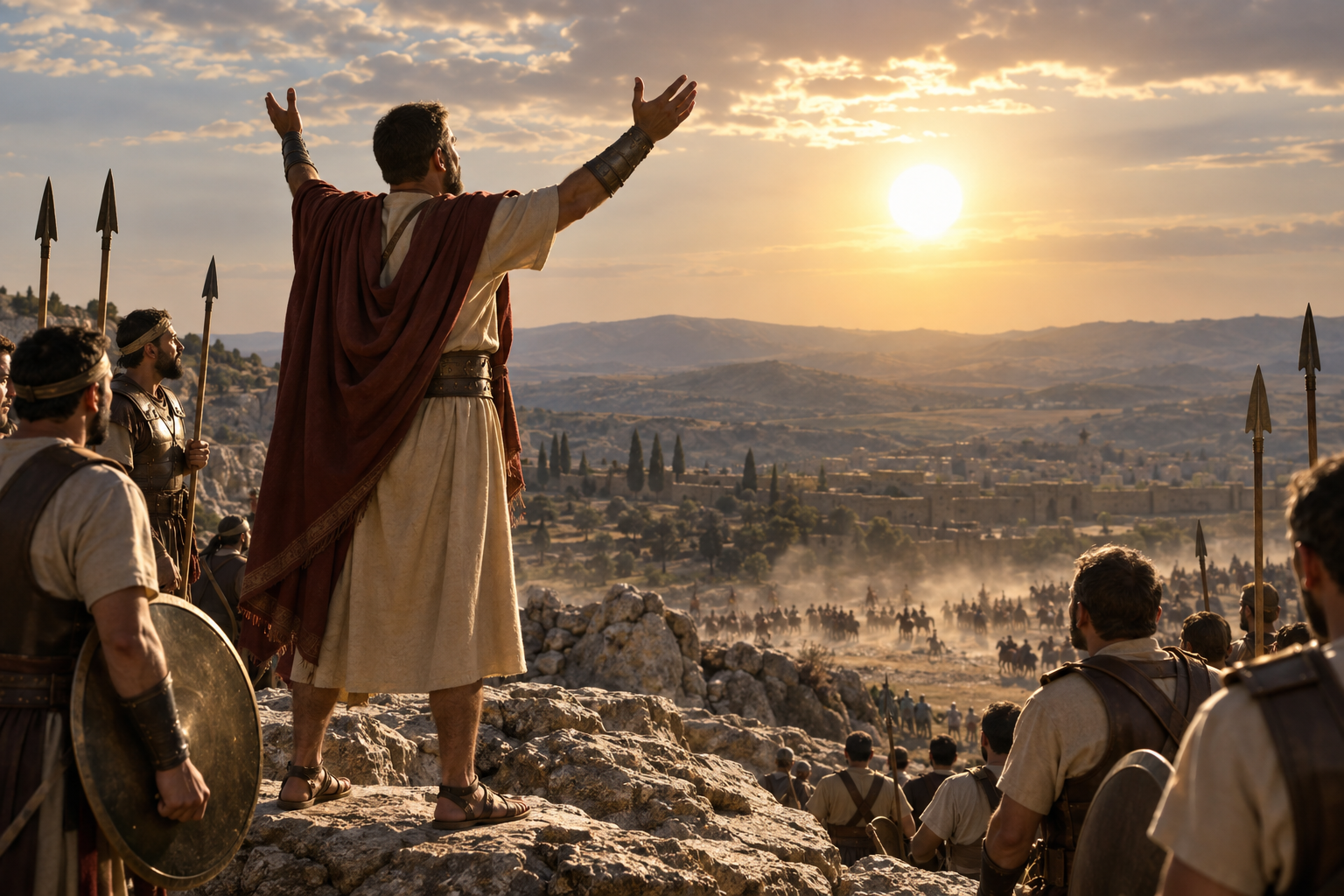
The most remarkable event of the chapter follows. Joshua speaks before Israel:
“Sun, stand thou still upon Gibeon; and thou, Moon, in the valley of Ajalon.”
— Joshua 10:12
Then Scripture states:
“And the sun stood still, and the moon stayed, until the people had avenged themselves upon their enemies.”
— Joshua 10:13
And again:
“So the sun stood still in the midst of heaven, and hasted not to go down about a whole day.”
— Joshua 10:13
The plain reading of the KJV presents this as a literal supernatural intervention by God. Scripture does not explain the physical mechanism by which God accomplished it, and therefore speculation concerning that mechanism should not be treated as biblical fact.
Joshua 10:14 emphasizes the uniqueness of the event:
“And there was no day like that before it or after it, that the LORD hearkened unto the voice of a man: for the LORD fought for Israel.”
The chapter also mentions that this event was written “in the book of Jasher.” Scripture does not give enough information in this passage to identify everything contained in that book, so conclusions beyond the statement itself would be uncertain.
The five kings flee and hide themselves in a cave at Makkedah. Joshua orders large stones placed over the cave while the pursuit continues. After the enemy forces have been defeated, the kings are brought out.
Joshua has the captains place their feet upon the necks of the kings. He then gives Israel a lesson in courage:
“Fear not, nor be dismayed, be strong and of good courage: for thus shall the LORD do to all your enemies against whom ye fight.”
— Joshua 10:25
Joshua afterward executes the five kings. Their bodies are hung upon trees until evening and then placed in the cave where they had hidden.
Joshua then conducts a rapid series of victories through the southern region. The chapter records the taking of:
- Makkedah
- Libnah
- Lachish
- Eglon
- Hebron
- Debir
Horam king of Gezer comes to assist Lachish, but Joshua defeats him also.
The theological explanation occurs near the end:
“And all these kings and their land did Joshua take at one time, because the LORD God of Israel fought for Israel.”
— Joshua 10:42
Joshua then returns with Israel to the camp at Gilgal.
Historical and Doctrinal Background
The destruction of the Canaanites must be understood as divine judgment commanded by God, not as ordinary warfare undertaken merely for territorial ambition. Deuteronomy 9:4–5 explicitly warns Israel not to think that the land was being given because of Israel’s own righteousness. The wickedness of the nations and God’s covenant promise are specifically named in that passage.
Therefore, Israel was not authorized to create its own standard of judgment. Joshua was obligated to obey what God had commanded through Moses.
Joshua 11 — The Northern Confederacy Defeated
Joshua 11 shifts the focus northward.
Jabin king of Hazor hears about Joshua’s victories and sends to numerous kings in the northern regions. Among those specifically named are:
- Jobab, king of Madon
- the king of Shimron
- the king of Achshaph
The coalition also includes Canaanite peoples from several regions.
Their military strength is described dramatically:
“And they went out, they and all their hosts with them, much people, even as the sand that is upon the sea shore in multitude, with horses and chariots very many.”
— Joshua 11:4
They gather at the waters of Merom to fight against Israel.
Again, the LORD speaks directly to Joshua:
“Be not afraid because of them: for to morrow about this time will I deliver them up all slain before Israel.”
— Joshua 11:6
Joshua is also commanded concerning their military equipment:
“thou shalt hough their horses, and burn their chariots with fire.”
Joshua and Israel come suddenly against the coalition at the waters of Merom.
Joshua 11:8 again attributes the victory directly to God:
“And the LORD delivered them into the hand of Israel.”
Israel pursues the defeated forces toward locations including great Zidon, Misrephothmaim, and the valley of Mizpeh.
Joshua then obeys the LORD concerning their horses and chariots.
Hazor receives particular attention because:
“Hazor beforetime was the head of all those kingdoms.”
— Joshua 11:10
Joshua kills Jabin king of Hazor and burns Hazor with fire.
The text makes an important distinction concerning the captured cities. Joshua 11:13 says Israel did not burn all the cities, “save Hazor only; that did Joshua burn.”
Israel also takes the spoil and cattle of these cities.
A major emphasis of the chapter is Joshua’s obedience:
“As the LORD commanded Moses his servant, so did Moses command Joshua, and so did Joshua; he left nothing undone of all that the LORD commanded Moses.”
— Joshua 11:15
This is one of the strongest statements concerning Joshua’s obedience in the book.
Joshua 11:18 adds:
“Joshua made war a long time with all those kings.”
That statement prevents the reader from assuming that the victories of chapters 10–11 necessarily occurred within only a few days. Scripture explicitly describes the broader campaign as lasting “a long time,” though this verse does not specify its exact length.
The text then says:
“There was not a city that made peace with the children of Israel, save the Hivites the inhabitants of Gibeon: all other they took in battle.”
— Joshua 11:19
The next verse contains an important doctrinal statement:
“For it was of the LORD to harden their hearts, that they should come against Israel in battle, that he might destroy them utterly.”
— Joshua 11:20
In its immediate context, this is judicial hardening connected with God’s historical judgment upon the Canaanite nations. The verse should be allowed to say exactly that. It should not be turned into a proof of Calvinistic regeneration or a doctrine teaching that sinners must be regenerated before they can believe. Neither subject is what Joshua 11 is discussing.
Joshua also destroys the Anakims from the mountainous regions associated with places including Hebron, Debir, and Anab.
The chapter specifically says:
“There was none of the Anakims left in the land of the children of Israel: only in Gaza, in Gath, and in Ashdod, there remained.”
— Joshua 11:22
The chapter closes:
“So Joshua took the whole land, according to all that the LORD said unto Moses; and Joshua gave it for an inheritance unto Israel according to their divisions by their tribes. And the land rested from war.”
— Joshua 11:23
This statement must be read together with Joshua 13:1, where the LORD later says, “there remaineth yet very much land to be possessed.”
Therefore, the safest conclusion is that Joshua 11:23 summarizes the decisive breaking of the organized Canaanite resistance and Israel’s acquisition of the land as its God-given inheritance. It does not require the claim that every individual locality had already been occupied and permanently settled.
Similarly, “the land rested from war” describes the conclusion of this major phase of warfare. Later chapters explicitly record remaining areas and further possession.
Joshua 12 — The Record of the Defeated Kings
Joshua 12 functions largely as a historical summary.
The first portion looks east of Jordan and records victories that occurred under Moses.
Two kings are especially named:
Sihon, king of the Amorites
His territory extended from the Arnon region northward into Gilead and toward the Sea of Chinneroth and the Dead Sea region.
Og, king of Bashan
He ruled from Ashtaroth and Edrei and possessed territory in Bashan and surrounding areas.
Joshua 12:6 states:
“Them did Moses the servant of the LORD and the children of Israel smite.”
The territories were afterward given to the Reubenites, Gadites, and half tribe of Manasseh.
The chapter then turns west of Jordan to the kings conquered by Joshua.
Joshua 12:7 says:
“And these are the kings of the country which Joshua and the children of Israel smote on this side Jordan on the west.”
The text then gives a formal list.
The kings defeated under Joshua are:
- Jericho
- Ai
- Jerusalem
- Hebron
- Jarmuth
- Lachish
- Eglon
- Gezer
- Debir
- Geder
- Hormah
- Arad
- Libnah
- Adullam
- Makkedah
- Bethel
- Tappuah
- Hepher
- Aphek
- Lasharon
- Madon
- Hazor
- Shimronmeron
- Achshaph
- Taanach
- Megiddo
- Kedesh
- Jokneam of Carmel
- Dor in the coast of Dor
- the nations of Gilgal
- Tirzah
The chapter concludes:
“all the kings thirty and one.”
— Joshua 12:24
The list is more than administrative detail. Within the narrative of Joshua it serves as a written testimony to repeated fulfillment of God’s promise and to the extent of the victories already granted to Israel.
Key People and Places
- Joshua — Leader of Israel and successor to Moses. Joshua 11:15 particularly emphasizes that he carried out what the LORD had commanded through Moses.
- The LORD God of Israel — The true source of Israel’s victory. Joshua 10:42 explicitly says the conquests occurred “because the LORD God of Israel fought for Israel.”
- Adonizedek — King of Jerusalem who organizes the five-king coalition against Gibeon.
- Hoham — King of Hebron and member of the coalition.
- Piram — King of Jarmuth.
- Japhia — King of Lachish.
- Debir — King of Eglon. This is the personal name of this king; Debir is also the name of a city conquered later in Joshua 10.
- The Gibeonites — The inhabitants of Gibeon who had made peace with Israel and call upon Joshua for help.
- Jabin — King of Hazor and organizer of the northern coalition.
- Jobab — King of Madon, allied with Jabin.
- Sihon — Amorite king defeated under Moses east of Jordan.
- Og — King of Bashan defeated under Moses.
Important geographic locations include:
- Gilgal — Israel’s camp from which Joshua marches to assist Gibeon.
- Gibeon — The city attacked by the five Amorite kings.
- Bethhoron — Associated with the route along which Israel pursued the fleeing southern forces.
- Ajalon — The valley mentioned when Joshua commands the moon to stand still.
- Makkedah — Location of the cave where the five kings hide.
- Jerusalem — Ruled at this time by Adonizedek.
- Hebron — Major southern city and kingdom.
- Jarmuth — Southern Canaanite city.
- Lachish — Important city attacked and taken by Joshua.
- Eglon — Southern city ruled by one of the five kings.
- Gezer — Its king, Horam, comes to assist Lachish.
- Libnah — City taken during the southern campaign.
- Debir — City conquered by Joshua.
- Hazor — Leading city of the northern coalition; Joshua 11:10 calls it “the head of all those kingdoms.”
- Waters of Merom — Gathering place of the northern coalition and location of Joshua’s attack.
- Zidon — Named in connection with Israel’s pursuit.
- Mount Hermon — Northern geographic marker.
- Gaza, Gath, and Ashdod — Places where Anakims remained according to Joshua 11:22.
- Jordan — Major geographical dividing line in Joshua 12 between the victories under Moses eastward and those under Joshua westward.
- Bashan — Kingdom formerly ruled by Og.
- Carmel — Associated with Jokneam in the list of defeated kings.
- Megiddo — One of the kingdoms named in Joshua 12.
- Tirzah — Final kingdom listed among the thirty-one.
Main Doctrinal or Spiritual Themes
1. God keeps His word
The victories in these chapters are connected to what God had previously commanded and promised.
Joshua 11:15 carefully links:
- the LORD’s command,
- Moses’ instruction,
- and Joshua’s obedience.
The conquest is therefore presented as fulfillment of God’s revealed word rather than Joshua inventing his own mission.
For the believer, this reinforces the absolute reliability of God’s Word.
2. The LORD is the source of victory
Joshua was a capable leader, and Israel fought actual battles, but Scripture deliberately directs attention above human ability.
Joshua 10:10:
“And the LORD discomfited them before Israel.”
Joshua 10:42:
“because the LORD God of Israel fought for Israel.”
Joshua 11:8:
“And the LORD delivered them into the hand of Israel.”
Human responsibility and divine power are both present. Joshua obeys and fights; God gives the victory.
3. Faith should rest upon God’s revealed promise
Joshua did not enter the battle at Gibeon merely hoping circumstances would work in his favor. God had said:
“Fear them not: for I have delivered them into thine hand.”
Biblical faith rests upon what God has actually said.
This is different from presumption. A believer today should not claim promises that God never made personally to the church or to an individual. Faith believes God’s written Word according to its proper context.
4. God has absolute power over His creation
The hailstones and the standing still of the sun demonstrate that creation remains subject to its Creator.
Joshua 10 does not portray God as struggling against natural laws. The God who created heaven and earth is sovereign over them.
The proper response is to believe what the KJV states without inventing explanations the passage does not supply.
5. God is holy and judges sin
The destruction of the Canaanite kingdoms is solemn.
It should never be treated casually.
The conquest belongs within the broader KJV testimony concerning God’s judgment upon the nations and His promise concerning the land. Deuteronomy 9:4–5 specifically prevents Israel from boasting that its own righteousness earned the inheritance.
God’s patience does not mean that He will never judge.
His holiness remains unchanged.
6. Obedience must be complete
Joshua 11:15 gives one of the central lessons of these chapters:
“he left nothing undone of all that the LORD commanded Moses.”
Partial obedience is not the standard presented here.
For the Christian, obedience does not purchase salvation. Salvation is entirely by grace through faith, apart from works. Nevertheless, those who belong to Christ ought to take God’s commands seriously.
7. Courage is grounded in God, not self-confidence
Joshua repeatedly hears:
“Fear them not.”
The reason is not that Israel is naturally superior.
The reason is that God has spoken.
Likewise Joshua tells the captains:
“Fear not, nor be dismayed, be strong and of good courage.”
Biblical courage is confidence in the LORD and His Word rather than confidence in human ability.
8. God’s judgment and God’s mercy must both be taken seriously
Joshua 11:19 explicitly notes:
“There was not a city that made peace with the children of Israel, save the Hivites the inhabitants of Gibeon.”
The statement should be kept within its historical context. Scripture explicitly records Gibeon’s peace with Israel; it does not authorize speculation about what every other city might have done under different circumstances.
The text gives us what God intended us to know.
9. Judicial hardening is a real biblical truth
Joshua 11:20 explicitly says:
“For it was of the LORD to harden their hearts, that they should come against Israel in battle.”
The immediate subject is God’s judicial dealing with these Canaanite nations.
Nothing in this passage teaches that a sinner must be spiritually regenerated before he can exercise faith. Importing Calvinistic regeneration into Joshua 11 would go beyond the subject of the text.
10. Israel and the Church must remain distinct
These wars concern Israel, Canaan, covenant promises, and God’s historical judgment upon specific nations.
The New Testament church has no command to conquer territory by force.
The Christian’s warfare is spiritual:
“For the weapons of our warfare are not carnal, but mighty through God to the pulling down of strong holds.”
— 2 Corinthians 10:4
A dispensational reading preserves the plain distinction rather than transferring Israel’s national military commands to the church.
Practical Applications or Lessons
Obey what God has actually said.
Joshua’s strength was not in creative reinterpretation of God’s command. Joshua 11:15 praises him because he carried out what God had commanded through Moses. Christians should likewise submit to Scripture rather than reshaping Scripture around preference, culture, or convenience.
Do not measure the difficulty of a task only by the apparent strength of the opposition.
The northern coalition possessed “horses and chariots very many,” yet that military advantage did not prevent God from fulfilling His word.
Opposition may be formidable without being sovereign.
Fear should be answered with God’s Word.
Twice in these campaigns the emphasis is “Fear them not.” Courage comes from knowing what God has said, not from pretending danger does not exist.
Remember who gives the victory.
Joshua fought faithfully, but the text says, “the LORD God of Israel fought for Israel.” Christian service likewise leaves no room for boasting in human strength.
Prayer should be joined to faith in God’s power.
Joshua 10 records an extraordinary answer when Joshua spoke concerning the sun and moon. Scripture does not promise believers that they may command celestial bodies today, but it does reveal that nothing is beyond God’s power.
Do not confuse God’s patience with indifference toward sin.
The judgment upon Canaan is severe because God’s holiness is real. The believer should therefore never make light of sin.
Do not use God’s judgment on Canaan as permission for personal vengeance.
Joshua acted under explicit divine command given to Israel. Personal resentment, political ambition, or religious hostility cannot legitimately be baptized with the language of Joshua’s conquest.
Finish what God gives you to do.
The statement “he left nothing undone” gives a strong pattern of faithfulness. Believers should resist careless, selective obedience.
Past victories should become reminders of God’s faithfulness.
Joshua 12 deliberately records the defeated kings. Israel was given a record of what God had already done. Remembering God’s past faithfulness can strengthen present confidence in His Word.
Do not confuse progress with completion.
Joshua 11:23 says Joshua “took the whole land,” while Joshua 13:1 later says “there remaineth yet very much land to be possessed.” The KJV itself therefore requires careful reading. Great victories had been won, but additional possession remained.
That principle also provides a useful devotional lesson: genuine progress in Christian obedience should produce gratitude, not the assumption that spiritual growth is complete.
Keep human leaders beneath the authority of God’s Word.
Joshua is commended because he obeyed what the LORD had commanded. His authority was not independent of revelation.
The lesson remains important for churches: no preacher, teacher, tradition, or commentary stands above Scripture.
Overall Message of Joshua 10–12
Joshua 10–12 presents the LORD as the covenant-keeping God who judges wickedness, fulfills His promises to Israel, rules over creation, strengthens His servant, and gives victory according to His word.
Joshua’s proper response is faith, courage, obedience, and perseverance.
The central emphasis is not the greatness of Joshua’s military ability but the greatness of Joshua’s God:
“because the LORD God of Israel fought for Israel.”
— Joshua 10:42
The Christian should therefore come away from these chapters with a higher view of God’s holiness, God’s power, God’s faithfulness, and the necessity of taking His written Word seriously.
Comments are closed