Chapter Summaries
Joshua 8 — The Fall of Ai and the Renewal of the Covenant
 After the sin of Achan was purged (Joshua 7), the Lord restored fellowship with Israel and gave Joshua renewed assurance: “Fear not, neither be thou dismayed” (v. 1). God commanded him to take all the people of war and go up against Ai, promising victory and allowing the spoils and cattle this time for themselves—a reminder that obedience brings blessing where disobedience brought defeat.
Joshua then laid an ambush behind the city, sending about thirty thousand mighty men by night. The main body of troops approached Ai from the front, pretending retreat as before, while the ambush waited in hiding. When the men of Ai pursued Israel out of the city, Joshua stretched out the spear in his hand toward Ai—God’s signal for the ambush to rise up (v. 18). The city was set aflame, the pursuers were trapped between the two forces, and Ai was utterly destroyed. The king of Ai was taken alive, hanged on a tree till evening, and his body cast at the gate beneath a heap of stones—a memorial of divine judgment.
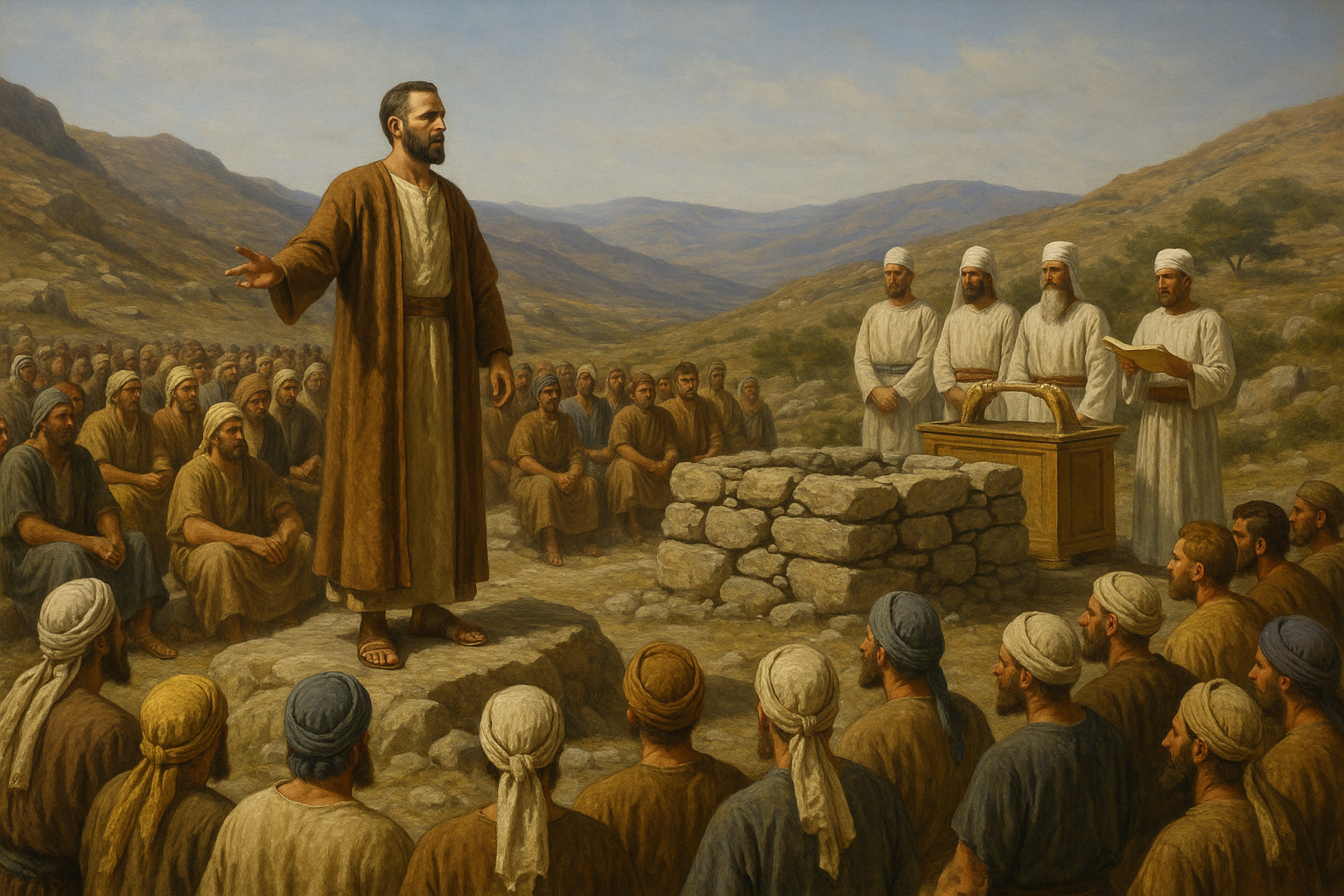
Following the victory, Joshua built an altar unto the LORD in Mount Ebal, as Moses had commanded (Deut. 27:4–8). There he wrote a copy of the law upon the stones, read it before all the people, and renewed the covenant. This solemn assembly reminded Israel that victory and life depended not on military might, but on obedience to God’s Word.
Joshua 9 — The Deception of the Gibeonites
The fame of Israel’s victories caused the kings of Canaan to unite in fear, but the inhabitants of Gibeon chose another tactic. Knowing the LORD was with Israel, they acted craftily, pretending to be ambassadors from a distant land. They came with worn-out sacks, torn wineskins, and moldy bread, asking for a treaty.
Joshua and the princes were deceived because they “asked not counsel at the mouth of the LORD” (v. 14). A league was made with them, and Israel swore by the LORD to let them live. Three days later the truth was discovered: the Gibeonites were local neighbors among the Canaanites whom Israel was to destroy.
Though the congregation murmured, the leaders honored their oath for the LORD’s name’s sake, making the Gibeonites servants—“hewers of wood and drawers of water for the congregation, and for the altar of the LORD” (v. 27). This preserved the sanctity of Israel’s word, though it introduced future complications (cf. 2 Sam. 21).
Key People and Places
-
Joshua — God’s appointed leader, obedient and humble, a type of Christ leading His people to victory.
-
Ai — A small Canaanite city near Bethel, destroyed through divine strategy. Its ruins testified to God’s judgment on sin and faithlessness.
-
Gibeon — A Hivite city north of Jerusalem. Its people submitted deceitfully, later becoming servants but spared from destruction.
-
Mount Ebal and Mount Gerizim — Mountains in central Canaan near Shechem, where the blessings and cursings of the Law were read aloud (Deut. 27).
-
The Elders and Princes of Israel — Leaders who confirmed the covenant with the Gibeonites, illustrating both the weight of an oath and the need for divine guidance.
Main Doctrinal or Spiritual Themes
-
Victory Through Obedience and Divine Guidance — The conquest of Ai teaches that success follows repentance and obedience to God’s will. The first defeat in chapter 7 came from sin; the victory in chapter 8 came through faith and submission.
-
The Sanctity of God’s Word and Covenant — The altar at Ebal underscores the centrality of Scripture. Israel’s renewed covenant shows that their relationship with God was the foundation of national life.
-
The Importance of Seeking God’s Counsel — The deception of Gibeon stemmed from human reasoning apart from prayer. Failure to seek divine counsel always leads to compromise.
-
The Binding Nature of an Oath Before God — Israel honored their vow despite deception, teaching the seriousness of one’s word before the Lord (Eccl. 5:4–6; Ps. 15:4).
-
God’s Mercy Amid Judgment — Even the Gibeonites, though deceitful, found mercy by seeking alliance under Israel’s God. Their servitude placed them near the altar—a token of grace to Gentiles.
Practical Applications or Lessons
-
Sin Must Be Dealt With Before Blessing Returns — Just as Ai’s defeat was reversed only after Achan’s sin was judged, believers must confess and forsake sin before God’s power can again rest upon their lives.
-
Never Act Without Prayer — Joshua’s failure to inquire of the LORD in chapter 9 reminds Christians to seek God’s guidance in every decision, great or small (Prov. 3:5–6).
-
True Leadership Requires Both Courage and Humility — Joshua balanced strength in battle with reverence before the Law of God, an example for pastors and spiritual leaders today.
-
Keep Your Word Even When It Costs — The Gibeonite covenant shows that integrity matters more than convenience. Christians should be people whose “yea” means “yea.”
-
God Uses Even Our Failures for His Glory — The Gibeonites later served within Israel’s worship life (Josh. 9:27; Neh. 3:7), showing that God can redeem human mistakes for His purpose.
Comments are closed