Chapter Summaries
Joshua 1 – God’s Charge to Joshua
 After the death of Moses, the Lord directly commissions Joshua, saying, “Moses my servant is dead; now therefore arise, go over this Jordan” (1:2). God assures Joshua of His continual presence—“As I was with Moses, so I will be with thee” (1:5)—and commands him to be “strong and of a good courage.” Joshua is to lead Israel into the Promised Land, carefully observing “to do according to all the law, which Moses my servant commanded thee” (1:7–8).
Joshua, now the divinely appointed leader, instructs the officers to prepare provisions, for in three days they will cross the Jordan. He reminds the Reubenites, Gadites, and half tribe of Manasseh of their promise to aid their brethren in conquest before returning to their own lands east of Jordan. The people affirm their obedience to Joshua, pledging, “As we hearkened unto Moses in all things, so will we hearken unto thee” (1:17).
Joshua 2 – Rahab and the Spies
Joshua secretly sends two men to spy on Jericho. They lodge with Rahab, a harlot whose house was on the wall. When the king’s men seek them, Rahab hides the spies under flax on her roof and confesses her faith: “I know that the Lord hath given you the land” (2:9). She recounts how the fear of Israel has fallen upon all, citing the Red Sea and victories over Sihon and Og. She requests deliverance for her household, sealing an oath with the spies. They instruct her to tie a scarlet cord in the window as a token of safety. After escaping to the mountains for three days, the spies return to Joshua, reporting, “Truly the Lord hath delivered into our hands all the land.”
Joshua 3 – Crossing the Jordan
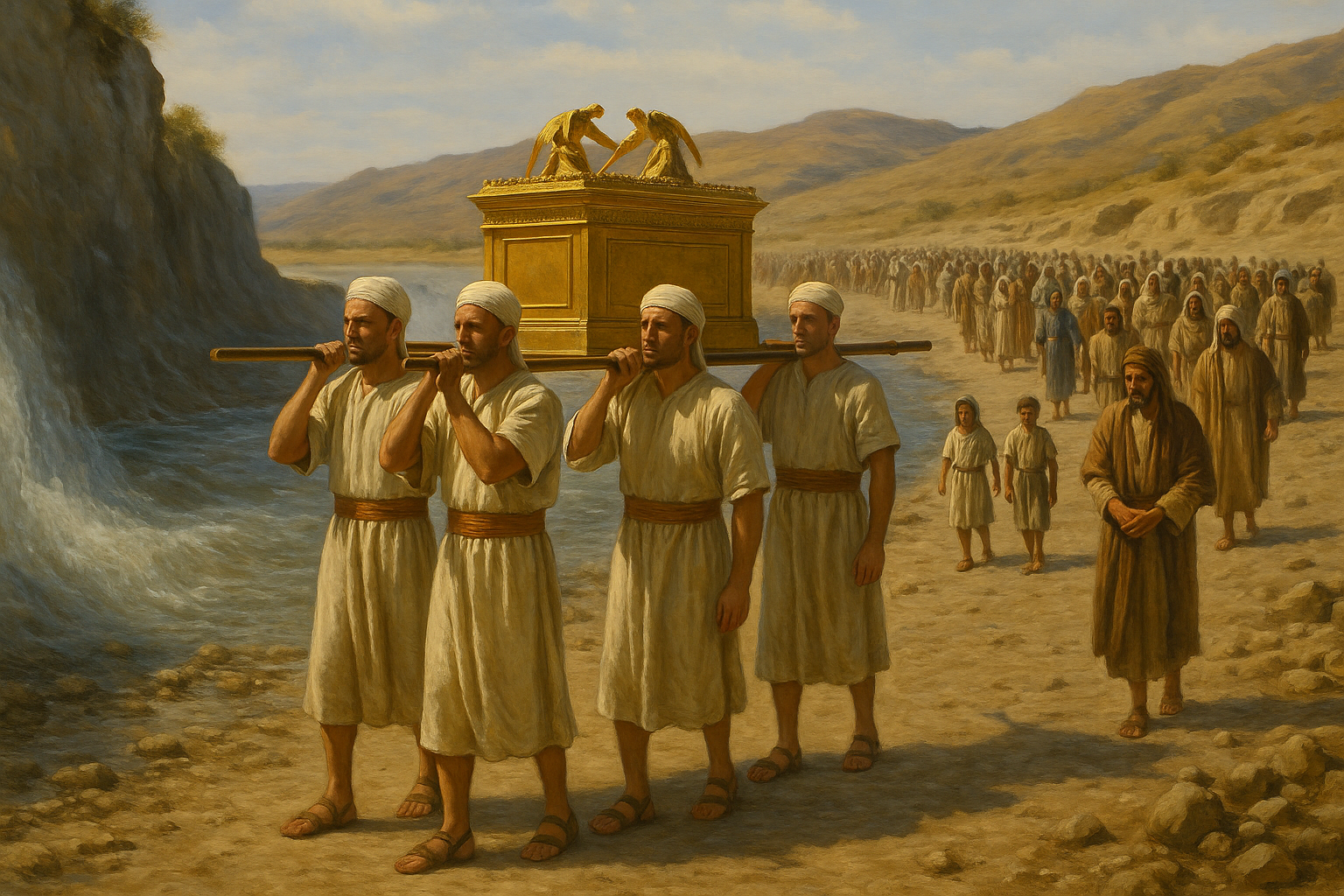
The people move from Shittim to the banks of Jordan. The priests bearing the ark of the covenant lead the procession. When their feet touch the brim of the water, “the waters which came down from above stood and rose up upon an heap” (3:16), and the people pass over on dry ground. The ark’s presence, representing the Lord’s power and holiness, is central—“the ark of the covenant of the Lord of all the earth passeth over before you into Jordan” (3:11). This miracle mirrors the Red Sea crossing and affirms God’s presence with Joshua as with Moses (3:7).
Joshua 4 – Memorial Stones from the Jordan
At God’s command, twelve men—one from each tribe—take stones from the riverbed and set them up in Gilgal as a memorial, “that all the people of the earth might know the hand of the Lord, that it is mighty” (4:24). Joshua also sets up twelve stones in the midst of the river. When the priests bearing the ark step out of the river, the waters return. The people come up on the tenth day of the first month and camp in Gilgal. The miraculous crossing and memorial stones mark Israel’s entry into Canaan and God’s faithfulness to His covenant promises.
Key People and Places
-
Joshua – Successor to Moses, divinely appointed leader of Israel, exemplifying obedience and faith.
-
Rahab – Gentile woman of Jericho who believed in Jehovah and acted in faith; later listed in Hebrews 11.
-
The Two Spies – Faithful emissaries who confirmed God’s promise and demonstrated prudence and courage.
-
Jordan River – Natural barrier dividing the wilderness from Canaan; its crossing symbolizes faith and divine power.
-
Jericho – The first Canaanite city to be confronted; represents the beginning of conquest.
-
Gilgal – Israel’s first encampment in Canaan and site of the twelve-stone memorial.
Main Doctrinal or Spiritual Themes
-
Divine Commission and Obedience
God’s servants must act upon His Word with strength and courage. Success in God’s work is tied to steadfast adherence to His Word (1:8). -
Faith and Grace in Rahab’s Redemption
Rahab’s faith demonstrates salvation by grace through faith, even for a Gentile sinner. Her scarlet cord symbolizes redemption through blood—a foreshadowing of Christ’s atonement. -
God’s Power and Presence
The miracle of the Jordan’s parting affirms that God’s presence accompanies obedience. His power is unchanging from generation to generation. -
Memorials of God’s Faithfulness
The stones at Gilgal serve as perpetual testimony of divine deliverance and a teaching tool for future generations. God’s mighty acts are to be remembered and proclaimed. -
Covenant Continuity
Joshua’s leadership continues God’s covenantal purpose begun with Abraham and Moses. Israel’s inheritance depends not on might, but on the faithfulness of God and the obedience of His people.
Practical Applications or Lessons
-
Be Courageous in Obedience: As Joshua was commanded, believers must face challenges with faith in God’s promises. Spiritual success requires steadfast meditation upon and obedience to the Word of God (1:8).
-
God Uses the Willing, Not the Worthy: Rahab’s conversion proves God’s mercy to repentant sinners and His readiness to use unexpected instruments for His glory.
-
Follow the Ark (God’s Presence): Just as Israel followed the ark, the believer must walk close to Christ, keeping eyes fixed on Him to cross life’s “Jordan” trials.
-
Remember God’s Works: Every believer should maintain memorials—both spiritual and practical—that remind future generations of God’s faithfulness.
-
Unity in Purpose: The tribes that had already received their inheritance still aided their brethren, teaching that Christian service requires unity and mutual support within the body of Christ.
Comments are closed