Chapter Summaries
Jeremiah 27
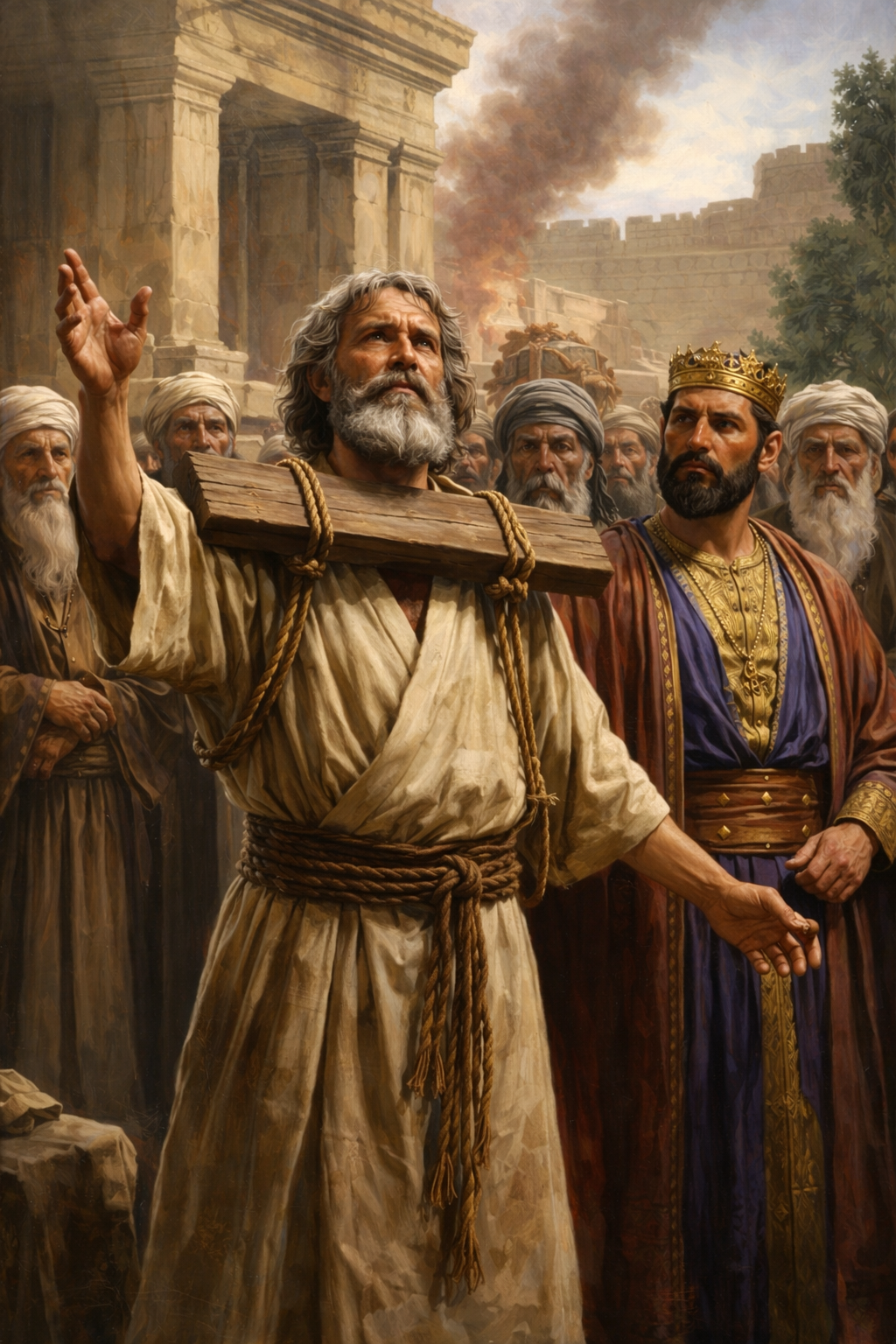
 Jeremiah 27 centers on the yoke that the LORD commands Jeremiah to wear as a sign. In the beginning of the chapter, Jeremiah is told to make “bonds and yokes” and put them upon his neck, then send similar yokes to the kings of Edom, Moab, the Ammonites, Tyrus, and Zidon by the hand of their messengers who had come to Jerusalem unto Zedekiah king of Judah. The message is plain: the God of Israel, who made “the earth, the man and the beast,” has sovereign right to give kingdoms to whomsoever He will. He declares that He has given these lands “into the hand of Nebuchadnezzar the king of Babylon, my servant,” and that the nations are to serve him, his son, and his son’s son for an appointed season.
The historical setting is one of political unrest and temptation to form alliances against Babylon. Judah and the surrounding nations wanted relief from Babylonian domination, but God’s message through Jeremiah was not revolt, but submission under divine chastening. This is one of the striking lessons of the chapter: when God sends judgment, resistance to His hand is not courage but rebellion. The people were not simply dealing with Babylon; they were dealing with the LORD who had ordained Babylon for His purposes.
Jeremiah warns the kings and peoples not to listen to their prophets, diviners, dreamers, enchanters, and sorcerers who say, “Ye shall not serve the king of Babylon.” These false assurances were not comforting truth but deadly deception, because they encouraged the people to resist God’s decree and thereby bring greater destruction on themselves. The true prophet was the one calling the nation to humble obedience, even though his message was unwelcome.
The same warning is brought directly to Zedekiah: “Bring your necks under the yoke of the king of Babylon, and serve him and his people, and live.” Jeremiah also addresses the priests and all the people concerning the vessels of the house of the LORD. False prophets claimed that the vessels already taken to Babylon would soon return, but Jeremiah says otherwise. The vessels remaining in Jerusalem would also be carried to Babylon and remain there “until the day that I visit them, saith the LORD.” Thus the chapter emphasizes that God’s Word, not national optimism or religious sentiment, must govern the believer’s thinking.
Jeremiah 28
Jeremiah 28 records the confrontation between Jeremiah and the false prophet Hananiah. Hananiah speaks in the house of the LORD before the priests and all the people and boldly claims that within “two full years” God will break the yoke of the king of Babylon, bring again the vessels of the LORD’s house, and return Jeconiah and the captives from Babylon. His message was pleasant, patriotic, and religious sounding, but it was false.
Jeremiah’s first answer is striking. He says, “Amen: the LORD do so,” not because Hananiah was right, but because Jeremiah himself would have rejoiced if the message had truly come from God. Yet he immediately reminds the hearers that the prophets before him had commonly prophesied “against many countries, and against great kingdoms, of war, and of evil, and of pestilence.” The test of a prophet was not whether he spoke smooth things, but whether his word actually came to pass. Truth is not determined by popularity, optimism, or emotional appeal.
Hananiah then acts out his rebellion by taking the yoke from off Jeremiah’s neck and breaking it, saying that even so will the LORD break the yoke of Nebuchadnezzar within two years. It was a dramatic gesture, but dramatic symbolism cannot overturn divine revelation. After Jeremiah departs, the word of the LORD comes to him again: Hananiah had broken the wooden yokes, but God would make “yokes of iron.” In other words, refusal to submit to God’s lighter chastening would bring heavier bondage.
Jeremiah then pronounces direct judgment upon Hananiah. He tells him that the LORD has not sent him, but that he made the people “to trust in a lie.” Because Hananiah had taught rebellion against the LORD, he would die that same year. The chapter closes with the fulfillment of that sentence: “So Hananiah the prophet died the same year in the seventh month.” This is a solemn warning about false preaching. False doctrine is not a harmless mistake; it can be rebellion against God that destroys souls and invites judgment.
Jeremiah 29
Jeremiah 29 contains the letter Jeremiah sent from Jerusalem unto the elders, priests, prophets, and all the people whom Nebuchadnezzar had carried away captive from Jerusalem to Babylon. The chapter is especially important because it shows God’s instruction to His people while they are under chastening in a foreign land. Rather than promising immediate deliverance, the LORD tells them to settle down: “Build ye houses, and dwell in them; and plant gardens, and eat the fruit of them.” They are to marry, raise families, and seek the peace of the city whither they had been carried away captive, praying unto the LORD for it. This was not compromise with Babylonian idolatry, but sober submission to God’s providence during a long captivity.
The captives were again warned not to be deceived by their prophets and diviners. God explicitly says, “They prophesy falsely unto you in my name: I have not sent them.” The true timeline of deliverance was seventy years. Only after that would the LORD visit His people and perform His “good word” toward them in causing them to return. In this context comes the well-known promise: “For I know the thoughts that I think toward you, saith the LORD, thoughts of peace, and not of evil, to give you an expected end.” In context, this is not a shallow promise of immediate personal success, but a covenant assurance that God had not cast off His chastened people. His plans remained merciful, purposeful, and faithful.
The chapter also stresses repentance and renewed seeking after God: “Then shall ye call upon me, and ye shall go and pray unto me, and I will hearken unto you.” “And ye shall seek me, and find me, when ye shall search for me with all your heart.” The captivity was not merely political punishment; it was a spiritual dealings of God designed to turn His people back to Himself.
Jeremiah also explains that those still in Jerusalem who refused the warning would face sword, famine, and pestilence. The captives in Babylon might have felt forgotten, but in fact those left behind in defiant unbelief were in greater danger. God’s chastening in Babylon was severe, yet it was also preservative and hopeful compared with the coming destruction in Judah.
The latter part of the chapter deals with specific false prophets among the captives. Ahab and Zedekiah are condemned for prophesying lies in God’s name and for gross moral wickedness. Nebuchadnezzar would slay them, and they would become a curse among the captives. Then Shemaiah the Nehelamite is judged for sending letters to Jerusalem in opposition to Jeremiah, attempting to silence the true prophet. Because he taught rebellion and false hope, the LORD declared that he would not have a man to dwell among the people, nor would he see the good that God would do for His people. The chapter ends, again, with the seriousness of rejecting God’s true Word.
Key People and Places
Jeremiah
The true prophet of the LORD, faithfully declaring God’s message even when it was hated, mocked, and contradicted.
Zedekiah king of Judah
The last king of Judah before Jerusalem’s fall. He was urged to submit to Babylon as God’s chastening hand, but he was weak and often swayed by contrary voices.
Nebuchadnezzar king of Babylon
The pagan ruler whom God calls “my servant” in the sense that God used him as an instrument of judgment upon Judah and surrounding nations.
Hananiah
A false prophet in chapter 28 who contradicted Jeremiah, promised a quick end to Babylonian domination, and died under divine judgment.
Jeconiah (Jehoiachin)
The king already carried away captive to Babylon. His captivity became part of the false prophets’ message of quick restoration.
Ahab and Zedekiah (Jeremiah 29)
False prophets among the captives in Babylon who spoke lies in God’s name and lived wickedly.
Shemaiah the Nehelamite
A false teacher who opposed Jeremiah’s letter and sought to stir resistance against the true prophetic word.
The priests and all the people
Frequent audience of Jeremiah’s warnings, showing that the message concerned both civil and religious life.
Jerusalem
The center of Judah’s political and religious life, yet under judgment because of persistent sin and refusal to hear God’s prophets.
Babylon
The place of captivity and divine chastening. Though a pagan empire, it was under God’s sovereign rule.
Edom, Moab, Ammon, Tyrus, and Zidon
Neighboring nations addressed in chapter 27, showing that God’s sovereignty extended beyond Judah alone.
Main Doctrinal or Spiritual Themes
The absolute sovereignty of God over nations
These chapters strongly teach that the LORD rules over kings, kingdoms, and historical events. Babylon’s rise was not accidental. God Himself gave lands into Nebuchadnezzar’s hand for His own righteous purposes.
Divine chastening for covenant disobedience
Judah’s bondage was not merely political misfortune. It was God’s chastening hand because of sin, idolatry, and refusal to hear His Word.
The danger and guilt of false prophets
A major theme across all three chapters is the destructive ministry of men who claim to speak for God while contradicting His Word. They offered peace where God had declared judgment, and hope without repentance.
Submission to God’s revealed will
In this context, submission to Babylon was really submission to the LORD. Refusing that yoke meant resisting God’s ordinance for that season.
The certainty of God’s Word
What God says will stand, no matter how many popular voices oppose it. Hananiah’s broken yoke could not break the decree of heaven.
Hope in judgment
Jeremiah 29 shows that even in captivity God had not abandoned His people. His purposes were corrective, not merely destructive. He intended restoration after repentance and after His appointed time.
Prayer and wholehearted seeking of God
The captivity was designed to bring the people to call upon the LORD and seek Him with all their heart. Affliction was meant to restore fellowship.
Separation from lying religious influence
God’s people were not to let dreams, visions, or religious personalities draw them away from the plain Word of God.
Practical Applications or Lessons
Do not mistake pleasant messages for true messages.
A preacher or teacher is not faithful merely because he is encouraging. Hananiah’s message sounded better than Jeremiah’s, but it was a lie. Believers must test all teaching by Scripture.
God sometimes requires submission, not escape.
There are seasons when the godly response is not to break free immediately, but to bow under God’s hand, repent, and endure until He changes the situation.
Lighter chastening should move us to repentance before heavier chastening comes.
The change from wooden yokes to iron yokes teaches that resisting God’s correction only worsens the matter.
National crisis does not cancel personal obedience.
Even in Babylon, the captives were to build, plant, marry, pray, and live faithfully. God’s people are to obey Him where they are, even in difficult providences.
Seek the Lord with the whole heart.
Jeremiah 29 teaches that restoration is linked with sincere prayer and wholehearted seeking after God, not mere outward religion.
False doctrine often travels with moral corruption.
In Jeremiah 29, lying prophecy and immoral conduct go together. Error in doctrine and looseness in life often feed each other.
God’s promises must be read in context.
“Thoughts of peace, and not of evil” was spoken to a chastened people in exile, not as a blanket promise of immediate ease. God’s comfort is real, but it is holy, wise, and tied to His larger redemptive purpose.
God’s Word will outlive every contradiction.
Men may mock, distort, or oppose truth for a time, but the Word of the Lord will be fulfilled exactly. The believer is safest when standing with Scripture rather than popular opinion.
How useful was this post?
Click on a star to rate it!
Average rating 0 / 5. Vote count: 0
No votes so far! Be the first to rate this post.
We are sorry that this post was not useful for you!
Let us improve this post!
Tell us how we can improve this post?
Comments are closed