
Genesis 4–7 traces the rapid spread of sin after the fall, the continuation of Adam’s family, the increasing corruption and violence of mankind, the godly walk of Enoch and Noah, and finally God’s worldwide judgment in the Flood. Yet judgment is not the only emphasis. Grace appears prominently in Genesis 6:8: “But Noah found grace in the eyes of the LORD.”
The chapters present both sides of a solemn biblical truth: God is holy and judges sin, yet He shows grace and provides deliverance according to His word.
Chapter Summaries
 Genesis 4 — Cain and Abel, the First Murder, and the Growth of Human Society
Cain and Abel bring offerings — Genesis 4:1–7
Eve bears Cain and afterward Abel. Abel is “a keeper of sheep,” while Cain is “a tiller of the ground” (Genesis 4:2).
Both men bring offerings unto the LORD:
Genesis 4:3–5: “And in process of time it came to pass, that Cain brought of the fruit of the ground an offering unto the LORD. And Abel, he also brought of the firstlings of his flock and of the fat thereof. And the LORD had respect unto Abel and to his offering: But unto Cain and to his offering he had not respect.”
The text explicitly says that God accepted Abel and his offering and did not accept Cain and his offering.
Hebrews gives additional inspired explanation:
Hebrews 11:4: “By faith Abel offered unto God a more excellent sacrifice than Cain, by which he obtained witness that he was righteous…”
Therefore, Abel’s offering was offered “by faith.”
It is common to say that Cain’s offering was rejected simply because it contained no blood. However, Genesis 4 does not explicitly state that this alone was the reason for its rejection. Conservative interpretation should not make a statement stronger than Scripture. What Scripture certainly tells us is that Abel acted by faith and that Cain’s spiritual condition was evil.
First John adds:
1 John 3:12: “Not as Cain, who was of that wicked one, and slew his brother. And wherefore slew he him? Because his own works were evil, and his brother’s righteous.”
God then confronts Cain’s anger:
Genesis 4:7: “If thou doest well, shalt thou not be accepted? and if thou doest not well, sin lieth at the door.”
The warning reveals both Cain’s responsibility and the danger of allowing sin to rule his conduct.
Cain murders Abel — Genesis 4:8–15
Cain speaks with Abel in the field and kills him.
This is the first murder recorded in Scripture.
When the LORD asks Cain where Abel is, Cain responds:
“I know not: Am I my brother’s keeper?” — Genesis 4:9
His response combines falsehood with defiance.
God declares:
Genesis 4:10: “The voice of thy brother’s blood crieth unto me from the ground.”
Cain concealed the crime from men, but nothing was hidden from God.
God judges Cain by placing a particular curse upon him concerning the ground. Cain is to be “a fugitive and a vagabond…in the earth” (Genesis 4:12).
Cain fears that someone finding him will kill him. God consequently places a mark upon Cain:
Genesis 4:15: “And the LORD set a mark upon Cain, lest any finding him should kill him.”
Scripture does not explicitly say what this mark was. Any attempt to identify its physical nature goes beyond the text.
Cain’s fear of other people may indicate a larger human population descended from Adam and Eve by this point, but Genesis 4 does not identify those particular individuals.
Cain’s descendants — Genesis 4:16–24
Cain goes “out from the presence of the LORD” and dwells in “the land of Nod, on the east of Eden” (Genesis 4:16).
Cain builds a city and names it after his son Enoch.
His descendants include:
- Jabal, described as “the father of such as dwell in tents, and of such as have cattle.”
- Jubal, “the father of all such as handle the harp and organ.”
- Tubalcain, “an instructer of every artificer in brass and iron.”
- Naamah, Tubalcain’s sister.
These statements establish that before the Flood Scripture records city-building, animal husbandry, musical instruments, and metalworking.
Lamech has two wives, Adah and Zillah. This is the first polygamous household specifically recorded in Scripture.
Lamech also speaks of having killed a man. His words display the continuing presence of violence in the line being described.
Seth and Enos — Genesis 4:25–26
Adam and Eve have another son:
Genesis 4:25: “And she called his name Seth: For God, said she, hath appointed me another seed instead of Abel, whom Cain slew.”
Seth has a son named Enos.
The chapter closes:
Genesis 4:26: “then began men to call upon the name of the LORD.”
Thus Genesis 4 contains a striking contrast: murder, rebellion, and violence appear alongside a continuing testimony of men calling upon the LORD.
Genesis 5 — The Generations from Adam to Noah
Genesis 5 records “the book of the generations of Adam.”
It deliberately connects later humanity back to God’s original creation:
Genesis 5:1: “In the day that God created man, in the likeness of God made he him.”
Adam then begets Seth:
Genesis 5:3: “And Adam lived an hundred and thirty years, and begat a son in his own likeness, after his image.”
The genealogy proceeds through:
Adam ? Seth ? Enos ? Cainan ? Mahalaleel ? Jared ? Enoch ? Methuselah ? Lamech ? Noah.
One repeated statement dominates the chapter:
“and he died.”
Adam died. Seth died. Enos died. Cainan died. Mahalaleel died. Jared died. Methuselah died. Lamech died.
The repetition demonstrates the reality of the judgment announced after man’s fall.
Enoch — Genesis 5:21–24
Enoch is the great exception to the repeated pattern.
Twice Scripture says:
“Enoch walked with God.”
Then:
Genesis 5:24: “And Enoch walked with God: and he was not; for God took him.”
Hebrews removes any uncertainty concerning what occurred:
Hebrews 11:5: “By faith Enoch was translated that he should not see death; and was not found, because God had translated him…”
Enoch therefore provides an explicit biblical example of a man being taken by God without experiencing ordinary physical death.
From a dispensational perspective, Enoch’s translation before the Flood may provide an illustration that reminds believers of the Church’s future translation before divine judgment. However, Genesis does not explicitly identify Enoch as a prophetic type of the pretribulation Rapture, so the doctrine of the Rapture should rest upon explicit passages such as 1 Thessalonians 4:13–18 and 1 Corinthians 15:51–52 rather than upon Genesis 5 alone.
Methuselah
Methuselah lives:
“nine hundred sixty and nine years: and he died.” — Genesis 5:27
That is the greatest age explicitly recorded for any man in Scripture.
Noah
Lamech names his son Noah and says:
Genesis 5:29: “This same shall comfort us concerning our work and toil of our hands, because of the ground which the LORD hath cursed.”
This statement records Lamech’s expressed expectation concerning Noah. The verse itself should not be expanded beyond what Lamech actually said.
At five hundred years old, Noah begets Shem, Ham, and Japheth.
Genesis 6 — Universal Corruption, Noah’s Grace, and the Ark
Genesis 6 records mankind’s terrible moral corruption immediately before the Flood.
The sons of God and daughters of men — Genesis 6:1–4
Genesis states:
Genesis 6:2: “That the sons of God saw the daughters of men that they were fair; and they took them wives of all which they chose.”
Verse 4 also mentions “giants in the earth in those days.”
A caution is necessary here because of the strict wording of the passage.
Genesis 6 does not explicitly identify who the “sons of God” were. Conservative Bible interpreters have proposed different explanations. Because the passage itself does not settle their identity by an explicit explanatory statement, their precise identity should not be made the controlling doctrine of the chapter.
The unmistakable emphasis comes immediately afterward: human wickedness had become enormous.
The wickedness of man — Genesis 6:5–7
One of Scripture’s strongest descriptions of human depravity appears here:
Genesis 6:5: “And GOD saw that the wickedness of man was great in the earth, and that every imagination of the thoughts of his heart was only evil continually.”
Notice God’s knowledge reaches beyond outward behavior to “the thoughts of his heart.”
Man’s sin results in divine grief and judgment:
Genesis 6:6: “And it repented the LORD that he had made man on the earth, and it grieved him at his heart.”
This does not mean God discovered information He had previously lacked or that His divine character changed. Scripture elsewhere declares:
1 Samuel 15:29: “the Strength of Israel will not lie nor repent: for he is not a man, that he should repent.”
Genesis 6 describes a real change in God’s dealings with sinful mankind and His genuine grief over man’s corruption; it does not present God as a fallible man reconsidering a mistake.
Noah finds grace — Genesis 6:8–10
Against the dark background of human wickedness comes one of the great statements of Genesis:
Genesis 6:8: “But Noah found grace in the eyes of the LORD.”
Grace therefore stands prominently before the account of Noah’s obedience.
Genesis continues:
Genesis 6:9: “Noah was a just man and perfect in his generations, and Noah walked with God.”
The word “perfect” should not be stretched into a claim that Noah was sinlessly perfect. Scripture later records Noah’s own sin in Genesis 9. Here the text describes his righteous character and walk in his generation.
Noah’s righteousness did not eliminate the necessity of God’s grace. The chapter specifically begins Noah’s description with:
“Noah found grace.”
That harmonizes with the biblical doctrine that salvation is of grace.
A world filled with violence — Genesis 6:11–13
Scripture repeats the condition:
Genesis 6:11: “The earth also was corrupt before God, and the earth was filled with violence.”
And:
Genesis 6:12: “all flesh had corrupted his way upon the earth.”
God tells Noah:
Genesis 6:13: “The end of all flesh is come before me; for the earth is filled with violence through them.”
Sin had consequences. God’s patience did not mean that judgment would never come.
The ark — Genesis 6:14–22
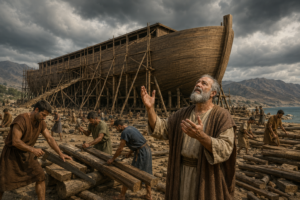
God commands Noah to make an ark of gopher wood.
Its dimensions are explicitly given:
- Length — 300 cubits
- Breadth — 50 cubits
- Height — 30 cubits
- A window
- A door in its side
- Lower, second, and third stories
- Rooms within
- Pitch within and without
Scripture does not identify with certainty what modern species of wood corresponds to “gopher wood.”
God announces:
Genesis 6:17: “I, even I, do bring a flood of waters upon the earth, to destroy all flesh…”
Yet He also promises Noah:
Genesis 6:18: “But with thee will I establish my covenant.”
Noah is instructed to bring his household, representatives of the animals, and food aboard the ark.
The chapter concludes with one of its central practical statements:
Genesis 6:22: “Thus did Noah; according to all that God commanded him, so did he.”
Noah obeyed God’s instructions as they were given.
Genesis 7 — The Flood Comes
Noah enters the ark — Genesis 7:1–10
The LORD commands:
Genesis 7:1: “Come thou and all thy house into the ark; for thee have I seen righteous before me in this generation.”
God instructs Noah concerning clean animals, unclean animals, and birds. The distinction between clean and unclean animals therefore appears in Scripture before the giving of the Mosaic Law.
Seven days remain before the Flood begins.
Again the text stresses Noah’s obedience:
Genesis 7:5: “And Noah did according unto all that the LORD commanded him.”
Noah is six hundred years old when the Flood comes.
The Flood begins — Genesis 7:11–16
The exact beginning is carefully recorded:
Genesis 7:11: “In the six hundredth year of Noah’s life, in the second month, the seventeenth day of the month…”
On that day:
“all the fountains of the great deep broken up, and the windows of heaven were opened.”
Rain continues for forty days and forty nights.
Noah, his wife, his sons, and his sons’ wives enter the ark.
The account then says:
Genesis 7:16: “and the LORD shut him in.”
God Himself secured Noah within the place He had provided.
The waters prevail — Genesis 7:17–24
The text repeatedly stresses the overwhelming extent of the Flood:
Genesis 7:19: “And the waters prevailed exceedingly upon the earth; and all the high hills, that were under the whole heaven, were covered.”
And:
Genesis 7:20: “Fifteen cubits upward did the waters prevail; and the mountains were covered.”
The plain grammatical-historical reading is a worldwide Flood. The text uses universal language—“all the high hills, that were under the whole heaven”—and explicitly says the mountains were covered. Nothing in Genesis 7 presents the judgment as merely a local river flood.
All land-dwelling creatures possessing “the breath of life” perish outside the ark.
Genesis 7:22 carefully specifies:
“All in whose nostrils was the breath of life, of all that was in the dry land, died.”
Therefore, the statement should not be expanded to claim that every form of aquatic life died; the verse specifically speaks of those “in the dry land.”
The chapter concludes:
Genesis 7:23: “Noah only remained alive, and they that were with him in the ark.”
The waters prevail upon the earth for one hundred and fifty days.
Key People and Places
Adam
The first man. Genesis 5 records his descendants through Seth and states that Adam lived 930 years and died.
Eve
The first woman and mother of Cain, Abel, and Seth, as well as other sons and daughters mentioned generally in Genesis 5:4.
Cain
Adam and Eve’s son who brought an offering unto the LORD, became angry when it was not respected, murdered Abel, and was judged by God.
Abel
Cain’s brother, a keeper of sheep. Hebrews 11:4 explicitly says that he offered his sacrifice “by faith.” Cain killed him because Cain’s works were evil and Abel’s righteous (1 John 3:12).
Seth
The son whom Eve described as another seed appointed by God “instead of Abel.”
Enos
Son of Seth. During the period associated with his birth, Genesis states that “then began men to call upon the name of the LORD.”
Enoch
Descendant of Seth who “walked with God.” God took him, and Hebrews 11:5 explicitly identifies this as translation without experiencing death.
Methuselah
Son of Enoch. He lived 969 years, the longest lifespan specifically recorded in Scripture.
Lamech, father of Noah
Descendant of Seth who named Noah and spoke of comfort concerning man’s toil under the curse.
Noah
A just man who walked with God and “found grace in the eyes of the LORD.” God commanded him to construct the ark, and Noah obeyed.
Shem, Ham, and Japheth
Noah’s three sons who entered the ark with Noah and their wives.
Cain’s Enoch
Cain’s son, distinct from the Enoch of Genesis 5 who walked with God. Cain named his city after this son.
Lamech in Cain’s line
A different Lamech from Noah’s father. He had two wives and spoke concerning a man whom he had slain.
Jabal
Associated with tent dwelling and cattle.
Jubal
Associated with the harp and organ.
Tubalcain
An instructor of craftsmen working in brass and iron.
Naamah
Sister of Tubalcain. Scripture records her name but provides no further information about her in this passage.
Eden
Cain departs from the presence of the LORD and settles east of Eden.
Land of Nod
The place where Cain dwells after God’s judgment. It is described only as being “on the east of Eden.” Scripture does not provide enough information to identify its modern geographical location.
The Ark
The vessel God commanded Noah to construct as the means by which Noah, his household, and the designated animals survived the Flood.
Main Doctrinal or Spiritual Themes
1. Sin spreads when it is permitted to rule
Genesis 4 begins with jealousy and anger, progresses to murder, and subsequently records further violence.
God warned Cain before the murder:
“sin lieth at the door.”
Cain was responsible for how he responded to temptation.
Genesis 6 eventually describes an earth “filled with violence.”
The progression demonstrates that sin is never harmless.
2. God sees both actions and hearts
Cain could not hide Abel’s murder from God.
Likewise:
Genesis 6:5: “GOD saw…every imagination of the thoughts of his heart…”
God’s judgment is based upon perfect knowledge. Men may conceal sins from one another, but never from God.
3. Acceptable worship involves faith
The safest inspired explanation for Abel’s offering is Hebrews 11:4:
“By faith Abel offered unto God a more excellent sacrifice than Cain.”
God is not obligated to accept worship merely because man chooses to offer something religious.
Worship must be according to God rather than man’s pride or self-will.
4. Human life is precious before God
Abel’s murder was not forgotten:
“The voice of thy brother’s blood crieth unto me from the ground.”
God held Cain personally accountable for taking his brother’s life.
5. Death confirms the consequence of sin
Genesis 5 repeatedly says:
“and he died.”
This accords with God’s warning concerning sin and with the later inspired declaration:
Romans 6:23: “For the wages of sin is death…”
Even men who lived hundreds of years eventually died.
6. It is possible to walk with God in a wicked world
Enoch “walked with God.”
Noah also “walked with God.”
Neither man’s culture nor the wickedness surrounding him excuses personal unfaithfulness.
The world of Noah was corrupt, but Noah’s surroundings did not force Noah to follow its corruption.
7. Grace precedes the great account of Noah’s obedience
The order of Genesis 6 is doctrinally significant:
First:
“Noah found grace in the eyes of the LORD.”
Then Noah’s righteous character and obedience are described.
This is entirely harmonious with salvation by grace rather than human merit.
Ephesians 2:8–9: “For by grace are ye saved through faith…Not of works, lest any man should boast.”
Noah’s obedience was real and extensive, but Genesis first emphasizes the grace of God.
8. Biblical faith produces obedience
Twice the passage emphasizes:
Genesis 6:22: “according to all that God commanded him, so did he.”
Genesis 7:5: “Noah did according unto all that the LORD commanded him.”
Hebrews explains:
Hebrews 11:7: “By faith Noah, being warned of God of things not seen as yet, moved with fear, prepared an ark…”
Faith does not mean merely acknowledging that God exists. Biblical faith takes God at His word.
This does not teach salvation by works. Noah’s obedience demonstrates his faith; it does not replace grace as the basis upon which sinful man must approach God.
9. God’s patience does not cancel God’s judgment
The world continued functioning while Noah built according to God’s instructions. But the day came when:
“the fountains of the great deep broken up, and the windows of heaven were opened.”
What God had announced eventually occurred exactly as He had said.
God’s longsuffering should never be mistaken for indifference toward sin.
10. The Flood was a literal divine judgment
Genesis treats Noah, the ark, its measurements, the animals, the dates, the rainfall, the fountains of the deep, and the duration of the waters as actual history.
Christ likewise treated Noah and the Flood as historical:
Matthew 24:38–39: “For as in the days that were before the flood…until the flood came, and took them all away…”
A grammatical-historical reading therefore rejects attempts to reduce the Flood account to mere mythology or moral allegory.
11. The Flood was worldwide
Genesis does not describe merely a local catastrophe.
The KJV says:
“all the high hills, that were under the whole heaven, were covered.”
And:
“the mountains were covered.”
The straightforward reading is global judgment upon the inhabited earth.
12. God provides deliverance according to His own word
Noah did not design his own means of escape.
God gave the instructions.
God specified the ark.
God commanded Noah to enter.
And finally:
“the LORD shut him in.”
Deliverance was found by believing and obeying what God had revealed.
One should be cautious about asserting every detail of the ark as a prophetic symbol, because Genesis does not explicitly label the ark a type of Christ. Nevertheless, the account plainly demonstrates the broader scriptural principle that God Himself determines the means by which He delivers from judgment.
Practical Applications or Lessons
Take sin seriously before it grows
Cain’s murder began with an angry heart that refused God’s warning.
God asked:
“Why art thou wroth?”
Believers should deal with bitterness, jealousy, anger, pride, and rebellion before those sins produce further evil.
Never substitute religious activity for obedience to God
Cain was religious enough to bring an offering.
That did not make him right with God.
Mere religious activity cannot replace faith and obedience.
Do not compare yourself with another believer
Cain turned against Abel rather than humbling himself before God.
Another person’s righteousness is no justification for jealousy.
The proper response to correction is repentance, not resentment.
Remember that hidden sin is never hidden from God
Cain apparently attempted to conceal his brother’s murder, but God already knew.
Nothing escapes His sight.
Guard the home from the world’s moral corruption
By Genesis 6 the earth was “filled with violence.”
Noah nevertheless walked with God.
A Christian family does not have to adopt the moral standards of its surrounding culture simply because those standards become common.
Walk with God personally
Enoch walked with God.
Noah walked with God.
A faithful Christian life is not merely opposition to evil; it is fellowship with God, submission to His Word, and continued obedience.
Believe God before circumstances confirm His Word
Noah acted because God had spoken.
Hebrews 11:7 says he was:
“warned of God of things not seen as yet.”
Faith rests upon God’s Word before sight supplies confirmation.
Obey God’s instructions completely
Genesis does not praise Noah for creativity or innovation concerning the ark. It praises his obedience:
“according to all that God commanded him, so did he.”
There is an important principle here for Christian living: God’s Word is not improved by man’s revisions.
Do not mistake God’s patience for God’s approval
Judgment did not fall the moment Genesis first records man’s wickedness.
But judgment eventually came exactly as God declared.
The same principle remains true:
Ecclesiastes 8:11: “Because sentence against an evil work is not executed speedily, therefore the heart of the sons of men is fully set in them to do evil.”
Delayed judgment is not canceled judgment.
Remember that grace is man’s great need
The decisive statement about Noah is not that Noah was stronger, cleverer, or more deserving than everybody around him.
It is:
“But Noah found grace in the eyes of the LORD.”
From Genesis onward, man’s hope rests upon God’s grace rather than human merit.
God’s Word will be fulfilled
God said the Flood would come.
The Flood came.
God specified how Noah was to prepare.
Noah obeyed and was preserved.
Genesis 4–7 therefore urges the reader to take God’s warnings, promises, commandments, and judgments with absolute seriousness.
Overall Message of Genesis 4–7
These four chapters reveal the devastating expansion of sin after Eden. Sin moves from disobedience in Genesis 3 to jealousy, murder, defiance, violence, and eventually a world whose “every imagination of the thoughts of his heart was only evil continually.”
But alongside man’s corruption stands the faithfulness of God.
Abel worships by faith.
Enoch walks with God.
Noah finds grace.
Noah believes God’s warning.
Noah obeys God’s Word.
God provides the ark.
God brings the judgment He promised.
God preserves those whom He placed within the ark.
Genesis 4–7 therefore presents a solemn but consistent biblical pattern:
Sin brings judgment.
God sees the heart.
Faith takes God at His Word.
Grace is man’s only hope.
True faith produces obedience.
God preserves His own purposes even in a corrupt world.
And everything God says will ultimately come to pass.
Comments are closed