Genesis 34–36 records a difficult period in Jacob’s family history. Chapter 34 describes Dinah’s defilement at Shechem and the violent revenge taken by Simeon and Levi. Chapter 35 records God’s command for Jacob to return to Bethel, the putting away of strange gods, God’s renewed appearance and covenant promises, and several significant deaths and family events. Chapter 36 then turns to Esau, tracing his descendants and the development of Edom.
A central contrast runs through these chapters: human sin brings defilement, deceit, violence, grief, and division, while God remains faithful to His covenant purposes and calls His people to purity, obedience, and worship.
Chapter Summaries
Genesis 34 — Dinah, Shechem, and the Sin of Simeon and Levi
 Genesis 34 opens:
Genesis 34:1 — “And Dinah the daughter of Leah, which she bare unto Jacob, went out to see the daughters of the land.”
The KJV states that Dinah went out “to see the daughters of the land.” Scripture does not explicitly say that Dinah sinned by doing so, nor does it give her motive beyond what the verse states. Therefore, responsibility for what follows must not be transferred to her beyond the wording of Scripture.
Shechem defiles Dinah
Shechem was the son of Hamor the Hivite, described as “prince of the country.”
Genesis 34:2 — “And when Shechem the son of Hamor the Hivite, prince of the country, saw her, he took her, and lay with her, and defiled her.”
The text explicitly calls what happened a defilement.
Afterward:
Genesis 34:3 — “And his soul clave unto Dinah the daughter of Jacob, and he loved the damsel, and spake kindly unto the damsel.”
This does not undo or excuse what verse 2 records. Scripture places both statements in the narrative: Shechem defiled Dinah, and afterward desired her as his wife.
Shechem asked his father:
“Get me this damsel to wife.”
— Genesis 34:4
Jacob and his sons hear what happened
Jacob learned that Dinah had been defiled, but he “held his peace until they were come” because his sons were with his cattle in the field.
When the sons returned:
Genesis 34:7 — “the men were grieved, and they were very wroth, because he had wrought folly in Israel in lying with Jacob’s daughter: which thing ought not to be done.”
Their grief and anger had a legitimate cause. Scripture plainly declares that what Shechem had done “ought not to be done.”
However, righteous indignation does not justify sinful revenge.
Hamor proposes intermarriage and economic union
Hamor asked Jacob’s family to allow Dinah to marry Shechem. He also proposed a much wider arrangement:
Genesis 34:9 — “And make ye marriages with us, and give your daughters unto us, and take our daughters unto you.”
He further offered:
Genesis 34:10 — “And ye shall dwell with us: and the land shall be before you; dwell and trade ye therein, and get you possessions therein.”
The proposal would have joined Jacob’s household closely with the inhabitants of the land through marriage, residence, commerce, and property.
It may suggest a serious danger to the distinct identity of the covenant family. Nevertheless, Genesis 34 itself does not explicitly state what Jacob would ultimately have done with Hamor’s proposal had his sons not intervened deceitfully.
The sons of Jacob answer deceitfully
Genesis 34:13 explicitly says:
“And the sons of Jacob answered Shechem and Hamor his father deceitfully…”
They required the males of the city to be circumcised.
Circumcision had been given by God as the covenant sign to Abraham and his seed in Genesis 17. Here, Jacob’s sons used that sacred sign as part of a deceptive scheme.
This was a grave misuse of something God had ordained.
Hamor and Shechem persuaded the men of the city to consent, partly by appealing to material gain:
Genesis 34:23 — “Shall not their cattle and their substance and every beast of their’s be ours?”
Thus both sides displayed earthly motives: Jacob’s sons operated deceitfully, while the men of the city were attracted by the prospect of acquiring Jacob’s substance.
Simeon and Levi attack the city
On the third day after the circumcision:
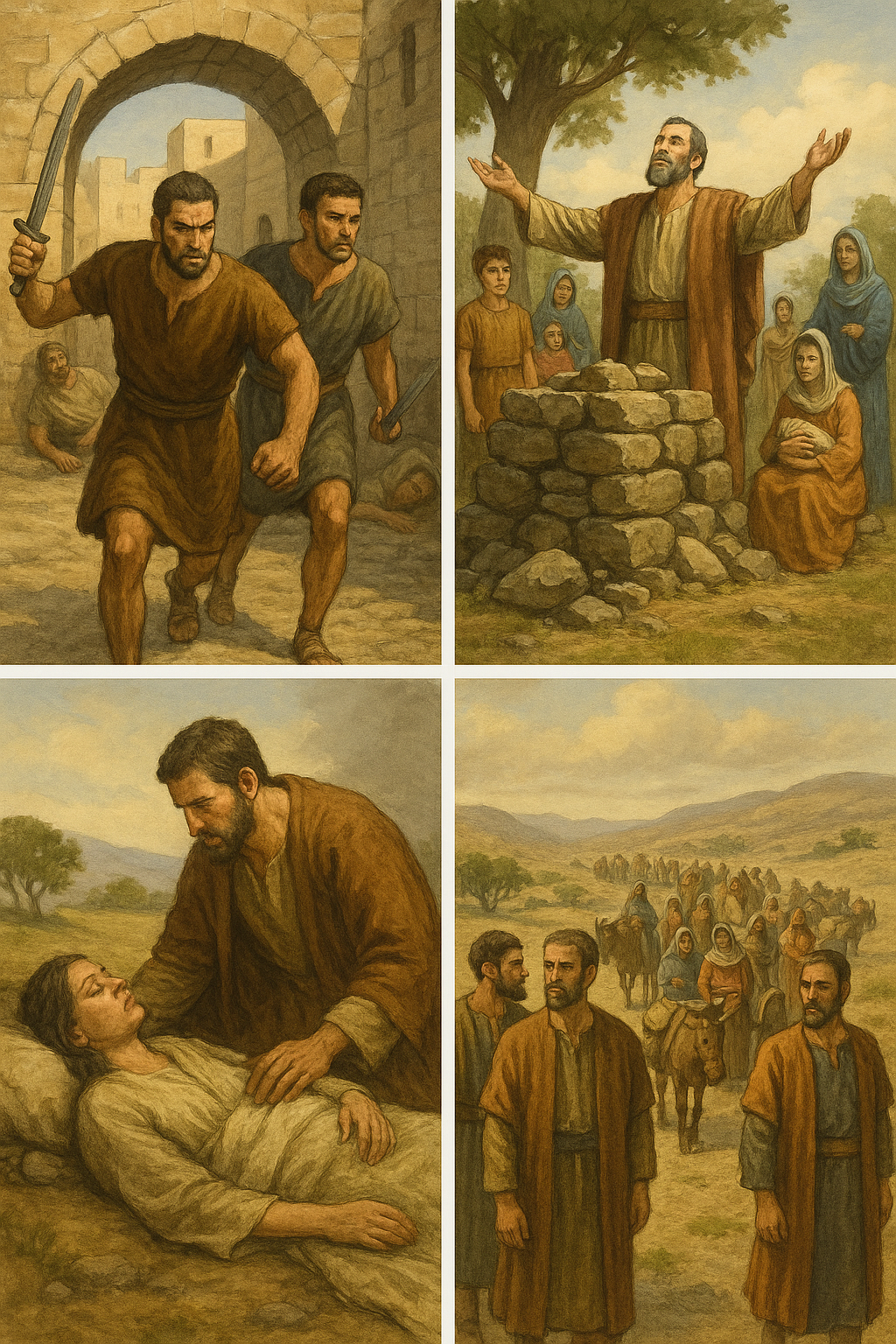
Genesis 34:25 — “Simeon and Levi, Dinah’s brethren, took each man his sword, and came upon the city boldly, and slew all the males.”
They killed Hamor and Shechem and brought Dinah out of Shechem’s house.
The other sons then spoiled the city.
Scripture gives no command from God authorizing this act of vengeance.
Jacob rebuked Simeon and Levi:
Genesis 34:30 — “Ye have troubled me to make me to stink among the inhabitants of the land…”
The brothers answered:
Genesis 34:31 — “Should he deal with our sister as with an harlot?”
Their question points back to the genuine evil done against Dinah, but it does not establish divine approval for their method of retaliation.
Genesis 49 later gives inspired commentary on Simeon and Levi’s violence. Jacob said:
Genesis 49:5 — “Simeon and Levi are brethren; instruments of cruelty are in their habitations.”
And:
Genesis 49:7 — “Cursed be their anger, for it was fierce; and their wrath, for it was cruel…”
Therefore, Scripture itself prevents us from defending their actions merely because their anger began with a real wrong.
Genesis 35 — Return to Bethel, Cleansing, Covenant Renewal, and Sorrow
Genesis 35 marks a sharp change.
After the turmoil at Shechem:
Genesis 35:1 — “And God said unto Jacob, Arise, go up to Bethel, and dwell there: and make there an altar unto God…”
God directed Jacob back to the place associated with his earlier encounter with the LORD in Genesis 28.
Jacob commands his household to put away strange gods
Jacob responded:
Genesis 35:2 — “Put away the strange gods that are among you, and be clean, and change your garments:”
Then he said:
Genesis 35:3 — “And let us arise, and go up to Bethel; and I will make there an altar unto God…”
This is an unmistakable call to separation from idolatry and preparation for worship.
The household obeyed:
Genesis 35:4 — “And they gave unto Jacob all the strange gods which were in their hand, and all their earrings which were in their ears; and Jacob hid them under the oak which was by Shechem.”
The text explicitly says that strange gods were present among Jacob’s household. Scripture does not tell us how every individual idol came into their possession or who worshiped each one. We should therefore go no further than the text.
The primary truth is plain: before going to Bethel, Jacob required the strange gods to be removed.
God protects Jacob’s household
As they traveled:
Genesis 35:5 — “the terror of God was upon the cities that were round about them, and they did not pursue after the sons of Jacob.”
This is explicitly attributed to God.
Jacob had feared retaliation in Genesis 34:30. Genesis 35:5 records God’s providential protection as the family journeyed.
Jacob builds an altar at Bethel
Jacob arrived at Luz, which is Bethel:
Genesis 35:7 — “And he built there an altar, and called the place Elbethel: because there God appeared unto him, when he fled from the face of his brother.”
“Bethel” is associated with the “house of God”; “Elbethel” directs attention to the God of Bethel.
The spiritual emphasis is therefore not merely upon a sacred location, but upon God Himself.
Deborah dies
Genesis 35:8 records the death of Deborah, Rebekah’s nurse.
She was buried beneath Bethel under an oak called Allonbachuth.
Scripture does not explain when or how Deborah had joined Jacob’s household. Her presence here is explicit; additional reconstruction of the circumstances would be uncertain.
God appears to Jacob and confirms the name Israel
God appeared again unto Jacob and blessed him.
Genesis 35:10 — “Thy name is Jacob: thy name shall not be called any more Jacob, but Israel shall be thy name…”
Jacob had already received the name Israel in Genesis 32:28. Genesis 35 records God personally reaffirming that name.
God then declared:
Genesis 35:11 — “I am God Almighty: be fruitful and multiply; a nation and a company of nations shall be of thee, and kings shall come out of thy loins;”
And:
Genesis 35:12 — “And the land which I gave Abraham and Isaac, to thee I will give it, and to thy seed after thee will I give the land.”
These promises are literal covenant promises connected with Jacob and his descendants.
From a dispensational, conservative Baptist reading, this passage should not be spiritualized into the New Testament Church. God specifically names Abraham, Isaac, Jacob, Jacob’s seed, and the land.
The Church does not erase Israel or cancel the promises God made to Jacob.
Jacob sets up a pillar
Jacob:
“set up a pillar in the place where he talked with him, even a pillar of stone…”
He poured a drink offering and oil upon it and again called the place Bethel.
Worship follows revelation: God speaks; Jacob responds.
Rachel dies giving birth to Benjamin
As the family traveled from Bethel, Rachel experienced hard labor.
The midwife told her:
Genesis 35:17 — “Fear not; thou shalt have this son also.”
As Rachel died:
Genesis 35:18 — “she called his name Benoni: but his father called him Benjamin.”
“Benoni” is associated with the sorrow surrounding his birth; Jacob named him Benjamin.
Rachel was buried:
Genesis 35:19 — “in the way to Ephrath, which is Bethlehem.”
Jacob placed a pillar upon her grave.
The chapter therefore combines great spiritual privilege with profound personal sorrow. God’s covenant faithfulness does not mean that His servants are exempt from bereavement.
Reuben sins with Bilhah
Genesis states plainly:
Genesis 35:22 — “Reuben went and lay with Bilhah his father’s concubine: and Israel heard it.”
The verse gives the fact without elaborating here upon Jacob’s immediate response.
Genesis 49:3–4 later explicitly connects Reuben’s loss of preeminence with this sin:
“Unstable as water, thou shalt not excel…”
This demonstrates the lasting consequences of immoral conduct.
Isaac dies
The chapter lists Jacob’s twelve sons and then records Jacob’s return to Isaac at Mamre.
Genesis 35:29 — “And Isaac gave up the ghost, and died, and was gathered unto his people, being old and full of days: and his sons Esau and Jacob buried him.”
Isaac was 180 years old.
Despite the former conflict between Jacob and Esau, both sons are explicitly present at their father’s burial.
Genesis 36 — Esau and the Generations of Edom
Genesis 36 turns from Jacob to Esau.
Its repeated emphasis is unmistakable:
Genesis 36:1 — “Now these are the generations of Esau, who is Edom.”
And again:
Genesis 36:8 — “Thus dwelt Esau in mount Seir: Esau is Edom.”
The chapter establishes the genealogical and territorial identity of the Edomites.
Esau separates geographically from Jacob
Genesis records:
Genesis 36:6 — “And Esau took his wives, and his sons, and his daughters, and all the persons of his house, and his cattle…”
He went:
“into the country from the face of his brother Jacob.”
The reason is explicitly stated:
Genesis 36:7 — “For their riches were more than that they might dwell together; and the land wherein they were strangers could not bear them because of their cattle.”
This resembles the earlier separation of Abraham and Lot in the limited sense that abundant possessions created pressure upon available grazing land. Scripture specifically attributes Esau and Jacob’s separation here to their possessions and the land’s inability to support them together.
The descendants of Esau
Esau’s descendants through his wives are carefully recorded. Among the prominent names are:
- Eliphaz
- Reuel
- Jeush
- Jaalam
- Korah
- Amalek
Genesis 36:12 identifies Amalek as a son of Eliphaz by Timna his concubine.
This genealogy becomes important because several peoples descended from Esau later appear in Israel’s history.
The inhabitants of Seir
The chapter also gives descendants of Seir the Horite, including Lotan, Shobal, Zibeon, Anah, Dishon, Ezer, and Dishan.
This provides geographical and genealogical background for the region into which Esau’s family settled.
Kings in Edom
Genesis 36:31 says:
“And these are the kings that reigned in the land of Edom, before there reigned any king over the children of Israel.”
The text plainly says that Edom had kings before Israel had a king.
It would be improper to force more chronological conclusions out of that sentence than Scripture itself requires.
The chapter names a succession of Edomite rulers, including Bela, Jobab, Husham, Hadad, Samlah, Saul, Baalhanan, and Hadar.
Genesis concludes the record by again identifying Esau as:
Genesis 36:43 — “the father of the Edomites.”
Key People and Places
People
Jacob / Israel — Son of Isaac and father of the twelve sons who become the tribal fathers of Israel. God commands him to return to Bethel and reaffirms his covenant promises.
Dinah — Daughter of Jacob and Leah. She is defiled by Shechem in Genesis 34.
Shechem — Son of Hamor, “prince of the country.” He defiles Dinah and afterward desires her for his wife.
Hamor — Father of Shechem. He negotiates with Jacob concerning marriage and closer union between the two peoples.
Simeon and Levi — Sons of Jacob and full brothers of Dinah through Leah. They kill the males of Shechem in retaliation for what was done to their sister. Genesis 49 later explicitly condemns the cruelty of their anger.
Rachel — Jacob’s wife. She dies while giving birth to Benjamin and is buried near Ephrath/Bethlehem.
Benjamin — Rachel’s second son and Jacob’s youngest son.
Reuben — Jacob’s firstborn. Genesis 35 records his sexual sin with Bilhah; Genesis 49 connects that sin with his loss of preeminence.
Bilhah — Rachel’s handmaid and Jacob’s concubine.
Deborah — Rebekah’s nurse. She dies and is buried below Bethel.
Isaac — Jacob and Esau’s father. He dies at 180 years old.
Esau / Edom — Jacob’s brother. Genesis 36 traces his descendants and identifies him as the father of the Edomites.
Seir the Horite — An earlier prominent ancestor associated with the inhabitants of Mount Seir.
Places
Shechem — Location of the events involving Dinah, Shechem, Hamor, and Jacob’s sons.
Bethel / Luz — The place to which God commands Jacob to return. Jacob builds an altar there and calls it Elbethel.
Elbethel — The name Jacob gives to the place of the altar because “there God appeared unto him.”
Ephrath / Bethlehem — The area near which Rachel dies and is buried.
Migdaleder — A location beyond which Israel spread his tent after Rachel’s death.
Mamre / Kirjatharba / Hebron — Isaac’s dwelling place, to which Jacob comes before Isaac’s death.
Mount Seir — The principal territory associated with Esau and the Edomites.
Edom — The territory and nation identified with Esau and his descendants.
Main Doctrinal or Spiritual Themes
1. Sin Cannot Be Corrected by Further Sin
Shechem’s act against Dinah was genuinely wicked:
“which thing ought not to be done.”
— Genesis 34:7
But Simeon and Levi’s response added deceit, slaughter, and plunder.
The principle is plain: the existence of one evil does not authorize another evil.
Later Scripture confirms the moral character of their conduct:
Genesis 49:7 — “Cursed be their anger, for it was fierce; and their wrath, for it was cruel…”
Biblical separation from evil never authorizes fleshly vengeance.
2. Anger Must Be Governed by Righteousness
Simeon and Levi had reason to be angry over the treatment of their sister. Their failure was not that they recognized the wrong, but that their anger became cruel and destructive.
This harmonizes with the later principle:
Ephesians 4:26 — “Be ye angry, and sin not…”
There is such a thing as righteous moral indignation, but human anger can quickly pass beyond righteousness into sin.
3. Sacred Things Must Never Be Used to Serve Carnal Purposes
Circumcision was God’s covenant sign with Abraham.
Yet Jacob’s sons used circumcision deceitfully as part of their plan against Shechem.
This teaches a sobering principle: religious language, ceremonies, or biblical truth must never be manipulated to accomplish sinful ends.
Something holy does not make an unholy purpose acceptable.
4. God Calls His People to Separation from Idolatry
Jacob commanded:
Genesis 35:2 — “Put away the strange gods that are among you, and be clean…”
Before Bethel came purification.
Before the altar came the putting away of idols.
For believers today, the direct command concerning Israel’s household should not be mechanically transferred as though the Church were Israel. Nevertheless, the moral principle of separation from idolatry is reaffirmed in the New Testament:
1 John 5:21 — “Little children, keep yourselves from idols. Amen.”
God will not share the believer’s devotion with idols.
5. Worship Centers Upon God Himself
Jacob called the altar site Elbethel because:
“there God appeared unto him.”
Bethel mattered because of the God who revealed Himself there.
The great need of the believer is not attachment to sacred memories, personalities, buildings, or traditions in themselves, but fellowship with and obedience to God according to His Word.
6. God Is Faithful to His Covenant
In Genesis 35 God repeats promises concerning:
- Jacob’s identity as Israel,
- multiplication of his descendants,
- nations,
- kings,
- and the land promised to Abraham and Isaac.
Genesis 35:12 — “And the land which I gave Abraham and Isaac, to thee I will give it, and to thy seed after thee will I give the land.”
The plain reading is national and territorial.
A premillennial, dispensational understanding receives these promises according to their stated recipients rather than transferring them to the Church.
Israel remains Israel; the Church remains the Church.
7. God’s Faithfulness Does Not Remove Earthly Sorrow
Genesis 35 contains tremendous spiritual blessings, but also several painful events:
- Deborah dies.
- Rachel dies.
- Reuben commits serious sin.
- Isaac dies.
Spiritual obedience does not guarantee freedom from bereavement, disappointment, or family trouble.
The chapter demonstrates that divine faithfulness and earthly sorrow can exist at the same time.
8. Sexual Sin Has Serious Consequences
Genesis 34 and Genesis 35 both contain sexual wrongdoing.
Shechem’s act is explicitly called defilement.
Reuben’s act with Bilhah later costs him the privileged position associated with the firstborn:
Genesis 49:4 — “thou shalt not excel; because thou wentest up to thy father’s bed…”
Scripture consistently treats sexual morality seriously. Such sins should never be minimized merely because modern culture normalizes them.
9. God’s Purposes Continue Despite Human Failure
Genesis 34 displays moral failure in Jacob’s family.
Genesis 35 nevertheless shows God speaking, commanding, protecting, blessing, and reaffirming His covenant.
This does not mean God approved their sins.
Rather, it demonstrates that God’s covenant faithfulness rests upon His own character, not upon human perfection.
This same truth is seen throughout Genesis: Abraham, Isaac, and Jacob were imperfect men, but God remained faithful to what He had promised.
10. Genealogies Are Part of Inspired Scripture
Genesis 36 may appear less dramatic than Genesis 34–35, but it serves important purposes.
It establishes:
- Esau as Edom,
- the ancestry of Edomite clans,
- the connection with Mount Seir,
- the existence of Edomite rulers,
- and the historical distinction between Jacob’s descendants and Esau’s descendants.
The chapter reminds us that:
2 Timothy 3:16 — “All scripture is given by inspiration of God…”
Genealogical portions are therefore not filler. They form part of God’s inspired historical record.
Practical Applications or Lessons
Guard anger before anger governs you
A genuine injustice occurred in Genesis 34. Yet Simeon and Levi allowed their response to become sinful.
Believers must not allow another person’s wrongdoing to become an excuse for their own.
Romans 12:19 — “Dearly beloved, avenge not yourselves…”
Never use spiritual things deceptively
Jacob’s sons turned circumcision into an instrument of deception.
A Christian must never use Scripture, church membership, ministry, prayer, spiritual terminology, or religious reputation as a tool for manipulation.
God’s things must be handled honestly.
Put away idols before approaching worship carelessly
Jacob said:
“Put away the strange gods…”
The believer should examine anything competing with devotion to God—possessions, ambitions, relationships, entertainment, status, or self.
Not every valued possession is an idol, and Scripture does not teach that material things are inherently sinful. But anything given the devotion belonging to God becomes spiritually dangerous.
Obey God’s clear command instead of remaining where failure occurred
God told Jacob:
“Arise, go up to Bethel…”
Jacob obeyed.
When God’s Word gives a clear command, the proper response is obedience rather than rationalization.
Remember what God has done
Bethel was connected with God’s earlier revelation to Jacob.
Returning there brought Jacob again to the place associated with God’s promise.
Believers likewise benefit from remembering God’s faithfulness—not by living sentimentally in the past, but by allowing past mercies to strengthen present obedience.
Do not interpret prosperity as proof of spiritual approval
Genesis 36 shows Esau possessing a large household, cattle, goods, and considerable descendants.
Material prosperity by itself is therefore no proof that a person occupies the place of covenant blessing or enjoys God’s approval in every area.
We should judge spiritual matters by God’s Word rather than possessions or earthly success.
Family sin can have consequences beyond the individual
Shechem’s sin affected Dinah, Jacob, his sons, Hamor’s city, and the surrounding relationships.
Simeon and Levi’s conduct likewise affected the reputation and security of Jacob’s entire household.
Reuben’s conduct affected his future privilege.
Sin is personal, but its consequences frequently reach beyond the sinner.
Do not blame the victim where Scripture does not
Genesis says of Shechem:
“he took her, and lay with her, and defiled her.”
Scripture nowhere states that Dinah caused Shechem’s conduct.
Her going “to see the daughters of the land” must therefore not be turned into a claim that Scripture itself does not make.
Conservative interpretation requires moral clarity, but it also requires textual restraint. We should condemn what God condemns and refuse to add guilt where God has not stated it.
Overall Message of Genesis 34–36
These chapters move from defilement and vengeance, to cleansing and worship, and then to God’s orderly record of the nations descending from Esau.
Genesis 34 shows the destructive multiplication of sin: one man’s wicked act is followed by deceit, uncontrolled wrath, killing, and plunder.
Genesis 35 brings the focus back to God:
“Arise, go up to Bethel…”
Jacob removes the strange gods, builds an altar, and hears God reaffirm His covenant promises. Yet the chapter also reminds us that obedience does not eliminate sorrow: Deborah, Rachel, and Isaac die, and Reuben brings disgrace upon himself.
Genesis 36 demonstrates that God is also governing the history of Esau. Edom becomes an identifiable people with rulers, clans, and territory. Nevertheless, the covenant promises concerning the land and the chosen line continue through Jacob, whom God names Israel.
The theological center is therefore not the goodness of Jacob’s family. Their failures are recorded plainly. The center is the faithfulness of the God who said:
Genesis 35:11–12 — “I am God Almighty… a nation and a company of nations shall be of thee, and kings shall come out of thy loins; And the land which I gave Abraham and Isaac, to thee I will give it, and to thy seed after thee will I give the land.”
God remains holy. Sin remains sin. His people are called to separation and obedience. And His promises remain sure despite the failures of men.
Comments are closed