Genesis 29–30 records Jacob’s arrival in Haran, his marriages to Leah and Rachel, the birth of eleven sons and one daughter, and the beginning of his material increase while serving Laban. The chapters show God advancing His covenant purposes through a household marked by love, disappointment, deception, rivalry, barrenness, and human weakness.
The passage should be read as literal history. It describes conduct such as polygamy, domestic rivalry, and the use of handmaids without presenting those practices as God’s original design for marriage.
Chapter Summaries
 Genesis 29 — Jacob, Leah, Rachel, and the Beginning of Israel’s Family
1. Jacob arrives in the land of the people of the east
Genesis 29:1–8
Jacob continued his journey after the events at Bethel:
“Then Jacob went on his journey, and came into the land of the people of the east.”
— Genesis 29:1
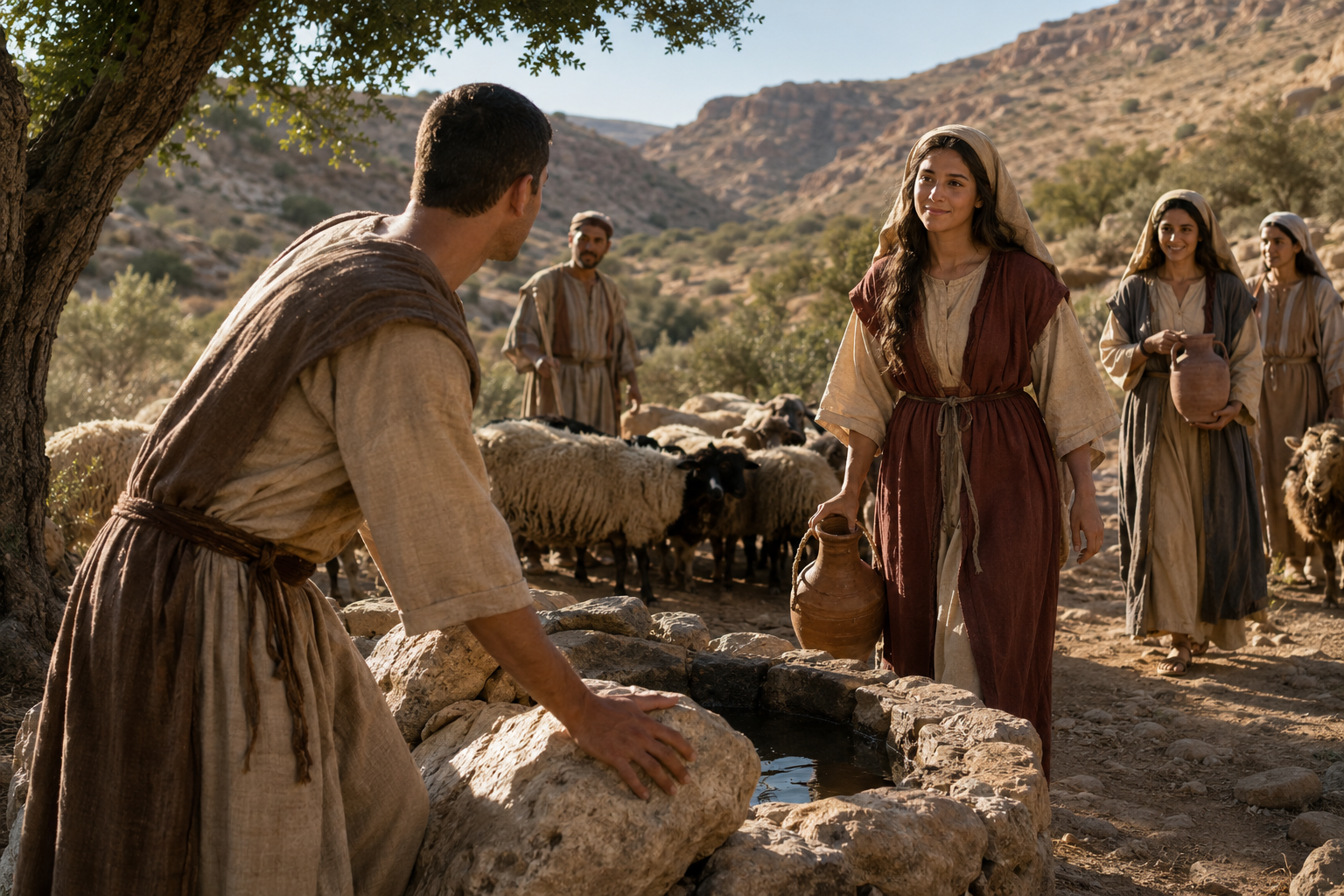
He found shepherds gathered beside a well. A great stone covered its mouth, and the flocks were watered when the shepherds gathered and rolled away the stone.
Jacob learned that the men were from Haran and that they knew Laban, the son of Nahor. They told him that Laban was well and that Rachel, Laban’s daughter, was approaching with her father’s sheep.
Background: Jacob had been sent toward Padanaram to obtain a wife from the family of Laban, his mother’s brother (Genesis 28:1–5). He was also leaving because Esau had intended to kill him after Isaac’s blessing had been obtained through deception (Genesis 27:41–45).
2. Jacob meets Rachel
Genesis 29:9–14
When Rachel arrived, Jacob rolled the stone from the well and watered Laban’s flock.
“And Jacob kissed Rachel, and lifted up his voice, and wept.”
— Genesis 29:11
Jacob told Rachel that he was Rebekah’s son. Rachel ran and informed her father. Laban received Jacob, embraced him, and brought him into his house.
Laban said:
“Surely thou art my bone and my flesh.”
— Genesis 29:14
Jacob remained with him for one month before the matter of wages was discussed.
3. Jacob agrees to serve seven years for Rachel
Genesis 29:15–20
Laban had two daughters:
“The name of the elder was Leah, and the name of the younger was Rachel.”
— Genesis 29:16
The KJV describes Leah as “tender eyed,” while Rachel was “beautiful and well favoured” (Genesis 29:17). Scripture does not further explain the expression “tender eyed,” so it is unwise to build a firm physical or medical conclusion upon it.
Jacob loved Rachel and offered to serve Laban seven years for her.
“And Jacob served seven years for Rachel; and they seemed unto him but a few days, for the love he had to her.”
— Genesis 29:20
This plainly demonstrates the strength of Jacob’s affection and his willingness to labour patiently for the woman he desired to marry.
4. Laban deceives Jacob and gives him Leah
Genesis 29:21–26
After Jacob completed the seven years, Laban made a feast. That evening, however, Laban brought Leah to Jacob instead of Rachel.
“And it came to pass, that in the morning, behold, it was Leah.”
— Genesis 29:25
Scripture does not explain how Jacob failed to recognize Leah before morning. Customs concerning clothing, veils, darkness, and wedding ceremonies may be proposed as possible explanations, but the KJV does not state which circumstances made the deception possible.
Jacob confronted Laban:
“What is this thou hast done unto me? did not I serve with thee for Rachel? wherefore then hast thou beguiled me?”
— Genesis 29:25
Laban answered that it was not customary in his country to give the younger daughter before the firstborn. This was Laban’s stated explanation. The passage does not independently establish whether Laban had previously informed Jacob of such a custom.
The narrative may suggest a moral correspondence between Jacob’s earlier deception of Isaac and Laban’s deception of Jacob. However, Genesis 29 does not explicitly call Laban’s action divine retribution, so that conclusion should not be stated as a direct declaration of Scripture.
5. Jacob also receives Rachel
Genesis 29:27–30
Laban required Jacob to complete Leah’s wedding week. He then gave Rachel to Jacob also, in exchange for another seven years of service.
“And he went in also unto Rachel, and he loved also Rachel more than Leah.”
— Genesis 29:30
The text plainly establishes unequal affection within the household. Jacob loved Rachel more than Leah.
Genesis records this plural marriage as historical fact, but it does not overturn God’s original pattern:
“Therefore shall a man leave his father and his mother, and shall cleave unto his wife: and they shall be one flesh.”
— Genesis 2:24
The turmoil that follows is consistent with the departure from the one-man, one-wife order established at creation.
6. The LORD sees Leah’s condition
Genesis 29:31–35
“And when the LORD saw that Leah was hated, he opened her womb: but Rachel was barren.”
— Genesis 29:31
Genesis 29:30 says Jacob loved Rachel more than Leah. Therefore, “hated” in verse 31 is understood in this immediate context as Leah’s being less loved and rejected in comparison with Rachel. The verse does not require the conclusion that Jacob possessed absolute personal hatred for Leah.
God saw Leah’s affliction and gave her children.
Reuben
“Surely the LORD hath looked upon my affliction; now therefore my husband will love me.”
— Genesis 29:32
Leah hoped the birth of a son would gain Jacob’s affection.
Simeon
“Because the LORD hath heard that I was hated, he hath therefore given me this son also.”
— Genesis 29:33
Levi
“Now this time will my husband be joined unto me, because I have born him three sons.”
— Genesis 29:34
Judah
“Now will I praise the LORD.”
— Genesis 29:35
With Judah, Leah’s recorded words turn from the hope of obtaining her husband’s affection to direct praise of the LORD.
Judah would later receive a place of great importance in the covenant and Messianic line:
“The sceptre shall not depart from Judah, nor a lawgiver from between his feet, until Shiloh come.”
— Genesis 49:10
Genesis 29 itself does not yet reveal all that God would accomplish through Judah, but later Scripture explicitly establishes his significance.
Genesis 30 — Rivalry, Children, Joseph’s Birth, and Jacob’s Increase
1. Rachel gives Bilhah to Jacob
Genesis 30:1–8
Rachel saw that she had not borne Jacob any children and envied Leah.
“Give me children, or else I die.”
— Genesis 30:1
Jacob became angry and replied:
“Am I in God’s stead, who hath withheld from thee the fruit of the womb?”
— Genesis 30:2
Jacob’s statement correctly recognizes that the power to give conception belongs to God. The text records his anger but does not specifically commend the manner in which he answered Rachel.
Rachel gave Bilhah, her handmaid, to Jacob “to wife” so that Bilhah’s children would be counted in connection with Rachel’s household.
Bilhah bore two sons.
Dan
“God hath judged me, and hath also heard my voice, and hath given me a son.”
— Genesis 30:6
Naphtali
“With great wrestlings have I wrestled with my sister, and I have prevailed.”
— Genesis 30:8
Rachel’s words reveal the rivalry between the sisters. The births were not merely received as family blessings; they became part of a contest for standing within the household.
2. Leah gives Zilpah to Jacob
Genesis 30:9–13
When Leah saw that she had ceased bearing, she gave Zilpah, her maid, to Jacob “to wife.”
Zilpah bore two sons.
Gad
“A troop cometh.”
— Genesis 30:11
Asher
“Happy am I, for the daughters will call me blessed.”
— Genesis 30:13
The text continues to show children being drawn into the domestic rivalry between Leah and Rachel. Scripture records these arrangements, but it does not present household competition as a godly pattern.
3. The mandrakes and the agreement between Rachel and Leah
Genesis 30:14–16
Reuben found mandrakes during wheat harvest and brought them to Leah. Rachel requested the mandrakes, and Leah answered:
“Is it a small matter that thou hast taken my husband? and wouldest thou take away my son’s mandrakes also?”
— Genesis 30:15
Rachel agreed that Jacob would lie with Leah that night in exchange for the mandrakes.
Scripture does not say that the mandrakes caused conception. Whatever beliefs may have existed about them, the biblical explanation for Leah’s next pregnancy is explicit:
“And God hearkened unto Leah, and she conceived.”
— Genesis 30:17
The power was not in the plants. God gave the child.
4. Leah bears Issachar, Zebulun, and Dinah
Genesis 30:17–21
Issachar
“God hath given me my hire, because I have given my maiden to my husband.”
— Genesis 30:18
This is Leah’s interpretation of the birth. Scripture records her statement without necessarily approving every part of her reasoning.
Zebulun
“God hath endued me with a good dowry; now will my husband dwell with me.”
— Genesis 30:20
Leah continued to desire Jacob’s settled affection.
Dinah
“And afterwards she bare a daughter, and called her name Dinah.”
— Genesis 30:21
Genesis 30 gives no explanation for Dinah’s name in this verse.
5. God remembers Rachel, and Joseph is born
Genesis 30:22–24
“And God remembered Rachel, and God hearkened to her, and opened her womb.”
— Genesis 30:22
“God remembered” does not mean that God had forgotten Rachel. In biblical language, it marks God’s action toward the person according to His purpose and mercy.
Rachel conceived and bore Joseph.
“God hath taken away my reproach.”
— Genesis 30:23
She then said:
“The LORD shall add to me another son.”
— Genesis 30:24
Joseph would later become central to the preservation of Jacob’s household during famine. That later role is explicit in subsequent chapters, but Genesis 30 presently emphasizes that his conception came when God hearkened to Rachel and opened her womb.
6. Jacob asks to leave Laban
Genesis 30:25–34
After Joseph’s birth, Jacob asked Laban for permission to return to his own country.
Laban acknowledged that his prosperity was connected with Jacob:
“I have learned by experience that the LORD hath blessed me for thy sake.”
— Genesis 30:27
Jacob likewise stated:
“The LORD hath blessed thee since my coming.”
— Genesis 30:30
Jacob proposed that his wages consist of certain marked animals: the speckled, spotted, and brown among the sheep and goats. This arrangement created an outwardly identifiable means of distinguishing Jacob’s possessions from Laban’s.
Jacob said:
“So shall my righteousness answer for me in time to come.”
— Genesis 30:33
Laban agreed to the terms.
7. Laban separates the marked animals
Genesis 30:35–36
Laban immediately removed the marked animals described in the agreement and placed them in the care of his sons. He also set three days’ journey between himself and Jacob.
This made Jacob’s starting circumstances more difficult because the animals already bearing the agreed markings were separated from the flock under his immediate care.
8. Jacob’s rods, the flocks, and his increase
Genesis 30:37–43
Jacob peeled rods from green poplar, hazel, and chestnut trees and placed them before the flocks when they came to drink. The text then records that the flocks produced ringstraked, speckled, and spotted offspring.
Jacob also arranged matters so that the stronger animals were associated with his portion, while the feebler animals remained Laban’s.
“And the man increased exceedingly, and had much cattle, and maidservants, and menservants, and camels, and asses.”
— Genesis 30:43
Scripture does not explain a natural biological mechanism by which the rods produced the markings. Therefore, the passage should not be used confidently to teach a scientific breeding method.
Later Scripture supplies the controlling explanation. Jacob testified:
“Thus God hath taken away the cattle of your father, and given them to me.”
— Genesis 31:9
The LORD also showed Jacob in a dream that He had observed what Laban was doing (Genesis 31:10–12). Therefore, Jacob’s increase must finally be attributed to God’s providential intervention rather than to superstition or the inherent power of peeled rods.
Key People and Places
Jacob
The son of Isaac and Rebekah and the recipient of the covenant promises confirmed at Bethel. In these chapters, he becomes husband to Leah and Rachel and father to the growing family from which the tribes of Israel would arise.
Jacob is also deceived by Laban after having previously participated in deceiving Isaac. A connection may be morally suggested, but Genesis 29 does not explicitly call Laban’s deception a direct judgment from God.
Rachel
The younger daughter of Laban, loved by Jacob. She was initially barren, envied Leah, gave Bilhah to Jacob, and later bore Joseph after God remembered her and opened her womb.
Leah
The elder daughter of Laban and Jacob’s first wife through Laban’s deception. She was less loved than Rachel, but the LORD saw her affliction and gave her children. She bore Reuben, Simeon, Levi, Judah, Issachar, Zebulun, and Dinah.
Laban
The brother of Rebekah and father of Leah and Rachel. He received Jacob into his household, employed him, deceived him concerning Rachel, and benefited materially from the LORD’s blessing upon Jacob.
Bilhah
Rachel’s handmaid, given to Jacob “to wife.” She bore Dan and Naphtali.
Zilpah
Leah’s handmaid, given to Jacob “to wife.” She bore Gad and Asher.
Reuben
Jacob and Leah’s firstborn son. His name was connected with Leah’s declaration that the LORD had looked upon her affliction.
Simeon
Leah’s second son. His name was connected with her statement that the LORD had heard that she was hated.
Levi
Leah’s third son. Leah hoped Jacob would now be joined to her because she had borne him three sons.
Judah
Leah’s fourth son. At his birth Leah said, “Now will I praise the LORD.” Later Scripture places the royal and Messianic line through Judah.
Dan and Naphtali
The sons of Bilhah, counted within Rachel’s side of the household.
Gad and Asher
The sons of Zilpah, connected with Leah’s side of the household.
Issachar and Zebulun
Later sons born directly to Leah after “God hearkened unto Leah.”
Dinah
The daughter of Jacob and Leah. Genesis 30 records her birth but gives no further details about her in this passage.
Joseph
The first son born directly to Rachel. His birth follows the statement that God remembered Rachel, hearkened to her, and opened her womb.
Haran
The place associated with Laban and his family. Jacob came there after leaving Canaan.
The land of the people of the east
The regional description given at Jacob’s arrival in Genesis 29:1.
The well
The meeting place where Jacob first encountered Rachel. It also served as a gathering place for the shepherds and their flocks.
Main Doctrinal or Spiritual Themes
1. God’s providence operates amid human weakness
Jacob’s household was filled with deception, favoritism, rivalry, envy, and wounded affection. Nevertheless, God continued to advance His covenant purpose.
This does not excuse sin. It demonstrates that sinful men cannot finally overthrow God’s purposes.
“There are many devices in a man’s heart; nevertheless the counsel of the LORD, that shall stand.”
— Proverbs 19:21
2. God sees the rejected and afflicted
The LORD saw Leah’s condition:
“And when the LORD saw that Leah was hated, he opened her womb.”
— Genesis 29:31
Leah may have been less valued by Jacob, but she was not unseen by God. The LORD’s attention was not governed by outward beauty, social preference, or human favoritism.
3. Children are given by God
Jacob declared that God had withheld the fruit of Rachel’s womb. The text later says God hearkened to Leah and remembered Rachel.
The mandrakes did not receive the credit. Human arrangements did not receive the final credit. God opened the womb.
“Lo, children are an heritage of the LORD: and the fruit of the womb is his reward.”
— Psalm 127:3
4. Polygamy produces disorder
The passage records plural marriage, the use of handmaids, divided affection, jealousy, and bargaining over Jacob’s companionship. It does not present these things as God’s ideal.
God’s creation ordinance is one man joined to one wife as one flesh (Genesis 2:24). The disorder within Jacob’s home illustrates the sorrow that often accompanies departure from that pattern.
5. Partiality wounds families
Jacob loved Rachel more than Leah. Leah’s repeated statements show her longing for her husband’s affection, while Rachel envied her sister’s children.
The passage demonstrates that unequal treatment within a family can nourish bitterness, competition, and grief.
6. Worship is higher than human approval
At the births of Leah’s first three sons, her words repeatedly concerned gaining Jacob’s love or attachment. At Judah’s birth she said:
“Now will I praise the LORD.”
— Genesis 29:35
Her statement directs attention away from obtaining human approval and toward the worship of God.
Scripture does not say that Leah never again desired Jacob’s affection; Genesis 30:20 shows that she still did. Therefore, her spiritual development should not be overstated beyond the wording of the text.
7. God remains the source of material increase
Jacob employed careful management of the flocks, but later revelation makes clear that God transferred Laban’s cattle to him.
Industry and wisdom have their place, but blessing ultimately comes from the LORD.
“But thou shalt remember the LORD thy God: for it is he that giveth thee power to get wealth.”
— Deuteronomy 8:18
8. God’s covenant with Israel is advancing
The sons born in these chapters are literal historical ancestors connected with the nation of Israel. They should not be turned into arbitrary symbols of the Church.
Israel and the Church must remain distinct in biblical interpretation. These chapters concern the historical formation of Jacob’s family, from which the tribes of Israel would come.
9. The Messianic line advances through Judah
Judah’s birth may appear to be one birth among many in Genesis 29, but later Scripture identifies his tribe as the royal line. Ultimately, the Lord Jesus Christ came according to the flesh through Judah.
This meaning comes from later explicit revelation, not from an allegorical reinterpretation of Genesis 29.
Practical Applications or Lessons
1. Do not measure God’s care by human approval
Leah lacked the affection she desired, but the LORD saw her affliction. A believer who is overlooked by others is not overlooked by God.
Human rejection is painful, but it does not determine a person’s value before the Lord.
2. Never build happiness upon another person’s affection alone
Leah repeatedly hoped that children would make Jacob love her or become joined to her. Human relationships are important, but no person can occupy the place that belongs to God.
The believer’s deepest satisfaction must be in the LORD.
3. Favoritism creates lasting wounds
Parents, spouses, pastors, and other leaders should avoid partiality. Jacob’s unequal affection did not remain private; it affected the entire household.
“But if ye have respect to persons, ye commit sin.”
— James 2:9
4. Envy turns blessings into competition
Rachel’s envy prevented her from rejoicing in what God had given Leah. Leah likewise treated children as part of her struggle for Jacob’s affection.
“A sound heart is the life of the flesh: but envy the rottenness of the bones.”
— Proverbs 14:30
Believers should thank God for His dealings with others rather than interpreting another person’s blessing as their own loss.
5. Human manipulation cannot replace prayer and dependence upon God
Rachel used Bilhah, Leah used Zilpah, and the sisters bargained over mandrakes and access to Jacob. Yet the decisive statements remain:
“And God hearkened unto Leah.”
— Genesis 30:17
“And God remembered Rachel.”
— Genesis 30:22
Prayer and dependence upon God must not be displaced by rivalry, manipulation, or superstition.
6. Do not attribute spiritual power to objects
The passage does not say mandrakes caused conception, nor does it explain the rods as possessing magical power.
A conservative reading must reject superstition. God, not an object or ritual, governed the outcome.
7. Deception often multiplies sorrow
Laban’s deception created years of domestic pain. Jacob’s earlier deception had also produced division in his own family.
The narrative may suggest that deceit returns sorrow upon the deceiver, though the text does not explicitly identify every later hardship as a direct punishment for a particular earlier act.
“The getting of treasures by a lying tongue is a vanity tossed to and fro of them that seek death.”
— Proverbs 21:6
8. Honest agreements should be clear and verifiable
Jacob proposed wages that could be identified by visible markings. He desired a system in which his portion and Laban’s portion could be distinguished.
Believers should conduct business so that their dealings can withstand examination.
“Providing for honest things, not only in the sight of the Lord, but also in the sight of men.”
— 2 Corinthians 8:21
9. Material prosperity does not cure spiritual or family disorder
By the end of Genesis 30, Jacob had increased exceedingly. Yet the family remained marked by rivalry and unresolved tension.
Possessions cannot substitute for peace, righteousness, godly marriage, or contentment.
10. God can accomplish His purposes through imperfect people
Jacob, Leah, Rachel, and Laban all display serious weaknesses. Nevertheless, God’s covenant purpose continued.
This should encourage the believer without excusing sin. God’s faithfulness is not dependent upon human perfection, yet His grace must never be used as permission for disobedience.
Conclusion
Genesis 29–30 presents the sovereign providence of God working through a deeply troubled household. The LORD saw Leah, heard her, remembered Rachel, opened the womb, gave children, and prospered Jacob. Human beings schemed, competed, deceived, and struggled for affection, but God remained faithful to His covenant purpose.
The conservative Baptist conclusion is clear: the passage is literal history; God’s original design for marriage remains one man and one woman; children and material increase are under God’s providence; superstition must be rejected; and the sons born to Jacob are the historical beginnings of the tribes of Israel, not allegorical representations of the Church.
Comments are closed