
Genesis 24–25 moves the patriarchal record from Abraham toward Isaac and then toward Jacob and Esau. Chapter 24 records the LORD’s providential guidance in obtaining Rebekah as Isaac’s wife. Chapter 25 records Abraham’s final years and death, the descendants of Ishmael, the continuation of the covenant line through Isaac, the birth of Esau and Jacob, and Esau’s despising of his birthright.
A careful reading also shows the importance of not saying more than Scripture says. For example, Genesis 24 never names Abraham’s servant. Although some identify him with Eliezer from Genesis 15:2, Scripture does not explicitly say that the servant in Genesis 24 was Eliezer.
Chapter Summaries
Genesis 24 — A Wife for Isaac
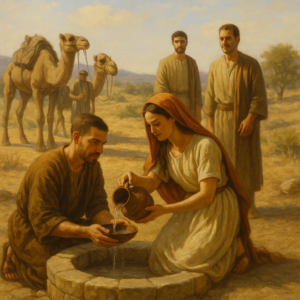 Genesis 24 opens with Abraham advanced in age:
“And Abraham was old, and well stricken in age: and the LORD had blessed Abraham in all things.” — Genesis 24:1
Abraham charges “his eldest servant of his house, that ruled over all that he had” to obtain a wife for Isaac. Abraham specifically forbids taking a wife for Isaac from “the daughters of the Canaanites” and commands the servant:
“But thou shalt go unto my country, and to my kindred, and take a wife unto my son Isaac.” — Genesis 24:4
This instruction is connected to the special covenant position of Abraham and Isaac. Abraham had been called out from his former country, yet Isaac was the promised son through whom God would continue the covenant promises. Abraham did not permit Isaac to leave the promised land merely because the woman might refuse to come. He tells the servant:
“Beware thou that thou bring not my son thither again.” — Genesis 24:6
Abraham expresses confidence in divine guidance, saying concerning the LORD:
“he shall send his angel before thee, and thou shalt take a wife unto my son from thence.” — Genesis 24:7
The servant takes ten camels and “all the goods of his master” in his hand and travels to Mesopotamia, “unto the city of Nahor” (Genesis 24:10).
At the well, the servant prays specifically for the LORD’s direction. He does not merely rely upon his own judgment:
“O LORD God of my master Abraham, I pray thee, send me good speed this day, and shew kindness unto my master Abraham.” — Genesis 24:12
He asks for a particular identifying circumstance: the woman whom he asks for water should willingly give him drink and also offer water for his camels. Before he finishes speaking, Rebekah appears.
The text explicitly identifies her as:
“Rebekah, who was born to Bethuel, son of Milcah, the wife of Nahor, Abraham’s brother.” — Genesis 24:15
She fulfills the circumstances for which the servant had prayed, giving him water and drawing water for his camels.
The servant then recognizes the LORD’s providence and worships:
“Blessed be the LORD God of my master Abraham, who hath not left destitute my master of his mercy and his truth: I being in the way, the LORD led me to the house of my master’s brethren.” — Genesis 24:27
The phrase “I being in the way, the LORD led me” is one of the clearest devotional statements in the chapter. The servant was carrying out the responsibility given to him, and the LORD directed his path.
Rebekah’s brother Laban receives the servant. Bethuel is also present when the matter is formally discussed. The servant refuses to eat until he has explained his errand and then carefully recounts Abraham’s command, his journey, his prayer, and his encounter with Rebekah.
Laban and Bethuel answer:
“The thing proceedeth from the LORD: we cannot speak unto thee bad or good.” — Genesis 24:50
The servant worships the LORD again.
Rebekah’s own willingness is then directly established. Her family asks:
“Wilt thou go with this man?”
And Scripture gives her answer:
“And she said, I will go.” — Genesis 24:58
That point should not be overlooked. Whatever customs surrounded ancient marriage arrangements, the KJV explicitly records Rebekah’s personal answer.
Rebekah and her attendants depart with Abraham’s servant.
Meanwhile, Isaac is living in the south country. Scripture records a quiet and significant scene:
“And Isaac went out to meditate in the field at the eventide.” — Genesis 24:63
Rebekah sees Isaac, asks who he is, and upon learning his identity covers herself with a veil. Scripture records the veil but does not explain every cultural meaning attached to it; explanations from ancient custom therefore should not be treated as though Genesis itself states them.
The servant reports what he had done, and the chapter closes:
“And Isaac brought her into his mother Sarah’s tent, and took Rebekah, and she became his wife; and he loved her: and Isaac was comforted after his mother’s death.” — Genesis 24:67
The marriage of Isaac and Rebekah thus becomes the next important stage in the continuation of the promised line.
Genesis 25 — Abraham’s Death, Ishmael’s Line, and Jacob and Esau
Genesis 25 first records:
“Then again Abraham took a wife, and her name was Keturah.” — Genesis 25:1
Children born through Keturah are listed, including Zimran, Jokshan, Medan, Midian, Ishbak, and Shuah.
Genesis 25:5 then emphasizes Isaac’s special position:
“And Abraham gave all that he had unto Isaac.”
Abraham also gives gifts to “the sons of the concubines, which Abraham had” and sends them eastward “from Isaac his son” while Abraham is still living (Genesis 25:6).
This distinction fits the covenantal emphasis already established in Genesis: Isaac is the son through whom the promises given to Abraham are to proceed.
Abraham dies at 175 years of age:
“Then Abraham gave up the ghost, and died in a good old age, an old man, and full of years; and was gathered to his people.” — Genesis 25:8
Isaac and Ishmael together bury their father:
“And his sons Isaac and Ishmael buried him in the cave of Machpelah…” — Genesis 25:9
The burial place is the same property Abraham had purchased in Genesis 23 and where Sarah had been buried.
After Abraham’s death:
“God blessed his son Isaac; and Isaac dwelt by the well Lahairoi.” — Genesis 25:11
The text then records the generations of Ishmael. God had previously promised Abraham concerning Ishmael that He would make him fruitful and multiply him exceedingly (Genesis 17:20). Genesis 25 records twelve sons described as:
“twelve princes according to their nations.” — Genesis 25:16
Ishmael dies at 137 years of age.
Beginning at Genesis 25:19, attention returns specifically to Isaac:
“And these are the generations of Isaac, Abraham’s son: Abraham begat Isaac.”
Isaac is forty years old when he takes Rebekah as his wife. Rebekah is barren, and Isaac responds by praying:
“And Isaac intreated the LORD for his wife, because she was barren: and the LORD was intreated of him, and Rebekah his wife conceived.” — Genesis 25:21
This is an important statement of answered prayer. Scripture explicitly connects Isaac’s entreaty with the LORD granting conception.
During Rebekah’s pregnancy, the children struggle within her. She goes “to enquire of the LORD” (Genesis 25:22).
The LORD answers:
“Two nations are in thy womb, and two manner of people shall be separated from thy bowels; and the one people shall be stronger than the other people; and the elder shall serve the younger.” — Genesis 25:23
The wording deserves careful attention. The LORD explicitly speaks of “two nations,” “two manner of people,” and “one people” in relation to another people. The immediate prophecy therefore concerns more than merely the personalities of two individual boys; Jacob and Esau stand at the heads of peoples that will proceed from them.
This passage should not be forced into teaching individual Calvinistic regeneration or reprobation. Genesis 25:23 does not state that one unborn child was irresistibly regenerated while the other was unconditionally condemned. The text explicitly concerns God’s determination regarding the two sons and the nations proceeding from them.
When the twins are born, the first is Esau:
“And the first came out red, all over like an hairy garment; and they called his name Esau.” — Genesis 25:25
Jacob follows:
“and his hand took hold on Esau’s heel; and his name was called Jacob.” — Genesis 25:26
Isaac is sixty years old at their birth.
The boys develop different ways of life:
“And Esau was a cunning hunter, a man of the field; and Jacob was a plain man, dwelling in tents.” — Genesis 25:27
Scripture also records a serious division in parental affection:
“And Isaac loved Esau, because he did eat of his venison: but Rebekah loved Jacob.” — Genesis 25:28
The verse plainly states the differing parental preferences. Scripture does not commend such divided favoritism, and subsequent chapters show severe family conflict surrounding these sons. One should nevertheless distinguish what Scripture explicitly states from conclusions concerning every motive of Isaac or Rebekah.
The chapter closes with the birthright episode.
Jacob prepares pottage. Esau returns from the field faint and asks for the “red pottage.” Jacob answers:
“Sell me this day thy birthright.” — Genesis 25:31
Esau agrees and confirms the transaction with an oath.
After eating, drinking, rising, and going his way, the Holy Ghost gives the inspired evaluation:
“thus Esau despised his birthright.” — Genesis 25:34
That final statement is decisive. Whatever may be said about Jacob’s conduct in bargaining, Genesis 25 explicitly condemns Esau’s attitude toward the birthright. Scripture does not explicitly say in this chapter that every aspect of Jacob’s bargaining is to be imitated or approved.
Hebrews later confirms the seriousness of Esau’s conduct, calling him a “profane person”:
“lest there be any fornicator, or profane person, as Esau, who for one morsel of meat sold his birthright.” — Hebrews 12:16
Key People and Places
- Abraham — The covenant patriarch. In Genesis 24 he arranges for Isaac to receive a wife from his kindred rather than from the Canaanites. Genesis 25 records his later family, death, and burial.
- Isaac — Abraham’s promised son. He receives Rebekah as his wife, is blessed by God after Abraham’s death, prays concerning Rebekah’s barrenness, and becomes the father of Esau and Jacob.
- Rebekah — Daughter of Bethuel and sister of Laban. She willingly leaves her family to become Isaac’s wife and later bears Esau and Jacob.
- Abraham’s servant — Called “his eldest servant of his house” and the man “that ruled over all that he had” (Genesis 24:2). Genesis 24 does not give his name.
- Bethuel — Rebekah’s father.
- Laban — Rebekah’s brother. He becomes much more prominent later in Jacob’s life.
- Keturah — Named in Genesis 25:1 as Abraham’s wife and mother of several sons. First Chronicles 1:32 also calls her “Abraham’s concubine”; both statements should be allowed to stand as Scripture gives them.
- Ishmael — Abraham’s son by Hagar. Genesis 25 records his twelve sons and his death at 137.
- Esau — Isaac and Rebekah’s firstborn twin, “a cunning hunter, a man of the field.” He sells his birthright and is explicitly said to have despised it.
- Jacob — Isaac and Rebekah’s younger twin, described as “a plain man, dwelling in tents.” The LORD had declared that “the elder shall serve the younger.”
- Mesopotamia — The region to which Abraham’s servant travels in Genesis 24:10.
- City of Nahor — Destination of the servant’s journey.
- Canaan — The land in which Abraham and Isaac reside and the land associated with God’s covenant promise to Abraham’s seed.
- Well Lahairoi — Associated with Isaac at the conclusion of Genesis 24 and again in Genesis 25:11.
- South country — The region where Isaac is dwelling when Rebekah arrives.
- Cave of Machpelah — Abraham’s burial place, where Sarah had already been buried.
- Padanaram — Rebekah’s region of origin as identified in Genesis 25:20.
- Havilah and Shur — Geographical boundaries mentioned in connection with the descendants of Ishmael in Genesis 25:18.
Main Doctrinal or Spiritual Themes
1. The Providence of God
Genesis 24 is one of Scripture’s clearest narratives of providential guidance without requiring speculation or mysticism.
Abraham trusted that God would direct the servant. The servant prayed. Rebekah appeared. The circumstances agreed with his request. Her family recognized God’s hand, and the servant himself declared:
“I being in the way, the LORD led me.” — Genesis 24:27
Biblical guidance does not require impressions that contradict Scripture. The servant had a definite responsibility, obeyed his master’s instruction, prayed for direction, observed God’s providence, and worshiped when the LORD answered.
2. Prayer and Dependence Upon God
Both chapters contain notable examples of prayer.
Abraham’s servant prays for guidance in Genesis 24. Isaac “intreated the LORD” concerning Rebekah’s barrenness in Genesis 25. Rebekah herself “went to enquire of the LORD.”
These passages present prayer as dependence upon a real, personal God who hears and answers according to His will.
3. Obedience While Seeking God’s Direction
The servant did not remain inactive while claiming to wait for guidance.
He obeyed Abraham’s command and traveled where he had been sent. Then he could testify:
“I being in the way, the LORD led me.”
There is a sound principle here: believers should obey what God has already made clear rather than demanding additional guidance while neglecting revealed duty.
4. Separation and Marriage
Abraham refused to obtain a Canaanite wife for Isaac.
This was connected particularly to the patriarchal covenant and the preservation of the promised line, so it should not be converted into an unscriptural racial doctrine.
For the believer today, the sound spiritual application is that marriage must honor God. The New Testament principle is:
“she is at liberty to be married to whom she will; only in the Lord.” — 1 Corinthians 7:39
Biblical separation concerns faithfulness to the LORD, not human pride or racial superiority.
5. God’s Faithfulness to His Covenant
Abraham dies, but God’s promises do not die with Abraham.
Genesis 25:11 immediately records:
“God blessed his son Isaac.”
The human instrument changes; the faithfulness of God does not.
Isaac now occupies the central place in the covenant narrative, exactly as God had previously declared:
“But my covenant will I establish with Isaac…” — Genesis 17:21
This concerns God’s historical covenant program and must be distinguished from the doctrine of personal salvation by grace through faith.
6. Israel and the Nations Remain Distinct in God’s Program
Genesis 25:23 speaks of:
“Two nations”
“two manner of people”
Jacob will be associated with the nation of Israel, while Esau becomes associated with Edom in the later biblical record.
This distinction should be allowed to remain literal. There is no reason to allegorize Jacob into “the church” or to erase the literal national promises associated with Abraham, Isaac, and Jacob.
7. God’s Sovereign Right to Direct the Covenant Line
God declares:
“the elder shall serve the younger.” — Genesis 25:23
Human custom regarding the firstborn does not bind God. God determines how His covenant purpose will proceed.
Yet the verse itself specifically identifies the issue as involving two nations and two peoples. It should not be expanded beyond what Scripture states into a doctrine that God arbitrarily regenerates certain individuals while withholding from others the possibility of salvation.
Salvation throughout Scripture remains by grace through faith, and the gospel invitation is genuinely extended to the lost.
8. The Seriousness of Despising Spiritual Privilege
Esau treats his birthright as less valuable than immediate physical satisfaction.
The inspired conclusion is:
“thus Esau despised his birthright.”
His problem was not merely hunger. Scripture evaluates his action as contempt for something of genuine value.
Hebrews 12:16 accordingly calls him “profane.”
The biblical contrast is between valuing what God has made significant and sacrificing it for temporary appetite.
9. Family Favoritism Brings Danger
Genesis 25:28 states:
“And Isaac loved Esau, because he did eat of his venison: but Rebekah loved Jacob.”
The text plainly reveals divided affection within the household.
Later chapters record severe conflict involving these same family relationships. It may suggest the danger of parental favoritism, but Scripture does not explicitly identify Genesis 25:28 as the sole cause of the later troubles. Therefore the application should be made with that restraint.
Practical Applications or Lessons
Seek God’s Will Through Scripture, Prayer, and Obedience
Abraham’s servant prayed, but he also obeyed. He could say:
“I being in the way, the LORD led me.”
A Christian should not substitute vague feelings for biblical obedience. Do what Scripture plainly commands, pray for wisdom, and trust God’s providence.
Treat Marriage as a Spiritual Matter
Genesis 24 treats Isaac’s marriage as something far more serious than physical attraction or convenience.
Believers should seek marriages that honor Christ and preserve spiritual faithfulness. Compatibility should never replace obedience to God as the controlling consideration.
Be Faithful With Responsibilities Entrusted to You
Abraham’s servant demonstrates remarkable faithfulness. He understands his instructions, carries them out, refuses to become distracted from his mission, and repeatedly gives the glory to Abraham’s God.
His name is not even supplied in the chapter, yet his faithfulness fills the narrative. Service does not require personal prominence.
Pray Specifically, but Submit to God’s Providence
The servant makes a definite request in Genesis 24:12–14. Isaac makes a definite request concerning his wife in Genesis 25:21.
Specific prayer is biblical. But these texts do not teach that believers may invent arbitrary “signs” and bind God to them. Genesis records what occurred in this particular event; it does not issue a universal command to construct signs whenever guidance is desired.
Give God the Glory When Prayer Is Answered
The servant repeatedly worships the LORD rather than congratulating himself.
“And the man bowed down his head, and worshipped the LORD.” — Genesis 24:26
Answered prayer ought to produce worship.
Be Willing to Follow God’s Direction
Rebekah answers simply:
“I will go.”
Without turning her experience into an allegory, her willingness supplies a legitimate devotional example of decisive obedience when the path before her has been made clear.
Maintain a Life of Meditation Upon God
Isaac:
“went out to meditate in the field at the eventide.”
Scripture does not tell us the exact subject of his meditation. Therefore it would be speculation to claim that he was specifically praying for his approaching bride.
What Scripture does establish is that Isaac practiced meditation. Biblical meditation is thoughtful occupation with the things of God, not the mind-emptying practices associated with pagan or mystical spirituality.
Remember That God’s Work Continues Beyond One Generation
Abraham dies in Genesis 25, but God blesses Isaac.
No servant of God is indispensable. God’s truth and purposes do not depend upon the lifespan of one man.
“And it came to pass after the death of Abraham, that God blessed his son Isaac…” — Genesis 25:11
Pray for Your Family
Isaac “intreated the LORD for his wife.”
A husband should pray for his wife. Parents should pray concerning their children. Families should take their needs to God rather than merely depending upon human ability.
Do Not Sacrifice Spiritual Value for Immediate Appetite
Esau’s decision is perhaps the strongest practical warning in Genesis 25.
He exchanges his birthright for one meal.
Temporary cravings can make eternal and spiritual matters appear unimportant if the flesh is allowed to govern the decision.
Hebrews identifies Esau as:
“a profane person.”
To be profane is to treat sacred things as common or worthless. Christians should guard against trading spiritual privileges, testimony, purity, family responsibilities, or faithfulness to God for momentary gratification.
Do Not Read Approval Into Mere Narrative
Genesis tells us that Jacob demanded the birthright as the price of the meal. The text explicitly says:
“thus Esau despised his birthright.”
It does not end by saying, “Thus Jacob did right.”
That distinction matters. Scripture often records human behavior without approving every action recorded. Sound Bible study must allow God’s explicit judgment to control our conclusions.
Overall Message of Genesis 24–25
These chapters show the LORD faithfully carrying forward the promises He made to Abraham.
In Genesis 24, God’s providence directs the circumstances surrounding Isaac’s marriage to Rebekah. Prayer, obedience, divine guidance, faithfulness, and worship dominate the chapter.
In Genesis 25, one generation passes and another takes its place. Abraham dies, but God blesses Isaac. Ishmael’s descendants become numerous as God had promised, while the covenant narrative continues through Isaac. Rebekah conceives in answer to prayer, and God declares His purpose concerning Jacob and Esau and the nations that will proceed from them.
The chapter then ends with a sharp moral contrast: Esau exchanges his birthright for immediate physical satisfaction.
The controlling lesson is that God is faithful to His Word, His purposes are not frustrated by changing generations, and His people should value what He values rather than exchange spiritual privilege for temporary gratification.
Comments are closed