
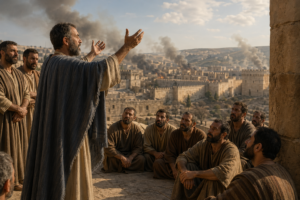
 Ezekiel 22–23 continues the Lord’s case against Jerusalem and Judah. These chapters are severe, direct, and morally weighty. God exposes Jerusalem’s bloodshed, idolatry, uncleanness, corruption, false religion, and spiritual adultery. The tone is judicial: the holy God is not merely disappointed with sin; He indicts, judges, and purges it.
Historically, Ezekiel is prophesying among the captives in Babylon before Jerusalem’s final fall in 586 B.C. The people still hoped Jerusalem would survive, but God shows that the city’s guilt was full. Doctrinally, these chapters emphasize the holiness of God, the certainty of judgment, the danger of corrupt leadership, and the shame of turning from the Lord to the world.
Chapter Summaries
Ezekiel 22 — Jerusalem, the Bloody City
1. Jerusalem is charged with bloodshed and idolatry
The chapter opens with God commanding Ezekiel to judge “the bloody city” and show her “all her abominations” (Ezekiel 22:2). Jerusalem is guilty of shedding blood and making idols. The city that should have been holy unto the LORD had become defiled by violence, false worship, and moral corruption.
God says, “Thou art become guilty in thy blood that thou hast shed; and hast defiled thyself in thine idols” (22:4). Her sins had brought her “days” and “years” of judgment near. The nations would mock her because she had become “infamous and much vexed” (22:5).
This is not merely political failure. It is covenant rebellion. Jerusalem had turned from God’s law, God’s worship, and God’s holiness.
2. The sins of society are exposed
Ezekiel lists the sins of the city in blunt terms. Princes abuse power. Parents are dishonored. Strangers, fatherless, and widows are oppressed. God’s holy things are despised, and the sabbaths are profaned (22:6–8).
There are men who carry tales to shed blood, others who commit idolatry upon the mountains, and others who practice gross immorality (22:9–11). Some take gifts to shed blood, others practice usury and increase, and many greedily gain from their neighbors by extortion (22:12).
The root problem is stated plainly: “and hast forgotten me, saith the Lord GOD” (22:12).
That phrase explains the chapter. When a people forget God, moral order collapses. Reverence disappears. Authority becomes abusive. Worship becomes polluted. Family life breaks down. The vulnerable are mistreated. Money becomes an idol. Sin becomes normal.
3. God announces judgment and scattering
Because of Jerusalem’s sins, God says He will “smite” His hand at their dishonest gain and bloodshed (22:13). He asks, “Can thine heart endure, or can thine hands be strong, in the days that I shall deal with thee?” (22:14). No sinner is strong enough to stand against the holy judgment of God.
The Lord declares that He will scatter them among the heathen and disperse them in the countries (22:15). This refers to the Babylonian captivity and the removal of Judah from the land. God’s purpose is not random destruction but purging: “and will consume thy filthiness out of thee” (22:15).
The captivity would show that sin brings consequences, but also that God’s chastening has a purifying purpose for His covenant people.
4. Israel is compared to dross in the furnace
In verses 17–22, God compares the house of Israel to worthless metal residue: “dross.” Silver, brass, tin, iron, and lead are gathered into a furnace to be melted. Likewise, God would gather the people into Jerusalem and pour out His fury upon them.
The picture is severe. Jerusalem thought of herself as precious, but God says she had become dross because of corruption. Judgment would be like a furnace: “I will gather you, and blow upon you in the fire of my wrath, and ye shall be melted in the midst thereof” (22:21).
This teaches that God’s holiness tests the true condition of a people. Religious identity cannot hide spiritual corruption.
5. Leaders, priests, princes, prophets, and people are condemned
The final section of the chapter shows that corruption had spread through every level of society.
The prophets had conspired like “a roaring lion ravening the prey” (22:25). They devoured souls, took treasure, and multiplied widows. Religious leaders who should have warned the people instead exploited them.
The priests violated God’s law and profaned His holy things. They failed to distinguish between “the holy and profane” and between “the unclean and the clean” (22:26). This is a major spiritual failure. When religious leaders blur the lines God has drawn, the people lose moral discernment.
The princes were like wolves, shedding blood and destroying souls for dishonest gain (22:27). The prophets daubed them “with untempered morter,” seeing vanity and divining lies (22:28). They gave false assurance when judgment was coming.
The people themselves also practiced oppression, robbery, and mistreatment of the poor, needy, and stranger (22:29).
6. God finds no intercessor to stand in the gap
One of the most sobering statements in Ezekiel is found in 22:30:
“And I sought for a man among them, that should make up the hedge, and stand in the gap before me for the land…”
But God says, “I found none.”
This does not mean God lacked power. It means the land lacked faithful men who would intercede, warn, preach truth, and stand for righteousness in the breach. Therefore, God says He poured out His indignation and consumed them with the fire of His wrath (22:31).
From a conservative Baptist standpoint, this verse is often applied to the need for faithful preachers, praying believers, godly fathers, and separated Christians who will stand where compromise has broken down the wall.
Ezekiel 23 — Aholah and Aholibah: Samaria and Jerusalem
Ezekiel 23 uses the parable of two sisters to describe the spiritual adultery of Israel and Judah. The language is intentionally strong because idolatry is spiritually shameful. God compares His people’s alliances with pagan nations and their worship of false gods to harlotry.
The chapter is not meant to be sensational. It is meant to expose how vile spiritual unfaithfulness is in the sight of God.
1. The two sisters are introduced
The word of the LORD comes to Ezekiel concerning two women, “the daughters of one mother” (23:2). Their names are Aholah and Aholibah.
God identifies them clearly:
“Samaria is Aholah, and Jerusalem Aholibah” (23:4).
Aholah represents the northern kingdom of Israel, with Samaria as its capital. Aholibah represents the southern kingdom of Judah, with Jerusalem as its capital.
Both had belonged to the Lord in covenant privilege, yet both were guilty of spiritual adultery. The point is that both Israel and Judah turned from the LORD to idolatry and worldly dependence.
2. Aholah — Samaria’s unfaithfulness and judgment
Aholah, representing Samaria, committed spiritual adultery with the Assyrians (23:5–8). This refers to Israel’s attraction to Assyrian power, culture, military strength, and false gods. Instead of trusting the LORD, the northern kingdom looked to heathen nations.
Because of this, God delivered her into the hand of the Assyrians, whom she had sinfully pursued (23:9). They exposed her shame, took her children, and slew her with the sword (23:10). This points to the fall of Samaria to Assyria in 722 B.C.
The lesson is clear: the very worldly powers Israel admired became instruments of her judgment. Sin often enslaves and destroys through the very thing it first used to entice.
3. Aholibah — Jerusalem’s greater guilt
Aholibah, representing Jerusalem and Judah, saw what happened to Samaria but “was more corrupt in her inordinate love than she” (23:11). Judah had the warning of Israel’s fall, yet continued in sin.
Jerusalem lusted after the Assyrians and then after the Babylonians, described as “captains and rulers,” “clothed most gorgeously,” and “horsemen riding upon horses” (23:12–15). The imagery describes Judah’s fascination with foreign power and pagan splendor.
Judah’s guilt was greater because she had more light. She had Jerusalem, the temple, the priesthood, the Davidic line, and the warning example of Samaria. Yet she still turned from the LORD.
4. Judah’s alliance with Babylon becomes judgment
Jerusalem sent messengers to the Babylonians, and they came to her (23:16). This reflects Judah’s political entanglements with Babylon and her spiritual compromise with heathen ways.
Eventually, her soul was alienated from them (23:17), but the damage was done. God says He was alienated from Jerusalem as He had been from Samaria (23:18). Sinful alliances never provide lasting security. They defile the soul and provoke God’s chastening.
The chapter reminds readers that worldly help purchased at the cost of obedience is never true help.
5. God raises Babylon against Jerusalem
Because Jerusalem continued in spiritual adultery, God says He will raise up her lovers against her: the Babylonians, Chaldeans, Pekod, Shoa, Koa, and Assyrians (23:22–23). These represent foreign powers that would come against Judah.
They would come with weapons, chariots, wagons, and an assembly of people (23:24). God says, “I will set judgment before them, and they shall judge thee according to their judgments” (23:24).
Jerusalem would suffer the consequences of trusting pagan powers instead of the LORD. Her punishment would be public, humiliating, and severe.
6. The purpose of judgment: ending uncleanness and idolatry
God says, “Thus will I make thy lewdness to cease from thee, and thy whoredom brought from the land of Egypt” (23:27). The reference to Egypt points back to Israel’s early corruption and long history of turning from God.
The judgment was meant to cut off idolatry and teach Judah not to lift up her eyes to false gods again. God’s chastening is severe because sin is destructive, and because God will not share His glory with idols.
7. Jerusalem must drink the cup of Samaria
In verses 31–34, Judah is told she will drink the same cup as Samaria. This “cup” represents judgment. It is described as deep, large, and full of astonishment and desolation.
Because Judah walked in Samaria’s way, she would suffer Samaria’s judgment. Greater privilege did not protect Judah from judgment; it increased her accountability.
8. The root charge: forgetting God
Verse 35 gives the core spiritual indictment:
“Because thou hast forgotten me, and cast me behind thy back…”
This is similar to Ezekiel 22:12. The root of Judah’s sin was not merely bad policy, social injustice, or ritual failure. It was forgetting God. They cast the LORD behind their back. They treated Him as unwanted, unimportant, and inconvenient.
God therefore says they must bear their sin.
9. The final indictment against both sisters
In verses 36–49, God commands Ezekiel to judge Aholah and Aholibah and declare their abominations. Their sins include idolatry, bloodshed, defiling the sanctuary, profaning the sabbaths, and even causing their children to pass through the fire to idols (23:37–39).
This is especially grievous: after committing idolatry, they came into God’s sanctuary “in the same day” and profaned it (23:39). They wanted pagan sin and religious respectability at the same time.
The chapter ends with God declaring that judgment will recompense their lewdness and idolatry upon them. The purpose is stated plainly:
“and ye shall know that I am the Lord GOD” (23:49).
Judgment reveals what sin tried to deny: the LORD alone is God.
Key People and Places
The LORD / Lord GOD
The holy covenant God of Israel. He is the Judge speaking through Ezekiel. He exposes sin, declares judgment, and acts to purge uncleanness from His people.
Ezekiel
The prophet among the captives in Babylon. He is commanded to judge Jerusalem, expose her abominations, and declare God’s word without softening it.
Jerusalem
The capital of Judah and the location of the temple. In Ezekiel 22, she is called “the bloody city.” In Ezekiel 23, she is represented by Aholibah. Her privileges made her guilt even greater.
Samaria
The capital of the northern kingdom of Israel. In Ezekiel 23, she is represented by Aholah. Her fall to Assyria serves as a warning to Jerusalem.
Aholah
Symbolic name for Samaria, representing the northern kingdom’s spiritual unfaithfulness and judgment.
Aholibah
Symbolic name for Jerusalem, representing Judah’s spiritual unfaithfulness. Her guilt is greater because she saw Samaria’s fall but continued in sin.
Assyria / Assyrians
The powerful empire that conquered Samaria. Israel had been attracted to Assyrian strength, but Assyria became the instrument of her judgment.
Babylon / Chaldeans
The empire God would use to judge Jerusalem and Judah. Judah’s sinful political and spiritual entanglement with Babylon would end in destruction and captivity.
Egypt
A symbol of Israel’s old bondage and early spiritual corruption. Ezekiel 23 traces Israel’s unfaithfulness back to Egypt, showing that the nation’s sin had deep roots.
Princes
Civil rulers who abused power, shed blood, and sought dishonest gain. Instead of protecting justice, they preyed upon the people.
Priests
Religious leaders who violated God’s law, profaned holy things, and failed to distinguish between the clean and unclean.
Prophets
False prophets who spoke lies, covered sin, and gave false assurance. They are compared to those who daub a wall with “untempered morter.”
The People of the Land
The general population, also guilty of oppression, robbery, and mistreating the poor, needy, and stranger.
Main Doctrinal or Spiritual Themes
1. God is holy and cannot overlook sin
Ezekiel 22–23 shows that God’s holiness is not passive. He sees bloodshed, idolatry, moral uncleanness, corruption, false worship, and hypocrisy. Jerusalem’s religious history did not excuse her sin.
A conservative Baptist reading should emphasize that God’s grace never cancels His holiness. The same God who is merciful is also righteous.
2. Sin corrupts every level of society
In Ezekiel 22, princes, priests, prophets, and people are all guilty. The corruption is not limited to one class. When a nation forgets God, sin spreads through government, religion, family, business, and daily life.
This is a warning against blaming only leaders or only the people. God holds all accountable.
3. False religion is especially dangerous
The priests failed to distinguish between holy and profane. The prophets spoke lies and gave false comfort. Their failure made the people more comfortable in sin.
This applies strongly to preaching and church life. A preacher who refuses to warn against sin is not being loving; he is leaving people unwarned before judgment.
4. Spiritual adultery is serious
Ezekiel 23 presents idolatry and worldly dependence as spiritual harlotry. Israel and Judah were not merely experimenting with foreign customs; they were betraying the LORD.
For believers today, the principle is separation from idols and worldly compromise. Anything that takes God’s place in trust, affection, worship, or obedience becomes spiritually dangerous.
5. Greater privilege brings greater accountability
Judah saw Samaria’s fall, yet sinned worse. Jerusalem had the temple, the law, the priesthood, and prophetic warnings. Therefore, her guilt was greater.
This is a sober lesson for churches, Christian families, and nations that have had Bible light. More light means more responsibility.
6. God judges dishonest gain and oppression
Ezekiel 22 condemns extortion, usury, dishonest gain, oppression of strangers, and mistreatment of widows and the fatherless. Biblical righteousness includes personal morality, true worship, and just dealings with others.
Conservative doctrine should not ignore practical righteousness. God cares how people worship, how they live, and how they treat the weak.
7. God seeks men to stand in the gap
Ezekiel 22:30 is one of the great calls to spiritual responsibility. God sought a man to “make up the hedge” and “stand in the gap,” but found none.
This points to the need for intercession, courage, preaching, fatherly leadership, and faithful testimony. In a day of compromise, God still uses men and women who will stand for truth.
8. Judgment can have a purifying purpose
God says He will consume Jerusalem’s filthiness and make her uncleanness cease. Though the judgment is severe, it is not meaningless. God uses chastening to expose, humble, and purge.
This does not minimize the horror of judgment, but it shows God’s righteous purpose.
9. Forgetting God is the root of ruin
Both chapters point to the same core issue: “thou hast forgotten me” and “cast me behind thy back.” Sin begins when God is pushed out of the heart, home, worship, leadership, and daily decisions.
Forgetting God is not innocent neglect. It is moral rebellion.
10. God’s final purpose is that men know He is the LORD
The repeated purpose of judgment in Ezekiel is that people may know the LORD. God’s glory will be vindicated. His name will not be forever dishonored by the sins of His people.
Practical Applications or Lessons
1. Do not mistake religious privilege for spiritual safety
Jerusalem had the temple, priests, sacrifices, and history. Yet she was judged. A church background, Bible knowledge, or outward religion cannot substitute for obedience and true faith.
2. Keep a clear line between holy and profane
The priests failed because they blurred what God had separated. Believers today must not let the world define morality, worship, family, entertainment, or truth. God’s Word must draw the lines.
3. Beware of false peace
The false prophets covered sin with lies. They made people comfortable when they should have been repenting. Any preaching or counsel that excuses sin and avoids judgment is dangerous.
4. Stand in the gap
God still calls His people to intercede, preach, warn, teach, and live faithfully. A father can stand in the gap for his home. A pastor can stand in the gap for a church. A believer can stand in the gap through prayer and witness.
5. Do not trust worldly powers more than God
Judah looked to Assyria and Babylon. Today, believers may be tempted to trust money, politics, popularity, human strategy, or worldly approval more than the LORD. These things cannot replace obedience to God.
6. Sin often destroys through what first attracted us
Samaria admired Assyria, and Assyria judged Samaria. Jerusalem was drawn to Babylon, and Babylon destroyed Jerusalem. Sin may look useful, powerful, or attractive at first, but it becomes a cruel master.
7. God sees public sins and private motives
Ezekiel exposes both outward wickedness and inward spiritual unfaithfulness. God saw bloodshed, greed, immorality, hypocrisy, and the heart that had forgotten Him.
8. Treat the vulnerable with righteousness
God condemns oppression of strangers, fatherless, widows, poor, and needy. A Bible-believing life must include honest dealings, compassion, and justice toward those who cannot easily defend themselves.
9. Learn from the fall of others
Judah saw Samaria fall but did not repent. One of the most foolish things a person can do is watch another suffer for sin and then walk the same road.
10. Do not come to worship while clinging to idols
Ezekiel 23 condemns those who practiced idolatry and then entered God’s sanctuary the same day. God is not honored by outward worship joined to inward rebellion. True worship requires repentance, reverence, and obedience.
11. God’s patience should not be mistaken for approval
Jerusalem’s judgment did not come all at once. God warned repeatedly through His prophets. But delayed judgment was not canceled judgment. The same is true today: God’s longsuffering is a call to repentance, not permission to continue in sin.
12. Remember the Lord
The heart of the warning is simple: do not forget God. Keep Him first in doctrine, worship, family, decisions, conduct, and service. A person, church, or nation that casts God behind its back is already on the road to ruin.
Concluding Thought
Ezekiel 22–23 presents Jerusalem and Judah as guilty before a holy God. The sins named are many: bloodshed, idolatry, oppression, immorality, false prophecy, corrupt priesthood, dishonest gain, and spiritual adultery. But beneath them all is the central failure: they had forgotten the LORD.
The chapters are severe, but they are necessary. They teach that God’s people must not play with sin, trust the world, tolerate false religion, or presume upon privilege. God seeks those who will stand in the gap, keep His Word, honor His holiness, and remain faithful when others compromise.
Comments are closed