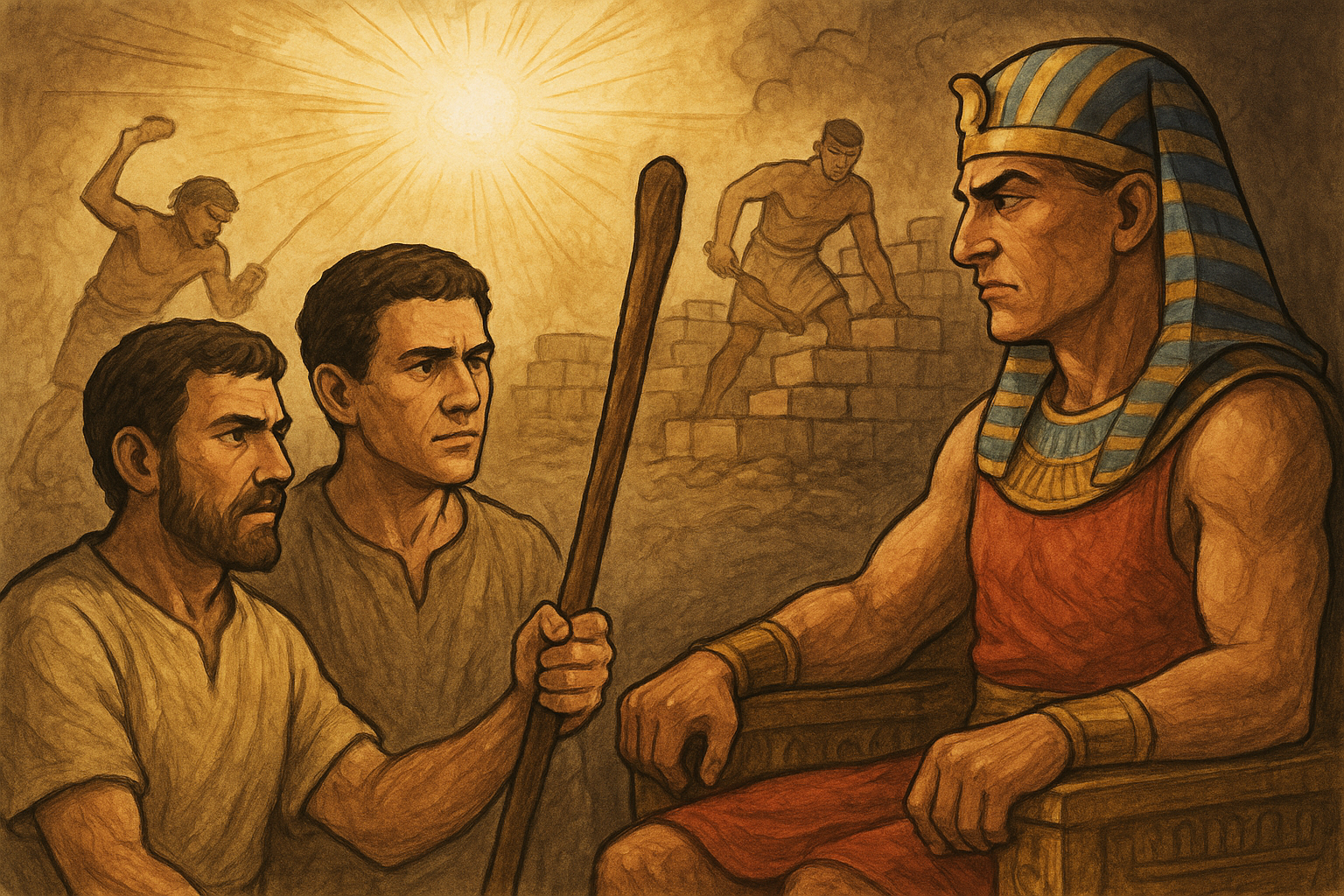
Exodus 4–6 records Moses’ continued hesitation, his return toward Egypt, the LORD’s confirmation of His message through signs, the first confrontation with Pharaoh, the worsening of Israel’s bondage, and God’s renewed declaration that He will redeem His covenant people. The passage moves deliberately from human weakness and opposition to the certainty of God’s word and covenant purpose.
These chapters must first be read as literal history concerning Moses, Pharaoh, Egypt, and the children of Israel. They contain rich spiritual instruction for believers, but Israel should not be allegorically replaced by the Church.
Chapter Summaries
 Exodus 4 — Moses Is Equipped and Sent
1. Moses fears Israel will not believe him — Exodus 4:1–9
Moses raises another objection:
“But, behold, they will not believe me, nor hearken unto my voice: for they will say, The LORD hath not appeared unto thee.” — Exodus 4:1
The LORD gives Moses three specific signs.
The first concerns Moses’ rod. God commands him to cast it upon the ground, where it becomes a serpent. When Moses takes it by the tail, it becomes a rod again.
The stated purpose is:
“That they may believe that the LORD God of their fathers, the God of Abraham, the God of Isaac, and the God of Jacob, hath appeared unto thee.” — Exodus 4:5
The second sign involves Moses’ hand. He places it in his bosom, and it becomes “leprous as snow.” When he returns it to his bosom, it is restored.
The third sign is to take water from the river and pour it upon dry land, where it will become blood.
These signs were specifically given by God to Moses for this particular commission. The text does not establish a general rule that believers should seek miraculous signs before obeying God. Moses already possessed the LORD’s spoken command; the signs authenticated the message God had entrusted to him.
2. Moses objects because of his speech — Exodus 4:10–17
Moses says:
“O my Lord, I am not eloquent, neither heretofore, nor since thou hast spoken unto thy servant: but I am slow of speech, and of a slow tongue.” — Exodus 4:10
Scripture explicitly says Moses considered himself deficient in speech. It does not explicitly state that he possessed a medical speech disorder, so it would go beyond the text to assert one.
The LORD answers by pointing Moses away from his perceived weakness and toward the Creator:
“Who hath made man’s mouth? or who maketh the dumb, or deaf, or the seeing, or the blind? have not I the LORD?” — Exodus 4:11
Then comes one of the great promises of the passage:
“Now therefore go, and I will be with thy mouth, and teach thee what thou shalt say.” — Exodus 4:12
Moses nevertheless pleads:
“O my Lord, send, I pray thee, by the hand of him whom thou wilt send.” — Exodus 4:13
At this point:
“And the anger of the LORD was kindled against Moses…” — Exodus 4:14
God appoints Aaron, Moses’ brother, to speak.
“And thou shalt speak unto him, and put words in his mouth: and I will be with thy mouth, and with his mouth, and will teach you what ye shall do.” — Exodus 4:15
Aaron would serve “instead of a mouth,” while Moses would be to Aaron “instead of God” (4:16). This does not make Moses divine. In the plain context, Moses functions as the one who receives God’s words and communicates them to Aaron with delegated authority.
Moses is also commanded to take the rod:
“And thou shalt take this rod in thine hand, wherewith thou shalt do signs.” — Exodus 4:17
3. Moses begins his return to Egypt — Exodus 4:18–23
Moses asks Jethro for permission to return to his brethren in Egypt.
The LORD tells Moses:
“Go, return into Egypt: for all the men are dead which sought thy life.” — Exodus 4:19
Moses takes his wife and his sons toward Egypt:
“and Moses took the rod of God in his hand.” — Exodus 4:20
God again tells Moses beforehand that Pharaoh will resist:
“but I will harden his heart, that he shall not let the people go.” — Exodus 4:21
This statement establishes God’s sovereign activity in the coming conflict. At the same time, subsequent chapters repeatedly show Pharaoh personally speaking, refusing, and acting against God. Scripture therefore presents both divine sovereignty and genuine human responsibility without requiring us to deny either.
God also gives Moses a message of enormous doctrinal importance:
“Thus saith the LORD, Israel is my son, even my firstborn:” — Exodus 4:22
And:
“Let my son go, that he may serve me…” — Exodus 4:23
This is literal national Israel. It should not be redefined as the New Testament Church.
God also warns Pharaoh:
“if thou refuse to let him go, behold, I will slay thy son, even thy firstborn.” — Exodus 4:23
The judgment upon Egypt’s firstborn is therefore announced before the plagues unfold.
4. The circumcision incident — Exodus 4:24–26
This is one of the more difficult portions of the chapter.
“And it came to pass by the way in the inn, that the LORD met him, and sought to kill him.” — Exodus 4:24
Zipporah then circumcises her son.
The passage does not explicitly identify by name the person referred to by “him” in verse 24. The immediate context may suggest Moses, which is the common interpretation, but Scripture does not state his name in that sentence.
What is explicit is that circumcision immediately becomes central to the event, and after Zipporah circumcises her son, the threatened judgment ceases:
“So he let him go…” — Exodus 4:26
Genesis 17 had already established circumcision as the covenant sign given to Abraham and his seed. Therefore, this incident plainly demonstrates that God did not treat covenant obedience as a trivial matter.
It would go beyond the text, however, to assert exactly why the circumcision had not previously taken place, who had opposed it, or what private disagreement may have existed within Moses’ household. Scripture does not explicitly say.
5. Aaron meets Moses; Israel believes — Exodus 4:27–31
The LORD tells Aaron:
“Go into the wilderness to meet Moses.”
Aaron meets Moses “in the mount of God” and kisses him.
Moses tells Aaron:
“all the words of the LORD who had sent him, and all the signs which he had commanded him.” — Exodus 4:28
Moses and Aaron gather the elders of Israel. Aaron speaks the LORD’s words, and the signs are performed.
The result is encouraging:
“And the people believed…” — Exodus 4:31
When Israel hears that the LORD has visited them and seen their affliction:
“then they bowed their heads and worshipped.” — Exodus 4:31
The chapter therefore closes with belief and worship.
Exodus 5 — Pharaoh Refuses and the Bondage Worsens
1. Moses and Aaron confront Pharaoh — Exodus 5:1–5
Moses and Aaron deliver God’s command:
“Thus saith the LORD God of Israel, Let my people go, that they may hold a feast unto me in the wilderness.” — Exodus 5:1
Pharaoh responds:
“Who is the LORD, that I should obey his voice to let Israel go? I know not the LORD, neither will I let Israel go.” — Exodus 5:2
This statement establishes the central conflict of the plague narrative. Pharaoh refuses to acknowledge the authority of the LORD.
The coming judgments will answer Pharaoh’s question through God’s acts in Egypt.
Moses and Aaron explain that:
“The God of the Hebrews hath met with us…” — Exodus 5:3
They request permission to make a three-days’ journey into the desert and sacrifice unto the LORD.
Pharaoh dismisses the request and accuses Moses and Aaron of interfering with the people’s labor.
2. Pharaoh increases Israel’s burdens — Exodus 5:6–14
Pharaoh commands the taskmasters:
“Ye shall no more give the people straw to make brick, as heretofore: let them go and gather straw for themselves.” — Exodus 5:7
Yet the required quantity of bricks remains unchanged.
Pharaoh declares:
“for they be idle; therefore they cry, saying, Let us go and sacrifice to our God.” — Exodus 5:8
And:
“Let there more work be laid upon the men…” — Exodus 5:9
The children of Israel are scattered to gather stubble instead of straw while still being required to produce the same quantity of bricks.
When the production falls short, the officers of the children of Israel are beaten.
The text therefore presents a direct worsening of Israel’s outward circumstances after Moses begins carrying out God’s commission.
3. Israel’s officers appeal to Pharaoh — Exodus 5:15–19
The officers of Israel cry unto Pharaoh, asking why they are being treated this way.
Pharaoh repeats his accusation:
“Ye are idle, ye are idle…” — Exodus 5:17
He refuses to lessen the workload.
The officers recognize:
“they were in evil case…” — Exodus 5:19
4. Israel turns upon Moses and Aaron — Exodus 5:20–21
After leaving Pharaoh, the officers meet Moses and Aaron and blame them for worsening their condition.
They say:
“The LORD look upon you, and judge…” — Exodus 5:21
Their earlier response had been belief and worship (4:31), but after increased suffering they now condemn Moses and Aaron.
The text does not say their original belief was false. It simply records both reactions.
5. Moses returns to the LORD — Exodus 5:22–23
Moses does not abandon the LORD. He brings his distress directly to Him:
“Lord, wherefore hast thou so evil entreated this people? why is it that thou hast sent me?” — Exodus 5:22
And:
“For since I came to Pharaoh to speak in thy name, he hath done evil to this people; neither hast thou delivered thy people at all.” — Exodus 5:23
Moses is looking at what has happened since his arrival: conditions have become worse rather than better.
The chapter ends before God’s answer is completed. Chapter 6 supplies that answer.
Exodus 6 — “I Am the LORD”
1. God answers Moses concerning Pharaoh — Exodus 6:1
God does not withdraw His promise.
He says:
“Now shalt thou see what I will do to Pharaoh…” — Exodus 6:1
And:
“for with a strong hand shall he let them go, and with a strong hand shall he drive them out of his land.”
Israel’s deliverance will not result from Pharaoh’s kindness, diplomacy, or a negotiated compromise. God Himself will act.
2. God declares His name and covenant faithfulness — Exodus 6:2–5
God says:
“I am the LORD:” — Exodus 6:2
Then:
“And I appeared unto Abraham, unto Isaac, and unto Jacob, by the name of God Almighty, but by my name JEHOVAH was I not known to them.” — Exodus 6:3
This verse must be handled carefully.
The KJV itself records Abraham using the name Jehovahjireh in Genesis 22:14. Therefore, Exodus 6:3 should not be expanded into the stronger claim that the name connected with JEHOVAH had never appeared in the patriarchal record.
The exact statement of Exodus 6:3 should be allowed to stand.
The distinction God makes may indicate that Israel was now going to know the covenant significance of His name through a mighty work of deliverance in a manner the patriarchs had not experienced. That is an interpretation consistent with the surrounding context, but the text does not explicitly phrase the explanation that way.
What the text states beyond dispute is that God had established His covenant:
“to give them the land of Canaan…” — Exodus 6:4
He had heard Israel’s groaning:
“and I have remembered my covenant.” — Exodus 6:5
God had not forgotten His promise in the sense of losing knowledge of it. Biblical language of God “remembering” His covenant concerns His acting in accordance with that covenant.
3. The great “I will” declarations — Exodus 6:6–8
This is one of the strongest declarations of divine action in Exodus.
God commands Moses to say:
“I am the LORD…”
Then God declares what He will do.
He says:
“I will bring you out from under the burdens of the Egyptians…”
“I will rid you out of their bondage…”
“I will redeem you with a stretched out arm, and with great judgments…”
“I will take you to me for a people…”
“I will be to you a God…”
“I will bring you in unto the land…”
“I will give it you for an heritage…”
The section concludes:
“I am the LORD.” — Exodus 6:8
The emphasis is unmistakable: deliverance rests upon God’s word, God’s power, God’s covenant, and God’s action.
The “redemption” here is explicitly Israel’s national deliverance from Egyptian bondage. It should not be confused with New Testament justification, though it certainly demonstrates the biblical principle that redemption is an act of divine power rather than human self-deliverance.
New Testament salvation remains:
“For by grace are ye saved through faith… Not of works…” — Ephesians 2:8–9
4. Israel cannot receive Moses’ message because of severe bondage — Exodus 6:9
Moses speaks God’s promises to Israel:
“but they hearkened not unto Moses for anguish of spirit, and for cruel bondage.” — Exodus 6:9
The KJV explicitly supplies the reason: anguish of spirit and cruel bondage.
This is a striking contrast with Exodus 4:31, where the people believed and worshipped.
Scripture does not say that God’s promise had changed. The people’s circumstances had changed dramatically, and their anguish affected their response to Moses’ message.
5. Moses again objects — Exodus 6:10–13
The LORD commands Moses to return to Pharaoh and demand Israel’s release.
Moses responds:
“Behold, the children of Israel have not hearkened unto me; how then shall Pharaoh hear me, who am of uncircumcised lips?” — Exodus 6:12
“Uncircumcised lips” is Moses’ own description of his speaking inadequacy in this context. Scripture does not require us to diagnose a particular physical disorder.
God nevertheless continues His commission.
The success of Moses’ ministry will therefore rest upon divine authority rather than natural eloquence.
6. The genealogy of Moses and Aaron — Exodus 6:14–27
The narrative pauses to identify the family line through which Moses and Aaron came.
The genealogy begins with Reuben and Simeon, then develops the line of Levi in greater detail.
It identifies:
- Levi
- Gershon
- Kohath
- Merari
- Amram
- Jochebed
- Aaron
- Moses
- Aaron’s sons
- Korah and associated Levite families
- Eleazar
- Phinehas
The genealogical section concludes:
“These are that Aaron and Moses, to whom the LORD said, Bring out the children of Israel from the land of Egypt according to their armies.” — Exodus 6:26
And:
“These are they which spake to Pharaoh king of Egypt…” — Exodus 6:27
The genealogy therefore anchors Moses and Aaron in the historical nation and specifically in the tribe of Levi.
7. The commission is restated — Exodus 6:28–30
The chapter closes by returning to the same issue.
God says:
“I am the LORD: speak thou unto Pharaoh king of Egypt all that I say unto thee.” — Exodus 6:29
Moses again responds:
“Behold, I am of uncircumcised lips, and how shall Pharaoh hearken unto me?” — Exodus 6:30
The unresolved question leads directly into Exodus 7, where God explains how Moses and Aaron will stand before Pharaoh.
Key People and Places
The LORD / JEHOVAH
The central Person throughout the passage. He commissions Moses, gives the signs, declares Israel His firstborn, judges disobedience, confronts Pharaoh, remembers His covenant, and promises redemption.
His repeated declaration in chapter 6 is:
“I am the LORD.”
Moses
God’s chosen servant and spokesman. Moses repeatedly expresses concern about unbelief, his speech, Pharaoh’s resistance, and Israel’s worsening circumstances. Yet God continues to command and equip him.
His weakness does not overturn God’s calling.
Aaron
Moses’ brother and appointed spokesman.
God says:
“I know that he can speak well…” — Exodus 4:14
Aaron meets Moses in the wilderness and assists him before both Israel and Pharaoh.
Zipporah
Moses’ wife. In Exodus 4:25 she circumcises her son during the serious incident at the lodging place.
The text records her actions but does not give enough information to construct a detailed theory about her motives or prior family disagreement.
Moses’ son
Exodus 4:25 calls him “her son” but does not identify which son by name in that passage. Therefore the overview should not assign a name where the immediate text does not.
Pharaoh
The king of Egypt. Exodus 5 records his refusal:
“Who is the LORD, that I should obey his voice…?”
He increases Israel’s workload rather than releasing them.
The elders of Israel
Moses and Aaron first present God’s message and signs to them. The people believe and worship.
The officers of the children of Israel
Israelites placed under Egyptian taskmasters. They are beaten when brick production falls short and eventually blame Moses and Aaron.
Abraham, Isaac, and Jacob
The patriarchs specifically named in Exodus 6 in connection with God’s covenant and the promised land.
Egypt
The land in which Israel is held in bondage and where Pharaoh resists the command of the LORD.
Midian
The region from which Moses departs when returning toward Egypt.
The wilderness
Aaron is commanded to go into the wilderness to meet Moses. Moses and Aaron also request that Israel be allowed to go into the wilderness to sacrifice to the LORD.
The mount of God
Aaron meets Moses there in Exodus 4:27. Exodus 3:1 had previously identified Horeb as “the mountain of God.”
Canaan
The land God says He covenanted to give Abraham, Isaac, Jacob, and their seed.
Main Doctrinal or Spiritual Themes
1. God’s Word Is Sufficient Despite Human Weakness
Moses repeatedly sees obstacles: unbelief, speech difficulty, Pharaoh, worsening bondage, and Israel’s discouragement.
God repeatedly points Moses back to Himself.
“I will be with thy mouth, and teach thee what thou shalt say.” — Exodus 4:12
The servant’s adequacy is not the foundation of the mission. The authority lies in the God who sends him.
For the preacher, this does not excuse poor preparation or laziness. It means confidence must finally rest in God’s Word rather than personality, talent, eloquence, or technique.
2. God Requires Obedience, Not Merely Agreement
Moses knew what God had commanded, yet repeatedly resisted the commission.
When he asked God to send someone else:
“the anger of the LORD was kindled against Moses.” — Exodus 4:14
A believer can speak respectfully and still be resisting God.
Good intentions do not substitute for obedience.
3. The Holiness of God Makes Covenant Matters Serious
Exodus 4:24–26 is severe.
Whatever questions remain concerning the pronouns in the passage, the connection with circumcision is explicit.
God’s covenant commands were not ceremonial trivia to be treated casually.
A conservative reading should neither soften the event nor invent details God has not supplied.
4. Israel Is God’s Firstborn Son
God says explicitly:
“Israel is my son, even my firstborn.” — Exodus 4:22
This concerns literal Israel.
It establishes Israel’s unique national covenant relationship with God and prepares for the judgment upon Pharaoh’s firstborn.
The Church should not be inserted into this verse as a replacement for Israel.
5. God Is Sovereign Over Pharaoh
God announces:
“I will harden his heart…” — Exodus 4:21
Yet Pharaoh also openly declares:
“neither will I let Israel go.” — Exodus 5:2
The Bible does not feel compelled to choose between God’s sovereignty and Pharaoh’s responsibility.
Both are true in the text.
The hardening of Pharaoh in this historical judgment should not be turned into a proof of Calvinistic regeneration or irresistible grace. Those ideas concern a different doctrinal question and are not what Exodus 4–6 is discussing.
6. Opposition Does Not Mean God’s Word Has Failed
After Moses obeys, things become worse.
That could have appeared to contradict the promised deliverance.
But Exodus 6 begins:
“Now shalt thou see what I will do to Pharaoh…”
God’s promise had not failed merely because immediate circumstances deteriorated.
Faith must judge circumstances by God’s Word rather than judge God’s Word by circumstances.
7. God Remembers His Covenant
God says:
“I have remembered my covenant.” — Exodus 6:5
He identifies Abraham, Isaac, and Jacob and promises the land He had sworn to give them.
The deliverance from Egypt is therefore tied directly to God’s covenant faithfulness.
Israel’s deliverance does not arise because Israel has become powerful enough to escape.
God acts because He is faithful.
8. Redemption Is God’s Work
The great emphasis of Exodus 6:6–8 is:
“I will.”
The LORD says:
“I will redeem you with a stretched out arm, and with great judgments.” — Exodus 6:6
Israel cannot redeem itself from Pharaoh.
The LORD must act.
Likewise, while this passage concerns national redemption, it harmonizes with the broader biblical truth that sinners cannot save themselves. Salvation is by grace through faith, apart from works.
9. The Name and Character of JEHOVAH
Exodus 6 repeatedly emphasizes:
“I am the LORD.”
Verse 3 specifically gives:
“JEHOVAH”
The chapter connects His name with covenant faithfulness, divine action, and the certainty of His promises.
We should be careful not to say more than Scripture says concerning exactly how the patriarchs understood that name. The safest course is to preserve the wording of Exodus 6:3 while recognizing that the KJV also records the name Jehovah in the earlier patriarchal history.
10. God’s Truth Is Not Invalidated by Human Discouragement
Israel does not hearken to Moses:
“for anguish of spirit, and for cruel bondage.” — Exodus 6:9
Their anguish is real.
But God does not revise His covenant because His people are discouraged.
His promise remains true independently of their emotional condition.
Practical Applications or Lessons
Obey what God has plainly said
Moses repeatedly raises reasonable-sounding objections, but God has already spoken.
There is a legitimate place for asking questions. There is also a point at which continued objection becomes resistance.
When Scripture plainly commands something, obedience should follow.
Do not make personal weakness an excuse for disobedience
Moses says he is “slow of speech.”
God answers:
“Who hath made man’s mouth?”
The Christian must distinguish genuine weakness from using weakness as an excuse.
God never required Moses to become naturally impressive before he could obey.
Depend upon God rather than eloquence
The LORD says:
“I will be with thy mouth.”
This is especially important for preaching.
A preacher should study diligently, speak clearly, and prepare carefully, but spiritual authority does not come from polished rhetoric. It comes from faithfully declaring what God has said.
Do not demand signs where God has already given His Word
Moses received miraculous signs because God specifically appointed them for his mission.
That passage does not authorize modern sign-seeking or charismatic claims.
The believer today possesses the completed Scriptures:
“All scripture is given by inspiration of God…” — 2 Timothy 3:16
Faith should rest in the written Word of God.
Take God’s holiness seriously
The lodging-place incident warns against treating divine commands lightly.
Some details are not revealed, and we should resist speculation. But the seriousness of the event itself is unmistakable.
God is not to be treated casually.
Expect obedience sometimes to bring immediate opposition
Moses obeys God and Pharaoh increases the burdens.
Obedience did not immediately produce easier circumstances.
A Christian should therefore reject the idea that hardship automatically proves he is outside God’s will.
The correct question is not merely, “Did life become easier?” but, “Am I obeying what God has actually said?”
Bring confusion to the LORD
Moses says:
“why is it that thou hast sent me?”
His understanding was incomplete, but he brought the matter to God.
The lesson is not that every complaint is righteous. The lesson is that perplexity should drive the believer toward God rather than away from Him.
Do not interpret temporary setbacks as final defeat
Exodus 5 ends with Moses saying:
“neither hast thou delivered thy people at all.”
Exodus 6 immediately answers:
“Now shalt thou see what I will do…”
One chapter’s circumstances do not determine the outcome when God has already declared His purpose.
Remember that ministry is judged by faithfulness, not immediate response
Israel believes in Exodus 4:31.
Israel refuses to hearken in Exodus 6:9.
Moses’ responsibility remains the same: speak what God commands.
A preacher cannot control every hearer’s response. He is responsible to remain faithful to the Word.
Be patient with suffering people
Israel’s refusal to listen is specifically connected with:
“anguish of spirit, and… cruel bondage.”
This does not make unbelief virtuous, but it should produce pastoral compassion.
Afflicted people may struggle to receive comfort even when the message is true. Faithful ministry should not dilute truth, but neither should it treat suffering people with needless harshness.
Trust God’s covenant faithfulness above present appearances
Egypt appears strong.
Israel appears helpless.
Pharaoh appears immovable.
Moses appears inadequate.
But the determining words of the passage are God’s:
“I will redeem you…”
“I will take you to me for a people…”
“I will bring you in unto the land…”
“I will give it you for an heritage…”
God’s purpose does not rest upon Pharaoh’s cooperation or Moses’ natural ability.
Overall Message of Exodus 4–6
Exodus 4–6 presents a stark contrast between the weakness of man and the certainty of God.
Moses hesitates.
Israel suffers.
Pharaoh refuses.
The officers complain.
The bondage grows worse.
Yet over all of it stands the repeated declaration:
“I am the LORD.”
The passage teaches that God’s servants must obey His Word even when they feel inadequate, His people must trust His promises even when circumstances worsen, and His enemies cannot finally overturn His declared purpose.
God has remembered His covenant.
God has heard Israel’s groaning.
God will confront Pharaoh.
God will redeem His people.
God will bring them into the land promised to Abraham, Isaac, and Jacob.
The entire movement of the passage is away from confidence in human ability and toward confidence in the faithful Word of JEHOVAH.
Comments are closed