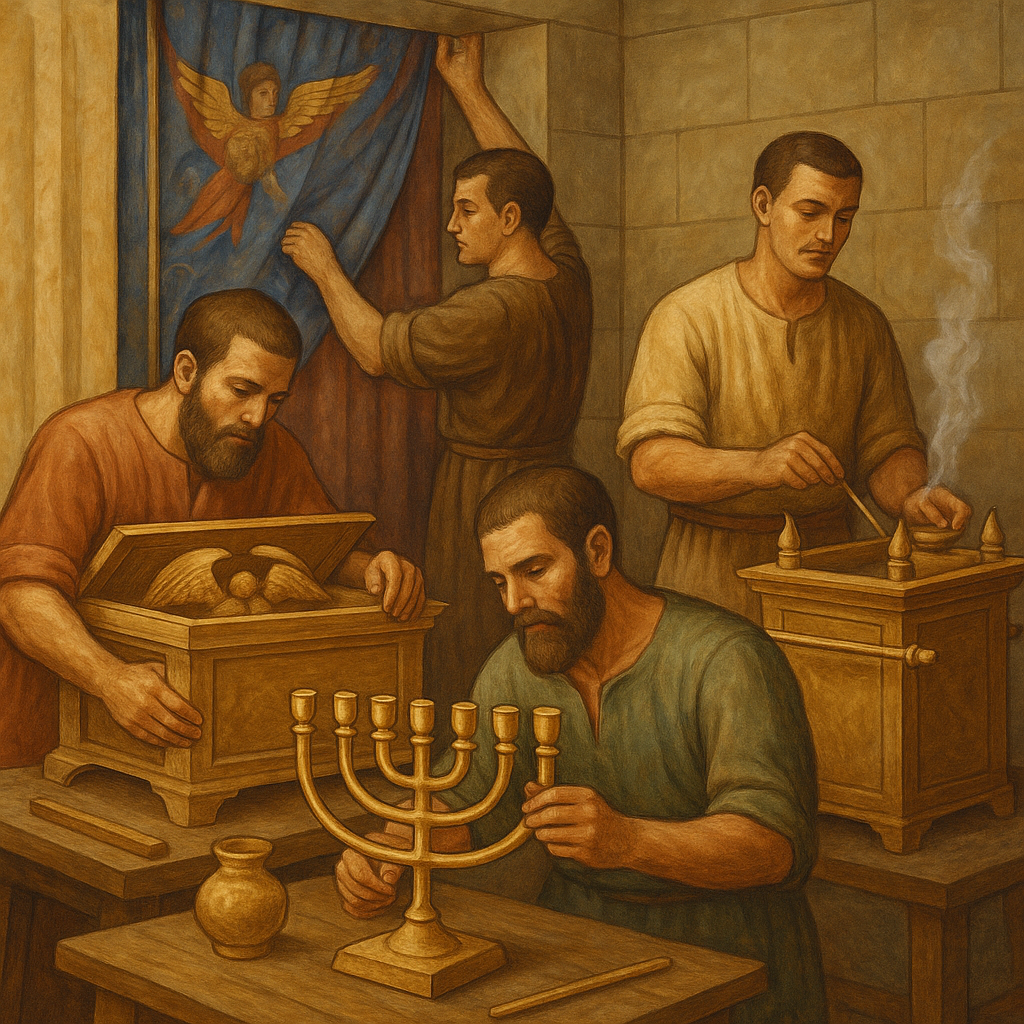
 Exodus 36–37 records the actual construction of the tabernacle and several of its sacred furnishings. The LORD had already given Moses the instructions and pattern in Exodus 25–31. After the interruption caused by Israel’s sin with the golden calf and the renewal of covenant dealings in Exodus 32–34, Exodus 35 begins the collection of materials and organization of the work. Chapters 36–37 then show the craftsmen carrying out what God had commanded.
A governing statement appears at the beginning of the section:
Exodus 36:1 — “Then wrought Bezaleel and Aholiab, and every wise hearted man, in whom the LORD put wisdom and understanding to know how to work all manner of work for the service of the sanctuary, according to all that the LORD had commanded.”
That final expression—“according to all that the LORD had commanded”—is central to understanding these chapters. The emphasis is not human innovation in worship, but careful obedience to divine revelation.
Chapter Summaries
Exodus 36 — The Tabernacle Structure Is Made
1. Bezaleel, Aholiab, and the wise-hearted begin the work — Exodus 36:1–2
Bezaleel, Aholiab, and the other skilled workers begin making the sanctuary according to God’s command.
The KJV explicitly states that the LORD had put “wisdom and understanding” in these men for the work. Their craftsmanship was therefore not presented merely as natural artistic ability; God had equipped them for the particular service He commanded.
Moses called those:
Exodus 36:2 — “…in whose heart the LORD had put wisdom, even every one whose heart stirred him up to come unto the work to do it.”
Two truths appear together: God supplied wisdom, and the workers willingly came to perform the work.
This was service to God, but it was service performed according to God’s revealed instructions. The builders were not authorized to redesign the sanctuary according to personal taste.
2. The people bring more than enough — Exodus 36:3–7
The children of Israel continued bringing free offerings for the work.
The craftsmen eventually reported to Moses:
Exodus 36:5 — “The people bring much more than enough for the service of the work, which the LORD commanded to make.”
Moses therefore commanded:
Exodus 36:6 — “Let neither man nor woman make any more work for the offering of the sanctuary. So the people were restrained from bringing.”
The remarkable conclusion is:
Exodus 36:7 — “For the stuff they had was sufficient for all the work to make it, and too much.”
The text plainly presents extraordinary willingness among the people at this point. There was no need to manipulate them into continued giving once the need had been met.
It would go beyond the text to claim that every Israelite possessed the same spiritual motive. What Scripture explicitly tells us is that the material supplied was “sufficient” and “too much.”
3. The ten inner curtains are made — Exodus 36:8–13
The workers made ten curtains from:
- fine twined linen,
- blue,
- purple,
- scarlet,
- and cherubims of cunning work.
The curtains were joined together with loops and golden taches so that the tabernacle formed a unified structure.
The details closely follow the instructions previously given in Exodus 26.
This repeated correspondence between command and construction emphasizes obedience. What God prescribed earlier is now being carried out.
4. The goats’ hair curtains and outer coverings — Exodus 36:14–19
Eleven curtains of goats’ hair were made for the tent over the tabernacle. They were connected with brass taches.
Over these came coverings of:
- “rams’ skins dyed red,”
- and “badgers’ skins.”
Scripture gives these materials plainly. Claims concerning the exact modern identification of every ancient material should not be treated as more certain than the KJV wording itself.
5. The boards, sockets, and bars — Exodus 36:20–34
Boards of shittim wood were made for the framework of the tabernacle.
The chapter describes:
- boards for the south side,
- boards for the north side,
- boards and corner arrangements for the west,
- silver sockets,
- bars of shittim wood,
- and gold overlay.
The middle bar was constructed to reach:
Exodus 36:33 — “…from end to end.”
The description shows an ordered and carefully constructed sanctuary. Nothing in the passage presents the tabernacle as casual or improvised worship.
6. The inner veil — Exodus 36:35–36
A veil was made of:
Exodus 36:35 — “…blue, and purple, and scarlet, and fine twined linen: with cherubims made he it of cunning work.”
It hung upon four pillars.
From the earlier divine instructions, this veil separated the holy place from the most holy place (Exodus 26:33).
The New Testament later specifically refers to the structure and divisions of the tabernacle in Hebrews 9. We should therefore recognize that Scripture itself gives theological significance to the tabernacle, while avoiding invented symbolism for every material, color, measurement, or fitting where Scripture gives no interpretation.
7. The hanging for the tabernacle entrance — Exodus 36:37–38
A hanging was made for the entrance of the tent from blue, purple, scarlet, and fine twined linen.
It was supported by five pillars with their appropriate hooks, chapiters, fillets, and brass sockets.
Exodus 36 therefore moves from the willing offerings of Israel to the construction of the principal fabric and framework of the tabernacle.
Exodus 37 — The Sacred Furniture Is Made
Exodus 37 shifts primarily from the structure itself to furniture placed within the tabernacle.
Bezaleel is specifically named as the maker of the ark.
1. The ark of the covenant — Exodus 37:1–5
Exodus 37:1 — “And Bezaleel made the ark of shittim wood…”
The ark was overlaid with pure gold within and without and surrounded with a crown of gold.
Four rings of gold were attached for carrying it, and staves of shittim wood overlaid with gold were placed through those rings.
The carrying arrangement reflects the instructions already given in Exodus 25.
The ark belonged especially to the most holy place and occupied a central position in Israel’s sanctuary worship.
Care should be taken not to invent meanings for each measurement or construction detail. Scripture gives important theological teaching concerning the ark and mercy seat elsewhere, but not every construction detail is assigned a separate symbolic interpretation.
2. The mercy seat and cherubims — Exodus 37:6–9
Bezaleel made:
Exodus 37:6 — “the mercy seat of pure gold”
Two cherubims of beaten gold were made at its ends.
Their wings spread upward, covering the mercy seat, while their faces looked toward one another and toward the mercy seat.
This is particularly important in light of God’s earlier words:
Exodus 25:22 — “And there I will meet with thee, and I will commune with thee from above the mercy seat…”
The mercy seat therefore was not merely ornamental furniture. It belonged to the place God appointed for His dealings with Israel through the Mosaic order.
Hebrews 9:5 later refers explicitly to:
“…the cherubims of glory shadowing the mercyseat…”
That New Testament passage confirms the continuing doctrinal importance of what Exodus records, while also warning against excessive speculation: Hebrews itself adds, “of which we cannot now speak particularly.”
3. The table of shewbread — Exodus 37:10–16
The table was made of shittim wood and overlaid with pure gold.
It included:
- a golden crown,
- rings,
- staves for carrying,
- dishes,
- spoons,
- bowls,
- and covers.
The previous command concerning this table stated:
Exodus 25:30 — “And thou shalt set upon the table shewbread before me alway.”
Thus the table had an appointed function in Israel’s worship.
Claims that every individual utensil possesses a distinct hidden spiritual meaning should be rejected unless Scripture itself supplies that meaning.
4. The golden candlestick — Exodus 37:17–24
The candlestick was made of pure beaten gold.
It included:
- a central shaft,
- six branches,
- bowls,
- knops,
- flowers,
- lamps,
- snuffers,
- and snuffdishes.
The detailed workmanship again corresponds to the instructions in Exodus 25.
Exodus 37:17 — “…of beaten work made he the candlestick…”
A talent of pure gold was used for the candlestick and its vessels.
The passage stresses both beauty and exact craftsmanship, but beauty was governed by God’s command rather than man’s imagination.
5. The altar of incense — Exodus 37:25–28
The incense altar was made of shittim wood and overlaid with pure gold.
It had:
- a horn at each corner,
- a golden crown,
- rings,
- and gold-covered staves.
This is the altar of incense, not the altar of burnt offering. The latter is constructed in Exodus 38.
The distinction is important because the two altars had different locations and functions in Israel’s tabernacle worship.
6. The anointing oil and incense — Exodus 37:29
The chapter closes:
Exodus 37:29 — “And he made the holy anointing oil, and the pure incense of sweet spices, according to the work of the apothecary.”
Their ingredients and instructions had been given previously in Exodus 30.
Again the principle remains consistent: what God commanded is what the servants made.
Key People and Places
- The LORD — The divine Author of the tabernacle instructions. The entire work was to be performed according to His command.
- Moses — God’s appointed leader of Israel. He received the tabernacle instructions and ordered the people to cease bringing materials once enough had been supplied.
- Bezaleel — Specifically named as a principal craftsman. Exodus 37:1 directly identifies him as the maker of the ark.
- Aholiab — Named with Bezaleel among those equipped for the sanctuary work.
- Wise-hearted craftsmen — Men in whom the LORD had put wisdom and understanding for the work.
- The children of Israel — They supplied the materials used in constructing the sanctuary.
- The tabernacle — The sanctuary structure being built according to God’s revealed pattern.
- The holy place and most holy place — Their distinction comes from the tabernacle instructions, particularly the veil described in Exodus 26 and constructed in Exodus 36.
- The wilderness of Sinai — Exodus 36–37 does not introduce a new named geographical location. The broader Exodus narrative places Israel in the wilderness of Sinai during this portion of the book (Exodus 19:1–2).
Main Doctrinal or Spiritual Themes
1. God’s worship must be governed by God’s Word
The strongest recurring lesson is expressed in Exodus 36:1:
“…according to all that the LORD had commanded.”
God determined the sanctuary, its materials, its arrangement, and its furnishings.
The craftsmen did not improve upon God’s design.
For the believer today, this establishes an enduring principle: God’s revealed will takes precedence over human creativity, tradition, popularity, or convenience.
This does not mean that the local church is Israel’s tabernacle or that Mosaic ceremonial regulations have been imposed upon the Church. Israel and the Church must remain distinct. The principle of obedience to divine revelation, however, remains valid.
2. God equips His servants for the work He appoints
The LORD put “wisdom and understanding” into the craftsmen.
Biblical service is not restricted to public preaching. In this passage, skilled manual labor was used directly in accomplishing God’s commanded work.
There is dignity in faithfully performing the task God has given, whether publicly visible or largely unseen.
3. Willing giving is preferable to coerced giving
The people supplied so much that Moses stopped the collection.
That harmonizes with the New Testament principle:
2 Corinthians 9:7 — “Every man according as he purposeth in his heart, so let him give; not grudgingly, or of necessity: for God loveth a cheerful giver.”
Exodus 36 should not be used to establish a precise New Testament financial system, but it certainly illustrates willing generosity toward God’s work.
4. God is a God of holiness and order
The sanctuary was constructed with boundaries, divisions, appointed materials, and prescribed furnishings.
The veil in particular marked a separation connected with access to the most holy place.
The New Testament explicitly develops this subject in Hebrews 9–10. The tabernacle belonged to the Mosaic order, and Christ’s finished work must govern Christian understanding of those Old Testament arrangements.
5. Redemption does not produce careless obedience
Israel had recently experienced grievous failure in the golden calf incident. In these chapters, however, the emphasis is upon doing what the LORD commanded.
Scripture does not authorize us to make claims about the inward spiritual condition of every individual involved. What the text clearly records is outward obedience in constructing the sanctuary according to God’s command.
6. God determines how He will be approached
The ark, mercy seat, veil, altar of incense, table, and candlestick were not invented by Israel.
God Himself established the tabernacle order.
Under the present dispensation, believers do not approach God through the Mosaic tabernacle. Access to God is through Jesus Christ.
1 Timothy 2:5 — “For there is one God, and one mediator between God and men, the man Christ Jesus;”
Thus the tabernacle should be understood within God’s dealings with Israel while recognizing that the New Testament uses it to teach important truths concerning Christ’s priestly work.
7. Scripture warrants typology; imagination does not
Hebrews expressly uses the tabernacle in teaching concerning Christ, sacrifice, priesthood, covenant, and access to God.
Therefore biblical typology is legitimate where Scripture establishes it.
But it is unsafe to claim, without biblical authority, that every hook, socket, board, color, number, measurement, or material possesses a hidden prophetic meaning. Conservative interpretation requires restraint as well as conviction.
Practical Applications or Lessons
Obey precisely where God has spoken
The craftsmen repeatedly followed what God had commanded. Faithfulness does not consist merely in good intentions.
John 14:15 — “If ye love me, keep my commandments.”
A believer should ask not simply, “What do I prefer?” but, “What hath God said?”
Use the abilities God has given you
Bezaleel and the craftsmen served through skilled labor.
A Christian should not despise practical ability simply because it is not pulpit ministry. Work performed faithfully for God’s glory has value.
Colossians 3:23 — “And whatsoever ye do, do it heartily, as to the Lord, and not unto men;”
Give willingly rather than grudgingly
Israel’s contribution became so abundant that further giving had to be stopped.
That is a powerful example of generosity without coercion.
Do God’s work God’s way
The golden calf episode demonstrated the danger of self-made worship. The tabernacle construction demonstrates the opposite principle: worship directed by revelation.
Religious sincerity cannot substitute for biblical obedience.
Excellence and holiness are not enemies
The tabernacle was both carefully made and separated unto God.
Poor workmanship should not be excused merely because something is called ministry. Neither should outward excellence replace spiritual obedience. Exodus 36–37 joins craftsmanship with submission to God’s command.
Do not confuse Old Testament Israel with the New Testament Church
The tabernacle was given to Israel within the Mosaic system.
The Church is not commanded to reproduce its sanctuary, furniture, priesthood, sacrifices, or ceremonial system. Hebrews explains their relationship to Christ’s work.
Sound dispensational interpretation preserves that distinction rather than transferring Israel’s ceremonial ordinances directly to the Church.
God’s Word sets the boundary for interpretation
These chapters contain rich details, but not every detail is explained symbolically.
Where Scripture speaks, we may speak confidently. Where Scripture does not explain a detail, we should resist building doctrine upon imagination.
That restraint is not lack of faith. It is submission to the sufficiency of what God has actually written.
Overall Message
Exodus 36–37 presents obedient service according to divine revelation.
God supplied the pattern.
God supplied wisdom to the workers.
The people supplied abundant materials.
The craftsmen executed the work.
And the repeated standard was what “the LORD had commanded.”
The tabernacle was not Israel’s invention. It was God’s appointed sanctuary for His dealings with Israel under the Mosaic covenant. The structure, veil, ark, mercy seat, table, candlestick, and incense altar all belonged to an ordered system established by God.
For believers today, the chapters teach reverence for God’s Word, careful obedience, willing service, generous giving, disciplined workmanship, and restraint against inventing religious practices or interpretations beyond Scripture.
Comments are closed