 Exodus 31–33 forms a major turning point in Israel’s experience at Sinai. Exodus 31 concludes the LORD’s instructions concerning the tabernacle and gives Moses the two tables of testimony. Exodus 32 records Israel’s grievous sin with the golden calf, Moses’ intercession, and divine judgment. Exodus 33 shows the seriousness of broken fellowship, Moses’ continuing intercession, and his remarkable request to see the glory of God.
Throughout these chapters, the KJV emphasizes the holiness of God, the sinfulness of idolatry, the necessity of obedience, the value of intercessory prayer, and the supreme importance of the presence of God.
Chapter Summaries
Exodus 31 — Bezaleel, Aholiab, the Sabbath, and the Tables of Testimony
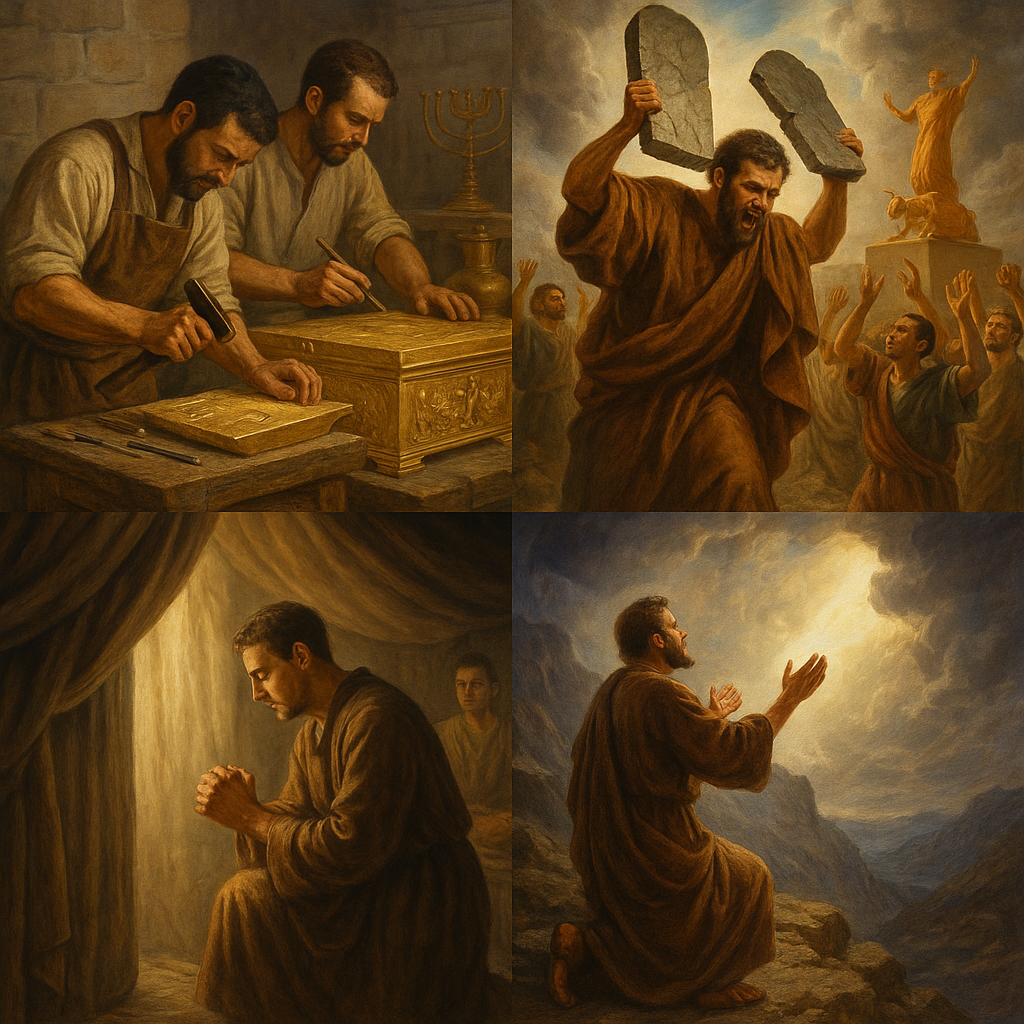
After giving Moses detailed instructions concerning the tabernacle and its service in Exodus 25–30, the LORD names particular men whom He has equipped to carry out the work.
God says concerning Bezaleel:
Exodus 31:2–3: “See, I have called by name Bezaleel the son of Uri, the son of Hur, of the tribe of Judah: And I have filled him with the spirit of God, in wisdom, and in understanding, and in knowledge, and in all manner of workmanship,”
Bezaleel is therefore explicitly called by God and explicitly enabled by God for the craftsmanship required for the tabernacle. His abilities include working with gold, silver, brass, precious stones, and timber.
Aholiab, of the tribe of Dan, is appointed with him:
Exodus 31:6: “And I, behold, I have given with him Aholiab, the son of Ahisamach, of the tribe of Dan: and in the hearts of all that are wise hearted I have put wisdom, that they may make all that I have commanded thee;”
The point is not merely human artistic ability. God supplied the wisdom necessary to accomplish what He had commanded. Their skill was to operate under divine revelation, not human invention.
The LORD then speaks again concerning the Sabbath. It is especially important to retain the precise wording of the passage:
Exodus 31:13: “Verily my sabbaths ye shall keep: for it is a sign between me and you throughout your generations…”
And:
Exodus 31:16–17: “Wherefore the children of Israel shall keep the sabbath, to observe the sabbath throughout their generations, for a perpetual covenant. It is a sign between me and the children of Israel for ever…”
The explicit text identifies the Sabbath here as a sign between the LORD and the children of Israel. From a dispensational standpoint, this covenant sign should not be transferred to the New Testament church as though the church were Israel. The Church is not placed under the Mosaic covenant.
The chapter closes with a tremendous statement concerning the divine origin and authority of the testimony:
Exodus 31:18: “And he gave unto Moses, when he had made an end of communing with him upon mount Sinai, two tables of testimony, tables of stone, written with the finger of God.”
The tables were not the religious opinions of Moses. God Himself gave them.
Exodus 32 — The Golden Calf, Moses’ Intercession, and Judgment
While Moses is on the mountain, Israel turns aside from the LORD’s commandment.
The people approach Aaron:
Exodus 32:1: “Up, make us gods, which shall go before us; for as for this Moses, the man that brought us up out of the land of Egypt, we wot not what is become of him.”
The text directly connects their demand with Moses’ prolonged absence from their sight. It does not justify further speculation regarding every individual motive.
Aaron takes the people’s golden earrings and fashions the gold:
Exodus 32:4: “And he received them at their hand, and fashioned it with a graving tool, after he had made it a molten calf…”
This becomes especially important when Aaron later attempts to explain his actions to Moses. Whatever excuse Aaron later gives, verse 4 plainly says that he fashioned it with a graving tool.
The people then say:
“These be thy gods, O Israel, which brought thee up out of the land of Egypt.”
Aaron builds an altar before the calf and proclaims:
Exodus 32:5: “To morrow is a feast to the LORD.”
Thus the passage shows something particularly dangerous: the name of the LORD was being associated with worship that directly violated His commandment. Calling something a “feast to the LORD” did not make the worship acceptable.
God tells Moses:
Exodus 32:7: “Go, get thee down; for thy people, which thou broughtest out of the land of Egypt, have corrupted themselves:”
He describes Israel as:
Exodus 32:9: “a stiffnecked people.”
The LORD announces judgment, but Moses intercedes. Moses appeals to God’s name before Egypt and to God’s sworn promises concerning Abraham, Isaac, and Israel.
Then Scripture says:
Exodus 32:14: “And the LORD repented of the evil which he thought to do unto his people.”
We should retain the KJV wording without forcing upon it ideas the text does not teach. God had announced that He would consume Israel in His wrath; following Moses’ intercession, that announced destruction of the nation was not carried out in that form. Nothing in the passage teaches that God had sinned, made a moral mistake, or discovered information previously unknown to Him.
Moses descends carrying the two tables. Joshua hears the noise of the people, but Moses recognizes that it is neither the sound of victory nor defeat.
When Moses sees the calf and the dancing:
Exodus 32:19: “Moses’ anger waxed hot, and he cast the tables out of his hands, and brake them beneath the mount.”
He burns the calf, grinds it to powder, scatters it upon the water, and makes the children of Israel drink of it.
Moses then confronts Aaron.
Aaron attempts to shift attention toward the people:
Exodus 32:22: “Thou knowest the people, that they are set on mischief.”
He then says:
Exodus 32:24: “Then I cast it into the fire, and there came out this calf.”
Yet verse 4 has already stated that Aaron “fashioned it with a graving tool.” The contrast is supplied by Scripture itself.
Moses then stands in the gate of the camp and gives one of the great calls to separation found in the Old Testament:
Exodus 32:26: “Who is on the LORD’S side? let him come unto me.”
The sons of Levi gather unto Moses. At the LORD’s command, judgment falls, and:
Exodus 32:28: “there fell of the people that day about three thousand men.”
This was judicial action within Israel under the Mosaic covenant. It should not be used as authorization for the New Testament church to employ physical violence against idolaters, unbelievers, or false teachers. The church’s weapons are not carnal.
The next day Moses tells the people plainly:
Exodus 32:30: “Ye have sinned a great sin.”
He returns to God and intercedes:
Exodus 32:32: “Yet now, if thou wilt forgive their sin–; and if not, blot me, I pray thee, out of thy book which thou hast written.”
God answers:
Exodus 32:33: “Whosoever hath sinned against me, him will I blot out of my book.”
The passage calls it “my book.” Exodus 32 itself does not give enough information to justify importing every theological conclusion sometimes attached to that expression.
Moses demonstrates extraordinary concern for Israel, but Moses cannot become their substitute for sin. Scripture maintains individual accountability before God.
The chapter closes:
Exodus 32:35: “And the LORD plagued the people, because they made the calf, which Aaron made.”
Intercession prevented the announced destruction of the entire nation, but it did not mean that sin ceased to have consequences.
Exodus 33 — The Presence of God and Moses’ Request to See His Glory
The LORD commands Moses to continue toward the land promised to Abraham, Isaac, and Jacob.
God promises to send an angel before them and to drive out the nations of the land. The text here says “an angel” in Exodus 33:2. We should not identify that angel more specifically than the passage itself does without additional explicit Scripture.
Then comes the sobering statement:
Exodus 33:3: “for I will not go up in the midst of thee; for thou art a stiffnecked people: lest I consume thee in the way.”
The people mourn when they hear these “evil tidings.”
The LORD commands them to put off their ornaments:
Exodus 33:6: “And the children of Israel stripped themselves of their ornaments by the mount Horeb.”
Moses then takes what the KJV calls “the tabernacle” and pitches it outside the camp:
Exodus 33:7: “And Moses took the tabernacle, and pitched it without the camp, afar off from the camp, and called it the Tabernacle of the congregation.”
Because the KJV itself uses this wording, it is safest simply to retain it. Scripture in this verse does not explain every chronological detail concerning this structure in relation to the later completed tabernacle, so unnecessary speculation should be avoided.
When Moses enters the tabernacle, the cloudy pillar descends, and:
Exodus 33:9: “the LORD talked with Moses.”
The people rise and worship, every man at his tent door.
Then Scripture says:
Exodus 33:11: “And the LORD spake unto Moses face to face, as a man speaketh unto his friend.”
This verse must be interpreted together with verse 20, where God tells Moses:
Exodus 33:20: “Thou canst not see my face: for there shall no man see me, and live.”
Therefore, Exodus 33:11 cannot mean that Moses literally looked upon the unveiled face of God in the sense specifically prohibited in verse 20. The expression describes the remarkable directness and personal character of God’s communication with Moses. Verse 20 supplies the necessary limitation.
Joshua is also mentioned:
“his servant Joshua, the son of Nun, a young man, departed not out of the tabernacle.”
The text explicitly calls Joshua “a young man.” It does not supply his exact age here.
Moses then pleads for the LORD’s presence. God answers:
Exodus 33:14: “My presence shall go with thee, and I will give thee rest.”
Moses responds:
Exodus 33:15: “If thy presence go not with me, carry us not up hence.”
Moses understood that possessing a land without the presence and favor of God would not be enough.
He further says:
Exodus 33:16: “so shall we be separated, I and thy people, from all the people that are upon the face of the earth.”
Here separation is directly associated with God’s presence among His people.
Then Moses makes his famous request:
Exodus 33:18: “I beseech thee, shew me thy glory.”
God answers that He will make His goodness pass before Moses and proclaim the name of the LORD.
He also declares:
Exodus 33:19: “I will be gracious to whom I will be gracious, and will shew mercy on whom I will shew mercy.”
The verse plainly teaches God’s sovereign freedom in showing grace and mercy. In its immediate context, however, the subject is God’s dealings with Moses and Israel following the golden-calf rebellion. The verse by itself does not establish Calvinistic regeneration, irresistible grace, or the doctrine that God regenerates selected sinners before faith.
Because Moses cannot see God’s face and live, God places him in a cleft of the rock:
Exodus 33:22: “I will put thee in a clift of the rock, and will cover thee with my hand while I pass by:”
Then:
Exodus 33:23: “And I will take away mine hand, and thou shalt see my back parts: but my face shall not be seen.”
The chapter therefore ends not with man mastering the glory of God, but with God graciously revealing only what Moses is permitted to behold.
Key People and Places
- The LORD — The holy covenant God of Israel, who commands the tabernacle work, gives the tables of testimony, judges idolatry, hears Moses’ intercession, and reveals His goodness and glory.
- Moses — Israel’s God-appointed leader and mediator in these chapters. He receives the tables, confronts Israel’s sin, intercedes for the nation, and pleads for God’s presence.
- Bezaleel — Son of Uri, son of Hur, of Judah. God explicitly calls him and fills him with wisdom and skill for the tabernacle workmanship.
- Aholiab — Son of Ahisamach, of Dan. Appointed to work with Bezaleel.
- Aaron — Moses’ brother. He receives Israel’s gold and makes the molten calf. His later explanation does not erase the explicit statement that he fashioned it.
- Joshua — Moses’ servant. He accompanies Moses in the Sinai account and is described in Exodus 33:11 as “a young man.”
- The children of Israel — The covenant nation that turns aside into idolatry and is repeatedly described in these chapters as “stiffnecked.”
- The sons of Levi — Those who gather to Moses after his call, “Who is on the LORD’S side?”
- Mount Sinai — Named in Exodus 31:18 as the place where God gives Moses the tables of testimony.
- Mount Horeb — Named in Exodus 33:6 in connection with Israel removing its ornaments. These chapters themselves use both geographical names; there is no need to add more than the KJV states.
- The camp of Israel — Scene of the golden-calf rebellion and subsequent judgment.
- The Tabernacle of the congregation outside the camp — The place where Moses meets with the LORD in Exodus 33.
- The promised land — The land sworn to Abraham, Isaac, and Jacob, toward which Israel is commanded to continue.
Main Doctrinal or Spiritual Themes
1. God Determines How He Is to Be Worshipped
Israel could not invent its own worship and make it acceptable merely by attaching the LORD’s name to it.
Aaron proclaimed:
“To morrow is a feast to the LORD.”
Yet the calf remained an abomination.
Sincerity, enthusiasm, crowds, celebration, and religious terminology cannot sanctify worship that contradicts God’s Word.
2. Idolatry Is a Direct Rebellion Against God
The golden calf was not a harmless cultural expression. God said:
Exodus 32:8: “They have turned aside quickly out of the way which I commanded them.”
The fundamental issue was departure from God’s command.
3. God’s Word Possesses Divine Authority
The tables were:
“written with the finger of God.”
God’s commandments do not derive their authority from human acceptance. God speaks with authority because He is God.
4. God Equips Men for the Work He Commands
Bezaleel and Aholiab demonstrate that practical ability can be used in God’s service.
There is no biblical division in which preaching is “spiritual” but faithful craftsmanship is insignificant. God Himself gave wisdom for the tabernacle work.
At the same time, Exodus 31 should not be forced into a doctrine of modern charismatic sign gifts. The passage explicitly concerns divine enablement for the work God had commanded.
5. The Sabbath in Exodus 31 Is a Sign With Israel
The wording is unmistakable:
“It is a sign between me and the children of Israel for ever.”
This supports the biblical distinction between Israel and the Church. The church does not become Israel, and the Mosaic Sabbath covenant sign should not be transferred to the Body of Christ.
6. Sin Brings Real Consequences
Israel was the redeemed nation that had been brought out of Egypt, yet privilege did not make rebellion harmless.
About three thousand died, and the LORD later plagued the people.
Deliverance from Egypt did not give Israel permission to live contrary to God’s commands.
Likewise, salvation by grace does not give a believer permission to practice sin. Salvation is not earned by holy living, but those who have been saved should desire to walk in obedience to God.
7. Intercessory Prayer Matters
Moses’ prayer is one of the strongest examples of intercession in the Old Testament.
He appeals to:
- God’s honor before Egypt.
- God’s promises.
- God’s covenant dealings with Abraham, Isaac, and Israel.
Biblical intercession rests upon God’s character and Word rather than man’s supposed merit.
8. Human Leaders Remain Accountable
Aaron’s failure provides a serious warning. He yielded to the demand of the people, participated in making the calf, and afterward offered an explanation that does not agree with the fuller description already given in verse 4.
Spiritual leadership requires courage to obey God when the crowd desires something else.
9. God Is Both Holy and Merciful
Exodus 32 contains severe judgment. Exodus 33 contains remarkable mercy.
These truths are not contradictory.
The God who judges idolatry is also the God who says:
“I will be gracious to whom I will be gracious, and will shew mercy on whom I will shew mercy.”
Biblical grace never requires God to cease being holy.
10. God’s Presence Is Greater Than Material Prosperity
Moses would not be satisfied merely with reaching the promised land.
“If thy presence go not with me, carry us not up hence.”
Land, possessions, security, and outward success were not adequate substitutes for God’s presence.
11. God’s People Are to Be Separated Unto Him
Moses says God’s presence would demonstrate that Israel was:
“separated…from all the people that are upon the face of the earth.”
Biblical separation is first a separation unto God, and therefore necessarily involves separation from that which violates His holiness.
12. God’s Glory Cannot Be Reduced to Human Terms
Moses asks to see God’s glory. God graciously grants a revelation, but sets a boundary:
“Thou canst not see my face: for there shall no man see me, and live.”
God reveals Himself according to His own will. Man does not place God under examination.
Practical Applications or Lessons
Use Whatever God Has Given You for His Service
Bezaleel and Aholiab remind believers that ability, knowledge, craftsmanship, organization, and practical skill can all be used for the glory of God.
The important question is not merely, “What can I do?” but, “Am I using what God has given me in obedience to His Word?”
Never Substitute Human Innovation for Divine Revelation
Israel wanted something visible and immediate.
God had already spoken.
Their problem was not that God had failed to reveal His will; they abandoned what He had revealed.
Churches likewise must never allow popularity, culture, entertainment, or religious fashion to overrule Scripture.
Do Not Put God’s Name on Something He Has Forbidden
Aaron’s words are especially sobering:
“To morrow is a feast to the LORD.”
A religious label cannot transform disobedience into obedience.
Everything done in God’s name must still be tested by God’s Word.
Do Not Let the Crowd Determine Your Convictions
Aaron knew the people were demanding something wrong, yet he participated.
A preacher, parent, teacher, church leader, or Christian cannot determine truth by counting votes.
Moses eventually stood and asked:
“Who is on the LORD’S side?”
That remains the essential question.
Deal Honestly With Personal Sin
Aaron attempted to explain away his involvement.
Verse 4 had already recorded what happened.
A believer grows spiritually by agreeing with God about sin, not by minimizing personal responsibility.
Proverbs 28:13: “He that covereth his sins shall not prosper: but whoso confesseth and forsaketh them shall have mercy.”
Pray From the Promises of God
Moses’ intercession rested heavily on what God had already promised.
Effective prayer is not an attempt to manipulate God. It brings God’s own Word before Him in faith and submission.
Never Assume That Forgiveness Makes Sin Consequence-Free
Israel was not completely destroyed, but judgment still followed.
Sin can be forgiven while earthly consequences remain.
This is an important warning against treating grace as permission to sin.
Value God’s Presence Above Outward Success
Moses essentially declares that the promised destination is worthless without the presence of the One who gave the promise.
A church can possess buildings, programs, money, activity, and reputation while desperately needing God’s blessing.
A believer should be able to say in principle with Moses:
“If thy presence go not with me, carry us not up hence.”
Desire to Know God More Deeply
Moses had already experienced extraordinary dealings with God, yet he prayed:
“I beseech thee, shew me thy glory.”
Past spiritual experience should never produce complacency.
There is always more of God’s character to know through His Word.
Approach God’s Glory With Reverence
Modern religion can become dangerously casual about the holiness and majesty of God.
Exodus 33 gives the opposite picture.
The LORD says:
“there shall no man see me, and live.”
The proper response to God’s glory is reverence, humility, obedience, and worship.
Overall Message of Exodus 31–33
Exodus 31 begins with divine order: God appoints the workers, gives the pattern, establishes His covenant sign with Israel, and gives Moses the tables written by His own finger.
Exodus 32 reveals human rebellion: while Moses is receiving God’s Word, Israel violates it. The golden calf exposes the danger of idolatry, corrupt worship, weak leadership, and departure from revealed truth.
Exodus 33 reveals the necessity of divine presence: Moses understands that Israel’s greatest need is not merely the promised land but the God who promised it.
The movement of these chapters can therefore be summarized:
God gives His Word / man violates His Word / judgment becomes deserved / intercession is made / mercy is shown / God’s presence becomes the supreme necessity.
One of the central spiritual cries of the entire section is Moses’ request:
“I beseech thee, shew me thy glory.” — Exodus 33:18
And one of its great practical tests remains:
“Who is on the LORD’S side?” — Exodus 32:26
Those two statements belong together. The person who truly desires the glory and presence of God must also be willing to stand on the LORD’s side when others turn aside.
Comments are closed