 Exodus 26–28 continues the LORD’s instructions to Moses concerning the tabernacle, its court and altar, and the priestly garments of Aaron and his sons. These chapters are primarily divine instructions, not a record that the work had already been completed. Exodus 36–39 records the carrying out of many of these commands.
A controlling principle appears twice:
“And thou shalt rear up the tabernacle according to the fashion thereof which was shewed thee in the mount.” — Exodus 26:30
“As it was shewed thee in the mount, so shall they make it.” — Exodus 27:8
The emphasis is therefore not human religious creativity, but obedience to the pattern God revealed.
Chapter Summaries
Exodus 26 — The Tabernacle, Its Coverings, Structure, and Veil
Exodus 26 gives detailed instructions for the physical structure of the tabernacle.
The chapter begins with ten curtains:
“Moreover thou shalt make the tabernacle with ten curtains of fine twined linen, and blue, and purple, and scarlet: with cherubims of cunning work shalt thou make them.” — Exodus 26:1
The curtains were joined together so that, as the LORD said,
“it shall be one tabernacle.” — Exodus 26:6
Additional coverings were commanded. Eleven curtains of goats’ hair were to form a covering over the tabernacle, followed by a covering of rams’ skins dyed red and another covering above that of badgers’ skins (Exodus 26:7–14).
The KJV explicitly gives these materials and arrangements. Scripture does not explicitly assign a separate symbolic meaning to every color or material in this chapter. Therefore, interpretations that make blue invariably mean one doctrine, purple another, scarlet another, and so forth should not be stated as biblical facts unless another passage of Scripture supplies that interpretation.
The LORD next commanded boards of shittim wood standing upright, with sockets of silver, rings, and bars to unite the structure (Exodus 26:15–29). The repeated measurements demonstrate that the tabernacle was not to be designed according to Moses’ preference.
God said:
“And thou shalt rear up the tabernacle according to the fashion thereof which was shewed thee in the mount.” — Exodus 26:30
That statement establishes an important theological principle: God determined the pattern of His sanctuary.
The Vail and the Most Holy Place
A special vail was commanded:
“And thou shalt make a vail of blue, and purple, and scarlet, and fine twined linen of cunning work: with cherubims shall it be made.” — Exodus 26:31
The ark was to be placed within the vail:
“and the vail shall divide unto you between the holy place and the most holy.” — Exodus 26:33
The mercy seat was to be placed upon the ark of the testimony “in the most holy place” (Exodus 26:34).
Outside the vail were the table and candlestick, with their locations specified by the LORD (Exodus 26:35). A hanging was also prescribed for the door of the tent (Exodus 26:36–37).
The separation created by the vail is explicit. The fuller doctrinal significance is supplied by the New Testament. Hebrews describes the tabernacle arrangements as “a figure for the time then present” (Hebrews 9:9). Concerning the believer’s approach to God through Christ, Hebrews 10:19–20 says:
“Having therefore, brethren, boldness to enter into the holiest by the blood of Jesus,
By a new and living way, which he hath consecrated for us, through the veil, that is to say, his flesh;”
Here Scripture itself supplies the Christological significance of the veil. We therefore need not invent meanings for details God has not interpreted.
Exodus 27 — The Altar, the Court, and Oil for the Light
Exodus 27 moves from the structure of the tabernacle to the altar, the surrounding court, and the provision of oil for the lamp.
The Altar
The LORD commanded:
“And thou shalt make an altar of shittim wood, five cubits long, and five cubits broad; the altar shall be foursquare: and the height thereof shall be three cubits.” — Exodus 27:1
Horns were to be made upon its four corners, and the altar was to be overlaid with brass (Exodus 27:2). Pans, shovels, basins, fleshhooks, firepans, a brass grate, rings, and staves were also specified (Exodus 27:3–7).
The altar was to be hollow with boards, and once again God emphasized conformity to revelation:
“as it was shewed thee in the mount, so shall they make it.” — Exodus 27:8
The chapter itself does not give the full system of sacrifices associated with Israel’s worship. Those instructions are supplied more fully elsewhere in the law. We should therefore distinguish between what Exodus 27 explicitly describes—the altar and its construction—and what subsequent passages say concerning its sacrificial use.
The Court
The LORD then prescribed the court of the tabernacle with hangings, pillars, sockets, hooks, fillets, and a gate (Exodus 27:9–18).
The south and north sides were each one hundred cubits long. The west side was fifty cubits wide. The east side also measured fifty cubits, with arrangements for the entrance and its hanging.
Exodus 27:18 summarizes:
“The length of the court shall be an hundred cubits, and the breadth fifty every where, and the height five cubits of fine twined linen, and their sockets of brass.”
Again the emphasis is precision. God did not merely tell Moses to construct a religious enclosure and leave the design to human imagination.
Pure Oil for the Light
The final part of the chapter concerns the lamp:
“And thou shalt command the children of Israel, that they bring thee pure oil olive beaten for the light, to cause the lamp to burn always.” — Exodus 27:20
Aaron and his sons were responsible for its ordering:
“Aaron and his sons shall order it from evening to morning before the LORD.” — Exodus 27:21
The verse explicitly calls this “a statute for ever unto their generations on the behalf of the children of Israel.”
This wording is important dispensationally. The command was given within God’s covenant dealings with Israel, and the duty was assigned to Aaron and his sons. The New Testament church should not be confused with Israel or placed under the Aaronic priesthood.
The spiritual principle of faithful, orderly service remains instructive, but the Mosaic ordinance itself belongs to the system God gave Israel.
Exodus 28 — Aaron, His Sons, and the Holy Garments
Exodus 28 turns particularly to the priesthood.
God said to Moses:
“And take thou unto thee Aaron thy brother, and his sons with him, from among the children of Israel, that he may minister unto me in the priest’s office, even Aaron, Nadab and Abihu, Eleazar and Ithamar, Aaron’s sons.” — Exodus 28:1
This is explicit: Aaron and his named sons were separated for the priest’s office.
Holy Garments
God commanded:
“And thou shalt make holy garments for Aaron thy brother for glory and for beauty.” — Exodus 28:2
God also told Moses to speak:
“unto all that are wise hearted, whom I have filled with the spirit of wisdom” — Exodus 28:3.
Their task was to make Aaron’s garments so that he might be consecrated to minister in the priest’s office.
The garments named in Exodus 28:4 are:
- a breastplate,
- an ephod,
- a robe,
- a broidered coat,
- a mitre,
- and a girdle.
The chapter then describes them in detail.
The Ephod and the Names of Israel
The ephod was made with gold, blue, purple, scarlet, and fine twined linen (Exodus 28:6).
Two onyx stones were to bear the names of the children of Israel:
“Six of their names on one stone, and the other six names of the rest on the other stone, according to their birth.” — Exodus 28:10
God explains their purpose:
“And Aaron shall bear their names before the LORD upon his two shoulders for a memorial.” — Exodus 28:12
We therefore do not need to speculate concerning what the stones represented: the text tells us that the engraved names served as a memorial, and Aaron bore those names before the LORD.
The Breastplate of Judgment
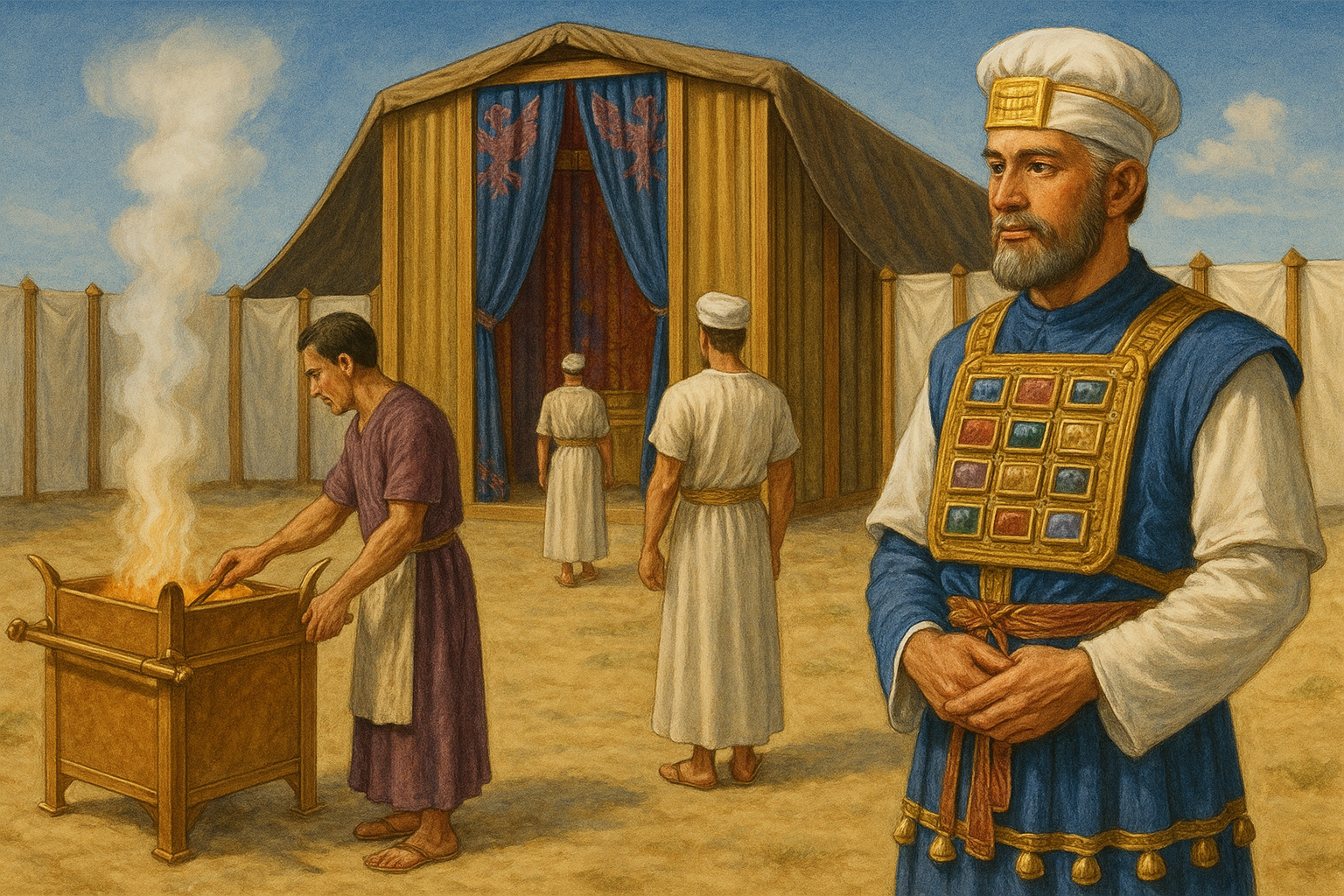
The breastplate contained twelve precious stones in four rows, with the names of Israel’s twelve tribes engraved upon them (Exodus 28:15–21).
God said:
“And Aaron shall bear the names of the children of Israel in the breastplate of judgment upon his heart, when he goeth in unto the holy place, for a memorial before the LORD continually.” — Exodus 28:29
Thus Aaron bore Israel both upon his shoulders and upon his heart before the LORD.
Verse 30 introduces the Urim and Thummim:
“And thou shalt put in the breastplate of judgment the Urim and the Thummim; and they shall be upon Aaron’s heart, when he goeth in before the LORD.”
The KJV does not explain in this chapter their physical appearance or construction. Consequently, detailed reconstructions of exactly what they looked like go beyond what Exodus 28 states.
The verse concludes:
“and Aaron shall bear the judgment of the children of Israel upon his heart before the LORD continually.”
The Robe, Bells, and Pomegranates
The robe of the ephod was to be all of blue (Exodus 28:31). Its hem had pomegranates of blue, purple, and scarlet alternating with golden bells (Exodus 28:33–34).
God explicitly gives this requirement:
“And it shall be upon Aaron to minister: and his sound shall be heard when he goeth in unto the holy place before the LORD, and when he cometh out, that he die not.” — Exodus 28:35
Any additional symbolic meanings assigned individually to the bells and pomegranates are, at most, possible inferences unless Scripture elsewhere establishes them. They should not be presented as explicit doctrine.
“HOLINESS TO THE LORD”
A plate of pure gold was placed upon Aaron’s mitre with this engraving:
“HOLINESS TO THE LORD.” — Exodus 28:36
Aaron was to bear it upon his forehead:
“that Aaron may bear the iniquity of the holy things, which the children of Israel shall hallow in all their holy gifts.” — Exodus 28:38
The chapter repeatedly joins priestly service with holiness.
Garments for Aaron’s Sons
Aaron’s sons were also given coats, girdles, and bonnets:
“for glory and for beauty.” — Exodus 28:40
Moses was commanded concerning Aaron and his sons:
“and shalt anoint them, and consecrate them, and sanctify them, that they may minister unto me in the priest’s office.” — Exodus 28:41
The chapter also commands linen breeches:
“to cover their nakedness; from the loins even unto the thighs they shall reach.” — Exodus 28:42
The stated purpose is therefore modest covering in connection with holy service.
The chapter ends with a solemn warning that they must wear the appointed garments when ministering:
“that they bear not iniquity, and die: it shall be a statute for ever unto him and his seed after him.” — Exodus 28:43
God’s service was not to be approached casually or according to personal preference.
Key People and Places
- The LORD — The divine Lawgiver who determines the tabernacle pattern, priesthood, garments, and manner of service. The plans originate with God, not Moses.
- Moses — Receives the instructions and is responsible for seeing that the tabernacle and priestly arrangements conform to the revealed pattern.
- Aaron — Moses’ brother, specifically chosen “that he may minister unto me in the priest’s office” (Exodus 28:1). He is the central priestly figure in these chapters.
- Nadab and Abihu — Sons of Aaron named in Exodus 28:1 as among those appointed to the priestly office. Exodus 28 itself does not describe the later events concerning them recorded elsewhere.
- Eleazar and Ithamar — Aaron’s other two sons named for priestly service in Exodus 28:1.
- The children of Israel — The covenant nation for whom these tabernacle and priestly arrangements were given. Their names were borne by Aaron before the LORD.
- Wise-hearted craftsmen — Exodus 28:3 describes those “whom I have filled with the spirit of wisdom” for the making of the priestly garments.
- The mount — Exodus 26:30 and 27:8 refer to the pattern shown Moses “in the mount.” In the broader Exodus narrative, Moses had gone up into Mount Sinai to receive revelation from God (Exodus 24:12–18).
- The tabernacle — The sanctuary whose structure and coverings are prescribed in Exodus 26.
- The holy place — The area outside the inner vail; Exodus 26:33 explicitly distinguishes it from “the most holy.”
- The most holy — The place within the vail where the ark and mercy seat were placed (Exodus 26:33–34).
- The court of the tabernacle — The enclosed area described in Exodus 27:9–18.
Main Doctrinal or Spiritual Themes
1. God Determines How He Is to Be Approached
The dominant truth of these chapters is that worship begins with divine revelation rather than human invention.
God repeatedly specifies measurements, materials, locations, garments, and duties and then says:
“according to the fashion thereof which was shewed thee in the mount.”
Biblical worship is therefore not founded upon what man finds impressive, emotional, traditional, or culturally appealing. The servant of God is bound by what God has revealed.
This does not mean that every tabernacle regulation is a command to the New Testament church. It means that the underlying principle of submission to revealed truth remains valid.
2. God Is Holy
Holiness pervades the passage:
- “holy place” — Exodus 26:33
- “most holy” — Exodus 26:33
- “holy garments” — Exodus 28:2
- “HOLINESS TO THE LORD” — Exodus 28:36
- “holy things” — Exodus 28:38
God’s holiness is not a ceremonial decoration added to worship. It governs access, conduct, service, and priesthood.
The believer should never reduce the worship and service of God to entertainment, casual familiarity, or self-expression.
3. Sinful Man Does Not Dictate His Own Access to God
The vail divided:
“between the holy place and the most holy.” — Exodus 26:33
The tabernacle system plainly contained distinctions and restrictions.
Hebrews gives the inspired New Testament interpretation of the larger system:
“The Holy Ghost this signifying, that the way into the holiest of all was not yet made manifest, while as the first tabernacle was yet standing:” — Hebrews 9:8
Under the New Testament, our access is through Christ:
“Having therefore, brethren, boldness to enter into the holiest by the blood of Jesus.” — Hebrews 10:19
The contrast magnifies the privilege purchased for believers by Jesus Christ.
4. The Aaronic Priesthood Belongs to Israel’s Mosaic Order
Exodus 28 expressly assigns the priestly office to Aaron and his sons.
The New Testament church does not continue the Aaronic priesthood. Hebrews teaches a change in priesthood and presents Jesus Christ as the believer’s great High Priest:
“Seeing then that we have a great high priest, that is passed into the heavens, Jesus the Son of God” — Hebrews 4:14.
This maintains the proper dispensational distinction between Israel and the church.
A Baptist pastor is not a New Testament equivalent of an Aaronic sacrificing priest, nor does any earthly priesthood stand between a saved believer and Jesus Christ.
5. The Tabernacle System Points Forward to Christ, but Typology Must Be Controlled by Scripture
Hebrews explicitly tells us that elements of the Mosaic system had a typical or figurative function.
Hebrews 9:9 calls the first tabernacle:
“a figure for the time then present.”
Hebrews 10:1 says:
“For the law having a shadow of good things to come, and not the very image of the things…”
Therefore it is biblically sound to recognize that the tabernacle and priestly system participate in a God-given pattern that finds fulfillment in Christ.
However, conservative interpretation should be restrained. Scripture does not explicitly give an individual prophetic meaning to every socket, board, color, hook, stone, bell, or pomegranate. We should accept inspired typology where Scripture identifies it and refuse speculative allegory where Scripture is silent.
One especially clear example is the veil, because Hebrews 10:20 expressly says:
“through the veil, that is to say, his flesh.”
That interpretation comes from Scripture itself.
6. Representation Before God
Aaron carried the names of Israel upon his shoulders:
“for a memorial.” — Exodus 28:12
He also carried them over his heart:
“for a memorial before the LORD continually.” — Exodus 28:29
The explicit fact is that the high priest bore the names of the tribes before the LORD.
This fits the broader biblical concept of priestly representation, while ultimately pointing us toward the superior ministry of Christ, who:
“ever liveth to make intercession for them.” — Hebrews 7:25
We should not claim that every feature of Aaron’s garments independently symbolizes a particular aspect of Christ unless Scripture identifies that connection.
7. Service to God Requires Consecration
Aaron’s garments were not merely prestigious clothing. They belonged to a divinely ordained ministry.
God said concerning Aaron and his sons:
“and shalt anoint them, and consecrate them, and sanctify them, that they may minister unto me in the priest’s office.” — Exodus 28:41
The priesthood was a holy calling under the Mosaic covenant.
For the Christian, holiness still matters. Salvation is entirely by grace through faith apart from works, but the saved believer is called to holy living because he belongs to God.
8. God’s Work Is to Be Done God’s Way
Exodus 26–28 contains extraordinary attention to detail.
Measurements matter. Materials matter. Placement matters. Garments matter. Duties matter.
The doctrinal principle is not that churches today should imitate tabernacle architecture. The principle is that man’s sincerity never grants him authority to alter what God has commanded.
This harmonizes with the broader biblical principle:
“Behold, to obey is better than sacrifice” — 1 Samuel 15:22.
Practical Applications or Lessons
Obedience is more important than religious innovation.
Moses was not commissioned to improve God’s design. Twice in these chapters the work is tied to the pattern shown in the mount. God’s people should therefore measure doctrine and practice by Scripture rather than popularity, personal preference, or religious fashion.
God’s holiness should produce reverence.
The repeated references to what is “holy” and “most holy” remind us that serving the LORD is serious. Familiarity with biblical things should never produce irreverence toward the God of the Bible.
Those who serve God should take their responsibilities seriously.
Aaron and his sons could not treat their office casually. The repeated warnings concerning their ministry demonstrate accountability before God. While New Testament ministry is not the Aaronic priesthood, Hebrews 13:17 teaches that spiritual leaders “watch for your souls, as they that must give account.”
God values faithful craftsmanship used in obedience to Him.
The people making Aaron’s garments are described as:
“wise hearted, whom I have filled with the spirit of wisdom.” — Exodus 28:3
Skill was valuable because it was placed under the command of God. Talent does not replace obedience; talent should serve obedience.
Modesty is consistent with holiness.
The stated purpose of the priests’ linen breeches was:
“to cover their nakedness.” — Exodus 28:42
The immediate command concerns Aaron and his sons in priestly ministry, so it should not be converted into an invented New Testament dress measurement. Nevertheless, the explicit concern for covering nakedness agrees with the broader biblical principle of modesty.
God’s people should be remembered before Him.
Aaron literally carried the names of Israel before the LORD upon his shoulders and heart. As a practical application, this may suggest the seriousness with which spiritual leaders should carry concern for those entrusted to their care. The New Testament explicitly commands prayer and intercession for others in passages such as 1 Timothy 2:1.
Christ provides what the earthly system could only foreshadow.
The tabernacle, veil, and priesthood were real parts of Israel’s worship, not imaginary allegories. Yet Hebrews expressly teaches that the system also contained figures and shadows pointing beyond itself.
The believer now has a perfect High Priest:
“But Christ being come an high priest of good things to come…” — Hebrews 9:11
And His sacrifice is sufficient:
“For by one offering he hath perfected for ever them that are sanctified.” — Hebrews 10:14
The glory of Exodus 26–28 is therefore not diminished by Christ; it is understood more fully in light of Him.
Overall Message of Exodus 26–28
These three chapters emphasize God’s holiness, God’s prescribed order, man’s need for divinely appointed access, priestly representation, consecrated service, and exact obedience to revelation.
Exodus 26 establishes the ordered sanctuary and the separation of the holy place from the most holy. Exodus 27 describes the altar, court, and continuing responsibility for the lamp. Exodus 28 establishes Aaron and his sons in the priestly office and describes the holy garments required for that ministry.
The conservative Baptist reader should also maintain two safeguards.
First, Israel is Israel and the church is the church. These ordinances were expressly given to Aaron, his sons, and the children of Israel. They are not church ordinances.
Second, biblical typology should never become uncontrolled allegory. Hebrews authoritatively shows that the tabernacle system contained figures and shadows fulfilled in Christ, but Scripture does not authorize us to manufacture a doctrine for every color, fabric, measurement, jewel, bell, or fitting.
The safest and strongest interpretation is to believe exactly what God has written, compare Scripture with Scripture, and stop where Scripture stops.
Comments are closed