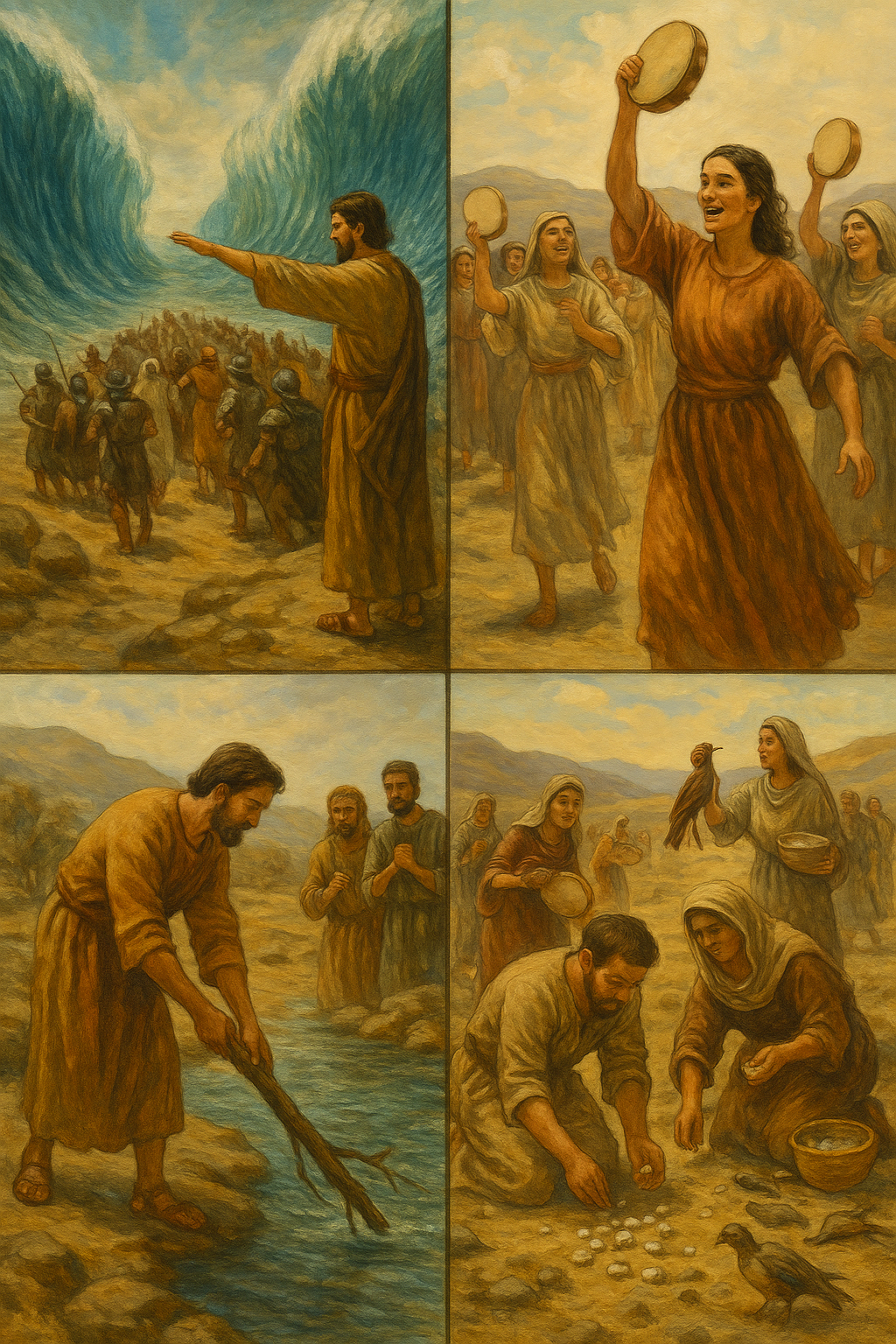
Exodus 14–16 records three closely connected stages in Israel’s departure from Egypt: the LORD’s decisive deliverance of Israel at the Red Sea, Israel’s praise followed quickly by testing at Marah, and the LORD’s provision of manna and quails in the wilderness. The chapters display both the faithfulness of God and the instability of the people He had delivered.
A careful reading should preserve the immediate meaning of the passages. The “salvation” of Exodus 14:13 is, in its immediate context, Israel’s physical deliverance from Pharaoh and his army. Likewise, the “redemption” celebrated in Exodus 15 concerns the LORD bringing Israel out from Egyptian bondage. These truths certainly harmonize with broader biblical doctrines of salvation, but the text itself should not be made to say more than it says.
Chapter Summaries
Exodus 14 — The LORD Delivers Israel at the Red Sea
 The chapter opens with the LORD directing Moses concerning Israel’s encampment:
“Speak unto the children of Israel, that they turn and encamp before Pi-hahiroth, between Migdol and the sea, over against Baal-zephon…”
— Exodus 14:2
The precise modern locations of these sites are not identified by the KJV text. Scripture gives the geographical names and their relationship to Israel’s route, but a specific modern crossing location should not be stated as biblical fact.
The LORD explicitly declares what He will do concerning Pharaoh:
“And I will harden Pharaoh’s heart, that he shall follow after them; and I will be honoured upon Pharaoh, and upon all his host; that the Egyptians may know that I am the LORD.”
— Exodus 14:4
Pharaoh takes “six hundred chosen chariots, and all the chariots of Egypt” and pursues Israel (14:7–9).
Israel’s fear
When Israel sees the Egyptians approaching, the people become afraid:
“And when Pharaoh drew nigh, the children of Israel lifted up their eyes, and, behold, the Egyptians marched after them; and they were sore afraid…”
— Exodus 14:10
They cry unto the LORD, but they also accuse Moses:
“Because there were no graves in Egypt, hast thou taken us away to die in the wilderness?”
— Exodus 14:11
Their words reveal fear and unbelief in that moment. Scripture does not say that every Israelite possessed exactly the same inward spiritual condition, but the congregation’s recorded response is plainly one of fear and complaint.
Moses answers:
“Fear ye not, stand still, and see the salvation of the LORD…”
— Exodus 14:13
And:
“The LORD shall fight for you, and ye shall hold your peace.”
— Exodus 14:14
Here “salvation” is explicitly deliverance from the Egyptian army, as the remainder of the verse shows: “for the Egyptians whom ye have seen to day, ye shall see them again no more for ever.”
The next command balances “stand still” with obedient action:
“Wherefore criest thou unto me? speak unto the children of Israel, that they go forward:”
— Exodus 14:15
There is no contradiction. Israel could not accomplish its deliverance, but once God opened the way, they were responsible to walk through it.
The LORD divides the sea
The angel of God and the pillar of cloud move behind Israel, separating Israel from the Egyptians (14:19–20).
Moses stretches his hand over the sea:
“And the LORD caused the sea to go back by a strong east wind all that night, and made the sea dry land, and the waters were divided.”
— Exodus 14:21
Israel passes through:
“And the children of Israel went into the midst of the sea upon the dry ground: and the waters were a wall unto them on their right hand, and on their left.”
— Exodus 14:22
The Egyptians pursue them. The LORD troubles the Egyptian host and takes off their chariot wheels so that they drive heavily. Even the Egyptians recognize:
“Let us flee from the face of Israel; for the LORD fighteth for them against the Egyptians.”
— Exodus 14:25
At God’s command Moses again stretches forth his hand. The waters return over Pharaoh’s army:
“There remained not so much as one of them.”
— Exodus 14:28
Yet:
“The children of Israel walked upon dry land in the midst of the sea…”
— Exodus 14:29
The chapter concludes:
“Thus the LORD saved Israel that day out of the hand of the Egyptians…”
— Exodus 14:30
And:
“And Israel saw that great work which the LORD did upon the Egyptians: and the people feared the LORD, and believed the LORD, and his servant Moses.”
— Exodus 14:31
That is the explicit conclusion of the chapter.
A doctrinal note on Pharaoh’s hardening
Exodus 14 explicitly states that God hardened Pharaoh’s heart (14:4, 8, 17). Earlier Exodus also explicitly states that Pharaoh hardened his own heart:
“…he hardened his heart…” — Exodus 8:15
“And Pharaoh hardened his heart at this time also…” — Exodus 8:32
“…he sinned yet more, and hardened his heart…” — Exodus 9:34
Therefore, the KJV record should be allowed to stand in its fullness. God sovereignly hardened Pharaoh, while Scripture also holds Pharaoh responsible for his own repeated rebellion. Describing God’s action as judicial hardening may be a reasonable theological description of the sequence, but that phrase itself is an explanation rather than wording used in Exodus 14.
The passage does not teach that Pharaoh was an innocent or spiritually passive man whom God arbitrarily caused to rebel.
Exodus 15 — The Song of Moses, Marah, and Elim
After the deliverance comes worship.
Moses and the children of Israel sing:
“I will sing unto the LORD, for he hath triumphed gloriously: the horse and his rider hath he thrown into the sea.”
— Exodus 15:1
The song gives all glory to the LORD:
“The LORD is my strength and song, and he is become my salvation…”
— Exodus 15:2
Again, “salvation” in the immediate historical context concerns deliverance from Egypt and Pharaoh.
The LORD’s power in judgment is celebrated:
“The LORD is a man of war: the LORD is his name.”
— Exodus 15:3
The song repeatedly emphasizes that the victory belonged to God rather than Israel’s military strength.
A central declaration is:
“Who is like unto thee, O LORD, among the gods? who is like thee, glorious in holiness, fearful in praises, doing wonders?”
— Exodus 15:11
This brings together God’s uniqueness, holiness, majesty, and supernatural power.
Verse 13 says:
“Thou in thy mercy hast led forth the people which thou hast redeemed…”
The text therefore explicitly attributes Israel’s redemption to God’s mercy and His power.
The song anticipates fear among surrounding peoples and specifically names Palestina, Edom, Moab, and Canaan (15:14–16). It concludes with the certainty of divine kingship:
“The LORD shall reign for ever and ever.”
— Exodus 15:18
Miriam
Miriam is explicitly identified as:
“Miriam the prophetess, the sister of Aaron…”
— Exodus 15:20
She takes a timbrel, and the women follow her “with timbrels and with dances.” Miriam answers them:
“Sing ye to the LORD, for he hath triumphed gloriously; the horse and his rider hath he thrown into the sea.”
— Exodus 15:21
No additional claim about the nature or extent of Miriam’s prophetic ministry needs to be made beyond what Scripture states.
From triumph to testing
Moses brings Israel from the Red Sea into the wilderness of Shur. They travel three days and find no water.
When they reach Marah:
“…they could not drink of the waters of Marah, for they were bitter…”
— Exodus 15:23
The people murmur against Moses:
“What shall we drink?”
— Exodus 15:24
Moses responds differently:
“And he cried unto the LORD…”
— Exodus 15:25
The LORD shows Moses a tree. Moses casts it into the waters, and:
“the waters were made sweet.”
Scripture does not explain a natural property in the tree that chemically changed the water. Neither does it explicitly say that the tree itself possessed supernatural power. The safe conclusion is simply what the verse says: God showed Moses the tree, Moses obeyed, and the waters were made sweet.
The verse continues:
“there he made for them a statute and an ordinance, and there he proved them,”
— Exodus 15:25
The testing of Israel is therefore explicit, not inferred.
God then gives Israel a conditional statement concerning obedience:
“If thou wilt diligently hearken to the voice of the LORD thy God…”
— Exodus 15:26
ending with:
“for I am the LORD that healeth thee.”
This promise occurs in God’s dealings with Israel in this historical setting. It should not be converted into an unconditional promise that every obedient Christian in the present church age will always be physically healed or never experience disease. That conclusion is not stated by the passage.
Israel then comes to Elim:
“where were twelve wells of water, and threescore and ten palm trees…”
— Exodus 15:27
The contrast is striking: the God who permitted the test at Marah was fully capable of providing abundance at Elim.
Exodus 16 — Manna, Quails, Daily Dependence, and the Sabbath
Israel leaves Elim and enters:
“the wilderness of Sin, which is between Elim and Sinai…”
— Exodus 16:1
“Sin” here is the name of a geographical location. The KJV text does not identify the name of the wilderness with the English moral term sin, so no spiritual symbolism should be built upon the similarity of the English spelling.
The date is specified:
“the fifteenth day of the second month after their departing out of the land of Egypt.”
— Exodus 16:1
Israel murmurs again
The congregation murmurs against Moses and Aaron:
“Would to God we had died by the hand of the LORD in the land of Egypt, when we sat by the flesh pots, and when we did eat bread to the full…”
— Exodus 16:3
Their statement idealizes what they had in Egypt while accusing Moses and Aaron of bringing them into the wilderness “to kill this whole assembly with hunger.”
The LORD answers their murmuring with provision:
“Behold, I will rain bread from heaven for you…”
— Exodus 16:4
But the provision also includes a test:
“that I may prove them, whether they will walk in my law, or no.”
— Exodus 16:4
God’s provision did not eliminate the necessity of obedience.
Quails and manna
In the evening quails cover the camp (16:13).
In the morning, after the dew is gone:
“behold, upon the face of the wilderness there lay a small round thing, as small as the hoar frost on the ground.”
— Exodus 16:14
The Israelites ask what it is. Moses tells them:
“This is the bread which the LORD hath given you to eat.”
— Exodus 16:15
Each man is to gather according to his eating, an omer for every person (16:16).
When gathered:
“he that gathered much had nothing over, and he that gathered little had no lack…”
— Exodus 16:18
The LORD provided sufficiently for the people.
Moses commands them not to leave it until morning. Some disobey:
“notwithstanding they hearkened not unto Moses…”
— Exodus 16:20
What they keep contrary to God’s command breeds worms and stinks.
The lesson is simple: God’s provision does not excuse disobedience to God’s instructions.
The sixth and seventh days
On the sixth day they gather twice as much.
Moses explains:
“To morrow is the rest of the holy sabbath unto the LORD…”
— Exodus 16:23
The seventh day is therefore explicitly called a sabbath before Israel reaches the giving of the law recorded at Sinai in Exodus 20.
Nevertheless, some Israelites go out to gather on the seventh day:
“And it came to pass, that there went out some of the people on the seventh day for to gather, and they found none.”
— Exodus 16:27
The LORD responds:
“How long refuse ye to keep my commandments and my laws?”
— Exodus 16:28
And:
“the LORD hath given you the sabbath…”
— Exodus 16:29
In its immediate context, this command is addressed to Israel. Later Scripture explicitly identifies the Sabbath as a sign between the LORD and the children of Israel in Exodus 31:16–17. Therefore, a dispensational reading should not erase the distinction between Israel and the New Testament church or automatically place Israel’s Sabbath regulations upon the church.
The manna preserved
The manna is described:
“And the house of Israel called the name thereof Manna: and it was like coriander seed, white; and the taste of it was like wafers made with honey.”
— Exodus 16:31
An omer is kept:
“that they may see the bread wherewith I have fed you in the wilderness…”
— Exodus 16:32
Aaron lays it up:
“before the Testimony, to be kept.”
— Exodus 16:34
The chapter closes with an explicit retrospective statement:
“And the children of Israel did eat manna forty years, until they came to a land inhabited…”
— Exodus 16:35
God’s wilderness provision was not momentary. Scripture explicitly says it continued for forty years.
Key People and Places
- The LORD — The central actor throughout all three chapters. He directs Israel’s route, judges Egypt, divides the sea, receives Israel’s praise, tests Israel, makes bitter water sweet, provides quails and manna, and gives commands concerning the Sabbath.
- Moses — God’s servant and Israel’s appointed leader. He speaks God’s commands, stretches his hand over the sea at God’s direction, leads the song of Exodus 15, cries unto the LORD at Marah, and communicates God’s instructions concerning manna.
- Aaron — With Moses during Israel’s complaints in Exodus 16. He speaks to the congregation and later places the preserved manna before the Testimony.
- Miriam — Explicitly called “the prophetess, the sister of Aaron” in Exodus 15:20. She leads the women in praising the LORD after the Red Sea deliverance.
- Pharaoh — The ruler of Egypt who pursues Israel after previously letting them go. Exodus 14 records his final military pursuit and the destruction of his host in the sea. The text says the host is destroyed; Exodus 14 does not explicitly state in so many words that Pharaoh’s own corpse was among those seen on the shore, so no additional detail should be asserted beyond the text.
- The children of Israel — The nation God delivered from Egypt. They witness great deliverance, praise the LORD, yet repeatedly murmur when confronted with thirst and hunger.
- The Egyptians — Pharaoh’s pursuing military force. They enter the sea after Israel and are overwhelmed by the returning waters.
- The angel of God — Explicitly mentioned in Exodus 14:19 as moving from before Israel’s camp to behind them. The passage itself should govern how much more is said about His identity.
- Pi-hahiroth — Israel’s encampment near the sea before the crossing.
- Migdol — Named geographical marker near Israel’s encampment.
- Baal-zephon — Another location named in relation to Israel’s camp.
- The Red Sea — The body of water connected explicitly with the deliverance in Exodus 15:4 and 15:22. Scripture does not provide modern GPS coordinates for the crossing.
- Wilderness of Shur — The wilderness entered after Israel departs from the Red Sea.
- Marah — Location where the water was bitter until the LORD made it sweet.
- Elim — Place with twelve wells and seventy palm trees.
- Wilderness of Sin — Wilderness between Elim and Sinai where Israel murmurs for food and receives manna.
- Sinai — Mentioned geographically in Exodus 16:1 as beyond the wilderness of Sin.
- Canaan — Mentioned in the song of Exodus 15 and in Exodus 16:35 in connection with the eventual end of Israel’s manna provision.
Main Doctrinal or Spiritual Themes
1. The LORD Alone Receives the Glory for Deliverance
God states His purpose concerning Pharaoh:
“I will be honoured upon Pharaoh, and upon all his host.”
— Exodus 14:4
Israel did not engineer the Red Sea crossing. God divided the waters, protected His people, and destroyed the pursuing army.
The principle is unmistakable: what God does by His power should result in glory to God.
2. God’s Sovereignty Does Not Remove Human Responsibility
God hardened Pharaoh’s heart, yet earlier passages also say Pharaoh hardened his own heart.
Israel was incapable of opening the sea, yet after God opened the way, Israel was commanded:
“that they go forward.”
— Exodus 14:15
Scripture holds divine sovereignty and human responsibility together without treating them as contradictory.
3. God’s Holiness
Israel sings:
“glorious in holiness”
— Exodus 15:11
The LORD is not merely powerful. His power belongs to One who is perfectly holy.
His destruction of Egypt is therefore not arbitrary cruelty. It occurs within the context of Pharaoh’s repeated defiance of God’s command and Egypt’s oppression of Israel recorded in the preceding chapters.
4. God’s Faithfulness in Provision
God provides:
- A dry path through the sea.
- Protection from the Egyptian army.
- Sweet water at Marah.
- Wells at Elim.
- Quails in the evening.
- Manna in the morning.
- A continuing food supply for forty years.
The same God who delivered Israel was able to sustain Israel.
5. Faith Must Rest upon God’s Word Rather Than Visible Circumstances
At the sea, Israel saw Pharaoh’s army behind them and water before them.
Moses said:
“Fear ye not, stand still, and see the salvation of the LORD…”
— Exodus 14:13
Their circumstances appeared impossible, but God’s promise and command were sufficient.
Biblical faith is not pretending that danger does not exist. It is believing God in the presence of the danger.
6. Praise Should Follow God’s Deliverance
Exodus 15 begins:
“Then sang Moses and the children of Israel this song unto the LORD…”
— Exodus 15:1
Their song centers upon who the LORD is and what the LORD has done.
Biblical worship is God-centered rather than man-centered.
7. Great Spiritual Victories Do Not Eliminate Future Testing
The same people who sang beside the Red Sea murmured at Marah only a short time afterward.
The text therefore demonstrates that witnessing a mighty work of God does not automatically guarantee faithful conduct during the next trial.
Believers should not presume that yesterday’s victory will substitute for today’s faith and obedience.
8. Testing Reveals Whether People Will Obey God’s Word
At Marah:
“there he proved them”
— Exodus 15:25
Regarding manna:
“that I may prove them, whether they will walk in my law, or no.”
— Exodus 16:4
The word prove is the language of the KJV text. God uses circumstances in which obedience or disobedience becomes manifest.
9. Daily Dependence upon God’s Provision
Israel generally gathered manna one day at a time.
Attempting to preserve it contrary to God’s command resulted in corruption. On the sixth day, however, God specifically commanded a double provision for the Sabbath, and it did not corrupt.
The difference was not merely the food. The decisive issue was God’s word concerning the food.
10. Obedience Matters Even in Matters That May Appear Small
Some Israelites kept manna overnight contrary to command.
Others went searching on the Sabbath after being told not to do so.
In both instances the problem is identified plainly: they did not hearken to God’s instructions.
God determines what obedience is; man does not have authority to revise His commands according to personal convenience.
11. God’s Grace and Human Obedience Must Not Be Confused
Israel did not earn the Red Sea deliverance by gathering manna. The deliverance had already occurred.
Likewise, obedience in Exodus 16 governed their walk under God’s instructions; it did not purchase their release from Egypt.
That distinction is consistent with the biblical principle that salvation is not earned by works. Obedience has its proper place, but man’s obedience must never be turned into the price of God’s saving grace.
12. Israel Must Remain Distinct From the Church
Exodus 14–16 concerns the literal children of Israel.
Their national deliverance, wilderness journey, manna, and Sabbath instructions belong first to their historical setting. Spiritual lessons may properly be drawn from these events, especially where later Scripture does so, but Israel should not be allegorically converted into the church.
The plain historical meaning comes first.
Practical Applications or Lessons
- Do not judge God’s faithfulness solely by present circumstances. Israel could see Pharaoh’s army, but they could not yet see the path God was about to open. God had not lost control simply because Israel could not see His solution.
- When God clearly commands action, faith obeys. “Stand still” did not mean permanent inactivity. When God said, “go forward,” Israel was responsible to move.
- Remember God’s past faithfulness when present trials arise. Israel saw an extraordinary deliverance in Exodus 14, yet murmured when water and food became scarce. The believer should deliberately remember what God has already done rather than allowing the newest difficulty to erase previous evidence of His faithfulness.
- Bring needs to the LORD rather than turning first to murmuring. At Marah the people murmured, but Moses “cried unto the LORD.” Exodus 15 places those two responses beside one another.
- Do not romanticize former bondage merely because present obedience is difficult. Israel remembered Egypt’s “flesh pots” and bread while speaking as though death there would have been preferable. Their words in Exodus 16 may warn believers against idealizing a former condition simply because the present path involves testing.
- Receive God’s daily provision with gratitude. Manna was not something Israel manufactured. “This is the bread which the LORD hath given you to eat” (16:15).
- Partial obedience is still disobedience. Those who kept manna when they were told not to keep it and those who searched for manna when they were told none would be given both disregarded specific instructions.
- Worship should emphasize God’s character and works. Exodus 15 praises God’s strength, holiness, mercy, power, faithfulness, and eternal reign.
- Do not build doctrine upon details Scripture does not explain. The exact modern crossing point, the natural properties of the tree at Marah, and many proposed symbolic meanings are not given in the KJV text. Where God has spoken, we should speak confidently; where He has not spoken, restraint is the safer course.
- Trials do not prove that God has abandoned His people. In these chapters, the same God who permits Israel to encounter the sea, bitter water, and hunger is the God who opens the sea, sweetens the water, and sends bread from heaven.
Central Emphasis of Exodus 14–16
The great recurring truth is that the LORD is sufficient for the people He has delivered.
At the Red Sea, He was their deliverer.
At Marah, He was their provider.
In the wilderness of Sin, He was their sustainer.
Yet in each setting Israel was responsible to believe what God had said and obey what God commanded.
The proper response is summarized beautifully in Israel’s song:
“Who is like unto thee, O LORD, among the gods? who is like thee, glorious in holiness, fearful in praises, doing wonders?”
— Exodus 15:11
And:
“The LORD shall reign for ever and ever.”
— Exodus 15:18
Comments are closed