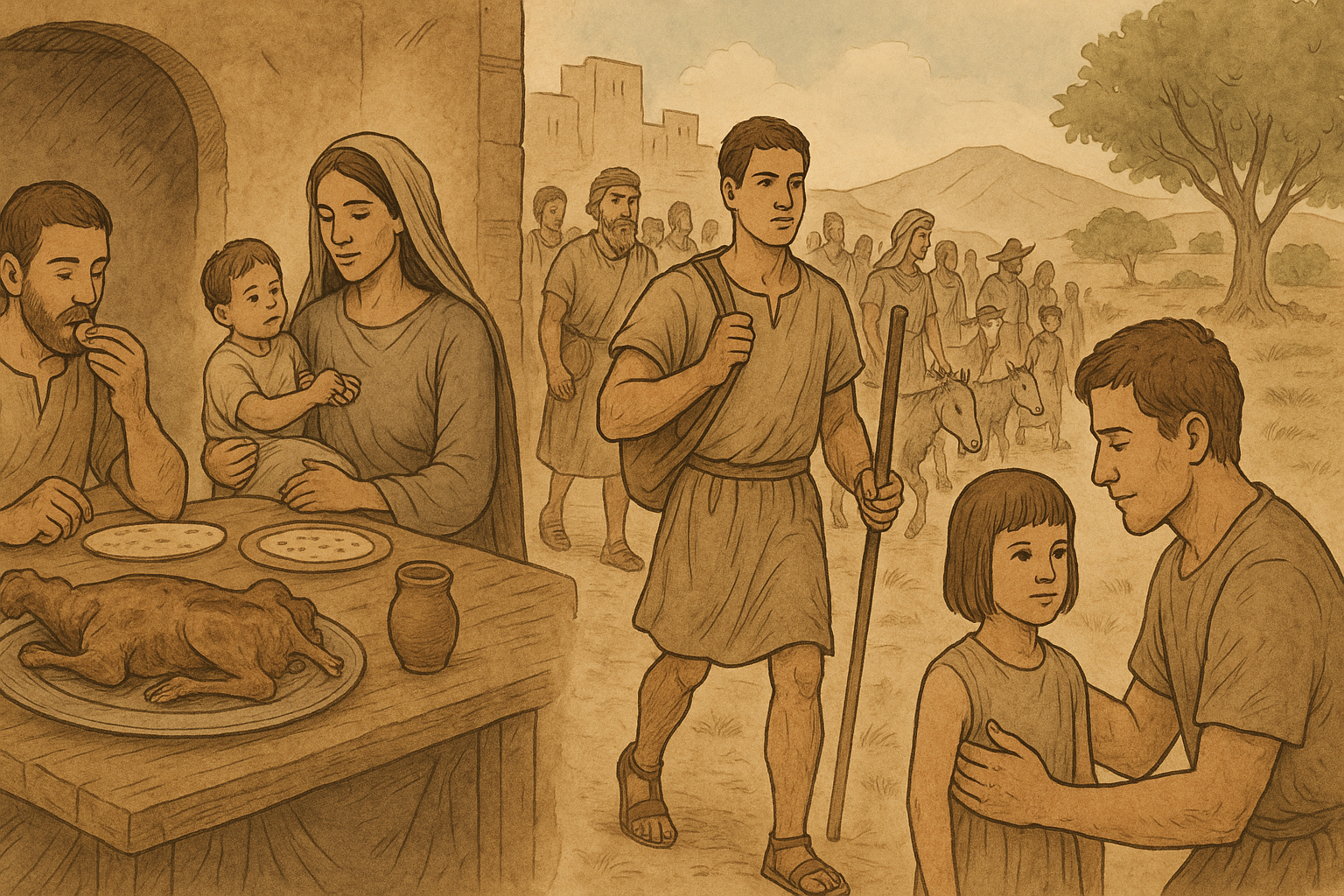
Exodus 12–13 records the institution of the Passover, the judgment of the firstborn in Egypt, Israel’s departure from bondage, the consecration of the firstborn, the memorial of unleavened bread, and the LORD’s visible leading of Israel toward the wilderness. These chapters mark a decisive transition: Israel goes out from Egyptian bondage under the protection of shed blood and under the direct leadership of God.
The Passover was given specifically to Israel as an ordinance connected with their deliverance from Egypt. The New Testament later gives it direct typological significance concerning Christ: “For even Christ our passover is sacrificed for us” (1 Corinthians 5:7). That New Testament identification permits the typology; it does not erase the historical meaning of Exodus or the distinction between Israel and the Church.
Chapter Summaries
 Exodus 12 — The Passover and Israel’s Departure from Egypt
1. The beginning of months — Exodus 12:1–2
The LORD spoke unto Moses and Aaron in the land of Egypt:
“This month shall be unto you the beginning of months: it shall be the first month of the year to you.” — Exodus 12:2
God established a new beginning in Israel’s national calendar in connection with their redemption from Egypt.
Exodus 13:4 identifies the month as Abib. Scripture later calls the first month Nisan in Esther 3:7. Beyond those biblical statements, one should not build doctrinal conclusions upon later calendar traditions.
A clear spiritual principle is present: the deliverance God was about to accomplish was so significant that the calendar itself would henceforth reckon from it.
2. The Passover lamb selected — Exodus 12:3–6
On the tenth day of the month, each household was to take a lamb. The lamb was to be:
“without blemish, a male of the first year” — Exodus 12:5
It could be taken from the sheep or from the goats.
It was to be kept until the fourteenth day, when:
“the whole assembly of the congregation of Israel shall kill it in the evening.” — Exodus 12:6
The text explicitly establishes the requirement of an acceptable, unblemished sacrifice.
The New Testament explicitly connects the principle of an unblemished sacrifice with Christ. Peter describes believers as redeemed:
“With the precious blood of Christ, as of a lamb without blemish and without spot.” — 1 Peter 1:19
The connection therefore rests upon Scripture itself rather than imaginative allegory.
3. The blood applied — Exodus 12:7, 12–13
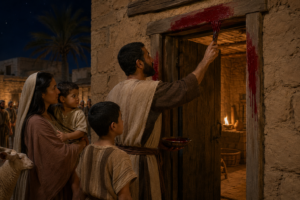
The Israelites were commanded to take the blood and place it:
“on the two side posts and on the upper door post of the houses” — Exodus 12:7
The LORD declared that He would pass through Egypt and smite the firstborn. Concerning the blood He said:
“And when I see the blood, I will pass over you, and the plague shall not be upon you to destroy you.” — Exodus 12:13
The protection was not grounded in Israel being inherently better than Egypt. The stated distinction at the houses was the blood which God had commanded.
Hebrews 11:28 explicitly connects Moses’ keeping of the Passover with faith:
“Through faith he kept the passover, and the sprinkling of blood, lest he that destroyed the firstborn should touch them.”
This furnishes a sound biblical picture of salvation: God gives the word, God provides the appointed means, and faith receives what God has said.
For the Christian, the fulfillment is not found in literally placing animal blood upon a house. Christ has already offered Himself. Salvation is by grace through faith in Christ, apart from human works.
4. The Passover meal — Exodus 12:8–11
The lamb was to be eaten:
- roasted with fire,
- with unleavened bread,
- with bitter herbs.
Nothing was to remain until morning; what remained was to be burned.
They were to eat it prepared for departure:
“with your loins girded, your shoes on your feet, and your staff in your hand.” — Exodus 12:11
The LORD concludes:
“it is the LORD’S passover.”
The historical meaning is explicit: Israel was to be prepared to leave Egypt.
It may suggest a principle of readiness to obey God without delay, but Scripture does not require every detail of clothing or posture to carry a separate symbolic meaning.
5. Judgment upon Egypt — Exodus 12:12, 29–30
God had announced:
“against all the gods of Egypt I will execute judgment: I am the LORD.” — Exodus 12:12
At midnight:
“the LORD smote all the firstborn in the land of Egypt.” — Exodus 12:29
The judgment extended from Pharaoh’s household to the captive in the dungeon, along with the firstborn of cattle.
The result was:
“a great cry in Egypt; for there was not a house where there was not one dead.” — Exodus 12:30
The text presents this directly as divine judgment. Scripture gives no basis for reducing the event to a natural disaster or symbolic legend.
God had repeatedly warned Pharaoh. The final plague demonstrates both God’s patience in warning and His certainty in judgment.
6. Pharaoh commands Israel to leave — Exodus 12:31–32
Pharaoh called for Moses and Aaron by night and said:
“Rise up, and get you forth from among my people, both ye and the children of Israel.”
He even added:
“and bless me also.” — Exodus 12:32
The Egyptians also urged Israel to depart quickly:
“for they said, We be all dead men.” — Exodus 12:33
The deliverance came precisely as the LORD had declared.
7. Israel leaves with unleavened dough and goods from Egypt — Exodus 12:34–39
The people took their dough before it was leavened.
They had also asked of the Egyptians:
“jewels of silver, and jewels of gold, and raiment.” — Exodus 12:35
The LORD gave them favor with the Egyptians:
“so that they lent unto them such things as they required. And they spoiled the Egyptians.” — Exodus 12:36
This fulfilled what God had already declared in Exodus 3:21–22 and 11:2–3.
The word “spoiled” is the KJV wording. The text presents the transfer as occurring under God’s providence and according to His earlier promise.
8. From Rameses to Succoth — Exodus 12:37–39
Israel journeyed:
“from Rameses to Succoth.”
The text states:
“about six hundred thousand on foot that were men, beside children.” — Exodus 12:37
It also states:
“And a mixed multitude went up also with them.” — Exodus 12:38
Scripture does not identify every person included in the mixed multitude, so claims about its exact ethnic composition should be treated as uncertain.
Their bread was unleavened because:
“they were thrust out of Egypt, and could not tarry.” — Exodus 12:39
9. The 430 years — Exodus 12:40–42
The KJV states:
“Now the sojourning of the children of Israel, who dwelt in Egypt, was four hundred and thirty years.” — Exodus 12:40
Then:
“at the end of the four hundred and thirty years, even the selfsame day it came to pass, that all the hosts of the LORD went out from the land of Egypt.” — Exodus 12:41
Chronological questions surrounding the patriarchal period have produced different calculations among interpreters. The safe course is to retain exactly what Exodus says rather than force more precision upon the passage than the text itself supplies.
The night was to be remembered:
“a night to be much observed unto the LORD.” — Exodus 12:42
10. Regulations governing the Passover — Exodus 12:43–51
The LORD gave further instructions.
No uncircumcised person was to eat the Passover:
“no uncircumcised person shall eat thereof.” — Exodus 12:48
A stranger who desired to keep it had to meet the covenant requirement of circumcision.
The lamb was to be eaten within one house, and:
“neither shall ye break a bone thereof.” — Exodus 12:46
John 19:36 expressly connects the fact that Christ’s bones were not broken with Scripture:
“A bone of him shall not be broken.”
Care should still be taken not to assign symbolic significance to every Passover regulation unless another passage of Scripture supplies that connection.
The chapter closes:
“Thus did all the children of Israel; as the LORD commanded Moses and Aaron, so did they.” — Exodus 12:50
Exodus 13 — Consecration, Remembrance, and Divine Guidance
1. The firstborn belongs to the LORD — Exodus 13:1–2
The LORD commanded Moses:
“Sanctify unto me all the firstborn, whatsoever openeth the womb among the children of Israel, both of man and of beast: it is mine.”
The word “sanctify” in this context concerns setting apart unto God.
God was establishing a continuing memorial of His deliverance of Israel’s firstborn during the judgment upon Egypt.
2. Remember the day of deliverance — Exodus 13:3–10
Moses told the people:
“Remember this day, in which ye came out from Egypt, out of the house of bondage; for by strength of hand the LORD brought you out from this place.” — Exodus 13:3
They were not to eat leavened bread during the prescribed observance.
When God brought them into the promised land, they were to keep this service.
The feast was also designed to teach succeeding generations:
“And thou shalt shew thy son in that day, saying, This is done because of that which the LORD did unto me when I came forth out of Egypt.” — Exodus 13:8
Biblical remembrance is not merely sentimental. God commanded Israel to teach their children what He had actually done.
The memorial was described figuratively as:
“a sign unto thee upon thine hand, and for a memorial between thine eyes.” — Exodus 13:9
The stated purpose was:
“that the LORD’S law may be in thy mouth.”
One should be cautious about building later ceremonial practices into this verse unless Scripture itself requires them. The central emphasis in Exodus 13 is remembrance and instruction concerning God’s deliverance.
3. Redemption of the firstborn — Exodus 13:11–16
The firstborn males of clean beasts were to belong to the LORD.
Concerning the firstling of an ass:
“thou shalt redeem it with a lamb; and if thou wilt not redeem it, then thou shalt break his neck.” — Exodus 13:13
The firstborn of Israel’s sons were also to be redeemed.
When a son later asked the meaning of this ordinance, the father was to explain:
“By strength of hand the LORD brought us out from Egypt, from the house of bondage.” — Exodus 13:14
The father was specifically to rehearse Pharaoh’s refusal and the death of Egypt’s firstborn.
Thus redemption and remembrance were to remain connected.
4. God deliberately chooses Israel’s route — Exodus 13:17–18
God did not lead Israel by the way of the land of the Philistines, although the text says:
“that was near.”
God Himself gave the reason:
“Lest peradventure the people repent when they see war, and they return to Egypt.” — Exodus 13:17
Instead:
“God led the people about, through the way of the wilderness of the Red sea.” — Exodus 13:18
This is an important textual safeguard. We need not guess why God chose the longer-looking route; He explicitly tells us.
God knew both the road and the people.
A believer may therefore learn that the easiest-looking path is not necessarily the path of God’s wisdom.
5. Israel goes out harnessed — Exodus 13:18
The KJV says:
“the children of Israel went up harnessed out of the land of Egypt.”
Exactly what equipment is encompassed by “harnessed” has been variously discussed.
Scripture does not explicitly say that this means Israel departed as a fully trained military force. Exodus 13:17 itself indicates that God was concerned about how the people would react upon seeing war. It is therefore best to retain the KJV wording without constructing a military condition the text does not plainly assert.
6. The bones of Joseph — Exodus 13:19
Moses carried Joseph’s bones with him because Joseph had required an oath of the children of Israel:
“God will surely visit you; and ye shall carry up my bones away hence with you.”
This reaches back to Genesis 50:25.
Hebrews 11:22 explicitly identifies Joseph’s command concerning his bones as an act connected with faith:
“By faith Joseph, when he died, made mention of the departing of the children of Israel; and gave commandment concerning his bones.”
Joseph had believed God’s promise concerning Israel’s future departure.
7. Succoth to Etham — Exodus 13:20
Israel:
“took their journey from Succoth, and encamped in Etham, in the edge of the wilderness.”
The passage gives the place names and general setting. Attempts to identify every modern geographical coordinate are outside what the KJV explicitly states and should not be treated as doctrinal certainties.
8. The pillar of cloud and fire — Exodus 13:21–22
The LORD went before Israel:
“by day in a pillar of a cloud, to lead them the way; and by night in a pillar of fire, to give them light.”
The purpose is explicitly given:
“to go by day and night.”
The chapter ends:
“He took not away the pillar of the cloud by day, nor the pillar of fire by night, from before the people.”
This was a real and visible manifestation of God’s guidance to Israel in this historical setting.
Christians should not use this passage to expect an individual miraculous pillar today. The sound application is that God’s people must depend upon God’s direction rather than human wisdom, while recognizing the different dispensational setting.
Key People and Places
The LORD — The Deliverer, Judge, Lawgiver, and Guide. He establishes the Passover, judges Egypt, brings Israel out, claims the firstborn, and leads Israel toward the wilderness.
Moses — God’s appointed servant through whom the Passover instructions and memorial ordinances are communicated. He also carries Joseph’s bones from Egypt.
Aaron — Receives the Passover instructions with Moses and is summoned with him by Pharaoh in Exodus 12:31.
Pharaoh — After the death of Egypt’s firstborn, he commands Israel to depart and asks Moses and Aaron to bless him.
The children of Israel — The people delivered from Egyptian bondage and commanded to observe the Passover memorial and teach their children.
The Egyptians — Experience God’s judgment upon the firstborn and urge Israel to depart.
The mixed multitude — Exodus 12:38 explicitly says they went up with Israel. Scripture here does not further define every member of this group.
Joseph — Though long dead, his faith is remembered through the carrying of his bones, fulfilling the oath recorded in Genesis 50.
Egypt — The land from which God delivers Israel and upon which He executes judgment.
Rameses — The place from which Israel begins the journey described in Exodus 12:37.
Succoth — Israel’s first stated destination after leaving Rameses and later the departure point for Etham.
Etham — Israel’s encampment “in the edge of the wilderness.”
The wilderness — The route into which God deliberately leads Israel.
The Red sea — The region toward which God leads them in Exodus 13:18. The crossing itself occurs in Exodus 14.
The land of the Philistines — A nearer route God deliberately does not use because He gives a specific reason concerning Israel’s reaction to war.
Main Doctrinal or Spiritual Themes
1. Redemption through shed blood
The central declaration is:
“When I see the blood, I will pass over you.” — Exodus 12:13
The New Testament provides the doctrinal fulfillment:
“Christ our passover is sacrificed for us.” — 1 Corinthians 5:7
And:
“In whom we have redemption through his blood, the forgiveness of sins.” — Colossians 1:14
Biblical salvation is not obtained through religious merit, sacraments, moral reform, or human works. Christ’s blood is sufficient, and the sinner receives salvation by faith.
2. Judgment upon sin is certain
Egypt had resisted repeated divine warnings. Exodus 12 demonstrates that God’s threatened judgment is not an empty threat.
“And it came to pass, that at midnight the LORD smote all the firstborn in the land of Egypt.” — Exodus 12:29
God is merciful, but His holiness must never be separated from His justice.
3. God makes a distinction according to His revealed provision
The difference on Passover night was not merely nationality or social standing. God had appointed the blood as the sign:
“the blood shall be to you for a token upon the houses where ye are.” — Exodus 12:13
No one should therefore presume upon heritage, church membership, morality, baptism, or family connections in the matter of salvation.
4. Redemption calls for separation from the old life
Israel was brought:
“out of the house of bondage.” — Exodus 13:3
The New Testament draws a direct moral application from the Passover and unleavened bread:
“For even Christ our passover is sacrificed for us: Therefore let us keep the feast, not with old leaven… but with the unleavened bread of sincerity and truth.” — 1 Corinthians 5:7–8
Paul applies leaven in that context to “malice and wickedness.”
Salvation is by grace apart from works, but the saved believer is called to holiness.
5. God’s people must remember redemption
Repeatedly Israel is commanded to remember and rehearse what God had done.
“Remember this day.” — Exodus 13:3
Biblical faith is grounded in the historical acts and revealed words of God, not private mystical impressions.
6. Parents are responsible to teach their children God’s truth
Exodus 13 repeatedly anticipates children asking about the meaning of these observances.
“And it shall be when thy son asketh thee in time to come, saying, What is this?” — Exodus 13:14
God intended truth to be taught deliberately from one generation to the next.
7. The redeemed belong to God
“Sanctify unto me all the firstborn… it is mine.” — Exodus 13:2
Israel’s deliverance established a claim of divine ownership.
For the Church, the New Testament gives a corresponding truth:
“ye are not your own… For ye are bought with a price.” — 1 Corinthians 6:19–20
This is an application based upon New Testament revelation, not a claim that the Church is under Israel’s firstborn ordinance.
8. God guides according to perfect wisdom
Exodus 13:17 is unusually clear about why God rejected the nearer road.
He knew what Israel might do upon seeing war.
The apparent detour was therefore purposeful.
God’s direction may not appear to human reasoning to be the shortest path, but His wisdom exceeds ours.
9. Israel and the Church must remain distinct
The Passover ordinance in Exodus 12 was given to Israel.
The Church is never commanded in the New Testament to place blood on doorposts, sacrifice a Passover lamb, or place itself under Israel’s national ceremonial ordinances.
At the same time, the New Testament explicitly teaches that Christ is:
“our passover.” — 1 Corinthians 5:7
Thus the historical event remains literal, Israel remains Israel, and the divinely authorized type points to Christ without confusing Israel with the Church.
10. God fulfills His word exactly
Exodus 12:41 emphasizes:
“even the selfsame day it came to pass.”
What God had promised concerning Israel’s departure was fulfilled.
Joseph’s bones provide another witness. Joseph had said:
“God will surely visit you.” — Genesis 50:25
Exodus 13:19 shows that his confidence was not misplaced.
Practical Applications or Lessons
Trust what God has said
The Israelites were not free to devise another method of protection from judgment. God specified the lamb, the blood, and its application.
Today the sinner likewise has no authority to invent another way of salvation.
Jesus said:
“I am the way, the truth, and the life: no man cometh unto the Father, but by me.” — John 14:6
Make much of the blood of Christ
Exodus 12 places blood at the heart of deliverance from judgment, and the New Testament places Christ’s blood at the heart of redemption.
“Without shedding of blood is no remission.” — Hebrews 9:22
Christian preaching must never replace the blood atonement with mere morality, self-improvement, psychology, or social reform.
Obey God’s Word precisely
Exodus 12:28 says:
“And the children of Israel went away, and did as the LORD had commanded Moses and Aaron, so did they.”
God’s commands are not suggestions.
Believers should cultivate obedience to the written Word rather than altering God’s requirements according to convenience.
Remove tolerated sin from Christian living
The New Testament itself applies the unleavened-bread imagery morally in 1 Corinthians 5:7–8.
Believers who have been redeemed by Christ should not make peace with known wickedness.
Grace does not excuse sin; grace teaches holiness.
Teach the next generation deliberately
God repeatedly commanded Israel to explain the meaning of these events to their children.
Christian parents should likewise make Scripture, salvation, doctrine, prayer, and the works of God regular subjects in the home.
Children should know not merely what the family believes, but why it believes it from Scripture.
Remember what God has done
Israel was repeatedly told:
“Remember this day.”
Forgetfulness often weakens gratitude and obedience.
The believer should regularly remember salvation, answered prayer, divine provision, and biblical truth while keeping Scripture—not personal experience—as the final authority.
Do not assume the nearest road is God’s road
The Philistine route was nearer, but God deliberately did not take Israel that way.
A shorter path is not automatically a better path.
The proper question is not simply, “What is easiest?” but, “What is right according to God’s Word?”
God’s guidance never contradicts God’s Word
Israel possessed a visible pillar of cloud and fire in this historical setting.
Christians today should not imitate this by seeking spectacular signs or private revelations. God has given His written Word.
“Thy word is a lamp unto my feet, and a light unto my path.” — Psalm 119:105
Keep confidence in God’s promises
Joseph’s command concerning his bones was based upon confidence that God would visit Israel and bring them out of Egypt.
Generations passed, but God’s promise did not fail.
“God will surely visit you.”
Faith rests upon what God has said even when fulfillment is not immediately visible.
Overall Message of Exodus 12–13
Exodus 12–13 presents redemption, judgment, separation, remembrance, consecration, and divine guidance.
God judges Egypt but provides the appointed blood for Israel’s protection. He brings His people out of bondage, commands them to remember His deliverance, claims the firstborn as His own, directs parents to teach their children, fulfills Joseph’s faith concerning the exodus, and personally leads Israel into the wilderness.
At the center stands the Passover:
“When I see the blood, I will pass over you.” — Exodus 12:13
The New Testament provides the inspired Christian conclusion:
“For even Christ our passover is sacrificed for us.” — 1 Corinthians 5:7
The lamb in Egypt was historical and literal. The deliverance of Israel was historical and literal. And Scripture itself identifies the ultimate redemptive significance in Jesus Christ, whose precious blood provides the only sufficient basis for the sinner’s redemption.
Comments are closed